Federal ITC for Residential Wind: What 30% Really Covers
The 30% federal residential clean energy tax credit covers turbine hardware, installation labor, and electrical work—but excludes permits, land prep, and repairs.
Share this article
windturbinehome.com/s/1e3ace
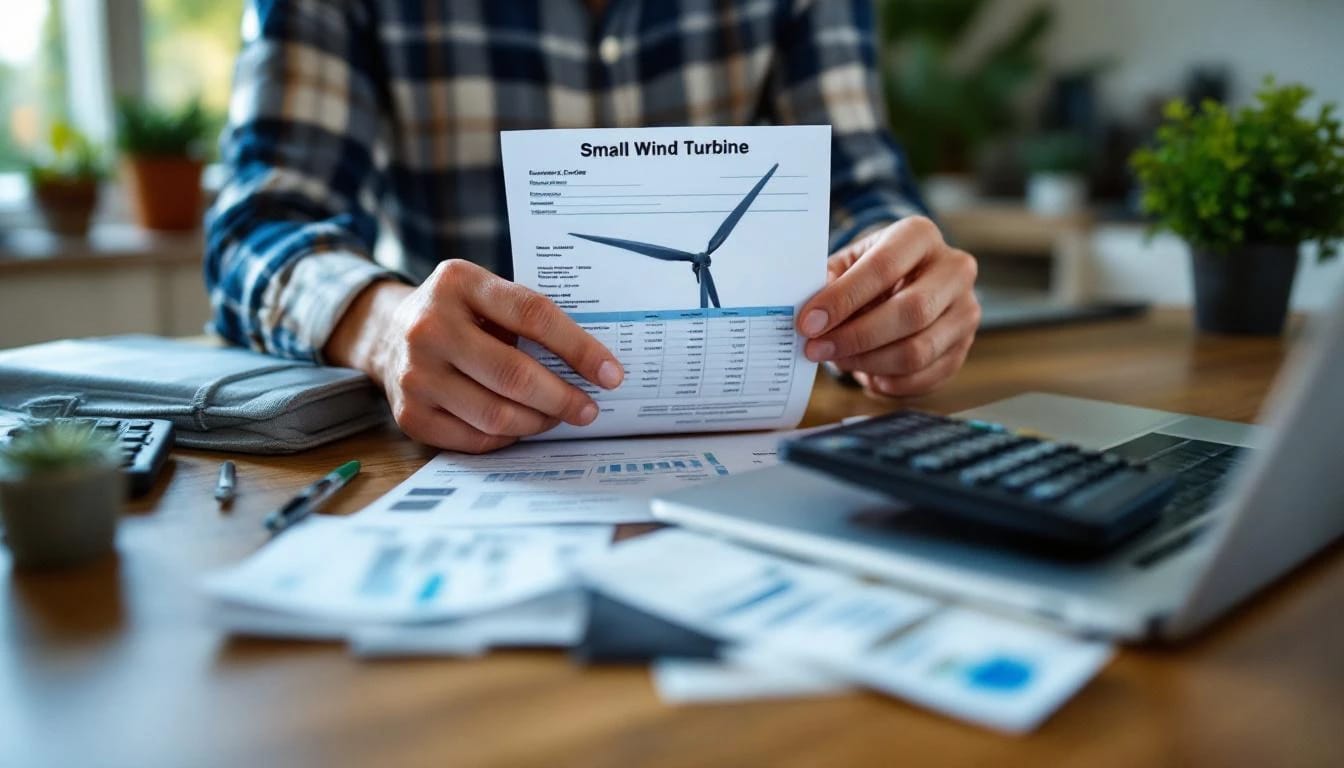
The federal residential clean energy tax credit (ITC) reduces the net cost of a qualifying small wind turbine system by 30% of eligible expenses through 2032. Under IRC §25D, the credit covers the turbine itself, tower and foundation, inverter, charge controller, batteries (if used to store wind-generated power), installation labor, and electrical connection to the home—filed via IRS Form 5695. It does not cover permit fees, land clearing, tree removal, or post-warranty repairs. A $15,000 installed system yields a $4,500 credit; a $35,000 install with battery backup returns $10,500. The credit carries forward if it exceeds the homeowner's tax liability in a given year, and there is no dollar cap.
What Congress means by "qualified small wind energy property"
IRC §25D(d)(4) defines qualified small wind energy property as equipment that uses a wind turbine to generate electricity for a dwelling located in the United States. The turbine's nameplate capacity must not exceed 100 kW, and the IRS looks for UL 6142 or IEC 61400-2 certification to confirm the system meets recognized safety and performance standards. Vertical-axis designs (Savonius, Darrieus, helical) and horizontal-axis machines both qualify. The dwelling can be a primary residence or a second home; rental properties and off-grid cabins count if the taxpayer uses them personally part of the year. A turbine installed solely for a rental property you never occupy does not qualify under §25D—commercial properties fall under the §48 investment tax credit instead.
The 100 kW ceiling is rarely a constraint in residential settings. Most grid-tied home turbines deliver 1–10 kW nameplate; off-grid systems serving a single household range from 2.5 kW (Primus Air 40) to 10 kW (Bergey Excel 10). A farm installing a 20 kW Endurance E-3120 to offset barn and house load remains well within the cap. Even a cluster of smaller turbines—say, three Pikasola 5 kW units on separate towers—qualifies as long as the combined capacity stays under 100 kW and all serve the same residence.
![INLINE: Homeowner reviewing IRS Form 5695 worksheet with turbine invoice and certification documents on kitchen table]
Line-by-line: eligible expenses you can claim
Turbine, tower, and foundation. The generator nacelle, rotor (blades or vertical airfoils), yaw bearing, tower (guyed lattice, freestanding monopole, or tilt-up gin-pole), and concrete foundation or helical anchor piles count in full. If the manufacturer sells a "kit" that includes all structural and rotating components, the entire purchase price is eligible. Tower height matters for production—most residential sites need 80–120 ft hub height to clear surface turbulence—but the ITC does not penalize taller towers. A $12,000 Bergey Excel 6 plus a $6,000 100 ft tilt-up tower both go into the credit base.
Inverter and charge controller. Grid-tied systems require a grid-interactive inverter that synchronizes AC output with utility voltage and frequency per IEEE 1547 and shuts down if the grid fails (anti-islanding). Battery-based systems use a charge controller to regulate DC current into the battery bank, then a battery inverter to produce household AC. Both components—and any transfer switch or disconnect required by NEC Article 705—are eligible. Expect $1,500–$4,000 for a residential wind inverter (Windy Boy, SMA, Schneider Conext) and $800–$2,500 for a charge controller rated for the turbine's amperage.
Battery storage. If you install lithium-ion, lead-acid, or flow batteries to store wind-generated electricity for later use, the cost qualifies under the same §25D language that covers solar-plus-storage. The key IRS requirement: the batteries must be charged solely by the on-site renewable system (or another on-site renewable source like rooftop solar). A hybrid system with a 5 kW turbine and a 10 kWh Tesla Powerwall that charges only from the turbine and existing rooftop panels counts in full. A backup battery that also charges from the grid during off-peak hours to arbitrage time-of-use rates does not qualify.
Installation labor and electrical work. Crane rental, tower erection, turbine lifting and mounting, trenching for underground conduit, wiring from turbine to disconnect to service panel, grounding electrode system, and final inspection labor are all covered. NEC Article 705.12 requires a dedicated breaker in the main panel or, on older panels, a supply-side tap ahead of the main breaker; the electrician's invoice for that work is eligible. Many installers quote a single turnkey figure; the entire labor portion qualifies. A licensed contractor is required in most jurisdictions—the IRS does not disallow DIY installations, but local code authorities and insurers typically do, and amateur work that fails inspection jeopardizes both the credit and the home's electrical certificate.
| Expense category | Credit-eligible | Example costs (USD) |
|---|---|---|
| Turbine + rotor | Yes | $8,000–$25,000 |
| Tower + foundation | Yes | $4,000–$12,000 |
| Inverter / charge controller | Yes | $1,500–$4,000 |
| Battery bank (wind-charged only) | Yes | $5,000–$15,000 |
| Installation labor + crane | Yes | $3,000–$8,000 |
| Electrical + NEC 705 connection | Yes | $1,200–$3,500 |
| Building permit fees | No | $200–$800 |
| FAA Part 77 determination | No | $0 (FAA review is free) |
| Zoning variance / hearing | No | $500–$2,000 |
| Tree removal / land grading | No | $1,000–$5,000 |
| Extended warranty | No | $800–$2,500 |
| Annual maintenance contract | No | $300–$600/year |
What stays outside the credit: fees, site prep, and ongoing costs
Permit fees paid to the county or municipality are not hardware or labor expenses and do not count. A typical residential wind permit runs $200–$800 depending on jurisdiction. Some counties bundle building, electrical, and zoning review into one fee; others charge separately. None of it qualifies.
FAA review under Part 77 is free—the FAA does not charge for a notice of proposed construction or for issuing a determination of no hazard. If the turbine exceeds 200 ft above ground level near an airport, or sits within specific notification slopes, the installer files electronically and receives a determination within weeks. Because there is no fee, there is nothing to claim.
Zoning variance or conditional-use hearings can cost hundreds to thousands of dollars in application and legal fees, especially in restrictive townships. The IRS treats these as regulatory compliance, not equipment or installation expense.
Site preparation beyond what is integral to foundation installation—tree removal, land grading, access road widening, stump grinding—falls outside the credit. If the installer's scope of work includes excavating the turbine foundation and pouring concrete, that labor qualifies. Hiring a separate excavation company to clear a path for the crane does not.
Extended warranties, service contracts, and insurance riders are operating expenses, not capital costs. The manufacturer's standard warranty (typically two to five years on residential turbines) is bundled into the purchase price and already counted. An optional ten-year extended warranty or a annual maintenance plan does not add to the credit base. Homeowners insurance endorsements for wind-turbine liability likewise remain outside §25D.
How the 30% steps down—and how to lock it in
The residential clean energy credit remains at 30% through December 31, 2032. It drops to 26% for systems placed in service in 2033 and 22% in 2034. Congress has not yet addressed what happens after 2034; absent new legislation, the credit expires entirely on January 1, 2035. "Placed in service" means the turbine is installed, operational, and generating electricity—not merely ordered or partially built. A system commissioned on December 15, 2032, qualifies for the full 30% even if the homeowner files the tax return in April 2033. A system completed on January 10, 2033, drops to 26%.
Supply-chain delays pushed many 2022–2023 projects into 2024. Manufacturers report lead times of eight to sixteen weeks for residential turbines; tower fabrication adds another four to eight weeks; crane scheduling, electrical inspections, and utility interconnection can stretch the timeline further. Homeowners aiming for the 30% rate should order by mid-2032 and build in buffer time. Unlike the solar ITC's safe-harbor provisions for large projects, the residential credit offers no "begin construction" exemption—completion is the trigger.
Claiming the credit: Form 5695 and carryforward mechanics
Line 14 of Form 5695 (Residential Energy Credits) collects qualified small wind energy property costs. The form asks for total expenditure; the 30% calculation happens automatically. The resulting credit flows to Schedule 3 (Form 1040), line 5, and reduces dollar-for-dollar the taxpayer's federal income-tax liability. Crucially, the credit is nonrefundable—it cannot create a refund or reduce liability below zero—but any unused portion carries forward indefinitely until exhausted.
Example: A couple with $6,800 in federal tax liability installs a $28,000 wind system in 2025. The credit is $8,400. They claim $6,800 in 2025, reducing tax to zero, and carry $1,600 forward to 2026. If 2026 liability is $5,000, they use the remaining $1,600 and owe $3,400. The carryforward provision makes the credit valuable even for retirees or part-time workers with modest annual tax bills—eventually, most households recover the full 30%.
The IRS requires written documentation: itemized invoice showing turbine model and serial number, tower specs, inverter make, labor breakdown, proof of payment, and a manufacturer certification statement that the equipment meets the §25D definition. UL 6142 or IEC 61400-2 test reports satisfy the certification requirement. Keep originals for three years after filing (the general statute of limitations) or six years if the credit is large relative to income.
State and local incentives stack. The federal ITC does not reduce eligibility for state rebates, property-tax exemptions, or sales-tax waivers—but those state benefits may reduce the federal cost basis. If a state utility offers a $2,000 rebate for installing a certified turbine, some tax practitioners subtract that $2,000 from the purchase price before calculating the 30%, yielding a smaller federal credit. IRS guidance on this interaction remains sparse; consult a CPA familiar with renewable-energy credits. The Database of State Incentives for Renewables & Efficiency (DSIRE) catalogs current programs by state—Montana, Alaska, and rural electric co-ops in the Midwest maintain the most active small-wind incentives as of 2025.
Common pitfalls that trigger partial disallowance
Mixed-use allocation. If the turbine powers both the home and a detached workshop used solely for a business, the IRS expects an allocation based on metered consumption or square footage. Only the residential portion qualifies for §25D; the business share may be eligible for the §48 commercial credit (which has different rules and typically requires a cost-segregation study). A 6 kW turbine feeding a house and a barn where the homeowner runs a side business might split 70/30 based on load profiles. Claiming 100% under §25D invites adjustment on audit.
DIY installation without licensed supervision. The credit does not prohibit owner labor, but NEC Article 705 and local code require that utility interconnection and final electrical work be performed or inspected by a licensed electrician. An entirely DIY install that bypasses permitting or uses non-compliant equipment can be rejected by the utility and disallowed by the IRS if it fails to meet the "qualified" standard. Labor you perform yourself has zero cost and adds nothing to the credit base; only paid labor and materials count.
Turbine purchased but not installed. Ordering a turbine and paying a deposit in 2032 does not trigger the credit until the system is placed in service. If the project stalls in 2033, the 26% rate applies. Some aggressive filers have tried to claim the credit upon payment; the IRS has consistently held that "placed in service" means operational.
Claiming non-qualifying improvements. Landscaping around the tower base, decorative shrouds, aesthetic lighting on the tower, or a shed to store turbine tools are not part of the energy-generating system. A few audits have caught taxpayers rolling every site expense into one invoice and claiming 30% of the total.
How the credit interacts with net metering and utility payments
Net metering—the policy allowing homeowners to export excess wind generation to the grid for bill credits—does not affect ITC eligibility. The credit is based on system cost, not on how much power you keep or sell. A turbine that produces 8,000 kWh annually while the home uses 6,000 kWh can send 2,000 kWh to the utility under net metering and still claim the full §25D credit on the original installed cost. Some states cap net-metering system size at 10 kW or 25 kW; those caps may limit which turbine you install but do not change the 30% math.
Performance-based incentives (payments per kWh produced over time) are taxable income but do not reduce the credit. If a rural electric co-op pays $0.03/kWh for renewable generation over ten years, the homeowner reports that income annually but does not subtract it from the turbine's cost basis for Form 5695. Upfront capacity rebates—lump sums paid upon commissioning—are treated differently; IRS Publication 17 suggests they reduce basis, though enforcement is inconsistent.
Comparing wind ITC to solar ITC: same statute, different realities
Both wind and solar residential systems claim the credit under the same IRC §25D language and the same 30% rate through 2032. The practical differences lie in cost, site dependence, and permitting. A 5 kW rooftop solar array installed in a suburban neighborhood costs $12,000–$18,000 after steep module price declines; a 5 kW wind turbine on a 100 ft tower costs $20,000–$30,000 and requires half an acre of unobstructed land, FAA review if near an airport, and local zoning approval that many townships deny outright. The credit's dollar impact is larger on wind (higher base cost) but harder to access (fewer eligible sites).
Battery-storage rules are identical: if the battery charges exclusively from on-site renewables, the cost qualifies. A homeowner who installs both rooftop solar and a small wind turbine, coupled to a single battery bank, can claim the combined system cost—turbine, panels, inverters, battery—under one Form 5695. The IRS does not care how many renewable sources feed the battery, only that grid charging is excluded.
Wind and solar credits also share the same carryforward mechanism and nonrefundable structure. The solar industry's lobbying scaled the credit up from 26% in 2022 to 30% in 2023; small wind rode that legislative wave without a separate fight.
State incentives, property-tax exemptions, and DSIRE resources
Several states add their own incentives on top of the federal credit. Montana exempts residential wind systems from property-tax valuation, preventing the county from raising taxes when a turbine adds $25,000 to the home's assessed value. Alaska offers a renewable-energy grant program (currently funded at $2 million annually) that reimburses up to 50% of eligible costs for remote communities; combined with the federal 30%, a $40,000 off-grid wind-diesel hybrid can net out at $8,000 after both incentives—though the federal credit may need to be recalculated if the state grant reduces basis.
South Dakota and Iowa provide sales-tax exemptions on renewable-energy equipment purchases; the exemption lowers the upfront cash outlay but does not reduce the ITC base, since the credit is calculated on actual expenditure. Oklahoma ran a zero-interest loan program for small wind through 2023; it has not been renewed. Oregon phased out its residential energy-tax credit in 2018; only commercial and community projects remain eligible.
Rural electric cooperatives in the Dakotas, Kansas, Nebraska, and Wyoming occasionally offer capacity rebates ($500–$1,500 per installed kW) to members who interconnect certified turbines. These programs appear and disappear with co-op budgets. DSIRE maintains the most current list, searchable by state and technology. Before signing a purchase order, check DSIRE for active programs; a $1,000 rebate can tip the return-on-investment calculation in marginal wind sites.
Real-world example: 10 kW off-grid system in rural Wyoming
A homeowner in Carbon County, Wyoming, replaces a propane generator and battery bank with a Bergey Excel 10 turbine on a 120 ft guyed tower. The site averages 14 mph annual wind speed at hub height. Installed cost breaks down as follows:
- Turbey Excel 10 turbine: $18,500
- 120 ft guyed lattice tower + anchors: $10,000
- Bergey Gridtek 10 inverter: $3,200
- Midnite Classic charge controller: $900
- 24 kWh lithium battery bank (Simpliphi): $12,000
- Crane rental + installation labor: $6,500
- Electrical (NEC 705 compliant): $2,400
- Building permit: $350 (not eligible)
Eligible total: $53,500
Federal ITC (30%): $16,050
Net cost: $37,450 (plus the $350 permit)
Carbon County exempts wind turbines from property tax, so the homeowner pays no additional annual levy. The system produces approximately 18,000 kWh/year, displacing diesel generator runtime that previously cost $0.35/kWh (fuel + maintenance). Annual savings: ~$6,300. Payback on the net $37,800 cost is six years; the turbine's expected service life is twenty-plus years with bearing replacement at year twelve ($2,500). The 30% credit cut nearly three years off simple payback.
Can I claim the 30% credit if I lease my turbine instead of buying it?
No. The credit belongs to the system owner. In a third-party lease or power-purchase agreement (PPA), the leasing company owns the equipment and claims the ITC (often under the commercial §48 rules). The homeowner receives reduced electricity costs but no tax credit. Leasing is rare in residential wind—most are structured as cash purchase or financed loan—but a handful of rural electric co-ops have experimented with community wind PPAs where members subscribe to a share of a larger turbine. Those subscribers do not get individual ITCs; the co-op or project sponsor claims the credit.
Does the credit apply if I install the turbine on a second home or vacation cabin?
Yes, as long as you use the property personally and it is located in the United States. IRC §25D covers a "dwelling unit… used as a residence by the taxpayer." The IRS has ruled that second homes qualify; investment rental properties that you never occupy do not. If you rent out the cabin part of the year but also use it yourself, the credit is allowed (though some practitioners recommend prorating expenses if rental use exceeds fourteen days and personal use is less than the greater of fourteen days or 10% of rental days—consult IRS Publication 527).
Can I claim both the federal wind credit and a state rebate without one reducing the other?
The federal ITC does not prevent you from receiving state rebates or grants, but those state benefits may reduce your federal cost basis. IRS guidance remains unclear; some tax advisors subtract rebates before calculating the 30%, others treat rebates as separate taxable income. If your state offers a $2,000 rebate on a $25,000 system, conservative practice calculates the ITC on $23,000 (yielding $6,900 instead of $7,500). Clarify with a CPA before filing.
What happens if I move before exhausting the carryforward credit?
The unused credit stays with you—it does not transfer to the new property owner. If you claimed $5,000 of a $9,000 credit in year one and sell the house in year two, the remaining $4,000 carries forward to your next tax return and can offset any federal tax liability, even if you have no renewable-energy system at your new address. The credit is personal, not property-specific.
Do I need a licensed electrician to claim the credit, or can I wire the turbine myself?
The IRS does not explicitly require a licensed electrician, but NEC Article 705.12 and local code do. Most jurisdictions will not issue a final electrical inspection—or allow utility interconnection—without licensed contractor sign-off. DIY wiring that passes inspection technically qualifies for the credit on material cost, but labor you perform yourself is worth $0 in the ITC calculation. Unpermitted or failed installations risk both code violations and IRS disallowance if the system is deemed not "qualified."
Bottom line
The 30% federal residential clean energy credit cuts $4,500 to $15,000 off the installed cost of a small wind turbine system, covering turbine, tower, inverter, batteries, and labor—but not permits, land prep, or extended warranties. The credit requires completion by December 31, 2032, to lock in the full rate, carries forward until used, and stacks with most state incentives. File IRS Form 5695 with receipts, certification documents, and an itemized invoice; consult a CPA for complex scenarios involving mixed use or state rebates. If your site has strong, consistent wind and you can navigate zoning, the ITC turns a $30,000 investment into a $21,000 net outlay—often the difference between marginal and compelling economics. Check DSIRE for current state incentives, confirm local code requirements, and request written cost breakdowns from installers to maximize your credit and defend it on audit.
Share this article
windturbinehome.com/s/1e3ace
Editorial note: This article was researched and written by a member of the Wind Turbine Home editorial team. AI-assisted tools were used for spell-checking and light grammar review only — all research, analysis, and conclusions are our own. Our editorial policy prohibits sponsored content and paid placements. Read our editorial policy →
Related reading

cost roi incentives
Wind Turbine Federal Tax Credit Deadline 2026: What to File When
The 30% federal Residential Clean Energy Credit for home wind turbines drops after 2032. Learn filing deadlines, eligible costs, and IRS Form 5695 requirements.

cost roi incentives
Wind Turbine ITC Step-Down Schedule: 2025-2034 Timeline
The federal Investment Tax Credit for residential wind turbines drops from 30% to 26% in 2033, then 22% in 2034. Learn how to maximize savings before each deadline.

cost roi incentives
State Rebates and Net-Metering for Small Wind Turbines (2024)
State-by-state guide to rebates, tax credits, and net-metering programs for residential wind turbines. Compare IRS 30% federal credit with local incentives.

cost roi incentives
Home Wind Turbine Cost in Ireland: SEAI Grants & ESB Networks
Installing a home wind turbine in Ireland costs €8,000-€35,000 including ESB Networks paperwork. SEAI grants cover up to €2,100, but NC6/NC7 approvals add 4-8 weeks to your timeline.

cost roi incentives
Home Wind Turbine Rebates Canada: Greener Homes & Provincial Programs
Canadian homeowners can access federal Greener Homes grants up to $5,000 plus provincial rebates for small wind turbines, though eligibility varies by region and system size.

cost roi incentives
Home Wind Turbine Cost in Iowa: Utility Programs and Federal Stack
Iowa homeowners can cut small wind turbine costs 30-50% through federal tax credits, net metering, and regional utility programs—here's the complete incentive stack.

cost roi incentives
Home Wind Turbine Cost in Texas: Incentives, Install & Payback
Texas home wind turbines cost $4,000–$65,000 installed. Federal 30% tax credit cuts upfront expense. Site-specific wind and tower height drive payback timelines of 12–25 years.

cost roi incentives
Wind Turbine Payback Period Calculation: Step-by-Step Math
Learn how to calculate small wind turbine payback period using real costs, energy production data, and incentives. Detailed formulas and examples included.

cost roi incentives
Home Wind Turbine Cost in Wyoming: Best Wind Class, Smallest Market
Wyoming has the nation's best residential wind resources but almost no small turbine market. Install costs run $15,000–$65,000 with federal 30% credit available.