2026 Home Wind Turbine Cost Guide: Equipment, Install & ROI
Total upfront costs range from $15,000 to $75,000 depending on turbine size, tower height, and site conditions. Federal tax credits recover 30% while payback spans 10-25 years.
Share this article
windturbinehome.com/s/b7898d

Total ownership cost for a residential wind turbine breaks down to equipment purchase, tower and foundation work, electrical interconnection, permitting, ongoing maintenance, and eventual component replacement. A typical 5 kW grid-tied system costs $30,000 to $45,000 installed before incentives. Larger 10 kW systems push $50,000 to $75,000. The federal Residential Clean Energy Credit returns 30% of the installed cost at tax time under the Inflation Reduction Act. Payback periods stretch from ten years in high-wind rural sites to twenty-five years or longer in marginal suburban locations where average wind speeds fall below 12 mph at hub height.
Equipment costs: turbine, tower, and balance of system
The turbine itself accounts for 40 to 50 percent of total project cost. A name-brand 5 kW unit from Bergey or Primus Wind Power runs $12,000 to $18,000 delivered. Generic imports undercut those prices by one-third but often lack UL certification and come with terse manuals translated from Mandarin. The inverter, charge controller (if battery-backed), disconnect switches, and metering hardware add another $1,500 to $3,000 to feed AC power into the home panel.
Tower selection drives the second-largest line item. Guyed lattice towers cost $8,000 to $15,000 for 80 to 120 feet of height, including guy cables, anchors, and the gin pole used during raising. Monopole towers cost more per foot but require smaller footprints and fewer anchor points. Tilt-up monopoles simplify maintenance—owners lower the turbine to ground level for blade inspection—but add $3,000 to $5,000 over fixed towers. Rooftop mounts rarely exceed $2,000 in hardware costs yet impose structural loads that demand engineered reinforcement. Vibration transmission into living spaces remains an unsolved annoyance.
Foundation and civil work
Guyed towers need four to six concrete anchor piers sunk three to five feet below frost line. Each pier consumes one to two cubic yards of concrete and requires rebar cages. Pad-and-pour foundations for monopoles range from four-foot-square pads for small turbines to eight-foot engineered piers for 10 kW machines in soft soil. Excavation, rebar, concrete, and compaction run $3,000 to $8,000 depending on soil type and local frost depth. Rocky substrates add jackhammer rental or rock-drilling equipment to the bill.
Trenching for buried electrical conduit from tower base to the home service panel adds $1,500 to $4,000 when runs exceed 200 feet or cross driveways that must be bored underneath. Underground conduit protects against livestock contact, mower strikes, and UV degradation but costs double what overhead triplex would run in rural settings where aesthetics matter less.
![INLINE: Concrete foundation pier with rebar cage and anchor bolts awaiting tower installation in open field]
Electrical interconnection and code compliance
Grid-tied systems must satisfy NEC Article 705 interconnection requirements. The turbine output connects to a dedicated breaker in the main service panel or, when panel capacity is exhausted, to a line-side tap between the meter and the panel. Either approach requires AHJ approval and utility notification. Utility interconnection agreements take four to twelve weeks to process; some utilities charge application fees up to $500 and impose annual meter fees for net metering accounts.
Grounding and bonding follow NEC Article 250. The tower itself becomes a ground electrode requiring a driven ground rod or grid of rods bonded to the turbine frame and to the home grounding system. Lightning arrestors at the turbine nacelle and again at the building entry point protect inverter electronics. Installers routinely spend $800 to $1,500 on grounding hardware, copper wire, and arrestor modules.
Permit fees vary by jurisdiction. Building permits run $200 to $800 depending on project value. Electrical permits add another $150 to $400. FAA Part 77 §77.13 requires notification for any structure exceeding 200 feet above ground level; home turbines rarely approach that threshold but owners near small airports should verify with the nearest Regional Airports Division office before tower erection. Zoning variances for height or setback can cost $500 to $2,000 in filing fees and may require public hearings.
Installation labor
Professional installation runs $5,000 to $15,000 depending on tower height, site access, and whether a crane is needed. Two-person crews with a gin pole can raise guyed towers up to 100 feet over a long weekend. Monopole installations require mobile cranes billed at $150 to $300 per hour with four-hour minimums. Remote sites with poor road access inflate crane transport fees.
Owner-builders can halve labor costs by handling foundation work and electrical trenching themselves, contracting only the tower raise and final electrical connection. A licensed electrician must make the service-panel connection and sign off for final inspection; expect $800 to $1,500 for that portion. When the AHJ demands engineered plans, structural engineers charge $1,200 to $2,500 to review and stamp tower foundation drawings.
Ongoing maintenance expenses
Annual maintenance includes visual blade inspection, gearbox oil check (if applicable), guy-cable tension verification, and bolt torque confirmation. Owners with tilt-up towers perform this work in an afternoon. Fixed-tower owners hire climbers at $500 to $1,200 per service call or invest in fall-arrest gear and climbing training. Blade leading-edge tape replacement every three to five years costs $200 to $400 in materials.
Bearing replacement becomes necessary around year ten for turbines in high-duty-cycle environments. Parts and labor run $1,500 to $3,000. Inverter replacement occurs at the twelve- to fifteen-year mark; replacement units cost $1,200 to $2,500 installed. Charge controllers in battery-backed systems fail more frequently—expect replacement every seven to ten years at $400 to $800 per unit.
Tower repainting postpones rust on galvanized lattice towers. Surface prep and two-coat systems run $2,000 to $4,000 when done by a contractor at year fifteen. Owners who defer this work face accelerated corrosion in coastal or industrial atmospheres.
Federal and state incentives
The Inflation Reduction Act extends the Residential Clean Energy Credit through 2034. Owners claim 30 percent of total installed cost—including equipment, labor, permitting, and sales tax—on IRS Form 5695. A $40,000 project returns $12,000 at tax time provided the owner has sufficient tax liability to absorb the credit in one year. The credit does not carry forward for residential installations.
State and utility incentives vary widely. California's Self-Generation Incentive Program historically covered small wind but shifted focus to energy storage. The DSIRE database maintained by North Carolina State University lists active programs by ZIP code. Cash rebates have disappeared in most markets. Net metering remains the primary state-level benefit. Thirty-eight states mandate net metering, crediting excess generation at retail rates. A dozen states use tiered structures that pay wholesale rates after monthly thresholds.
Property-assessed clean energy (PACE) financing allows owners to finance wind projects through property-tax assessments repaid over ten to twenty years. Interest rates run 6 to 8 percent. PACE availability is spotty—concentrated in California, Florida, and scattered Midwest municipalities.
Payback calculation methodology
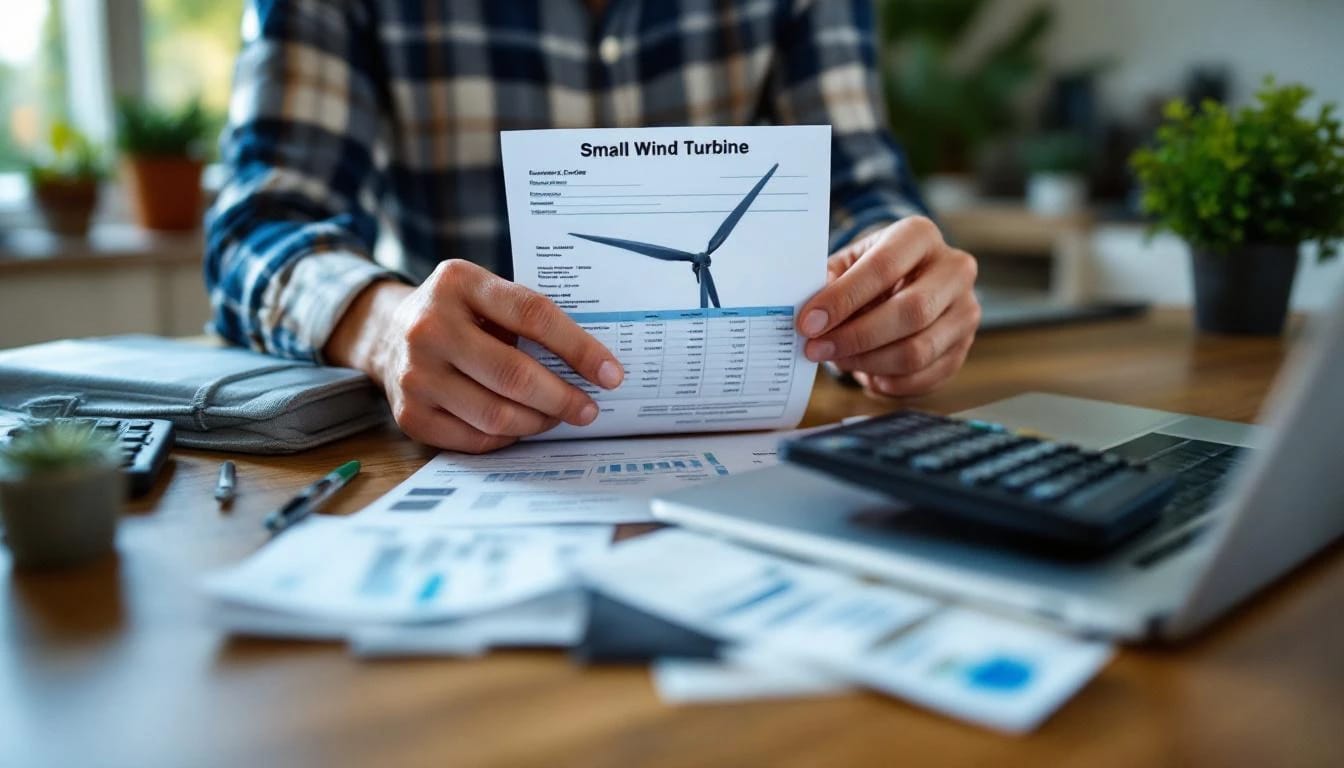
Payback period equals net installed cost divided by annual energy savings. Net installed cost is the sum of equipment, tower, installation, permitting, and first-year maintenance minus the federal tax credit and any state rebates. Annual energy savings equals kilowatt-hours generated multiplied by the blended retail electricity rate.
A 5 kW turbine in a 13 mph average wind site generates 6,000 to 8,500 kWh per year. At $0.14 per kWh, that yields $840 to $1,190 in displaced grid purchases. A $35,000 installed system drops to $24,500 after the 30 percent federal credit. Simple payback is $24,500 ÷ $1,015 = 24 years. High-wind sites with 15 mph averages and higher electricity rates push payback below fifteen years. Suburban sites with 10 mph averages stretch payback past thirty years, making the investment financially marginal.
This calculation ignores financing interest, which adds two to five years to payback when projects are loan-financed. Electricity-rate escalation shortens payback by one to three years if rates climb 3 percent annually, but that assumption depends on local utility regulation and fuel-mix trends.
Total cost comparison by system size
| System size | Turbine cost | Tower + foundation | Installation labor | Balance of system | Permits + engineering | Total before incentives | After 30% credit | Estimated annual output (13 mph) | Simple payback at $0.14/kWh |
|---|---|---|---|---|---|---|---|---|---|
| 2.5 kW | $8,000 | $9,000 | $4,000 | $1,800 | $700 | $23,500 | $16,450 | 3,500 kWh | 33 years |
| 5 kW | $15,000 | $12,000 | $6,000 | $2,500 | $1,000 | $36,500 | $25,550 | 7,200 kWh | 25 years |
| 10 kW | $28,000 | $18,000 | $10,000 | $4,000 | $1,500 | $61,500 | $43,050 | 14,500 kWh | 21 years |
Hidden costs and budget padding
Utility transformer upgrades occasionally become necessary when turbine output exceeds the existing service transformer capacity. Rural coops serving multiple homes on one transformer may require a dedicated transformer installation billed at $3,000 to $8,000. This cost is unpredictable—some utilities absorb it, others pass it through.
Tree removal improves wind access but adds $800 to $3,000 per large tree. Turbulence from nearby tree lines reduces output by 20 to 40 percent even when the tower clears treetop height by the recommended margin of 30 feet. Owners underestimate vegetation impact during site assessment then face disappointing generation numbers.
Homeowner association approval drags out timelines and sometimes derails projects entirely. Deed restrictions that ban towers taller than fence height require variance petitions and legal review. Attorney time runs $1,500 to $4,000 when covenants are ambiguous.
Refurbished and used equipment markets
Used turbines appear on auction sites and in regional classifieds. Prices run 40 to 60 percent below new for ten-year-old units in working condition. Buyers assume all transportation, reinstallation, and recommissioning costs. Manufacturer warranties do not transfer. Parts availability for discontinued models poses risk—Bergey maintains parts inventory for models dating to the 1980s while importers vanish after two years.
Refurbished towers sold by installation contractors who dismantle and relocate systems cost half what new towers command. Inspect for rust perforation, especially near ground level where moisture collects. Guy cables and hardware should be replaced regardless of claimed age; fatigue failures in wire rope are not visually apparent.
Battery-backed systems and off-grid premiums
Off-grid wind systems replace the grid-tie inverter with a charge controller, battery bank, and off-grid inverter. Battery banks for whole-home backup start at $8,000 for lead-acid and $12,000 for lithium-ion with sufficient capacity to carry loads through three windless days. Battery replacement every seven to twelve years adds $1,000 to $1,800 to the lifetime cost per replacement cycle.
Hybrid systems combine wind, solar, and propane gensets. Wind covers winter loads when solar output drops. Solar handles summer peaks when wind slackens. Hybrid charge controllers that manage multiple inputs cost $2,000 to $4,000. Total off-grid system costs escalate to $60,000 to $100,000 depending on load profile and backup-duration requirements.
Financing options and interest impact
Home equity lines of credit offer the lowest interest rates for wind projects, running 6 to 9 percent in current markets. A $40,000 project financed over fifteen years at 7 percent costs $47,600 in total payments. The federal tax credit provides a $12,000 lump sum in year one that owners can apply toward principal, dropping the financed amount to $28,000 and cutting total interest to $6,300.
Unsecured personal loans carry 9 to 14 percent rates and shorter terms. Ten-year terms at 11 percent on $40,000 result in $15,000 in interest charges. Manufacturer financing through captive lenders occasionally surfaces at promotional rates below 5 percent for twenty-four to thirty-six months. These deals rarely extend long enough to cover a project of this scale.
Comparative economics: wind versus rooftop solar
Residential solar installations cost $2.50 to $3.50 per watt installed. A 10 kW solar array runs $25,000 to $35,000 before the same 30 percent federal credit. Solar generates predictably during daylight hours in all fifty states. Wind output concentrates in winter months and overnight hours in most continental climates. Net metering treats both sources identically in states with strong programs.
Wind makes financial sense when annual average wind speed at hub height exceeds 12 mph and the site offers unobstructed exposure. Solar wins in moderate-wind settings and urban lots. Owners with roof space and a wind resource should model both; hybrid systems smooth monthly generation and reduce grid dependence year-round.
Resale value and home appraisal impact
Permanently installed wind turbines are considered real property improvements. Appraisers apply income capitalization methods to value the energy savings stream. In practice, few appraisers carry wind-energy training and most ignore the turbine entirely or assign nominal value. Resale appeal varies by region—wind turbines attract premium offers in rural Plains states and penalty discounts in suburban tracts where zoning variances are difficult.
Removal costs range from $2,000 for small tilt-up monopoles to $8,000 for guyed lattice towers requiring crane disassembly. Buyers who view the turbine as a liability negotiate removal as a condition of sale. Sellers in strong wind markets advertise the turbine as an income-producing asset and sometimes achieve modest premiums.
What is the cheapest way to install a home wind turbine?
Owner-builders who handle excavation, concrete work, trenching, and tower assembly themselves can cut installed costs by 30 to 40 percent. Contract a licensed electrician only for the final service-panel connection and inspection signoff. This approach requires mechanical aptitude, concrete-finishing experience, and access to a gin pole or A-frame for tower raising. Total cost for a 5 kW system drops from $36,000 to $22,000 before incentives when the owner provides all labor except electrical interconnection.
Do home wind turbines qualify for the federal solar tax credit?
Yes. The Residential Clean Energy Credit under IRC §25D covers wind turbines alongside solar, geothermal heat pumps, and battery storage. The credit equals 30 percent of installed cost including equipment, labor, and permitting. It remains at 30 percent through 2032, steps down to 26 percent in 2033, and drops to 22 percent in 2034 before expiring unless extended. Claim the credit on IRS Form 5695 filed with the annual tax return.
How long do wind turbine blades last before replacement?
Manufacturers rate residential turbine blades for fifteen to twenty-five years in standard duty cycles. Leading-edge erosion from airborne sand, ice, and insects degrades aerodynamic performance after eight to twelve years. Owners apply polyurethane leading-edge tape every three to five years to extend blade life. Catastrophic blade failure from fatigue cracks or lightning strike is rare but requires full blade-set replacement at $2,500 to $5,000 depending on turbine size.
Can a wind turbine increase my property taxes?
Permanent installations count as real property improvements in most jurisdictions, raising assessed value by the cost of the improvement. Thirty-one states exempt renewable energy systems from property-tax assessment increases through specific statutory carve-outs. Verify local treatment with the county assessor before installation. States without exemptions add $150 to $600 annually to the property-tax bill on a $40,000 improvement depending on the mill rate.
What wind speed do I need to make a turbine worthwhile?
Annual average wind speed of 12 mph or higher at turbine hub height justifies investment in most grid-tied scenarios. Sites below 11 mph generate insufficient output to recover installed costs within the turbine's service life. Order a wind assessment from a qualified consultant who installs an anemometer at the planned hub height for twelve months of data collection. Assessment costs run $1,500 to $3,000 but prevent expensive mistakes in marginal-wind locations.
Bottom line
Home wind turbines demand $30,000 to $75,000 in upfront capital and deliver ten- to twenty-five-year payback periods depending on wind resource and electricity rates. Federal tax credits recover 30 percent of costs while net metering captures surplus generation value. Owners in high-wind rural areas with unobstructed exposure achieve the shortest paybacks. Suburban and low-wind sites rarely justify the investment compared to rooftop solar. Obtain a professional wind assessment before committing funds to avoid underperforming installations that never repay their cost.
Share this article
windturbinehome.com/s/b7898d
Editorial note: This article was researched and written by a member of the Wind Turbine Home editorial team. AI-assisted tools were used for spell-checking and light grammar review only — all research, analysis, and conclusions are our own. Our editorial policy prohibits sponsored content and paid placements. Read our editorial policy →
Related reading

cost roi incentives
Wind Turbine Federal Tax Credit Deadline 2026: What to File When
The 30% federal Residential Clean Energy Credit for home wind turbines drops after 2032. Learn filing deadlines, eligible costs, and IRS Form 5695 requirements.

cost roi incentives
Wind Turbine ITC Step-Down Schedule: 2025-2034 Timeline
The federal Investment Tax Credit for residential wind turbines drops from 30% to 26% in 2033, then 22% in 2034. Learn how to maximize savings before each deadline.
cost roi incentives
Federal ITC for Residential Wind: What 30% Really Covers
The 30% federal residential clean energy tax credit covers turbine hardware, installation labor, and electrical work—but excludes permits, land prep, and repairs.

cost roi incentives
State Rebates and Net-Metering for Small Wind Turbines (2024)
State-by-state guide to rebates, tax credits, and net-metering programs for residential wind turbines. Compare IRS 30% federal credit with local incentives.

cost roi incentives
Home Wind Turbine Cost in Ireland: SEAI Grants & ESB Networks
Installing a home wind turbine in Ireland costs €8,000-€35,000 including ESB Networks paperwork. SEAI grants cover up to €2,100, but NC6/NC7 approvals add 4-8 weeks to your timeline.

cost roi incentives
Home Wind Turbine Rebates Canada: Greener Homes & Provincial Programs
Canadian homeowners can access federal Greener Homes grants up to $5,000 plus provincial rebates for small wind turbines, though eligibility varies by region and system size.

cost roi incentives
Home Wind Turbine Cost in Iowa: Utility Programs and Federal Stack
Iowa homeowners can cut small wind turbine costs 30-50% through federal tax credits, net metering, and regional utility programs—here's the complete incentive stack.

cost roi incentives
Home Wind Turbine Cost in Texas: Incentives, Install & Payback
Texas home wind turbines cost $4,000–$65,000 installed. Federal 30% tax credit cuts upfront expense. Site-specific wind and tower height drive payback timelines of 12–25 years.

cost roi incentives
Wind Turbine Payback Period Calculation: Step-by-Step Math
Learn how to calculate small wind turbine payback period using real costs, energy production data, and incentives. Detailed formulas and examples included.