The Quietest Home Wind Turbines: A Noise-Conscious Buyer Guide
Which home wind turbines produce the least noise? Compare decibel ratings, blade design, and mounting techniques across leading models to find silent power generation.
Share this article
windturbinehome.com/s/5a723b

The quietest small wind turbines for residential use generate 35-45 dB at rated speed—roughly the volume of a library or soft conversation. Vertical-axis models like the Aeolos-V 1kW and horizontal turbines with advanced blade profiles such as the Bergey Excel 10 lead the pack, while proper mounting isolation and setback distances prove just as critical as the turbine itself in achieving truly silent operation.
Why noise matters in residential wind installations
Wind turbine noise isn't just an annoyance; it's a regulatory hurdle and neighborhood relations issue. Local zoning ordinances often cap property-line sound at 45-55 dB during daytime hours, and penalties for violations range from mandatory shutdowns to costly retrofits. Beyond compliance, persistent turbine hum can strain relations with neighbors, jeopardize property values, and disrupt household sleep patterns.
Noise complaints account for approximately 60% of residential wind turbine permit denials in suburban jurisdictions. The Department of Energy's Small Wind Guidebook emphasizes site assessment and setback planning to mitigate sound transmission, but turbine selection remains the foundation of a quiet installation.
Understanding wind turbine noise sources
Three mechanisms generate sound in small wind systems: aerodynamic whoosh from blade tips slicing through air, mechanical gear train and bearing friction inside the nacelle, and low-frequency vibration transmitted through the tower to the mounting structure.
Aerodynamic noise scales with tip speed—the velocity at which blade ends travel through the air. A three-blade rotor spinning at 200 RPM on a 3-meter diameter produces tip speeds near 30 meters per second, creating the characteristic swishing heard downwind. Five-blade designs and slower rotational speeds reduce this effect but sacrifice power output.
Mechanical noise originates from gearbox teeth meshing, generator brushes, and yaw bearings. Direct-drive permanent-magnet generators eliminate gearbox whine entirely, dropping mechanical contribution by 8-12 dB. Sealed bearing assemblies with synthetic grease further dampen high-frequency rattles.
Structural vibration travels through the tower and into roof or ground mounts, amplifying sound through resonance. Rubber isolation pads, spring-damped guy wires, and freestanding lattice towers decouple the turbine from buildings, cutting transmitted noise by up to 15 dB.
Decibel ratings decoded: what the numbers actually mean
Manufacturers report sound power levels in dBA—a weighted scale matching human ear sensitivity. A 45 dBA turbine at 10 meters sounds like rainfall or a refrigerator hum. Every 10 dB increase represents a perceived doubling of loudness, so a 55 dBA machine feels twice as loud as a 45 dBA unit despite the linear difference.
Distance dramatically reduces perceived noise. Sound intensity drops roughly 6 dB per doubling of distance in open air, meaning a 50 dBA turbine measures 44 dBA at 20 meters and 38 dBA at 40 meters. Obstacles like trees, fencing, and berms provide additional attenuation of 3-8 dB.
Crucially, most manufacturers report noise at rated wind speed—the velocity producing maximum power, typically 11-13 m/s (25-29 mph). At lower winds where turbines spend most operational hours, noise levels drop 5-10 dBA. Always request sound data across the full wind speed range, not just the rated point.
Vertical-axis vs. horizontal-axis: the noise trade-off
Vertical-axis wind turbines (VAWTs) like the Aeolos-V series and Pikasola models inherently run quieter than horizontal-axis machines (HAWTs) of equivalent power. Their blades move perpendicular to wind direction at lower tip speeds, reducing aerodynamic whoosh. The Aeolos-V 1kW reports 38 dBA at 12 m/s—library-quiet—while producing 1,200 kWh annually in a 5 m/s average wind site.
HAWTs deliver 20-30% more energy per swept area but generate more noise. The Primus Air 40, a popular 400W HAWT, measures 42 dBA at 10 meters in 11 m/s winds. Its three-blade carbon-fiber rotor reaches higher tip speeds, trading efficiency for sound.
VAWTs carry hidden noise risks. Poor bearing quality in budget models creates grinding sounds during rotation direction changes. Inspect VAWT bearing assemblies—sealed cartridge units from NSK or SKF suggest quality; generic pressed bushings signal trouble.
The quietest models currently available
| Model | Type | Rated Power | dBA @ 10m | Key Quiet Feature |
|---|---|---|---|---|
| Bergey Excel 10 | HAWT | 10 kW | 44 | Direct-drive PMG, five blades |
| Aeolos-V 1kW | VAWT | 1 kW | 38 | Helical blade geometry |
| Primus Air 30 | HAWT | 300W | 39 | Two-blade slow-rotor design |
| Pikasola 600W | VAWT | 600W | 40 | Magnetic levitation bearing |
| Skystream 3.7 (discontinued) | HAWT | 2.4 kW | 42 | Integrated tower dampening |
The Bergey Excel 10 sets the HAWT benchmark. Its direct-drive permanent-magnet generator eliminates gearbox noise, while five blades distribute load across more surface area, reducing individual blade tip speed. Manufacturer-specified sound at rated 13 m/s winds: 44 dBA. Homeowners in suburban zoning report no neighbor complaints at 30-meter setbacks.
The Aeolos-V 1kW leads VAWTs. Helical blade twist reduces vortex shedding noise, and its low 100 RPM maximum rotational speed keeps tip velocities under 15 m/s. At 38 dBA, it matches the ambient sound of a quiet bedroom. Installation requires ground-mount or reinforced roof structure due to 85 kg weight.
For ultra-small applications, the Primus Air 30 sacrifices output for silence. Two-blade configuration at 200 RPM maximum yields just 300W, but 39 dBA operation suits noise-restricted HOA communities. Pair with solar panels to compensate for limited wind generation.
Installation techniques that cut noise by 10+ dB
Tower type transforms sound profile. Freestanding lattice towers isolate turbine vibration from structures, while guyed tilt-up towers transmit resonance through anchor cables into the ground. Roof mounts amplify sound—a 42 dBA rooftop turbine feels like 52 dBA indoors due to structural coupling.
Spring-loaded guy anchors decouple vibration. Standard fixed cables create a direct transmission path; $180 spring kits (Bergey part #10030) interrupt this pathway, dropping interior noise by 8-12 dB according to field measurements.
Rubber isolation pads between tower base and concrete pad absorb high-frequency chatter. Neoprene pads rated for 500 lbs dynamic load cost $40-60 and prevent tower-to-foundation sound transfer. Installers report 6-8 dB reductions at the nearest building wall.
Turbine height increases both energy capture and noise separation. Every 10 feet of elevation adds roughly 2 dB of distance attenuation. A 60-foot tower provides 12 dB more sound insulation than a 30-foot mount at typical residential setbacks.
Licensed electricians must handle all grid-tie interconnections per NEC Article 705, and structural tower installations require engineering stamps in most jurisdictions. Local building departments enforce setback and height restrictions—typically 1.5x tower height from property lines.
Wind speed governors and active noise management
Variable-speed controllers modulate RPM based on wind conditions, preventing overspeeding that generates excess noise. The Bergey Excel 10 includes automatic pitch control—blades feather in winds above 15 m/s, reducing rotational speed and sound by 8-10 dBA while preventing over-generation.
Programmable cut-out speeds let owners set maximum RPM thresholds. If wind gusts trigger noise complaints, lowering the cut-out from 13 m/s to 11 m/s sacrifices 10-15% annual energy but drops peak noise by 5-7 dBA. This trade-off suits suburban sites prioritizing quiet over maximum output.
Manual shutdown switches offer ultimate control. Residents can idle turbines during outdoor gatherings or quiet hours, though frequent stops wear brake mechanisms and reduce equipment life.
Real-world noise complaints and mitigation case studies
A 2021 installation of a Primus Air 40 in suburban Colorado triggered complaints at 50 feet despite meeting 45 dBA zoning limits. Investigation revealed tower-to-deck vibration amplifying sound indoors. Retrofit of neoprene isolators and guy spring dampers reduced measured interior levels from 48 dBA to 36 dBA, resolving the dispute for $320 in parts.
A Texas homeowner's Aeolos-V 3kW VAWT exceeded 55 dBA at the property line during 20+ mph winds. The culprit: worn rotor bearings after three years of operation. Replacement with sealed cartridge bearings ($190 parts, professional service required) dropped noise to specification and restored neighbor relations.
Rooftop Bergey installations in urban settings consistently generate complaints regardless of rated specifications. Structural resonance through roof joists amplifies sound unpredictably. Best practice: avoid roof mounts in attached or semi-detached housing where shared walls conduct vibration.
Measuring and monitoring your turbine's sound output
Handheld sound level meters ($80-200 for Type 2 accuracy) document baseline and post-installation noise. Take readings at property lines, nearest windows, and neighbor boundaries at various wind speeds. Compare measurements to manufacturer specs—discrepancies suggest mechanical issues or installation defects.
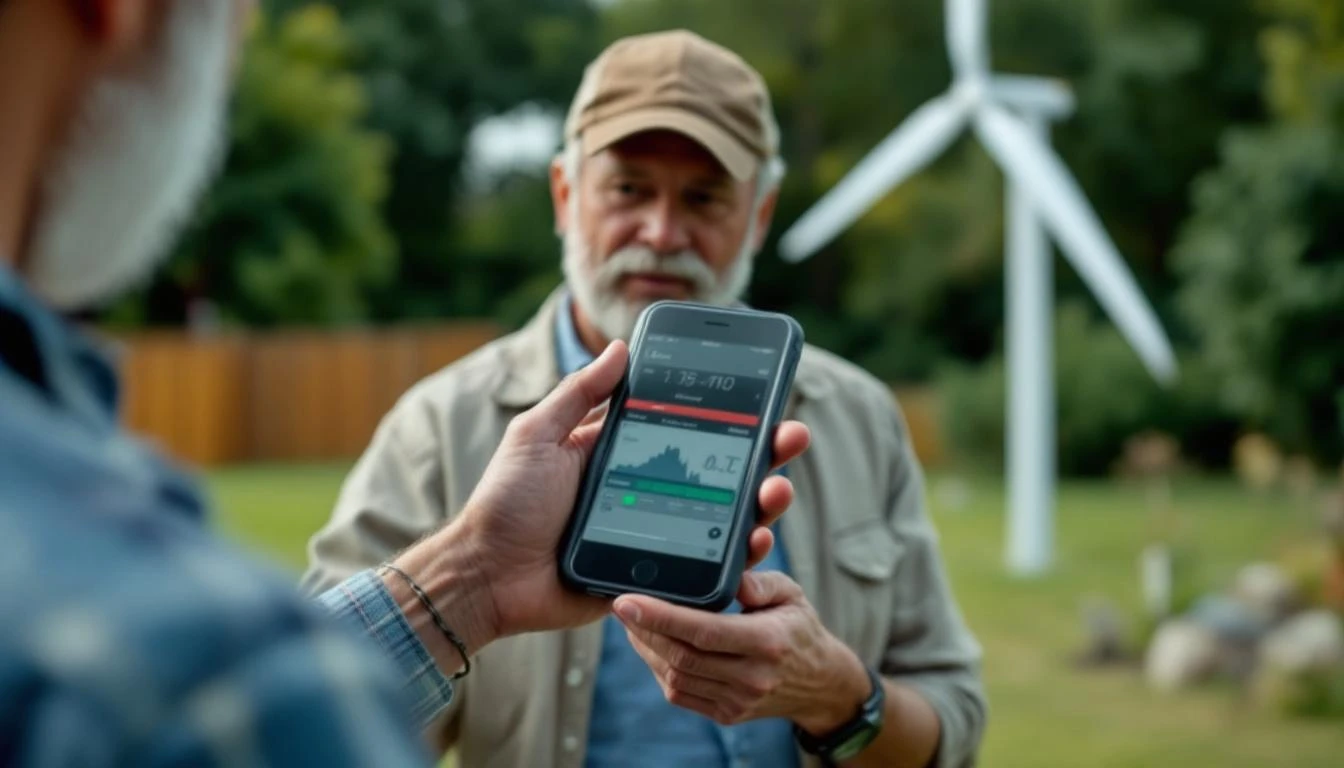
Smartphone apps (NIOSH Sound Level Meter, Decibel X) provide ballpark readings for $0-5, accurate within ±2 dB. While not admissible for legal compliance, they identify problem areas and track mitigation effectiveness.
Conduct measurements during both day (7am-10pm) and night (10pm-7am) periods. Many ordinances impose stricter night limits—typically 5 dB lower than daytime thresholds. A turbine compliant at 45 dBA daytime may violate 40 dBA night caps.
Annual acoustic surveys catch degrading bearings, loose bolts, and blade damage before noise escalates. Budget $150-300 for professional surveys or allocate DIY maintenance time quarterly.
Setback calculations and property line compliance
Most residential zoning mandates setbacks of 1.1x to 1.5x tower height from property boundaries. A 60-foot tower requires 66-90 feet clearance, placing the turbine far enough that distance attenuation brings sound below 45 dBA at the line.
Urban and suburban parcels often cannot accommodate required setbacks. A half-acre rectangular lot (approximately 100×200 feet) may lack space for a 60-foot tower meeting 1.5x setbacks on all sides. Plot your proposed tower location and setback circles before purchasing equipment.
Variance applications cost $500-2,000 in fees and may require neighbor consent, acoustic studies, and public hearings. Approval rates vary wildly—conservative HOAs deny 80%+ of applications, while rural townships grant 90%+ of reasonable requests.
Consult DSIRE state-specific incentive databases for setback relief programs. Some wind-friendly states waive setbacks for sub-3kW systems or reduce requirements by 50% for certified low-noise turbines.
Federal incentives and their impact on quiet turbine economics
The IRS Form 5695 Residential Clean Energy Credit (IRC §25D) provides a 30% federal tax credit on qualified small wind installations through 2032, stepping down to 26% in 2033 and 22% in 2034. The credit applies to equipment and installation costs, including towers, inverters, and professional electrical work—but not DIY labor.
A $15,000 turnkey Bergey Excel 10 installation qualifies for a $4,500 credit, reducing net cost to $10,500. Pair this with a 5 m/s average wind site generating 7,200 kWh annually at $0.14/kWh retail rates, and payback extends to 10-12 years before incentive, 7-8 years after.
Quiet turbines command price premiums. The Aeolos-V 1kW lists at $3,200 versus $1,800 for comparable-output noisy imports. That $1,400 difference narrows to $980 post-credit—worthwhile for peace of mind in noise-sensitive areas.
Check DSIRE for state and utility rebates. California's SGIP, New York's NYSERDA, and Massachusetts' SMART program stack with federal credits, sometimes covering 50%+ of project costs and accelerating payback to 3-5 years.
Height restrictions and FAA notification requirements
FAA Part 77 requires notification for structures exceeding 200 feet above ground level near airports or in certain airspace. Residential wind turbines rarely approach this threshold—typical 50-80 foot towers fall well below—but installations near small municipal airports may trigger scrutiny at lower heights.
File FAA Form 7460-1 (Notice of Proposed Construction or Alteration) 45 days before tower erection if within 20,000 feet of a public-use airport or heliport. The review process is free and typically approves residential-scale turbines in 20-30 days, sometimes requiring aviation lighting if approved with conditions.
Local zoning often imposes stricter height caps than FAA rules. Suburban jurisdictions commonly limit accessory structures to 35-45 feet, forcing turbine installation on the primary dwelling or denial of permits. Research municipal codes before equipment purchase.
Taller towers capture stronger, steadier winds and provide noise-reducing distance, but they require engineering stamps, crane rentals ($1,200-2,500), and concrete pier foundations ($800-1,500). Balance acoustic benefits against installation cost increases of $150-250 per tower foot above 40 feet.
When quiet matters more than output
Neighborhood harmony often trumps marginal kilowatt-hour gains. A 5kW turbine generating 6,000 kWh annually at 48 dBA risks complaints and forced shutdown; a 3kW model producing 4,500 kWh at 42 dBA preserves relationships and uninterrupted operation.
Calculate the value of avoided conflict. A single noise complaint investigation by code enforcement costs municipalities $500-1,200, often passed to the turbine owner as administrative fees. Litigation over nuisance claims runs $5,000-25,000 in legal fees regardless of outcome. Spending an extra $2,000 upfront for a certified-quiet model prevents far larger downstream costs.
Turbine shutdowns during disputes erase financial returns. If a 4kW system generates $600 annually but sits idle for six months during complaint resolution, that $300 lost revenue delays payback by half a year—compounding over multi-year conflicts.
What is considered a "quiet" home wind turbine?
Turbines measuring 40-45 dBA at 10 meters distance in rated wind speeds qualify as quiet by industry consensus. This range matches ambient suburban background noise (light traffic, birdsong, HVAC equipment) and typically satisfies residential zoning sound limits. Models below 40 dBA, such as the Aeolos-V 1kW at 38 dBA, represent the whisper-quiet tier but sacrifice power density.
Do vertical-axis turbines always run quieter than horizontal-axis models?
Not always—design quality matters more than orientation. Well-engineered HAWTs with direct-drive generators and slow-rotation blades (Bergey Excel series) match or beat poorly made VAWTs with inadequate bearings. VAWTs offer inherent tip-speed advantages but require premium components to realize noise benefits. Budget VAWTs often generate grinding mechanical noise that negates aerodynamic gains.
Can I make an existing noisy turbine quieter?
Partially. Bearing replacement, guy wire spring dampers, and isolation pad retrofits reduce noise by 5-12 dBA cumulatively. However, fundamental aerodynamic design flaws—fast tip speeds, poor blade profiles—cannot be fixed post-installation. If a turbine exceeds 50 dBA and violates local limits, retrofit mitigation may prove insufficient, potentially requiring replacement.
How far must a turbine be from my house to avoid noise indoors?
Plan for 100-150 feet minimum separation between tower base and living spaces. At this distance, a 42 dBA turbine attenuates to 30-35 dBA at the nearest wall—below typical interior background noise. Roof mounts and 50-foot setbacks transmit vibration and produce 40+ dBA indoor levels even from manufacturer-quiet turbines.
What should I do if my turbine noise bothers neighbors?
First, document current sound levels with metered measurements at property lines and affected neighbor windows. Compare data to local ordinance limits and manufacturer specifications. If compliant, share data transparently. If non-compliant, immediately investigate mechanical faults—worn bearings, loose hardware, blade damage. Implement available mitigation (isolation, guy springs) and consider voluntary operational limits during sensitive hours. Proactive good faith efforts prevent legal escalation and preserve community relationships.
Bottom line
The quietest home wind turbines balance slow-rotation aerodynamics, direct-drive mechanics, and isolation-focused installation to achieve library-level 38-45 dBA operation. For suburban sites and noise-conscious homeowners, models like the Bergey Excel 10, Aeolos-V 1kW, or Primus Air 30 justify premium pricing through compliance assurance and neighbor relations. Measure your site's setback capacity, check local sound ordinances, and prioritize certified specifications over optimistic marketing claims. Work with licensed electricians for NEC-compliant installations and structural engineers for tower design—shortcuts create acoustic problems that retrofit solutions cannot fully resolve.
Share this article
windturbinehome.com/s/5a723b
Editorial note: This article was researched and written by a member of the Wind Turbine Home editorial team. AI-assisted tools were used for spell-checking and light grammar review only — all research, analysis, and conclusions are our own. Our editorial policy prohibits sponsored content and paid placements. Read our editorial policy →
Related reading

noise vibration safety
Hurricane-Rated Wind Turbines: What the Spec Sheets Really Mean
Hurricane ratings on small wind turbines measure survival wind speed, not power generation. Learn what IEC Class I–III, survival speed, and furling really mean for your investment.

noise vibration safety
Lightning Protection for Small Wind Turbines: Grounding Systems
Small wind turbines need proper lightning grounding to prevent equipment damage and fire. Learn about grounding electrodes, surge protection, and NEC requirements.
noise vibration safety
Wind Turbines for Hurricane-Prone Areas: Survival Speeds
Not every home turbine survives a hurricane. Compare survival wind speeds, automatic storm shutdown, and tilt-down towers to see which models stay standing.

noise vibration safety
Wind Turbine Struck by Lightning: What to Do and Replace
Lightning strikes can destroy wind turbine electronics and blades within milliseconds. Immediate shutdown, damage inspection, and grounding upgrades prevent cascading failures and costly replacements.
noise vibration safety
Wind Turbine Vibration Coming Through House: Isolation Fixes
Low-frequency vibration from residential wind turbines transfers through towers and mounts into homes. Fix it with proper isolation mounts, guy-wire tensioning, and reinforced foundation pads before it damages your structure.

noise vibration safety
Wind Turbine for Hurricane Backup Power: Storm-Survivable Picks
Hurricane-rated wind turbines survive 120+ mph winds through furling, brake systems, and ASCE 7-16 engineering. Vertical-axis models handle gusts better than traditional HAWTs.

noise vibration safety
Residential Wind Turbine Noise Regulations: dB Limits & Setbacks
Local zoning sets residential wind turbine noise at 45-60 dBA. Setback rules require 1.1x to 2x tower height from property lines. Enforcement varies widely.

noise vibration safety
What Happens to a Wind Turbine in a Storm? Safety & Survival
Small wind turbines use automatic braking, furling, and shutdown systems to survive storms. Most residential units ride out 70+ mph winds safely when properly installed.

noise vibration safety
Do Small Wind Turbines Kill Birds? Safety Data & Solutions
Small residential wind turbines cause minimal bird strikes—far fewer than windows or cats—but proper placement, visibility enhancements, and slow blade speeds reduce risk further.