Zoning Laws for Home Wind Turbines USA: What to Check First
Before installing a home wind turbine, check local height restrictions, setback requirements, and noise ordinances. Most residential turbines need 1+ acre and zoning approval.
Share this article
windturbinehome.com/s/4b0bf7
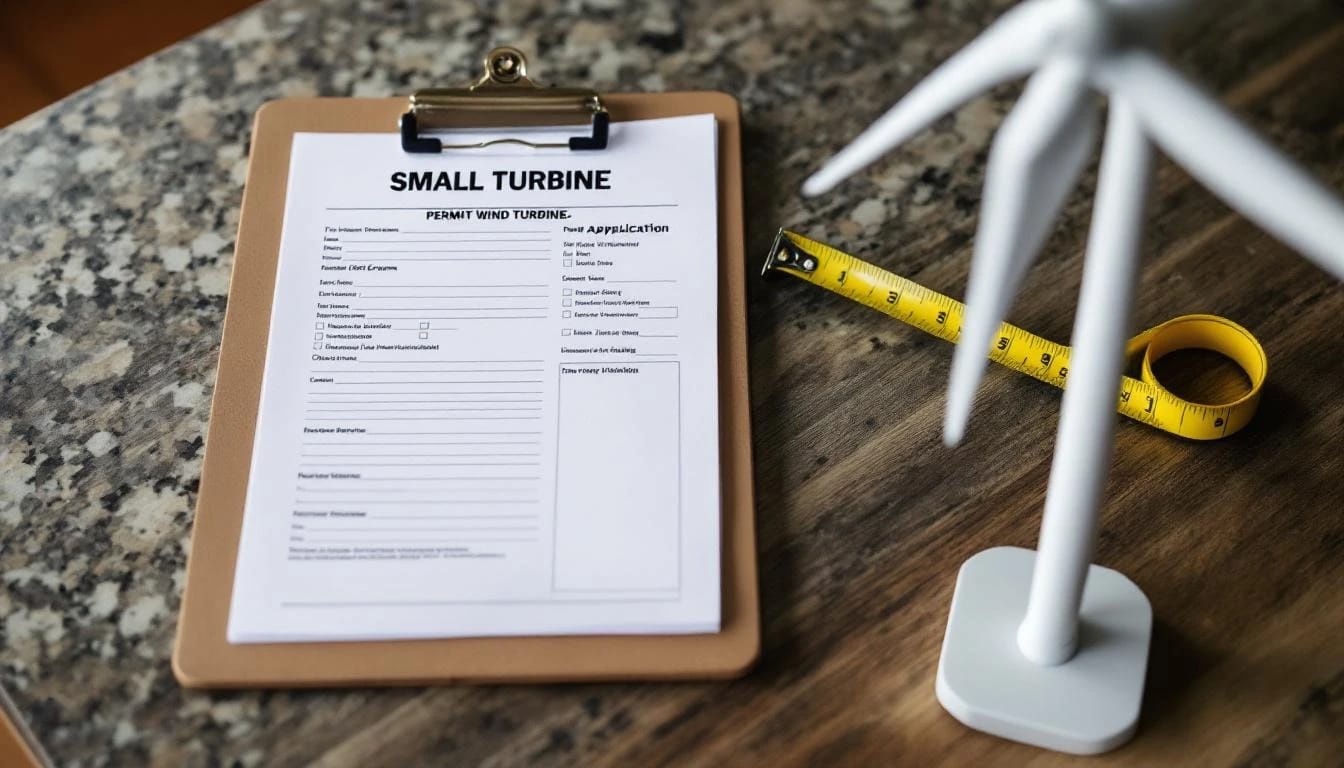
Installing a residential wind turbine means navigating a patchwork of local zoning codes that vary wildly from one municipality to the next. The U.S. Department of Energy's WINDExchange notes that approximately 19.3% of Americans live in rural areas with land parcels large enough for small wind systems—but zoning approval is never automatic. Height restrictions, setback rules, and noise ordinances are the three most common barriers. Homeowners who skip this research phase often face stop-work orders, retrofit costs, or forced turbine removal after thousands of dollars spent.
Why zoning matters more than the turbine itself
A Bergey Excel 10 or Primus Air 40 can deliver reliable kilowatt-hours for decades, but neither will spin if the local planning board denies your permit application. Zoning laws exist to balance property rights, neighbor concerns, and safety. Wind turbines trigger scrutiny because they're tall, visible, and sometimes audible. Height ordinances written for TV antennas or flag poles don't anticipate 60- to 80-foot towers. Setback rules designed for sheds or garages rarely account for blade sweep radius. Noise limits crafted for air conditioners may not address the low-frequency hum of a direct-drive permanent-magnet generator.
The mismatch creates friction. A 2021 survey by the American Wind Energy Association found that 37% of small wind permit applications faced delay or outright denial due to zoning conflicts—most of which could have been resolved earlier with better planning.
The three zoning tripwires
Height restrictions cap how tall any structure can rise above grade. Many suburban jurisdictions limit accessory structures to 35 feet, well below the 60-foot minimum the Department of Energy recommends for adequate wind exposure. Some counties tie height allowances to lot size: a 5-acre parcel might permit 80 feet, while a 1-acre lot maxes out at 50 feet. Tower height directly affects turbine performance—rule of thumb is that a turbine should sit 30 feet above any obstacle within 300 feet—so a restrictive height cap can render a site unworkable.
Setback requirements dictate how far a turbine must stand from property lines, roads, and occupied buildings. Common formulas include 1.1 times tower height from all property boundaries, or a flat 100-foot buffer. Vertical-axis turbines (Pikasola, Aeolos-V series) often fall under the same setback rules as horizontal-axis machines, even though their failure modes differ. A 10-kilowatt turbine on an 80-foot tower needs 88 feet of clearance under a 1.1× rule, effectively requiring more than 2 acres if setbacks apply to all four sides.
Noise ordinances set decibel limits at the property line or nearest residence. Typical thresholds range from 45 dBA (residential night) to 55 dBA (residential day). A 5-kilowatt turbine generates 35-45 dBA at the turbine base in moderate wind, but that sound carries. Some jurisdictions measure ambient noise pre-installation and prohibit any project that adds more than 5 dBA. Others ban "pure tone" or "impulsive" noise, terms that can ensnare gear-drive turbines or models with blade-tower interaction.
Where to start your research
Begin at the county planning or zoning office. Even if you live within city limits, county codes often apply to unincorporated areas just outside town. Request a copy of the zoning ordinance and ask explicitly about "accessory structures," "wind energy systems," and "towers." Some municipalities publish ordinances online; others require an in-person visit or FOIA request.
Next, check for overlay districts. Historic preservation zones, airport approach paths, and scenic viewsheds impose additional rules. FAA Part 77 requires notification (not approval) if your turbine exceeds certain heights or sits near an airport. The FAA will issue a Determination of No Hazard to Air Navigation if the turbine doesn't penetrate imaginary airspace surfaces. This is separate from local zoning approval—you need both.
Homeowner association covenants carry legal weight equal to municipal codes. If your deed includes HOA membership, review the covenants for language about "structures," "alterations," or "aesthetics." Many HOAs written before 2010 contain blanket bans on anything resembling a tower. Some states have enacted solar and wind access laws that prevent HOAs from blocking renewable energy systems, but enforcement is inconsistent.
Model ordinances and friendly jurisdictions
A handful of states and counties have adopted model wind ordinances that streamline permitting. Oregon's small wind model code, for example, uses a tiered approach: turbines under 10 kilowatts with towers under 80 feet qualify for administrative permits if setbacks and noise limits are met. Michigan's model ordinance allows towers up to 120 feet in agricultural zones with a conditional-use permit.
Wisconsin grants a rebate of up to $3,500 for residential wind systems (check DSIRE for current status), and many Wisconsin counties have permissive zoning in return. Kansas and Montana treat small wind turbines as farm equipment in rural zones, exempting them from accessory-structure height caps. Vermont requires municipalities to allow wind turbines as a permitted use in at least one zoning district.
Compare that to restrictive jurisdictions. Fairfax County, Virginia caps accessory structures at 25 feet. Cook County, Illinois requires a special-use permit for any turbine, with public hearings and neighbor notification. Some California coastal communities prohibit turbines outright to protect viewsheds.
| Jurisdiction Type | Typical Height Limit | Setback Formula | Noise Limit (dBA) | Permit Type |
|---|---|---|---|---|
| Rural agricultural | 80-120 ft | 1.1× or none | 50-55 | Building permit |
| Suburban residential | 35-60 ft | 1.5× tower height | 45-50 | Conditional use |
| Urban residential | 25-40 ft | Prohibited or 2× | 40-45 | Variance only |
| Unincorporated county | 80-100 ft | 1.1× or 100 ft min | 50-55 | Building permit |
The variance and conditional-use permit paths
When existing zoning doesn't allow your turbine, two options exist: variance or conditional-use permit (CUP). A variance grants an exception to a specific rule—say, allowing a 75-foot tower in a 60-foot zone. Applicants must prove "practical difficulty" or "undue hardship." Aesthetic preference doesn't qualify; loss of wind resource due to terrain might.
A CUP authorizes a use not normally permitted in that zone. Wind turbines often fall under "utility" or "accessory renewable energy" categories that require a CUP in residential districts. The process includes a public hearing, neighbor notification (usually within 300-500 feet), and often a site plan showing tower location, fall zone, electrical run, and sound modeling. Approval can include conditions: lower tower height, sound monitoring, or visual screening.
CUP hearings attract opposition. Neighbors cite property values, noise, "flicker" (shadow cast by spinning blades), and visual impact. Successful applicants bring data: sound studies from the turbine manufacturer, property-value research (studies show minimal to no effect), and photos of similar installations. Some hire an acoustical engineer to model sound propagation or a land-use attorney to present the case.
Electrical and structural codes
Zoning approval is only step one. The National Electrical Code (NEC) Article 705 governs interconnection of on-site generation, including wind turbines. Article 705 requires that all interconnected systems include a visible disconnect, proper grounding, and overcurrent protection. Many local inspectors are unfamiliar with wind installations; bringing a copy of the turbine's UL 1741 listing and the manufacturer's installation manual helps. A licensed electrician must sign off on the work in most jurisdictions.
Structural permitting covers the tower foundation. Tilt-up lattice towers and guyed monopoles need engineered foundations to resist overturning moment. Building officials require stamped structural drawings from a professional engineer licensed in your state. Manufacturers like Bergey and Primus provide tower engineering packages, but the PE stamp must come from someone authorized to practice locally.
Wind loads follow ASCE 7 standards. Inspectors want proof that the foundation can handle ultimate wind speed for your location (typically 115-140 mph three-second gust). Some jurisdictions demand soil reports and frost-depth calculations. Budget $800-$2,000 for engineering review and permit fees.
How to build a strong permit application
A complete application includes:
- Site plan showing property boundaries, existing structures, turbine location, fall zone (tower height plus 10%), electrical conduit route, and setback dimensions.
- Manufacturer spec sheets with sound data, power curve, tower options, and certifications (UL, IEC, AWEA).
- Sound study or manufacturer-provided dBA levels at specified distances.
- Visual simulation (optional but persuasive): photomontage showing the turbine from neighboring properties.
- Electrical single-line diagram showing turbine, inverter, disconnect, service panel, and utility connection point.
- Engineered foundation drawings with PE stamp.
- FAA determination letter if applicable.
Incomplete applications get delayed. Planners send requests for additional information, each adding weeks. Submit everything up front.
Some applicants hire a land-use consultant or small wind installer experienced in local permitting. An installer who has secured ten approvals in your county knows which arguments resonate and which officials to approach early. This costs $500-$1,500 but can cut six months off the timeline.
Timeline and costs
Permit timelines range from 6 weeks (rural building permit for compliant installation) to 12 months (urban CUP with appeals). Budget 4-6 months for a straightforward suburban application. Fees vary: $150-$500 for building permits, $800-$3,000 for a CUP including public hearing costs, and $200-$800 for electrical inspection.
Add engineering costs ($800-$2,500) and any required studies (sound, environmental, visual impact: $1,000-$5,000 total). A turbine installation that costs $25,000 might carry $2,000-$8,000 in permit-related expenses—10% to 30% overhead.
Federal incentives and state programs
The IRC §25D 30% Residential Clean Energy Credit (formerly Investment Tax Credit) applies to qualified small wind systems. IRS Form 5695 covers wind turbines installed through 2034, with the credit stepping down to 26% in 2033 and 22% in 2034. The system must serve a dwelling unit you own and use as a residence. Rental properties don't qualify unless you live there part-time. The credit has no dollar cap but requires that the turbine meet performance and quality standards—look for AWEA or IEC certification.
State incentives vary. Check the DSIRE database (Database of State Incentives for Renewables & Efficiency) for rebates, grants, and property-tax exemptions. Minnesota offers a sales-tax exemption on wind equipment. Oklahoma grants a $0.005 per kWh production credit for small wind. New York's incentive program ended in 2022, but property-tax exemptions remain in place for 15 years post-installation.
Some utilities offer net metering or feed-in tariffs. Net metering credits excess generation at retail rate; feed-in tariffs pay a fixed per-kWh rate for all production. Both require interconnection agreements separate from zoning approval.
Internal resources
- Small wind turbine fundamentals
- Tower types and height requirements
- Grid-tie vs off-grid systems
- Wind resource assessment for residential sites
- Homeowner association strategies for renewable energy
- Sound levels and neighbor relations
- Federal tax credits for small wind 2024
- Electrical permitting and NEC compliance
External references: Department of Energy Small Wind Guidebook, FAA Form 7460-1 Notice Criteria Tool, DSIRE Database, NEC Article 705 on Interconnected Electric Power Production Sources.
Do I need a lawyer to get zoning approval for a wind turbine?
Most straightforward residential installations don't require legal representation. If your application meets height and setback rules and you're applying for a standard building permit, a lawyer is optional. However, if you're seeking a variance or conditional-use permit, especially in a jurisdiction with active opposition, a land-use attorney can be worth $1,500-$3,500. They know procedural rules, can cross-examine objectors, and draft findings of fact that planning boards copy into approval orders. In hostile jurisdictions or if neighbors organize against your project, legal help becomes essential.
Can my HOA block my wind turbine even if local zoning allows it?
Yes. HOA covenants are private contracts enforceable in civil court, separate from municipal zoning. Even if the county approves your permit, the HOA can sue to compel removal if covenants prohibit the structure. Some states (Colorado, Utah, Arizona) have enacted solar and wind access laws that limit HOA power, but they don't override all restrictions. Review your CC&Rs before applying for permits. If the HOA has an architectural review committee, submit your proposal there first. Some HOAs grant exceptions for renewable energy if the system is well-designed and minimally visible.
How close to my property line can I install a turbine?
That depends on the setback formula in your zoning code. Common rules include 1.1 times tower height, 1.5 times tower height, or a flat distance (100 feet, 200 feet). A few jurisdictions allow placement at the property line if the adjoining landowner signs a waiver. The setback usually measures from the tower base to the property line—not from the blade-tip arc. If your turbine is 80 feet tall and the code requires 1.1× setback, you need 88 feet from the base to the nearest boundary. On a square lot, that constrains placement to the center or requires more land.
Do I need FAA approval for a home wind turbine?
FAA approval is not required, but notification is mandatory under Part 77 if your turbine exceeds certain heights or sits within airport imaginary surfaces. Generally, structures over 200 feet above ground level require notification. If you're within 20,000 feet of a public-use airport, lower thresholds apply—sometimes as low as 50 feet. File FAA Form 7460-1 at least 45 days before construction. The FAA issues a Determination of No Hazard if the turbine doesn't obstruct airspace. This determination is advisory for local zoning boards but doesn't override municipal codes. You still need local zoning approval.
What happens if I install a turbine without a permit?
Installing without a permit risks a stop-work order, daily fines, and forced removal. Code enforcement officers can issue citations with penalties ranging from $100 to $1,000 per day. If you later try to sell the property, title searches reveal unpermitted structures, complicating the sale or requiring retroactive permitting. Some jurisdictions allow after-the-fact permits with double fees and full inspections. Others mandate removal. Even if neighbors don't complain, a future property sale, insurance claim, or refinance can expose the unpermitted work. Always secure permits before construction.
Bottom line
Zoning research isn't optional—it's the first step in any residential wind project. Start by obtaining a copy of your local zoning ordinance and confirming height limits, setbacks, and noise rules. If your site is borderline, consult a land-use professional before purchasing equipment. A $2,000 investment in engineering and permit fees saves tens of thousands in aborted installations. Check DSIRE for state incentives and confirm the 30% federal tax credit applies to your situation using IRS Form 5695. With proper planning, most rural and many suburban sites can host a 5- to 10-kilowatt turbine legally and without neighbor conflict.
Share this article
windturbinehome.com/s/4b0bf7
Editorial note: This article was researched and written by a member of the Wind Turbine Home editorial team. AI-assisted tools were used for spell-checking and light grammar review only — all research, analysis, and conclusions are our own. Our editorial policy prohibits sponsored content and paid placements. Read our editorial policy →
Related reading

permits zoning hoa
FAA Tower Marking and Lighting Requirements for Small Wind Turbines
Small wind turbines over 200 feet AGL trigger FAA Part 77 notice requirements. Most residential units stay under thresholds, but taller towers near airports need marking or lighting.

permits zoning hoa
When the HOA Blocks Your Wind Turbine: Legal Options in 2026
HOA rejection isn't always final. State solar-access laws, variance petitions, and FCC's OTARD rule offer paths forward—plus practical workarounds for wind turbines.

permits zoning hoa
Home Wind Turbine Planning Permission UK: PD Rights vs Full Application
UK homeowners can install small wind turbines under Permitted Development rights if specific conditions are met. Otherwise, full planning permission is required from your Local Planning Authority.
permits zoning hoa
Wind Turbine Permits in Iowa: State, County, and Zoning Rules
Iowa wind turbine permits stack three layers: state exemptions below 25 kW (Iowa Code 476.48), county conditional-use or special-exception tracks, and local setback ordinances that trump state law.
permits zoning hoa
Wind Turbine Permits in Texas: TCEQ, County, and HOA Layers
Navigate Texas wind turbine permitting—TCEQ exemptions, county setback rules, HOA restrictions, and FAA notification. Everything homeowners need before installing small wind.

permits zoning hoa
HOA Rules for Wind Turbines: Laws That Override Restrictions
Homeowners associations can restrict wind turbines, but state solar/wind access laws in 20+ states limit those bans. Learn which rules override HOA covenants.

permits zoning hoa
Permit Requirements for a Home Wind Turbine in the USA
Most US homeowners need building, electrical, and possibly FAA permits before installing a residential wind turbine—here's the complete regulatory checklist.
permits zoning hoa
Wind Turbine Distance From Property Line: Setback Rules by Jurisdiction
Setback requirements for residential wind turbines range from 1.1× to 2.5× tower height depending on your jurisdiction. Learn state rules, local ordinances, and FAA limits.
permits zoning hoa
Are Home Wind Turbines Legal in Residential Areas? Permits & Rules
Home wind turbines are legal in most US residential areas, but require zoning approval, building permits, height restrictions, and often HOA consent before installation.