10 kW Wind Turbine Cost for Home 2026: Complete Price Guide
A 10 kW home wind turbine costs $40,000–$65,000 installed in 2026, with final price driven by tower height, site prep, and permit fees—plus 30% federal tax credit.
Share this article
windturbinehome.com/s/480381
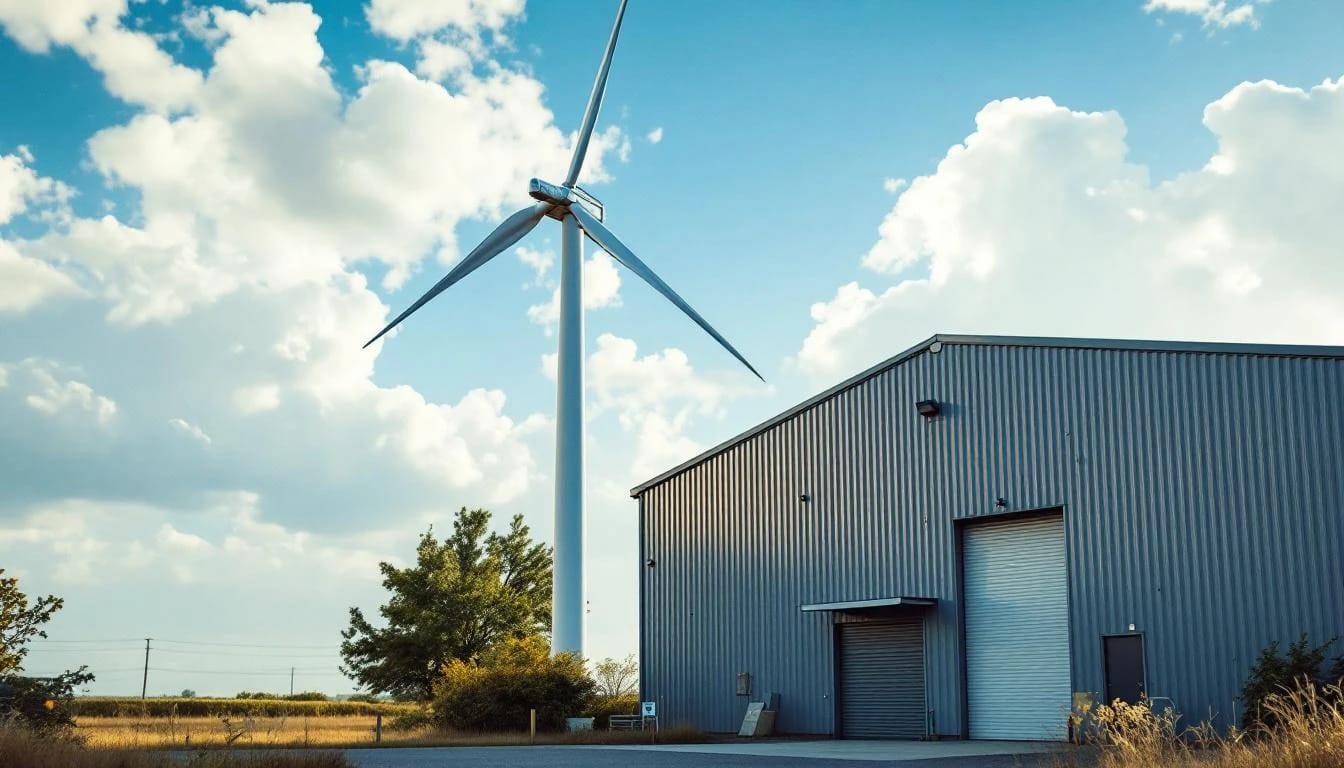
A 10 kW wind turbine system for home use typically costs between $40,000 and $65,000 fully installed in 2026, translating to roughly $4,000–$6,500 per kilowatt. That range includes the turbine, tower, inverter, wiring, foundation work, permits, and professional installation. After applying the federal 30% Residential Clean Energy Credit (IRC §25D), net out-of-pocket expense drops to $28,000–$45,500. The wide span reflects tower height choice (80-foot monopole versus 120-foot guyed lattice), soil conditions, local permit fees, and whether the site requires road improvements or crane access.
Why a 10 kW turbine suits many homeowners
Ten kilowatts sits in the sweet spot for rural and suburban properties with half an acre or more and moderate-to-good wind resources. The National Renewable Energy Laboratory's Distributed Wind Energy Futures Study identifies 10 kW as the most popular capacity for residential-scale projects, generating 10,000–30,000 kWh annually depending on average wind speed. A home using 900 kWh per month (10,800 kWh per year) can cover most or all consumption at a site with a Class 3 wind resource (6.5–7.5 m/s at turbine hub height). Larger systems typically trigger different permitting paths and lose eligibility for simplified interconnection agreements, making 10 kW an administrative as well as economic threshold.
Bergey WindPower's Excel 10 and Primus Wind Power's AIR X Marine (derated for land use) dominate the North American 10 kW segment, with Aeolos and Pikasola imports gaining traction. Each manufacturer publishes power curves certified to IEC 61400-2 or the newer AWEA 9.1 Small Wind Turbine Performance and Safety Standard, a critical benchmark for installer confidence and utility interconnection approval.
Turbine hardware and inverter: $22,000–$38,000
The turbine nacelle, blades, and tail or yaw mechanism account for $18,000–$28,000 of upfront cost. Bergey's Excel 10, a three-blade upwind design with a 23-foot rotor diameter, carries a manufacturer-specified price near $26,000 before dealer markup. Aeolos-H 10 kW models list around $19,500 FOB China, but freight, import duty (2.5% under HTS 8502.31), and domestic handling push landed cost to $23,000–$24,500. Vertical-axis turbines in the 10 kW nameplate category—such as Pikasola's helical Savonius—often underperform rated capacity in real-world conditions yet command similar sticker prices because of niche manufacturing volumes.
Grid-tied inverters add $3,000–$6,000. A modern string inverter with MPPT (maximum power point tracking) rated for 10 kW AC output must also comply with IEEE 1547-2018 interconnection requirements and include anti-islanding protection. SMA Windy Boy and ABB PVS-10 models are common choices; both carry UL 1741 certification and built-in data-logging for monitoring via smartphone app. Off-grid or hybrid setups require a battery bank, charge controller, and larger inverter, pushing the inverter-plus-storage budget to $12,000–$18,000 and placing the system outside typical residential-scale economics.
![INLINE: Close-up of a 10 kW turbine nacelle on a workshop floor, showing three-blade hub assembly and tail fin mechanism]
Tower and foundation: $12,000–$20,000
Tower selection drives more cost variability than any other component. An 80-foot tilt-up monopole—popular for ease of maintenance—runs $8,000–$11,000, while a 100-foot guyed lattice tower spans $10,000–$14,000. Heights below 80 feet rarely capture enough laminar flow to justify a 10 kW turbine; the wind-shear exponent means an extra 20 feet of elevation can boost annual energy by 15–25 percent in typical terrain.
Foundation work depends on soil bearing capacity and tower type. A monopole requires a reinforced-concrete pier 4–6 feet deep and 4 feet in diameter, involving 8–12 cubic yards of concrete, rebar cage fabrication, and often a geotechnical survey ($800–$1,500). Budget $3,000–$5,000 for materials and excavation. Guyed towers distribute load across four anchor points, each needing a 3×3-foot pad 3–4 feet deep; total concrete is less, but layout and tensioning labor offset some savings. Rocky or high-water-table sites can double foundation expense when drilling or blasting is required.
Crane rental for monopole erection averages $1,200–$2,400 for a half-day, assuming the site is accessible by a rough-terrain crane with 100-foot boom. Gin-pole or tilt-up methods eliminate crane costs but demand a skilled crew and favorable working radius.
Installation labor and electrical: $6,000–$12,000
Licensed electricians charge $75–$125 per hour in most U.S. markets; a 10 kW wind system install takes 30–50 labor hours spread over foundation pour, tower erection, turbine mounting, inverter wiring, and final inspection. Total labor cost lands between $4,000 and $8,000. NEC Article 705 mandates dedicated disconnects, proper grounding per Article 250, overcurrent protection, and clearly labeled emergency shutoff accessible from ground level. Copper conductors sized for turbine output and run length—often 2 AWG or larger for a 200-foot trench—add $800–$2,000 in wire and conduit.
Utility interconnection requires a bidirectional meter and often a production meter; some cooperatives provide these at no charge, while investor-owned utilities may bill $500–$1,200 for meter swap and inspection. States with net-metering caps or standby charges (looking at you, Alabama and Tennessee) can erode project economics, so confirm local policy via the Database of State Incentives for Renewables & Efficiency before committing funds.
Permitting, FAA review, and zoning: $1,500–$4,000
Building permits for wind turbines run $400–$1,200 depending on jurisdiction. Rural counties in Montana, Wyoming, and the Dakotas typically charge flat fees; suburban townships near metro areas may levy permits as a percentage of declared project value, pushing costs higher. Zoning variance applications for height or setback relief add $500–$2,500 and extend timelines by two to six months if neighbors lodge objections.
FAA Part 77 notification is mandatory for any structure exceeding 200 feet AGL or within glide slopes of airports. A 10 kW tower at 100 feet rarely triggers airspace concerns outside of metropolitan approach paths, but filing Form 7460-1 is free and takes ten business days for determination. Marking or lighting requirements—if imposed—cost $600–$1,800 per tower. The National Renewable Energy Laboratory's WindWatts tool includes siting constraints overlays that flag FAA, military training routes, and migratory bird corridors.
Federal tax credit and state incentives
The IRC §25D Residential Clean Energy Credit offers 30 percent of qualified expenditures through December 31, 2032, then steps down to 26 percent in 2033 and 22 percent in 2034. Qualified costs include turbine, tower, inverter, installation labor, permits, and interconnection fees but exclude energy storage unless the battery is charged exclusively by the turbine—a tough standard to prove with grid-tied systems. Claim the credit on IRS Form 5695 and carry forward unused portions if tax liability is insufficient in the installation year.
State-level incentives vary dramatically. Montana's Alternative Energy Investment Tax Credit adds 35 percent of costs up to a $500 credit cap—not particularly generous. Oregon offers a residential energy-tax credit covering 25 percent of eligible costs (capped at $6,000). Massachusetts, New York, and California previously ran rebate programs for small wind but defunded them between 2019 and 2022 as solar reached grid parity and administrative overhead for wind verification proved costly. Always consult the DSIRE database for current programs; some rural electric cooperatives provide per-kWh production incentives separate from state policy.
Comparison: 10 kW wind versus 10 kW solar
| Factor | 10 kW Wind | 10 kW Solar |
|---|---|---|
| Installed cost | $40,000–$65,000 | $25,000–$32,000 |
| Annual output (good resource) | 15,000–30,000 kWh | 12,000–16,000 kWh |
| Footprint | 0.25–0.5 acre clearance | 600–700 sq ft roof or ground |
| Maintenance (annual) | $300–$800 | $100–$200 |
| Lifespan | 20–25 years | 25–30 years |
| Permits/zoning complexity | High | Low to moderate |
Wind shines when the site has consistent Class 3 or better wind and low solar insolation (Pacific Northwest, northern Great Plains). Solar wins on simplicity, lower upfront cost, and fewer moving parts. A hybrid approach—6 kW solar plus a 5 kW wind turbine—can smooth seasonal gaps if budget allows, though interconnection and inverter coordination add complexity.
Ongoing maintenance and insurance
Budget $300–$800 per year for routine upkeep. Bergey recommends annual inspections covering guy-wire tension (if applicable), bolt torque, blade leading-edge condition, and yaw-bearing grease. Bearing replacement at year 10–12 costs $1,200–$2,000 including labor. Blade resurfacing or replacement after storm damage runs $800–$1,500 per blade. Gearbox-equipped turbines require oil changes; direct-drive permanent-magnet designs (Bergey Excel, Primus AirX) eliminate that task but may need magnet re-magnetization after 15–20 years, a $2,500–$4,000 service.
Homeowners insurance often excludes wind turbines or caps coverage at $10,000. Standalone turbine policies from specialist carriers cost $400–$900 annually for $50,000 in property coverage plus $1 million liability. Confirm that lightning-strike damage—common in the Great Plains—is included; some carriers carve it out or apply separate deductibles.
Site assessment: don't skip this step
Professional wind-resource evaluation costs $800–$2,500 and involves deploying an anemometer at proposed hub height for at least three months (twelve preferred). The data feeds into software like WindPRO or NREL's System Advisor Model (SAM) to estimate annual kWh output and financial return. Guessing wind speed from airport weather stations or online maps courts disappointment; local topography—ridges, tree lines, buildings—creates microclimates that shift averages by 1–2 m/s, enough to halve turbine productivity.
NREL's WindWatts tool overlays mesoscale wind-speed data at 100-meter resolution, but even that requires ground-truthing. The Competitiveness Improvement Project funded by the Department of Energy has improved modeling tools, yet on-site measurement remains the gold standard. A site with 5.5 m/s average at 100 feet will generate roughly 40 percent less energy than a 6.5 m/s site—a difference that stretches payback from 12 years to 21 years.
Real-world cost examples
A North Dakota wheat farmer installed a Bergey Excel 10 on a 100-foot tilt-up tower in early 2025: $48,200 all-in, including $4,800 for road grading to accommodate the crane. After the 30 percent federal credit, net cost settled at $33,740. The system generates 24,000 kWh annually in a Class 4 wind regime (7.2 m/s average), offsetting a $2,880 annual electric bill at $0.12 per kWh. Simple payback: 11.7 years, with a 25-year net present value of roughly $38,000 assuming 2.5 percent annual utility inflation.
A Vermont homeowner pursued an Aeolos-H 10 kW on an 80-foot monopole in 2024: $41,500 total. The site's Class 2 wind (5.8 m/s) delivered only 13,500 kWh the first year, covering 62 percent of household demand. After the federal credit ($12,450), net cost was $29,050. At $0.19 per kWh avoided cost, annual savings hit $2,565, yielding an 11.3-year payback—acceptable but not exceptional. The owner later added 4 kW of rooftop solar to fill summer doldrums when tree foliage blocks low-elevation wind.
A Texas rancher attempted a no-name Chinese 10 kW turbine purchased online for $16,000 plus $8,000 DIY tower fabrication. The turbine failed within eight months (blade delamination, controller burnout), and the manufacturer disappeared from Alibaba. Total loss: $24,000. The cautionary tale underscores the value of buying from established brands with U.S. service networks and IEC 61400-2 certification—documentation required by most utilities for interconnection approval and by the IRS for tax-credit eligibility.
Choosing between horizontal-axis and vertical-axis designs
Horizontal-axis wind turbines (HAWTs) dominate residential installations because they extract energy more efficiently across a wider wind-speed range. Bergey, Primus, and Aeolos all manufacture three-blade upwind HAWTs; rotor efficiency peaks at 35–42 percent of theoretical Betz limit. Vertical-axis wind turbines (VAWTs)—Savonius, Darrieus, helical—promise quieter operation and omnidirectional capture, but real-world capacity factors lag HAWTs by 30–50 percent. A VAWT rated at 10 kW often produces energy equivalent to a 5–6 kW HAWT in the same wind regime.
VAWTs appeal to urban and suburban settings where zoning limits height and neighbors worry about noise. Blade-tip speed on a HAWT reaches 150–180 mph, generating a rhythmic whoosh audible 300 feet away; VAWTs spin slower and muffle sound. Still, the efficiency penalty means longer payback and reduced return on investment. Unless aesthetic or zoning constraints force the choice, HAWTs deliver better economics.
Grid-tied versus off-grid configurations
Grid-tied systems—responsible for 90 percent of residential wind installations—feed surplus power to the utility under net-metering agreements and draw from the grid when the turbine idles. This setup requires no battery bank, simplifies equipment, and qualifies for the full 30 percent federal credit. When state net-metering policies are favorable (one-to-one retail credit, no monthly minimums), grid-tied configurations maximize financial return.
Off-grid systems pair the turbine with lithium or lead-acid battery banks (20–40 kWh typical), a hybrid inverter, and often a propane or diesel genset for extended calm periods. Total system cost climbs to $60,000–$95,000, and battery replacement every 8–12 years adds $6,000–$12,000 to lifecycle expense. Off-grid makes sense in locations where utility line extension exceeds $25,000 per mile or where owners prioritize energy independence over cost optimization. A 10 kW turbine rarely suffices alone for off-grid; most successful systems combine 5 kW wind, 8 kW solar, and 30 kWh storage.
Financing options and payback timelines
Cash purchase remains most common, but PACE (Property Assessed Clean Energy) loans and home-equity lines of credit spread payments over 10–20 years. PACE financing attaches the debt to property taxes; interest rates run 6–8 percent, and the obligation transfers to the next owner if the home sells. Some states (California, Florida, Missouri) offer PACE for wind; others restrict programs to solar and efficiency retrofits.
Manufacturer financing is rare; Bergey discontinued its lease program in 2021. Third-party solar lenders generally won't touch wind projects because residual-value models and default-recovery mechanisms haven't matured. Expect to self-finance or work with a local credit union familiar with rural energy projects.
Payback period spans 9–18 years depending on wind resource, electricity rate, and incentive stack. Sites with Class 4 wind and $0.16+ per kWh utility rates hit breakeven around year 10; Class 2 sites with $0.11 per kWh power stretch payback past 16 years, often exceeding the point where major component replacement erodes returns. Run conservative projections using NREL's SAM tool before signing contracts, and discount overly optimistic installer promises by 20 percent.
How much can a 10 kW wind turbine save on electricity bills annually?
A 10 kW turbine in a Class 3 wind site (average 6.5 m/s at hub height) generates 15,000–20,000 kWh per year. At a national average residential rate of $0.14 per kWh, that translates to $2,100–$2,800 in annual avoided cost. Higher wind resources or premium utility rates—common in Hawaii, Alaska, and the Northeast—can push savings past $4,000. Actual savings depend on net-metering policy; utilities imposing standby charges or crediting excess generation at wholesale rates ($0.03–$0.05 per kWh) slash returns by 30–60 percent.
Do 10 kW wind turbines require FAA approval?
Structures under 200 feet above ground level generally do not require FAA obstruction lighting or marking unless they sit within airport approach zones, near heliports, or along designated military training routes. A 100-foot tower clears the 200-foot threshold, but filing Form 7460-1 (Notice of Proposed Construction or Alteration) is free and recommended. The FAA typically issues a Determination of No Hazard within ten days. Skipping notification risks a stop-work order if a neighbor complains or if the installation falls within a newly designated flight path.
Can I install a 10 kW wind turbine myself?
DIY installation is legal in most jurisdictions but inadvisable unless you hold contractor and electrical licenses. NEC Article 705 requires a licensed electrician for all grid-interconnection work, and tower erection demands rigging expertise, crane operation, or practiced gin-pole technique. Insurance and utility interconnection approvals hinge on professional installation documentation. A self-installed system may void manufacturer warranties and disqualify the project from the federal tax credit if the IRS audits and finds non-compliant electrical work. Budget $8,000–$15,000 for professional installation; the peace of mind and code compliance justify the expense.
What maintenance does a 10 kW wind turbine need?
Annual inspections should cover guy-wire tension (torque to manufacturer spec), blade leading-edge for erosion or cracks, nacelle mounting bolts, yaw bearing grease, and inverter error logs. Blade surfaces may need cleaning or minor gelcoat repair every two to three years in dusty or coastal environments. Bearing replacement at year 10–12 is the largest scheduled expense ($1,200–$2,000). Lightning arrestors and grounding connections require testing after electrical storms. Direct-drive turbines skip gearbox oil changes, simplifying upkeep. Total annual cost averages $300–$800 if no major failures occur; budget an additional $1,500–$3,000 reserve for unscheduled repairs over the turbine's 20-year lifespan.
Which states offer the best incentives for home wind turbines?
Montana, Oregon, and Vermont historically provided state tax credits or rebates, though many programs have sunset or shifted focus to solar. The federal 30 percent Residential Clean Energy Credit (IRC §25D) applies nationwide and represents the single largest incentive. Some rural electric cooperatives—particularly in Iowa, Minnesota, and the Dakotas—offer production incentives of $0.01–$0.03 per kWh for the first five to ten years. California, Massachusetts, and New York phased out small-wind rebates between 2019 and 2022. Check the DSIRE database for current programs; incentive landscapes change with state legislative sessions and utility commission rulings.
Bottom line
A 10 kW home wind turbine delivers compelling economics at sites with consistent Class 3 or better wind, costing $40,000–$65,000 installed before the 30 percent federal tax credit. Payback hinges on wind resource accuracy, local electricity rates, and net-metering policy—run a professional site assessment and conservative financial model before committing capital. NEC-compliant installation by licensed professionals is non-negotiable for safety, warranty protection, and tax-credit eligibility. Ready to move forward? Request quotes from three certified installers, verify turbine IEC 61400-2 certification, and confirm your utility's interconnection timeline to avoid surprise delays.
Share this article
windturbinehome.com/s/480381
Editorial note: This article was researched and written by a member of the Wind Turbine Home editorial team. AI-assisted tools were used for spell-checking and light grammar review only — all research, analysis, and conclusions are our own. Our editorial policy prohibits sponsored content and paid placements. Read our editorial policy →
Related reading
small industrial wind
Farm-Scale Wind Turbines 10kW-50kW: Which Size Fits Your Operation
Choosing between 10kW, 25kW, or 50kW farm wind turbines depends on daily electrical demand, available land, and whether you net-meter or store power.
small industrial wind
Wind Energy for Warehouses and Light Industrial Sites
Commercial wind turbines for warehouses and light industrial facilities can offset 15-60% of electric costs. Site selection, zoning, and grid-tie economics determine ROI.
small industrial wind
Wind Turbine for Water Pumping: Modern Takes on a Century-Old Idea
Modern wind-powered water pumping marries century-old mechanical principles with solar-hybrid systems, battery banks, and smart controllers for off-grid livestock, irrigation, and rural domestic supply.
small industrial wind
Wind Turbine for a Greenhouse: Powering Fans, Vents, and Lights
Wind turbines rated 1-5 kW can power greenhouse ventilation, lighting, and controls. Grid-tie or battery systems store excess energy while direct DC connections minimize conversion losses.