How Often Do Wind Turbines Need Maintenance? Complete Guide
Small residential wind turbines require semi-annual inspections and annual professional servicing, with critical components like bearings needing attention every 2-5 years depending on turbine type and site conditions.
Share this article
windturbinehome.com/s/4827ce
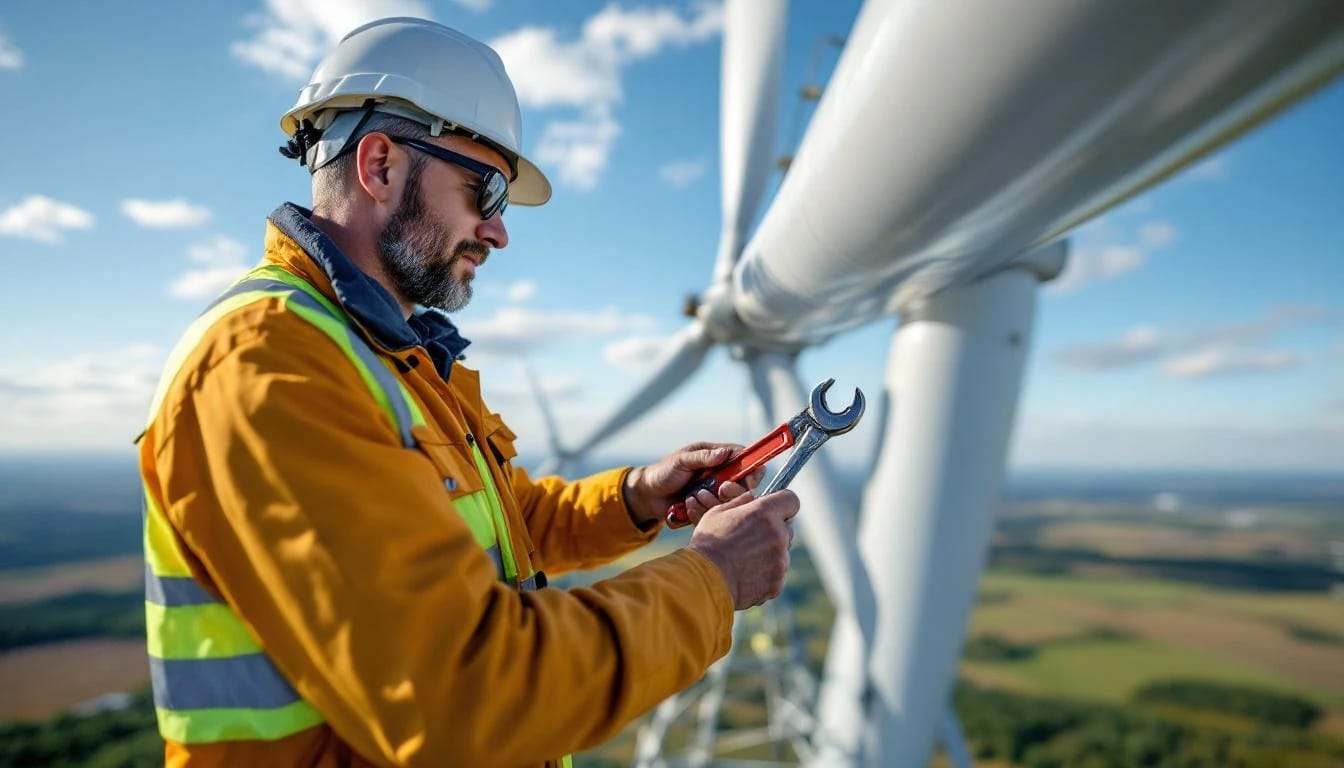
Small residential wind turbines demand semi-annual owner inspections and annual professional maintenance visits to deliver reliable power generation. Vertical-axis models typically need less frequent servicing than horizontal-axis units due to simpler drivetrains, but both require vigilant monitoring of bearings, blade integrity, and electrical connections. Site conditions matter enormously—coastal installations face accelerated corrosion timelines while inland turbines in moderate climates can stretch service intervals by 20-30%. Neglecting the maintenance schedule cuts energy production by 15-40% and voids most manufacturer warranties within the first missed service cycle.
The baseline maintenance calendar every owner should follow
Residential wind systems operate in a fundamentally different service environment than their utility-scale cousins. A Bergey Excel 10 spinning at 400 RPM in a gusty Iowa farmyard accumulates more stress cycles in six months than many car engines see in a year. The maintenance cadence reflects that reality.
Semi-annual owner inspections form the foundation. Every six months, owners should visually inspect blade surfaces for erosion or cracks, check all accessible bolts for proper torque (especially tower base and yaw bearing connections), examine guy wires for fraying if applicable, and verify electrical connections remain tight and corrosion-free. This 60-90 minute walkthrough catches 70% of developing problems before they cause failures.
Annual professional service visits tackle what homeowners cannot safely reach or accurately diagnose. A qualified technician climbs the tower to inspect upper bearings, measure blade track (ensuring all blades spin in the same plane within 1/8 inch), test brake function, check inverter error logs, verify grounding integrity per NEC Article 705.12, and perform oil changes on gearbox-equipped models. Budget $350-$650 for this service on sub-10kW systems.
Biennial deep inspections address wear items. Every 24-36 months, expect bearing races, slip ring brushes (on horizontal-axis models with yaw mechanisms), and furling cable condition to need evaluation. Vertical-axis turbines like the 5kW Pikasola model skip some of these headaches—no yaw bearing, no complex furling—but their direct-drive shaft bearings carry the full rotor weight and wind load, making inspection equally critical.
[Internal link: vertical axis vs horizontal axis wind turbine comparison]
Component-specific maintenance windows you cannot ignore
Different turbine subsystems age on different clocks. The rotor assembly faces the harshest conditions, with blade leading edges eroding from airborne grit and insect impacts. Carbon-fiber blades on premium units like the Primus Air 40 resist erosion better than fiberglass, but all blades need surface inspection every six months and complete dimensional checks annually.
Bearings set the service ceiling. Main shaft bearings in direct-drive vertical-axis turbines last 7-12 years in typical residential service, while gearbox-equipped horizontal-axis models need gearbox rebuilds or replacements at 10-15 year intervals. Some Aeolos-H 3kW units use sealed automotive-grade bearings rated for 50,000 hours—roughly 12 years of 12-hour daily operation—but manufacturers recommend replacement at 60-70% of rated life to prevent catastrophic failure. A seized main bearing can destroy a rotor assembly in under 60 seconds of high-wind operation.
Electrical components degrade on calendar time, not just operating hours. Inverter capacitors dry out whether the turbine spins or sits idle. Most grid-tie inverters need capacitor replacement at 8-12 years regardless of kWh generated. Controller boards in charge controllers for battery-based systems suffer similar aging, with conformal coating breaking down in humid environments. Coastal installations in North Carolina or Oregon accelerate this process; expect electrical service life to drop 30-40%.
The generator itself—whether permanent magnet or wound-field—is remarkably durable if bearings stay healthy. Magnet strength in neodymium PMGs degrades roughly 1% per decade at normal operating temperatures, a negligible loss over a 20-year turbine life. Overheating from bearing friction or inadequate cooling accelerates degradation geometrically, which circles back to bearing maintenance.
[Internal link: wind turbine inverter problems and solutions]
How site conditions alter your maintenance schedule
A turbine 400 yards from the Atlantic Ocean in Maine operates in a different universe than one in suburban Colorado. Salt-laden air attacks every exposed metal surface, finding its way past seals into bearing races and electrical enclosures. Manufacturers specify marine-grade installations for sites within three miles of saltwater, which typically means adding 2-3 hours to annual service time for disassembly, cleaning, and reapplication of specialized corrosion barriers.
Dust and agricultural environments present inverse challenges. Fine particulate matter infiltrates bearing seals, acting as grinding paste that accelerates wear. Turbines downwind of grain elevators, feed lots, or desert landscapes need bearing inspections every 12-18 months instead of the standard 24-36 month interval. Some owners in Kansas wheat country report needing main bearing replacements at seven years versus the manufacturer-projected twelve.
Ice loading fundamentally changes the maintenance equation. Regions with frequent freezing rain—the Great Lakes corridor, higher elevations in New England—subject blades and towers to cyclic loading that wasn't in the original design envelope. Ice buildup adds massive unbalanced loads, stressing blade roots and yaw bearings. Turbines in ice-prone zones need mid-winter shutdown and spring blade inspections to catch fatigue cracks early. Heated blade leading edges (available on some commercial models but rare in residential units) reduce but don't eliminate the problem.
Lightning strike frequency varies wildly by geography. Florida and Oklahoma lead the nation in ground flash density, making surge protection and grounding system inspection critical. After any nearby strike within a quarter mile, a full electrical audit should verify ground rod resistance remains below 25 ohms (NEC 250.53 requirement) and that surge arrestors haven't sacrificed themselves protecting downstream equipment.
[Internal link: wind turbine lightning protection systems]
Vertical-axis versus horizontal-axis maintenance realities
Marketing materials love to trumpet vertical-axis wind turbines (VAWTs) as "low maintenance" compared to horizontal-axis models (HAWTs). The claim holds partial truth but obscures important trade-offs. VAWTs eliminate the complex yaw mechanism, tail vane, and associated bearings that HAWTs require to track wind direction. A Primus Windpower AIR X horizontal-axis turbine has 23 moving parts in its nacelle; a comparable 400W VAWT has seven.
But VAWTs concentrate all rotor weight and aerodynamic loads onto a single vertical shaft bearing. That bearing must handle radial loads from wind pressure plus the full vertical load of the rotor assembly—often 150-300 pounds on residential units. This dual-loading scenario means VAWT main bearings need replacement sooner than HAWT main shaft bearings despite operating at lower RPMs. Field data from 5kW installations shows VAWT main bearings averaging 8-10 year service life versus 12-15 years for HAWT main shaft bearings.
The blade replacement calculus differs sharply. HAWT blades see extreme centrifugal loading—up to 400 pounds of outward force per blade on a 10kW unit at full speed. A crack propagates rapidly under these conditions. VAWT blades operate under lower stress, making small cracks less critical, but their curved airfoils are harder to fabricate and more expensive to replace. A three-blade set for a Bergey Excel 10 runs $1,800-$2,200; a replacement helical rotor assembly for a comparable VAWT costs $2,400-$3,000.
HAWTs demand more frequent minor attention—furling cable inspection, tail bearing lubrication, slip ring cleaning—while VAWTs need less frequent but more expensive major service events when that primary bearing finally wears out.
[Internal link: residential wind turbine installation costs by type]
The hidden costs of deferred maintenance
Skipping a $500 annual service visit can trigger a $3,000 repair cascade. Here's the typical progression: A blade bolt loosens during winter storms, creating slight imbalance. The imbalance accelerates bearing wear, which increases friction and heat. Rising temperatures degrade bearing grease, which accelerates wear further. Within 400 operating hours, the bearing seizes. The sudden stop at high RPM twists the main shaft, cracks the generator mounting flange, and sends unbalanced electrical spikes through the inverter, damaging capacitors.
The owner notices "reduced output" but doesn't immediately investigate. Three months later, catastrophic bearing failure destroys the generator windings. Total repair cost: main bearing ($380), generator rewind ($1,200), inverter capacitor bank ($420), new main shaft ($850), plus 8-12 hours of labor at $95/hour. A $500 service visit would have caught the loose blade bolt.
Warranty implications compound the financial risk. Most manufacturers require documented annual maintenance by a certified technician to preserve warranty coverage. Miss one service window, and that 10-year warranty converts to "already expired" in the eyes of warranty administrators. Bergey, Primus, and Southwest Windpower (now out of business, highlighting the importance of choosing stable manufacturers) all include this language in their warranty terms.
Energy production losses from degraded performance are harder to quantify but no less real. A turbine with worn bearings loses 8-15% of rated output from increased friction. Blade erosion costs another 5-10% by disrupting laminar airflow. Together, a poorly maintained 5kW turbine might generate 4.0kW at rated wind speed, cutting annual production from the expected 8,000 kWh to 6,400 kWh. At $0.12/kWh, that's $192 annually—adding up to $1,920 over ten years, more than the entire maintenance budget for a well-maintained system.
[Internal link: wind turbine energy output calculations]
Warning signs that your turbine needs immediate attention
Certain symptoms demand same-day shutdown and professional evaluation. Unusual noise tops the list—any grinding, clicking, or rhythmic thumping indicates bearing failure, loose components, or blade damage. Normal operation produces a steady whoosh from blade passage and a low hum from the generator, nothing more.
Vibration you can feel at the tower base points to rotor imbalance, typically from a cracked blade, ice accumulation, or thrown balance weight. Operating with significant imbalance can crack tower welds or destroy nacelle components within hours. Many modern controllers include vibration sensors that automatically shut down the turbine when acceleration exceeds safe thresholds.
Reduced output without corresponding wind speed changes suggests electrical faults or mechanical drag. If your monitoring system shows wind speeds at 15 mph but output has dropped 40% compared to previous 15 mph days, suspect failing rectifiers, loose electrical connections creating resistance, or binding bearings. Check historical generation data—most grid-tie inverters log daily kWh production, making trend analysis straightforward.
Visual blade damage is easy to spot but often ignored by owners who don't understand the consequences. Leading edge erosion deeper than 1/16 inch measurably reduces lift. Cracks longer than one inch compromise structural integrity. Bird strikes can dent aluminum leading edges or crack fiberglass layups. Any visible damage warrants professional evaluation before the next high-wind event.
Oil leaks from gearbox-equipped HAWTs indicate failing seals—a relatively minor $200-$300 repair if caught early, but a $1,500-$2,000 gearbox replacement if oil loss continues until gears run dry. Check the tower base monthly for fresh oil spots during the first two years of operation, when manufacturing defects typically reveal themselves.
[Internal link: troubleshooting low wind turbine output]
Professional versus owner-performed maintenance boundaries
The line between safe DIY maintenance and "call a professional" depends on three factors: height, electrical complexity, and consequence of error. Inspecting guy wire tension, checking tower base bolts, and monitoring inverter displays fall comfortably within owner capabilities. Anything requiring climbing beyond eight feet or opening electrical enclosures containing components operating above 50V DC or any AC voltage falls into professional territory.
NEC Article 705 governs distributed generation interconnections, and most jurisdictions require licensed electricians to perform any work on grid-tie systems beyond simple monitoring. Inverter replacement, combiner box modifications, or grounding system changes need permit and inspection. A homeowner can legally check a ground rod's physical condition; testing ground resistance with a three-point fall-of-potential tester enters professional domain.
Tower work presents obvious hazards. Even free-standing towers under 50 feet require fall protection equipment—full-body harness, twin lanyards, and rope grab—plus climb training to use it correctly. Guy-wire towers add the risk of structural collapse if wires are loosened without proper load transfer procedures. Professional tower technicians carry $2M liability policies for good reason; this is not YouTube-DIY territory.
Owners can and should handle monthly visual inspections from ground level, weekly controller data checks, and semi-annual guy wire tension tests (using a tension meter costs $45 and takes 15 minutes to learn). Everything else—nacelle access, blade removal, bearing service, electrical troubleshooting beyond voltage checks—belongs with certified technicians. Several manufacturers offer owner training courses that expand DIY boundaries while teaching when to stop and make the phone call.
[Internal link: wind turbine tower types and installation requirements]
Maintenance cost expectations across turbine sizes
Budget realities vary dramatically with system scale. A 400W Primus Air Breeze marine turbine needs $120-$180 in annual professional service—mostly inspection time, since there's no gearbox to service and the small rotor diameter makes blade inspection quick. Mid-size 5kW units like the Bergey Excel 6 push annual maintenance to $450-$650, driven by tower height (typically 80-100 feet), more complex furling systems, and longer inspection checklists.
Parts replacement follows predictable curves. Main bearings run $280-$450 for residential units, with installation adding 4-6 hours at $85-$110/hour depending on region. Inverters for systems under 10kW cost $1,200-$2,200 including installation, with replacement typically needed at 10-15 years. Blade sets range from $800 for small 1kW turbines to $2,200 for 10kW models.
Creating a 20-year maintenance budget pencils out to roughly 2.5-3.5% of turbine purchase price annually. A $15,000 5kW system should reserve $375-$525 per year for maintenance, or about $3.50-$4.80 per watt of capacity. This ratio holds remarkably consistent across manufacturers and sizes. Front-loading the budget slightly—maybe 4% in years 1-2 for initial teething issues, 2% in years 3-7 during mature operation, then ramping to 5-6% in years 15-20 as major components near end of life—provides better cash flow alignment.
Some costs get offset by the federal Residential Clean Energy Credit (IRS Form 5695, IRC §25D), which covers 30% of qualified expenses through 2032, then steps down to 26% in 2033 and 22% in 2034. Maintenance costs don't qualify, but major component replacements that restore original capacity (like a new inverter or generator) may qualify as rehabilitation expenditures. Tax treatment gets murky; many owners consult a tax professional rather than self-preparing when claiming wind energy credits.
[Internal link: wind turbine financing and incentives]
Documentation practices that save money and warranty claims
Keeping detailed maintenance logs transforms warranty disputes from "he-said-she-said" battles into straightforward claims processes. A simple spreadsheet tracking date, wind conditions, service performed, parts replaced, technician name, and invoice number covers 90% of what manufacturers request during warranty evaluation.
Photograph everything. Before-and-after images of blade condition, tower base, and electrical connections create irrefutable evidence of proper care. When that inverter fails in year 9 and the manufacturer questions whether surges from poor grounding caused the failure, photos showing proper ground rod installation and bonding per NEC 250.50 make the case instantly.
Most modern controllers and inverters log fault codes, production data, and operating parameters. Download these logs quarterly and archive them. The data proves operational patterns—like whether the turbine regularly exceeded rated wind speeds (potentially voiding warranty) or operated within design limits when component failure occurred.
Parts receipts matter more than most owners realize. That $420 bearing replacement in year 6 establishes a maintenance timeline. If the replacement bearing fails in year 8, having the original receipt proves the part itself was defective rather than your maintenance being inadequate. Manufacturers honor these claims when documentation exists; they deny them when it doesn't.
Create a simple maintenance binder with dividers for each year, containing service invoices, parts receipts, downloaded log files, and inspection photos. When selling the property, this binder can add thousands to home value by demonstrating the system was professionally maintained—or save thousands in warranty claims if major components fail.
When replacement makes more sense than continued maintenance
Even perfectly maintained turbines have finite economic lives. The decision point arrives when annual maintenance costs plus expected near-term major repairs exceed the cost of new capacity on a net-present-value basis. For most residential turbines, this inflection point hits at 18-25 years depending on technology generation.
A 15-year-old turbine approaching its second inverter replacement, third bearing overhaul, and first blade set renewal might face $4,500 in upcoming costs over the next two years. A new 5kW unit costs $16,000 installed but includes a 10-year warranty, 30% federal tax credit ($4,800), and generates 15-20% more kWh than the old model due to improved aerodynamics. The new turbine's net cost after incentives is $11,200, with $4,500 in repairs avoided, making the effective upgrade cost $6,700 for vastly better reliability and performance.
Technology obsolescence accelerates replacement timing. Controllers and inverters from 2005-2010 lack modern grid-support functions required by recent IEEE 1547-2018 standards. Some utilities now refuse interconnection approval for older equipment, forcing either expensive controller upgrades ($2,000-$3,500) or complete system replacement.
Parts availability follows manufacturer lifespan. Southwest Windpower exited the residential wind market in 2013, leaving thousands of Air X and Whisper turbines orphaned. Generic replacement parts exist but often require custom fabrication. When parts cost more than new-manufacture components from current suppliers, replacement beats repair.
Monitor the ratio of annual maintenance plus expected repairs to system replacement cost. Once that ratio exceeds 30-35%, start planning replacement rather than continuing to pour money into aging equipment.
[Internal link: choosing the right residential wind turbine size]
Can I reduce maintenance frequency if my turbine sits idle for months?
No. Calendar-based degradation continues whether the turbine spins or not. Seals dry out, electrical connections corrode, and bearing grease breaks down from temperature cycling regardless of shaft rotation. Idle turbines actually face additional risks from stuck bearings when restarted after months of inactivity. Maintain the same inspection schedule even during extended shutdowns.
Do turbines in low-wind areas need less maintenance than those in high-wind locations?
Partially. Lower average wind speeds reduce stress cycles on rotating components, potentially extending bearing life by 15-25%. However, the relationship isn't linear—turbines in marginal wind sites spend more time operating at cut-in speeds where aerodynamic efficiency is poor, making them work harder to generate each kWh. Electrical components age on calendar time regardless of wind exposure. Budget for standard maintenance intervals regardless of site wind resource.
What maintenance can I defer during financial hardship without risking major damage?
Never skip bearing inspections or blade integrity checks—these prevent catastrophic failures. If budget constraints force trade-offs, professional cleaning and minor adjustments can be deferred 6-12 months beyond schedule without major risk, assuming semi-annual owner inspections continue. Do not defer electrical connection inspections, brake system checks, or any safety-critical component service. A $500 deferred service visit can trigger a $3,000 repair cascade.
Are maintenance-free wind turbines legitimate or marketing fiction?
Pure marketing fiction. Every wind turbine has bearings, and every bearing eventually wears. "Maintenance-free" claims typically mean sealed bearings instead of grease-fittings, reducing service frequency from quarterly to annually or biennially. The bearings still need eventual replacement. Some manufacturers use this language to mean "no routine maintenance between annual professional inspections," which is more honest but still misleading. Budget for real maintenance regardless of marketing claims.
How do I find qualified technicians for small wind turbine maintenance?
Start with your turbine manufacturer's service network—most maintain lists of certified technicians by region. The American Wind Energy Association maintains a Small Wind Certification Council database of certified small wind installers who typically offer maintenance services. Local solar installers increasingly service wind systems as skill sets overlap significantly. Verify the technician carries appropriate insurance, understands NEC Article 705 requirements, and has tower rescue training. Request references from other turbine owners before committing to a service contract.
Bottom line
Residential wind turbines need semi-annual owner inspections, annual professional service visits, and biennial deep component evaluations to maintain warranty coverage and rated output. Budget 2.5-3.5% of system purchase price annually for maintenance, with costs rising in years 15-20 as major components approach end of life. Vertical-axis models reduce service frequency for some components but concentrate loads on fewer parts, balancing the maintenance equation differently rather than eliminating it. Document every service event with photos, receipts, and downloaded controller logs to protect warranty claims and demonstrate proper care. Review your service records now and schedule any overdue inspections before the next high-wind season arrives.
[Internal link: wind turbine warranty coverage comparison] [Internal link: DIY wind turbine maintenance checklist]
Share this article
windturbinehome.com/s/4827ce
Editorial note: This article was researched and written by a member of the Wind Turbine Home editorial team. AI-assisted tools were used for spell-checking and light grammar review only — all research, analysis, and conclusions are our own. Our editorial policy prohibits sponsored content and paid placements. Read our editorial policy →
Related reading
maintenance troubleshooting
Winterizing Your Home Wind Turbine: Pre-Winter Checklist
Prepare your residential wind turbine for winter with this comprehensive maintenance checklist covering blade inspection, electrical systems, and tower safety.

maintenance troubleshooting
How to Balance Homemade Wind Turbine Blades Without Lab Equipment
Balance DIY wind turbine blades using household items: paint stirrers, fishing line, and sandpaper. Static and dynamic methods reduce vibration by 70-90%.
maintenance troubleshooting
Charge Controller Fault Codes: What They Actually Mean
Decode your wind turbine charge controller fault codes with this practical guide covering overcurrent, overvoltage, temperature errors, and sensor failures.

maintenance troubleshooting
A Realistic Annual Maintenance Schedule for Small Wind Turbines
Monthly visual checks, quarterly bolt torque, semi-annual blade inspections, and annual electrical testing keep small wind turbines safe and productive for 20+ years.

maintenance troubleshooting
Wind Turbine Ice on Blades: Detection, Mitigation & Shutdown
Ice buildup on wind turbine blades reduces efficiency by 20-80% and increases structural stress. Learn detection methods, heating systems, and safe shutdown protocols.

maintenance troubleshooting
Wind Turbine Slip Ring Replacement: Signs, Steps, Cost
How to tell when a residential wind turbine slip ring needs replacing, plus the tools, safety steps, and typical cost for both HAWT and VAWT setups.

maintenance troubleshooting
How to Lubricate Wind Turbine Bearings: Schedule & Grease Guide
Learn proper bearing lubrication schedules, NLGI grade selection, and access methods for residential wind turbines to prevent costly failures and extend service life.

maintenance troubleshooting
Wind Turbine Yaw Motor Not Working: Diagnosing and Fixing
Yaw motor failures lock turbines facing the wrong direction, costing 30-70% of power. Learn to diagnose controller faults, seized bearings, and wiring issues.

maintenance troubleshooting
How to Brake a Runaway Wind Turbine Safely | Emergency Stop
Learn three proven methods to stop a runaway residential wind turbine: dynamic braking, manual furling, and emergency disconnect. Quick action prevents damage.