Can You Use Wind and Solar Together? Hybrid System Guide 2026
Yes, wind and solar work together in hybrid systems. Combining turbines with photovoltaic arrays delivers 24/7 renewable generation and smoother grid-tie performance.
Share this article
windturbinehome.com/s/08fdea
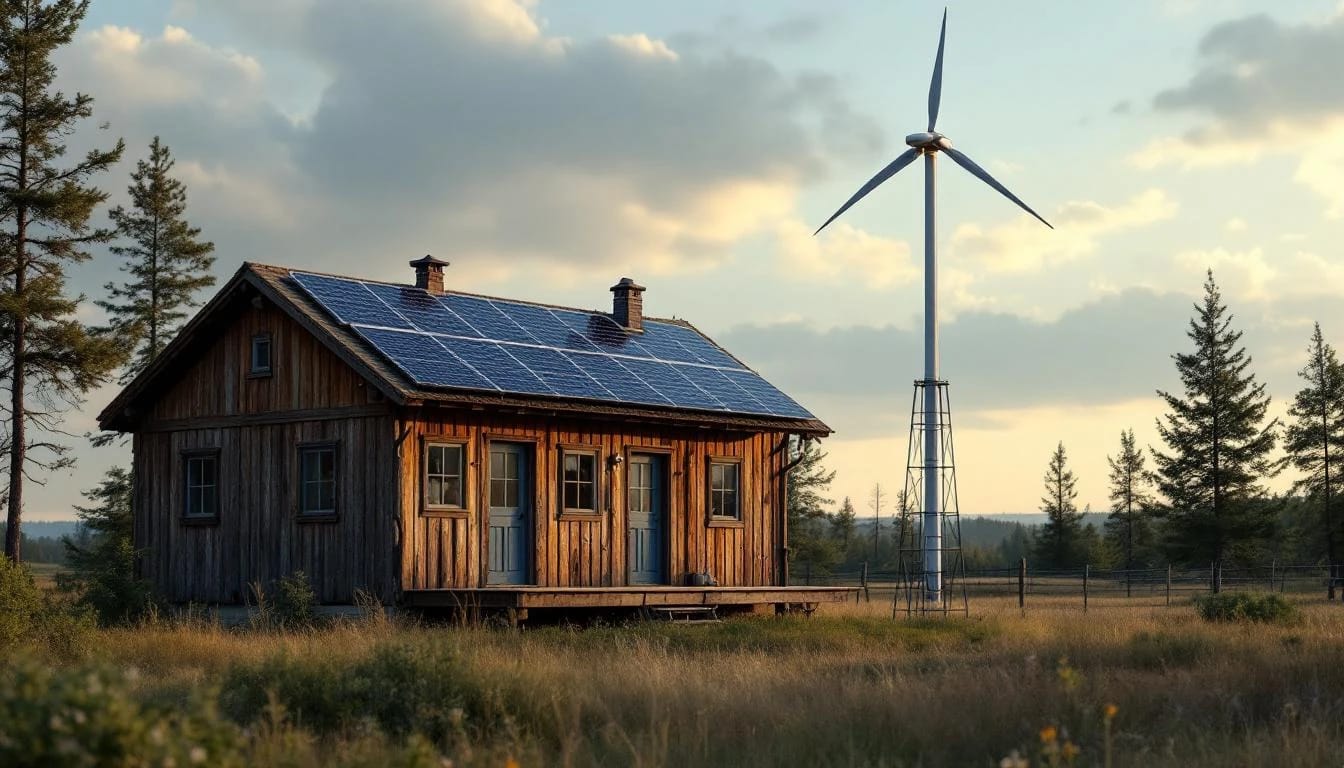
Yes, homeowners can combine wind turbines and solar panels in a single residential renewable energy system. A hybrid solar-wind installation generates electricity around the clock—solar panels produce during daylight hours while turbines capture wind at night and during overcast weather. This complementary generation pattern reduces reliance on the utility grid more effectively than either technology alone, particularly in locations with moderate-to-good wind resources and adequate sun exposure. The systems share a common battery bank and inverter infrastructure, cutting installed cost compared to separate stand-alone arrays.
Why hybrid systems outperform single-technology setups
Solar panels sit idle after sunset. Wind turbines produce nothing on calm days. A hybrid configuration fills the gaps. When clouds block the sun, afternoon breezes often pick up. When summer doldrums flatten wind speeds, long daylight hours deliver peak solar output. The Department of Energy's Small Wind Guidebook notes that wind energy is particularly effective for offsetting higher winter electricity demand when solar production falls and heating loads climb.
Hybrid systems smooth voltage and frequency variations for grid-tied installations. Instead of sharp morning solar ramps that stress inverters, blended generation creates gentler transitions. Battery charge cycles become shallower because wind can float the battery overnight rather than draining it completely before the sun returns. Shallower cycles extend lithium iron phosphate (LiFePO₄) battery life from 3,000 cycles to 5,000+ cycles at 80% depth of discharge.
The economic case strengthens when federal tax credits apply to both components. Under IRC §25D, the 30% Residential Clean Energy Credit covers qualified wind turbines and solar photovoltaic equipment installed through December 31, 2032. A $15,000 turbine plus $12,000 solar array qualifies for $8,100 in credits on IRS Form 5695, reducing net system cost to $18,900 before any state or utility incentives cataloged in the DSIRE database.
Equipment compatibility and sizing fundamentals
Most residential hybrids pair a 1–5 kW vertical-axis or horizontal-axis turbine with a 3–8 kW solar array. Bergey Excel 1 (1 kW) and Primus AIR 40 (2.4 kW) turbines integrate cleanly with 3–5 kW rooftop solar. Larger Bergey Excel 10 (10 kW) or Aeolos-H 5kW units match 6–10 kW ground-mount or carport arrays on properties with higher consumption.
The turbine and solar array feed a hybrid charge controller—either a dual-input MPPT controller or separate controllers connected to a common DC bus. Popular hybrid controllers include the Morningstar TriStar MPPT 600V (wind + solar inputs), Outback FlexMax 80 paired with a FlexNet DC hub, and Victron SmartSolar MPPT with a separate wind rectifier. Controllers regulate voltage to match the battery bank, typically 48 VDC for systems above 3 kW combined capacity.
Battery banks for hybrid systems typically range from 10–30 kWh usable capacity. A 15 kWh LiFePO₄ bank stores one day's generation for a household consuming 30 kWh/day with 50% renewable offset. Flooded lead-acid remains viable for off-grid budgets—eight Crown CR-430 6V batteries (865 Ah at 48V nominal, ~20 kWh usable) cost roughly $3,200 versus $9,000 for an equivalent SimplipHi 4 lithium bank.
Grid-tied hybrids use a multimode inverter that handles battery charging, solar MPPT, wind rectification, and utility interconnection. The Schneider XW Pro series, Sol-Ark 12K, and Outback Radian manage all functions in one enclosure. These inverters comply with IEEE 1547 and UL 1741-SA for anti-islanding and voltage ride-through, satisfying utility interconnection requirements under NEC Article 705.
Installation planning and permitting considerations
NEC Article 705 governs interconnection of multiple power sources. Section 705.12 limits the sum of all inverter breaker ratings to 120% of the service panel busbar rating. A 200-amp panel accommodates up to 240 amps total; if the main breaker supplies 200A, the hybrid inverter breaker cannot exceed 40A. Larger systems require a service upgrade or line-side tap before the main breaker.
Tower height restrictions appear in local zoning ordinances and FAA Part 77 airspace rules. The FAA requires notification for any structure exceeding 200 feet above ground level or penetrating imaginary surfaces around airports. Most residential turbines mount on 30–80 foot towers, well below FAA thresholds but often subject to municipal height limits. Check setback rules—many jurisdictions require tower height plus 10 feet of clearance from property lines.
Solar arrays on sloped roofs require structural review for dead load (2.5–4 lb/ft² for railed systems) and wind uplift (30–50 psf in high-wind zones). Ground-mount arrays sidestep roof penetrations but need frost-depth footings and setback compliance. Carport or pole-barn mounts offer a middle path, providing weather protection while avoiding main dwelling structural concerns.
Building permits typically bundle electrical, structural, and zoning approvals. Expect 4–12 weeks for permit review in suburban jurisdictions, 2–4 weeks in rural counties with streamlined processes. The authority having jurisdiction (AHJ) will inspect rough-in wiring, battery enclosures, grounding electrodes, and final interconnection. Many AHJs require a licensed electrician to pull permits and sign off on work, even if the homeowner performs the installation.
Utility interconnection agreements differ by provider. Investor-owned utilities follow state public utility commission rules; municipal utilities and cooperatives set their own policies. Grid-tie applications require single-line diagrams, inverter spec sheets, and anti-islanding certifications. Processing takes 15–60 days. Net metering policies determine whether excess generation earns retail-rate credits or wholesale buy-back rates—check your utility's tariff schedule before committing to system size.
Real-world performance expectations by climate zone
Hybrid systems deliver the best return in regions with complementary wind and solar seasons. The Great Plains see strong spring winds and good summer sun. A Kansas homeowner with a Bergey Excel 6 (6 kW rated) on a 100-foot tower plus 5 kW solar might harvest 12,000 kWh annually—6,500 kWh from wind, 5,500 kWh from solar—offsetting 80–100% of a typical 10,000–12,000 kWh household load.
Coastal New England properties benefit from offshore breezes and moderate solar resources. A Primus AIR 40 (2.4 kW) on a 60-foot tower paired with 4 kW solar yields roughly 6,500 kWh/year in coastal Massachusetts (3,500 kWh wind, 3,000 kWh solar), covering 50–65% of consumption. Winter wind compensates for short daylight hours; summer sun balances lighter winds.
Mountain West states combine high-altitude solar intensity with slope-effect winds. A Colorado hybrid with Aeolos-V 3kW vertical-axis turbine and 6 kW solar can produce 13,000 kWh/year—4,000 kWh wind, 9,000 kWh solar—in a location above 6,000 feet elevation. Thinner air reduces turbine output by 10–15% compared to sea level, but increased solar irradiance (up to 1,100 W/m² peak) offsets the deficit.
The Southeast faces lower average wind speeds and frequent summer thunderstorms. A hybrid system here leans solar-heavy: 6 kW solar plus a small Pikasola 600W turbine for overnight charging. Annual production might reach 7,500 kWh (7,000 solar, 500 wind), with the turbine providing trickle charging rather than primary generation. The configuration still reduces grid dependence during hurricane-season outages when diesel generators run short on fuel.
Component brands and product selection criteria
Horizontal-axis turbines: Bergey Windpower offers the Excel 1 (1 kW, $5,500), Excel 6 (6 kW, $21,000), and Excel 10 (10 kW, $32,000)—proven designs with 25-year track records. Primus Windpower AIR series ranges from the AIR Breeze (200W, marine-grade, $850) to the AIR 40 (2.4 kW, $3,400). Southwest Windpower Skystream 3.7 (1.9 kW, discontinued but available used) pioneered grid-tie residential turbines before the company folded.
Vertical-axis turbines: Aeolos-V models (1kW to 10kW, $3,200–$28,000) suit sites with turbulent winds and limited space. Urban Green Energy VisionAIR series integrates architectural aesthetics for visible installations. Vertical-axis machines accept wind from any direction without a tail vane, reducing mechanical complexity but sacrificing 15–25% efficiency compared to upwind horizontal-axis designs.
Solar panels: Tier-1 modules from Qcells, REC, Jinko, and Trina deliver 350–450W per panel with 25-year performance warranties. Monocrystalline PERC cells achieve 20–22% efficiency; bifacial modules capture reflected light from white roofs or snow, adding 5–10% yield. Avoid unbranded panels lacking UL 1703 and IEC 61215 certifications—they won't pass inspection or qualify for interconnection.
Inverters and controllers: For grid-tie hybrids, the Sol-Ark 12K ($4,800) handles 12 kW continuous output with dual MPPT inputs and generator start capability. The Schneider Conext XW Pro 6848 ($3,200) offers modular stacking for larger systems. Off-grid applications pair Victron Quattro inverters ($2,100–$3,800) with separate charge controllers. All must carry UL 1741 listing for grid interconnection.
Batteries: SimpliPhi PHI 3.5 modules ($3,800 each, 3.5 kWh) stack to 28 kWh in a wall-mount cabinet. Discover AES LiFePO₄ batteries ($5,500 for 7.4 kWh) include integrated BMS and heating for cold climates. Flooded lead-acid from Rolls-Surrette or Crown provides lower upfront cost but requires monthly watering and equalization cycles. Factor replacement every 5–7 years for lead-acid versus 12–15 years for lithium.
| Component | Entry-Level | Mid-Range | Premium |
|---|---|---|---|
| Wind Turbine | Pikasola 600W ($450) | Primus AIR 40 2.4kW ($3,400) | Bergey Excel 10 10kW ($32,000) |
| Solar Array | 3kW (8×370W panels, $4,500) | 6kW (16×370W panels, $9,000) | 10kW (26×385W panels, $16,000) |
| Hybrid Inverter | Victron MultiPlus 3kW ($1,800) | Sol-Ark 8K ($3,600) | Schneider XW Pro 6848 ($3,200) |
| Battery Bank | 10kWh FLA ($2,800) | 15kWh LiFePO₄ ($9,000) | 30kWh modular lithium ($18,000) |
| Total System | $9,550 | $25,000 | $69,200 |
Off-grid versus grid-tied configuration tradeoffs
Off-grid hybrids eliminate monthly utility bills but require oversized generation and storage to cover worst-case scenarios—consecutive cloudy, calm days in winter. A household consuming 30 kWh/day needs 4–6 days of battery autonomy (120–180 kWh usable) plus 10–15 kW combined wind-solar capacity. Installed cost runs $50,000–$85,000 depending on battery chemistry and tower height. Add a propane or diesel generator ($3,000–$8,000) for backup during extended low-production periods.
Grid-tied systems with battery backup cost 30–40% less by sizing storage for 1–2 days of critical loads (10–20 kWh) rather than full-house autonomy. The grid serves as an infinite battery—excess generation earns net metering credits, shortfalls draw grid power. Outage protection remains limited to backed-up circuits (refrigerator, well pump, lights) unless the battery bank grows to whole-house scale.
Grid-tied without batteries offers the lowest upfront cost and simplest installation. The inverter synchronizes directly with utility power; excess generation spins the meter backward (where net metering allows) or exports at wholesale rates. No outage protection exists—the system shuts down per IEEE 1547 anti-islanding rules. This configuration suits homeowners prioritizing return on investment over energy independence.
Hybrid systems with net metering perform best where retail-rate credits roll month-to-month. California NEM 2.0 (for grandfathered customers), Colorado's net metering statute, and many rural co-op programs offer 1:1 credit for exports. Avoid systems in states with net billing (Massachusetts) or time-of-use export rates (Hawaii) that pay $0.03–0.08/kWh for midday exports versus $0.25–0.35/kWh retail rates.
System costs and financial incentive analysis
A turnkey 5 kW hybrid (2.4 kW Primus AIR 40 + 3 kW solar + 10 kWh LiFePO₄ + Sol-Ark 8K inverter) installed on a 60-foot tilt-up tower costs $28,000–$36,000 depending on regional labor rates and site accessibility. Breakdown: $3,400 turbine, $6,800 tower and foundation, $4,500 solar array and racking, $9,000 battery, $3,600 inverter, $4,000 balance-of-system (wire, conduit, disconnects, panel), $6,700–$8,700 labor.
The 30% federal tax credit reduces net cost to $19,600–$25,200. Add state incentives: Montana offers a $500 residential renewable energy credit, Iowa provides a $5,000 solar + wind grant through the Iowa Energy Center, and Vermont's Small Scale Renewable Energy Incentive pays $0.06/kWh for wind generation. Property tax exemptions in 30+ states prevent assessed value increases from triggering higher bills.
Financing options include home equity loans (6.5–8.5% APR), PACE programs (7–9% APR, repaid through property taxes), and renewable energy loans from credit unions (5.5–7.5% APR, 10–15 year terms). Leases and power purchase agreements rarely apply to hybrid systems due to complexity and small scale—these structures work for solar-only projects with standardized output.
Payback periods range from 8–18 years based on displaced electricity costs and incentive stacking. A Kansas system offsetting 12,000 kWh/year at $0.14/kWh saves $1,680 annually, recovering $25,200 net cost in 15 years. Escalate utility rates 3% annually and payback shortens to 12 years. Factor battery replacement ($9,000 at year 12) and maintenance ($400/year for turbine inspections) to calculate true lifecycle costs.
Maintenance requirements and long-term operations
Wind turbines need annual inspections covering blade condition, yaw bearing lubrication, bolt torque, and vibration checks. Budget 2–4 hours of technician time ($300–$600) or DIY with a tilt-up tower. Bergey turbines include tilt mechanisms; Primus and Aeolos models often require a crane or gin pole for lowering. Inspect after severe storms—a bent blade causes imbalance that destroys bearings within weeks.
Replace turbine bearings every 5–7 years ($400–$800 parts) and blades every 10–15 years ($1,200–$2,800 for a set). Furling systems on horizontal-axis machines need cable inspection every 2 years; broken furling cables cause overspeed failures and thrown blades. Vertical-axis turbines require less frequent service but suffer higher rates of stress fractures on blade-to-hub connections—check welds annually with a bright light and magnifier.
Solar arrays need little maintenance beyond occasional rinsing in dusty or pollen-heavy locations. Inverters and charge controllers operate maintenance-free for 10–15 years, then require replacement. Battery systems demand the most attention: lithium banks need firmware updates and cell-balancing checks every 6 months; flooded lead-acid requires monthly watering and quarterly equalization cycles using a controlled charging profile.
Lightning protection for hybrid systems includes direct-strike air terminals on the turbine tower, solar array grounding conductors bonded to a common grounding electrode system, and Type 1 or Type 2 surge protective devices on all DC and AC circuits per NEC Article 705.10. Ground resistance should measure below 25 ohms; supplement with additional rods or a ground ring if soil resistivity exceeds 100 ohm-meters.
Permitting complications and zoning challenges
Height limits pose the biggest barrier. Suburban ordinances often cap accessory structures at 35 feet, far below the 60–100 foot towers needed for clean wind. Apply for variances citing agricultural exemptions (if available), public-interest findings, or conditional-use permits. Bring wind resource data and noise studies to hearings—measured sound levels from modern turbines at 300 feet typically read 35–42 dBA, quieter than highway traffic.
Homeowners association restrictions trump local zoning in deed-restricted communities. CC&Rs frequently ban turbines outright. Some states (Colorado, Arizona) have solar-access laws limiting HOA prohibition of renewable energy systems, but wind protections remain rare. Review the declaration of covenants before purchasing property if wind energy factors into long-term plans.
Setback multipliers complicate small-lot installations. A common rule requires tower height × 1.5 distance from property lines. An 80-foot tower needs 120 feet of clearance, consuming a 240×240 foot square—1.3 acres. Corner-lot placement or easement agreements with neighbors can solve the geometry, but expect negotiations and potential buy-in costs.
Wildlife studies apply in critical habitat areas. Consult U.S. Fish & Wildlife Service guidance if federally listed species (bald eagles, Indiana bats, sage grouse) inhabit the project site. Turbine lighting—required by FAA for towers above 200 feet—attracts migrating birds; below that threshold, lighting is optional and should be omitted to reduce avian impacts.
Smart monitoring and performance optimization
Modern hybrid systems ship with web-based monitoring portals. Victron VRM, Schneider Conext ComBox, and Sol-Ark display live generation, battery state of charge, and load consumption via smartphone apps. Set alerts for low battery voltage, inverter faults, and unexpected grid outages. Data logging reveals usage patterns that inform load-shifting strategies—run the dishwasher at 2 PM during solar peak, not at 9 PM drawing from batteries.
Turbine anemometers mounted at hub height measure actual wind speed versus weather-station estimates 10 miles away. Compare logged data to manufacturer power curves to verify rated output. Underperformance signals obstructions (tree growth), mechanical issues (bearing drag), or electrical losses (corroded connections). Some controllers support blade pitch adjustment for overspeed protection or furling threshold changes to improve low-wind startup.
Solar string monitoring identifies shaded or failing panels. Inverters with per-string MPPT display voltage and current for each series-connected group. A single shaded panel reduces string output to the lowest-producing module's level—partial shading costs 50–80% of potential generation. Relocate obstructions (satellite dishes, vent pipes) or add microinverters for panel-level optimization.
Battery management systems (BMS) track individual cell voltages in lithium banks. Imbalanced cells—one lagging 0.2V below others—indicate failing capacity or high self-discharge. Balancing circuits within the BMS correct minor drift; persistent imbalance warrants cell replacement. Flooded lead-acid monitoring requires a hydrometer to measure specific gravity; readings below 1.200 after full charging signal sulfation and capacity loss.
DIY installation versus professional contractors
Owner-builders with electrical experience can tackle hybrid installs, cutting labor costs by $6,000–$12,000. NEC permits homeowner wiring of residential systems under owner-occupant exemptions in most jurisdictions, but some AHJs require licensed electrician sign-off regardless. Pull permits in your name, hire an electrician as a consultant for final inspection prep ($800–$1,500), and perform the installation yourself to maximize savings.
Tower erection demands rigging knowledge and equipment. Tilt-up towers simplify the process—attach a winch and cable to the pivot base, assemble the tower horizontal, mount the turbine, then crank it upright. Fixed towers require a crane ($1,200–$2,000 for 4-hour rental plus operator) and crew to lift sections and install guy wires. Improper tensioning causes oscillation and fatigue failures; hire a tower professional for permanent installations if you lack experience.
Solar array mounting is straightforward for experienced DIYers. Flush roof racks attach to rafters with lag bolts and flashing; tilt racks add aluminum rail and adjustable legs. Ground mounts need concrete piers or helical anchors to resist wind uplift and frost heave. Rent a mini excavator ($280/day) for digging 3-foot-deep footings, or hand-auger in sandy soil. Most rail systems (IronRidge, Unirac, S-5!) include detailed installation manuals and online calculators for structural loads.
Electrical rough-in requires running conduit from the turbine base and solar array to the battery/inverter location, typically in a basement or garage. Use sunlight-resistant PV wire for exposed runs, THWN-2 copper inside conduit. Size conductors for 3% voltage drop or less—#6 AWG handles 40A at 48VDC over 100 feet with 2.8% drop. Install DC and AC disconnects at every transition point (turbine, solar combiner, battery, inverter, service panel) per NEC 705.20 and 705.21.
Can wind and solar share the same battery bank?
Yes, both sources charge a common battery bank through separate or integrated charge controllers. The DC bus voltage (typically 12V, 24V, or 48V nominal) must match across all components. Use a hybrid MPPT controller with dual inputs, or connect independent controllers to a busbar linking battery, inverter, and both charge sources. Ensure combined charging current does not exceed the battery manufacturer's maximum charge rate (typically 0.5C for lithium, 0.2C for lead-acid).
Do I need separate inverters for wind and solar?
Grid-tied hybrids use a single multimode inverter that handles DC-to-AC conversion for both sources. The inverter draws from the common DC bus where wind and solar charge controllers connect. Off-grid systems may use separate inverters for redundancy, though this adds cost and complexity. Avoid dedicated wind inverters marketed for single-source installations—they lack the MPPT solar input and battery charge management required for hybrid operation.
Will wind turbines work in my backyard?
Residential wind requires average speeds of 10 mph or higher at turbine hub height (60–100 feet above ground). Trees, buildings, and terrain create turbulence that reduces output and increases wear. Consult the Department of Energy's Wind Resource Map or install an anemometer for 3–6 months of site assessment. Suburban backyards rarely deliver adequate wind unless located on hilltops or coastal plains. Rural properties with 1+ acre and clear exposure offer better prospects.
What size hybrid system do I need?
Calculate your average daily consumption in kilowatt-hours (check 12 months of utility bills). A 30 kWh/day household needs 10–15 kW combined wind-solar generation capacity for 80–100% offset, assuming good wind and solar resources. Start with energy efficiency improvements—air sealing, insulation upgrades, LED lighting—to cut load by 20–40% before sizing the system. Oversizing increases upfront cost without proportional savings unless selling excess to the grid at retail rates.
How long do hybrid systems last?
Solar panels carry 25-year performance warranties (80% output after 25 years) and last 30–40 years with minimal degradation. Wind turbines operate 15–25 years with periodic component replacement—bearings at 5–7 years, blades at 10–15 years. Inverters last 10–15 years; battery banks 5–7 years for flooded lead-acid or 12–15 years for lithium iron phosphate. Budget for turbine refurbishment ($3,000–$8,000) at year 15 and battery replacement midway through system life.
Bottom line
Hybrid wind-solar systems deliver higher capacity factors and smoother generation profiles than single-source renewable installations, justifying the added complexity for homeowners with adequate land and good dual resources. The 30% federal tax credit and state incentives make 2025 an opportune year to install, before credit step-downs begin in 2033. Obtain at least three quotes from installers experienced with both technologies, verify local permitting requirements early, and confirm your utility's net metering policy applies to hybrid generation—then start harvesting free electrons from sun and wind.
Learn more: Understanding hybrid inverter sizing • Wind turbine tower height requirements • Battery bank selection for off-grid systems • Net metering policies by state • DIY wind turbine installation guide
Share this article
windturbinehome.com/s/08fdea
Editorial note: This article was researched and written by a member of the Wind Turbine Home editorial team. AI-assisted tools were used for spell-checking and light grammar review only — all research, analysis, and conclusions are our own. Our editorial policy prohibits sponsored content and paid placements. Read our editorial policy →
Related reading
hybrid solar wind
Hybrid Charge Controllers for Solar + Wind: What to Look For
Hybrid charge controllers merge solar and wind inputs into one battery bank. Look for MPPT solar tracking, turbine dump-load capability, voltage compatibility, and IP-rated enclosures rated for your climate.
hybrid solar wind
Sizing a Residential Solar + Wind Hybrid System: Complete Guide
Learn how to properly size a solar-wind hybrid system for your home. Calculate loads, balance generation sources, and optimize battery storage for year-round reliability.

hybrid solar wind
Wind Turbine for a Prepper Home: Long-Haul Off-Grid Resilience
Small wind turbines deliver genuine off-grid power when paired with solar and battery storage. The right setup keeps critical loads running through grid failures.
hybrid solar wind
Wind Turbine for a Hunting Cabin: Low-Maintenance Picks for Seasonal Use
Discover the best low-maintenance wind turbines for seasonal hunting cabins. Compare vertical-axis and small horizontal models built for remote, unattended operation.

hybrid solar wind
Wind Turbine for an Off-Grid Cabin: Full System Design Guide
Design a reliable off-grid wind system for your cabin with the right turbine, battery bank, charge controller, and inverter. Complete wiring, sizing, and NEC compliance guide.

hybrid solar wind
Best Off-Grid Wind Turbine Kits With Battery and Inverter
Complete off-grid wind turbine kits pair a HAWT or VAWT with battery storage and sine-wave inverter for standalone power. Top systems from Pikasola, Nature Power, and Missouri Wind supply 400W-3kW continuous output.