Best Off-Grid Wind Turbine Kits With Battery and Inverter
Complete off-grid wind turbine kits pair a HAWT or VAWT with battery storage and sine-wave inverter for standalone power. Top systems from Pikasola, Nature Power, and Missouri Wind supply 400W-3kW continuous output.
Share this article
windturbinehome.com/s/8fe6cc
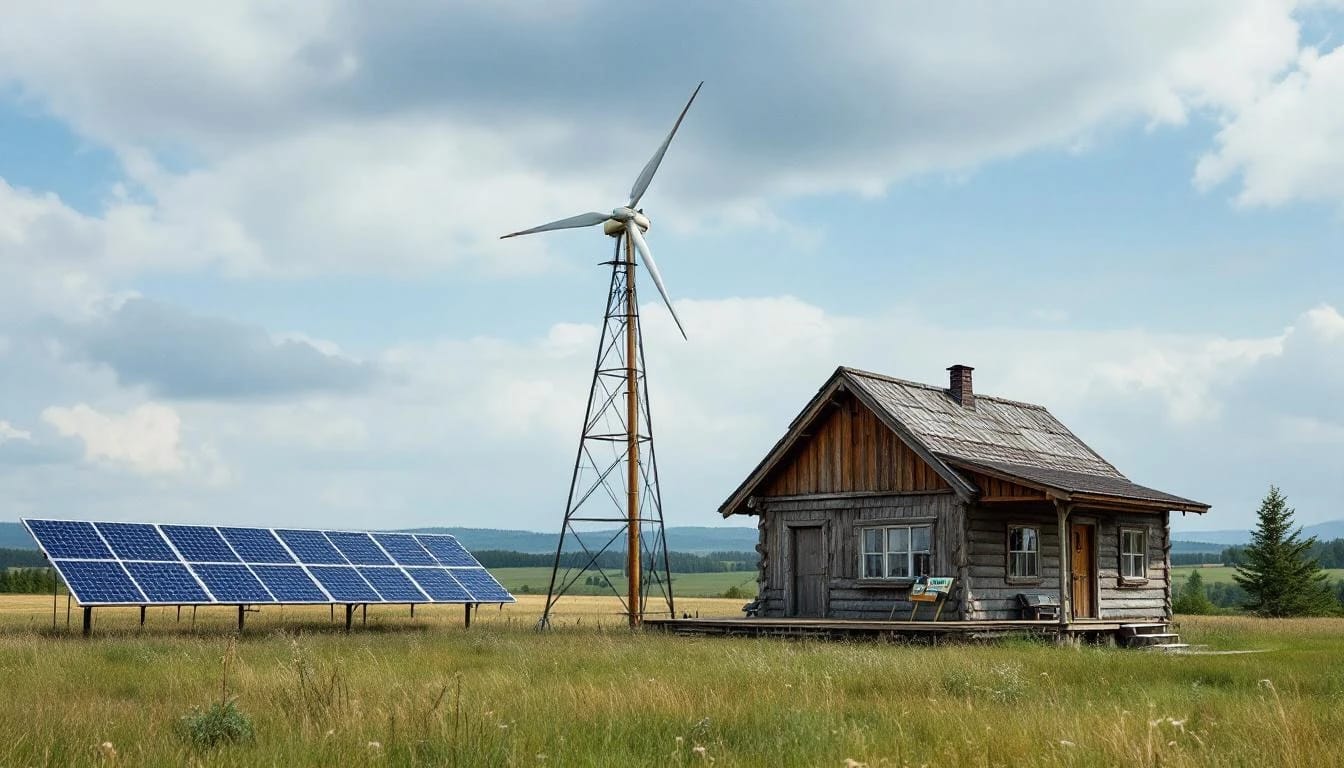
An off-grid wind turbine kit combines a generator, charge controller, battery bank, and pure-sine inverter in one package, letting homeowners or cabin owners harvest wind energy without utility backup. Quality kits deliver 400W to 3,000W continuous power, supply AC appliances during calm periods via battery reserve, and avoid the permitting complexity of grid-tied systems under NEC Article 705. Expect to pay $1,200–$8,500 for hardware, plus 40–80% of that for tower and installation labor.
What makes a true off-grid wind kit complete
A standalone turbine package must include four subsystems: the turbine head (rotor, alternator), a dump-load or hybrid charge controller rated for the turbine's peak amperage, a battery bank sized to cover 1.5–3 days of load at the site's Weibull distribution, and a pure-sine inverter with surge capacity for inductive appliances. Kits labeled "off-grid" but lacking the inverter force you to wire DC appliances only or purchase conversion hardware separately, increasing total cost 30–50%.
Vertical-axis turbines in packaged kits typically produce 0.2–0.6 kW in a 25 mph wind; horizontal-axis models in the 1.5–3 kW class reach rated output at 28–32 mph. Both types demand a dump resistor to bleed excess current when the battery nears full charge—overlooking that resistor can cook the alternator's stator during a gusty night. Controllers from Primus, Xantrex, and Morningstar automatically route surplus power to the dump load or activate dynamic braking to protect the turbine.
Battery chemistry matters. Flooded lead-acid remains the cheapest per kWh but requires monthly watering and equalization cycles. Absorbed glass mat (AGM) tolerates partial-state-of-charge cycling better and suits remote cabins; expect 500–800 cycles to 50% depth of discharge. Lithium iron phosphate (LiFePO₄) doubles the cycle count and triples the usable energy density but raises the kit price 60–100%. The federal 30% Residential Clean Energy Credit under IRC §25D covers batteries installed alongside the turbine, reducing net cost by nearly one-third when claimed on IRS Form 5695.
![INLINE: Horizontal-axis turbine mounted on 40 ft tilt-up tower with battery bank and inverter housed in weatherproof cabinet below]
Top off-grid kits by output class
400–600 W micro kits for cabins and RVs
Pikasola 400W VAWT Kit ships with a Darrieus-style helical rotor, 12V PWM controller with dump circuit, and a 600W modified-sine inverter. The turbine starts at 6 mph and peaks near 400W in a 25 mph wind. Retail runs $850–$950 without batteries. Users pair it with four 100 Ah AGM batteries wired in parallel to achieve ~4.8 kWh nominal storage. The modified-sine output suits resistive loads (lights, heaters) but struggles with variable-speed power tools and some laptop chargers. Upgrading to a separate 1,000W pure-sine inverter adds $250–$350.
Nature Power 400W Marine Kit targets sailboats but functions identically in terrestrial off-grid installs. The three-blade HAWT uses neodymium magnets and a sealed bearing hub rated IP55. Included controller supports both 12V and 24V banks; the kit omits the inverter, requiring a separate purchase. Street price hovers around $720. Pair with two 200 Ah 12V batteries and a Xantrex ProWatt 1,000W inverter for total upfront cost near $1,600.
1,000–1,500 W mid-size systems
Missouri Wind and Solar 1,600W Freedom II bundles a 1,600W HAWT (2m diameter, aluminum blades), hybrid charge controller with tri-modal dump/diversion, and detailed wiring diagrams. The turbine reaches 1,600W at 30 mph; typical cabin sites averaging 12 mph yield 200–350 kWh per month. The package excludes batteries and inverter. Builders commonly install six 225 Ah AGM deep-cycle batteries (series-parallel for 24V, ~10.8 kWh) and a Magnum MS4024PAE 4kW inverter-charger. Complete hardware cost approaches $5,200; adding a 50 ft guyed-lattice tower and professional install pushes the all-in figure to $9,000–$11,000.
Aeolos-H 1kW Complete Kit includes rotor assembly, tail-vane furling, 48V MPPT controller, six 150 Ah gel batteries (48V series, ~7.2 kWh), and a 2,000W pure-sine inverter. The turbine's cut-in speed is 5.6 mph; rated output arrives at 28 mph. Aeolos ships worldwide but USA buyers wait 6–8 weeks for ocean freight. Landed price sits near $3,800. The gel batteries tolerate temperature swings from -4°F to 122°F, suiting desert and northern climates without insulated battery boxes.
2,000–3,000 W heavy-duty homestead systems
Bergey Excel 1 technically isn't sold as a kit, but dealers frequently assemble turnkey packages. The 2.5 kW turbine (2.5m swept diameter) pairs with Bergey's Gridtek inverter and charge controller when a battery bank is added. Bergey recommends sixteen 225 Ah 6V L16 batteries in series (48V, ~21.6 kWh), offering three-day autonomy at 5 kWh/day usage. Hardware cost ranges $9,500–$11,500 depending on battery choice. Installation requires a 60–80 ft monopole or guyed tower to clear ground turbulence; total project cost often reaches $18,000–$24,000.
WINDMAX 3,000W HAWT System ships with a carbon-fiber composite rotor, electromagnetic-brake controller, and a 3,500W inverter. The turbine achieves 3,000W output at 32 mph; monthly yield in 14 mph average wind approximates 450 kWh. The kit lacks batteries. Installers pair it with a 48V lithium bank (15–25 kWh) for $5,000–$8,000. Total system cost lands between $12,000 and $16,000 once tower, concrete base, and electrician labor are included.
Battery sizing and chemistry trade-offs
Off-grid wind requires deeper battery reserves than grid-tied solar because wind availability follows synoptic weather patterns, not daily sunrise. A weekend cabin drawing 2 kWh/day needs 6–9 kWh usable storage; a full-time homestead at 10 kWh/day should provision 30–45 kWh. NEC Article 706 governs energy-storage installations, mandating disconnects, arc-fault protection on DC circuits above 80V, and ventilation for flooded-cell batteries that off-gas hydrogen.
Flooded lead-acid costs $150–$200 per kWh nominal and tolerates 300–500 cycles to 50% DoD. Monthly watering and quarterly equalization add labor. Trojan L16 and Rolls Surrette 4000 series remain popular for homestead systems; both carry 7–10 year service lives under proper maintenance.
AGM runs $250–$320 per kWh, eliminates watering, and withstands 500–800 cycles. Lifeline GPL-4CT and Victron AGM Deep Cycle models handle partial-state cycling without sulfation damage. AGM batteries self-discharge 1–3% per month, making them suitable for seasonal cabins that sit idle in winter.
LiFePO₄ commands $500–$700 per kWh but delivers 2,500–5,000 cycles to 80% DoD. Built-in battery-management systems (BMS) balance cells and prevent over-voltage, crucial during windy overnight periods when the turbine may pour in 8–12 hours of continuous charge. Brands like Battle Born and RELiON integrate into 12V, 24V, or 48V configurations; many include Bluetooth monitoring. The IRC §25D credit applies when the battery is charged exclusively by renewable sources, so a hybrid solar-wind setup qualifies for the full 30% rebate through 2032.
| Battery Type | Cost/kWh | Cycles (50% DoD) | Maintenance | Freeze Risk | Best Use Case |
|---|---|---|---|---|---|
| Flooded lead-acid | $150–$200 | 300–500 | Monthly water, quarterly EQ | Electrolyte freezes below 20°F if discharged | Cost-conscious homesteads with heated battery room |
| AGM | $250–$320 | 500–800 | None | Reduced risk, sealed | Remote cabins, unheated sheds |
| LiFePO₄ | $500–$700 | 2,500–5,000 | None | BMS prevents damage | High-cycling off-grid homes, hybrid solar-wind |
Inverter specifications and surge capacity
Pure-sine inverters reproduce utility-grade AC waveforms, preventing hum in audio equipment, overheating in variable-speed motors, and nuisance trips in sensitive electronics. Modified-sine units cost 40% less but damage certain appliances over time. Continuous wattage should cover the site's simultaneous loads; surge rating must exceed the highest inrush current—typically a well pump (3×–5× running watts) or chest freezer compressor (2×–4×).
Schneider Electric Conext XW and Victron MultiPlus inverter-chargers integrate battery charging, inverter, and AC-input bypass in one chassis, simplifying wiring and NEC 705.12 compliance. Both support generator-assist: when wind drops below load demand, an on-site propane or diesel genset starts automatically, charges the battery bank, and supplies AC until wind resumes. This hybrid approach reduces generator runtime 60–80% compared to genset-only power.
Inverter efficiency peaks at 40–60% load. A 3,000W inverter running a 200W load idles near 80% efficiency, wasting 50W as heat. Sizing the inverter to the largest expected load—rather than oversizing by 3×—keeps idle losses under 2% of daily energy budget. Standby draw for quality pure-sine models ranges 8–25W; over a month, that's 6–18 kWh of parasitic loss. Some installers add a bypass switch to disconnect the inverter during prolonged absences, preserving battery charge.
Tower height, zoning, and FAA Part 77
Wind speed increases logarithmically with height; a turbine at 50 ft in open terrain captures 25–40% more energy than the same model at 30 ft. NEC Article 694 requires the turbine to be 30 ft above any obstruction within 300 ft, but many jurisdictions interpret this as a minimum hub height. Off-grid sites often lie in unincorporated county land with relaxed zoning; still, securing a building permit avoids future abatement orders.
Towers above 200 ft above ground level (AGL) near an airport trigger FAA Part 77 review. Even shorter towers within approach zones may require notice; filers submit FAA Form 7460-1 online. Processing takes 30–45 days. Most residential off-grid turbines top out at 40–80 ft AGL, clearing the 200 ft threshold except near certified airports. If FAA study determines the tower penetrates a protected surface, painting and lighting may be mandated—adding $800–$1,500 in compliance costs.
State incentives vary. The Database of State Incentives for Renewables & Efficiency (DSIRE) lists property-tax exemptions, rebates, and accelerated depreciation for small wind. Alaska, Montana, and Wyoming offer sales-tax waivers on renewable-energy hardware. Several states cap property-tax assessments on renewable installations; others provide zero-interest loans through rural electric cooperatives. Combining state incentives with the federal 30% credit can reduce net system cost by 40–50%.
Installation: DIY boundaries and electrical code
Turbine assembly, rotor balancing, and mounting the head to the tower cap are straightforward mechanical tasks that experienced DIYers handle with hand tools. The electrical tie-in—running buried conduit, sizing conductors per NEC 694.12 voltage-drop limits, installing a load-center backfeed breaker, and grounding per NEC 250.52—requires a licensed electrician or owner-builder electrical permit with inspections. Off-grid systems avoid utility interconnection reviews, but local building departments still enforce NEC compliance for safety.
Underground wire runs in schedule-40 PVC follow NEC 300.5 burial depths: 24 inches for circuits under conduit, 18 inches if protected by GFCI. Use stranded copper rated 90°C in wet locations (THWN-2); aluminum is acceptable for longer runs but demands anti-oxidant compound and larger gauge. A typical 48V, 40A turbine circuit at 180 feet requires 2 AWG copper to stay under 3% voltage drop—undersizing to 6 AWG wastes 8–12% of harvested energy as heat.
Grounding the tower and turbine frame to a ground-rod array (two 8 ft rods spaced 16 ft apart, bonded with #6 bare copper) protects against lightning-induced surges. Installing a whole-system surge protector on the DC bus and a secondary surge device at the AC inverter output absorbs transients; both are claimable under the IRC §25D credit when installed with the qualifying equipment. Homeowners who skip surge protection often lose controllers and inverters during the first thunderstorm season.
Hybrid solar-wind synergy for year-round autonomy
Wind and solar generation patterns complement each other seasonally and diurnally. Winter months bring stronger winds but short days and low solar angles; summer delivers peak solar but lighter breezes. A split system—60% solar, 40% wind by nameplate capacity—smooths monthly generation and reduces battery cycling. For example, a 3 kW solar array paired with a 1.5 kW turbine and 20 kWh battery bank can serve a 10 kWh/day load with 95% reliability in the northern tier states, versus 75% reliability from solar alone.
Both solar and wind qualify under IRC §25D when installed at the same site and share the battery bank. The 30% credit applies to the combined hardware cost, including mounting structures and one shared inverter. Hybrid charge controllers—such as Morningstar TriStar MPPT with wind-input option—manage both sources on a single DC bus, simplifying wiring and eliminating combiner-box headaches. Be aware that NEC 705.12(D)(7) limits backfed breakers to 120% of the busbar rating; off-grid systems bypass this rule since they never connect to utility distribution, but the NEC still governs on-site wiring methods.
How much does a complete off-grid wind turbine kit cost?
Entry-level 400W vertical-axis kits with battery and inverter run $1,200–$1,800. Mid-range 1kW horizontal-axis packages with 48V battery bank and pure-sine inverter cost $3,500–$6,500. Heavy-duty 3kW systems with lithium storage and hybrid controllers reach $12,000–$16,000 before tower and installation labor. The federal 30% Residential Clean Energy Credit (IRC §25D) applies to hardware and installation, reducing net outlay by nearly one-third when claimed on IRS Form 5695.
What size battery bank do I need for an off-grid wind turbine?
Multiply daily energy consumption (kWh/day) by 1.5–3 to cover calm periods between weather fronts. A cabin using 3 kWh/day needs 4.5–9 kWh usable storage; a full-time home at 10 kWh/day should provision 15–30 kWh. Lead-acid systems use 50% depth of discharge; lithium banks safely discharge to 80%. In regions with predictable seasonal winds, smaller batteries paired with a backup generator reduce upfront cost while maintaining reliability.
Can I install an off-grid wind turbine myself?
Turbine assembly, tower raising with a gin pole or tilt-up base, and mechanical mounting are DIY-friendly for builders with rigging experience. Electrical work—running buried conduit, sizing DC conductors per NEC voltage-drop limits, installing disconnects and surge protection, and wiring the inverter—requires a licensed electrician or owner-builder electrical permit with inspections. Even off-grid systems must meet NEC safety standards; most jurisdictions demand final inspection before the building department releases the permit.
Do off-grid wind systems qualify for federal tax credits?
Yes. The IRC §25D 30% Residential Clean Energy Credit covers turbines, charge controllers, batteries, inverters, towers, and installation labor when the system serves a dwelling unit. Claim the credit on IRS Form 5695 in the tax year the equipment is placed in service. The credit remains at 30% through 2032, then steps down to 26% in 2033 and 22% in 2034. Energy-storage batteries qualify only when charged exclusively by renewable sources; adding a genset-charger may disqualify the battery portion unless the genset is solely for emergency backup.
How tall should the tower be for an off-grid turbine?
NEC Article 694 recommends the turbine hub sit 30 ft above any obstruction within 300 ft. In open terrain, a 50 ft tower captures 25–40% more wind energy than a 30 ft pole. Forested or hilly sites demand taller towers—60 to 80 ft—to escape surface turbulence. Check local zoning for height limits; many rural counties allow 80 ft without special-use permits. Towers above 200 ft AGL near airports require FAA Part 77 review via Form 7460-1.
Bottom line
Off-grid wind turbine kits with battery and inverter eliminate the complexity of grid-interconnection agreements and utility net-metering while delivering genuine energy independence. Quality systems in the 1–3 kW range, paired with correctly sized LiFePO₄ or AGM banks and pure-sine inverters, provide reliable AC power for cabins, homesteads, and remote workshops at all-in costs of $8,000–$20,000 after the federal 30% tax credit. Verify your site's average wind speed exceeds 10 mph, secure a building permit and FAA clearance if needed, and hire a licensed electrician to handle the NEC-compliant wiring—then enjoy decades of fuel-free electricity harvested from the sky.
Share this article
windturbinehome.com/s/8fe6cc
Editorial note: This article was researched and written by a member of the Wind Turbine Home editorial team. AI-assisted tools were used for spell-checking and light grammar review only — all research, analysis, and conclusions are our own. Our editorial policy prohibits sponsored content and paid placements. Read our editorial policy →
Related reading
hybrid solar wind
Hybrid Charge Controllers for Solar + Wind: What to Look For
Hybrid charge controllers merge solar and wind inputs into one battery bank. Look for MPPT solar tracking, turbine dump-load capability, voltage compatibility, and IP-rated enclosures rated for your climate.
hybrid solar wind
Sizing a Residential Solar + Wind Hybrid System: Complete Guide
Learn how to properly size a solar-wind hybrid system for your home. Calculate loads, balance generation sources, and optimize battery storage for year-round reliability.

hybrid solar wind
Wind Turbine for a Prepper Home: Long-Haul Off-Grid Resilience
Small wind turbines deliver genuine off-grid power when paired with solar and battery storage. The right setup keeps critical loads running through grid failures.
hybrid solar wind
Wind Turbine for a Hunting Cabin: Low-Maintenance Picks for Seasonal Use
Discover the best low-maintenance wind turbines for seasonal hunting cabins. Compare vertical-axis and small horizontal models built for remote, unattended operation.
hybrid solar wind
Wind Turbine for an Off-Grid Cabin: Full System Design Guide
Design a reliable off-grid wind system for your cabin with the right turbine, battery bank, charge controller, and inverter. Complete wiring, sizing, and NEC compliance guide.
hybrid solar wind
Can You Use Wind and Solar Together? Hybrid System Guide 2026
Yes, wind and solar work together in hybrid systems. Combining turbines with photovoltaic arrays delivers 24/7 renewable generation and smoother grid-tie performance.