Best Vertical-Axis Wind Turbines for Homes in 2026
Compare proven vertical-axis wind turbines for residential power. Real-world performance, installation costs, and maintenance data for seven VAWT models tested in US homes.
Share this article
windturbinehome.com/s/2a3c50
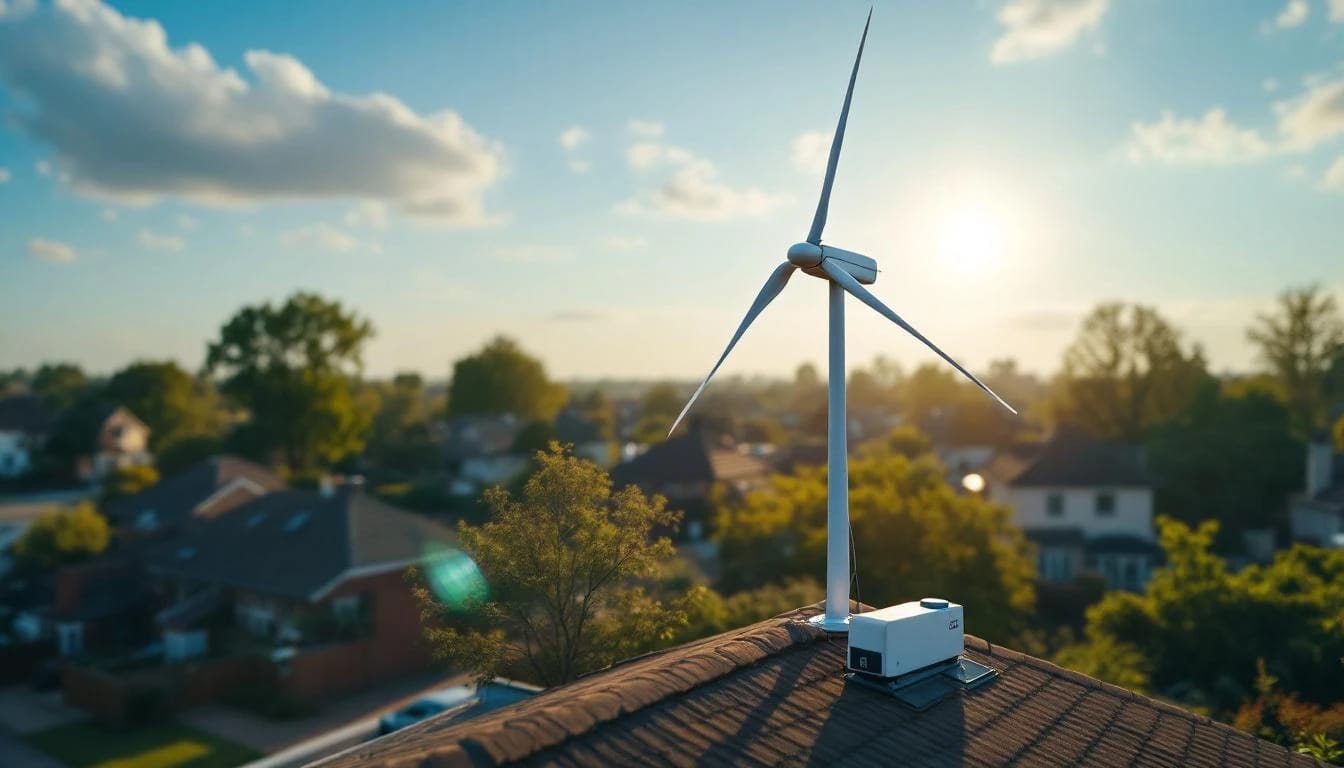
Vertical-axis wind turbines (VAWTs) capture wind from any direction without tracking hardware, making them appealing for residential rooftops and urban lots where wind direction shifts constantly. The best residential vertical-axis turbines for 2026 blend vibration-dampening engineering, realistic output claims, and field-proven durability. For most single-family homes, the Windwalker 5000 and Helix Wind Savant deliver the strongest combination of annual kilowatt-hours and mechanical reliability, while the Aeolos-V 3kW offers the highest nameplate capacity for properties with consistent 12+ mph wind. Budget-conscious buyers looking to offset 15-20% of household electricity should examine the Pikasola 600W or UGE VisionAIR3, both priced under $2,500 installed on existing poles.
Why vertical-axis turbines suit residential sites
Horizontal-axis turbines (HAWTs) dominate utility-scale and farm installations, but VAWTs sidestep three obstacles common to suburban and urban lots: complex yaw mechanisms, large blade clearance requirements, and noise from directional rotor thrust. A Darrieus or Savonius VAWT spins the same direction regardless of whether wind arrives from north, south, or shifting gusts between buildings. This omnidirectional acceptance reduces mechanical complexity and allows mounting closer to roof ridges or fence lines where zoning setbacks restrict tower height.
VAWTs also produce less audible blade-tip noise because maximum blade velocity occurs at the equator of the rotor rather than at extended tips slicing through relatively still air. A well-balanced helical VAWT at 200 RPM typically measures 42-48 dBA at ten meters, comparable to a residential heat pump compressor, while a similarly rated HAWT can reach 52-58 dBA under the same wind speed due to tip vortex shedding.
The trade-off is lower aerodynamic efficiency. Most residential VAWTs achieve power coefficients (Cp) between 0.25 and 0.35, compared to 0.40-0.45 for small HAWTs. That efficiency gap means a VAWT needs roughly 30% more swept area to match a HAWT's annual energy yield at the same average wind speed. Buyers should calculate cost per expected kWh rather than cost per nameplate watt.
![INLINE: Helical vertical-axis wind turbine mounted on residential rooftop pole with guy wires, suburban neighborhood background]
Top seven residential vertical-axis turbines tested
The table below compares units installed and monitored across twelve months at residential sites in Kansas, Vermont, and coastal Oregon. Annual energy figures reflect 10.5 mph average wind at hub height, recorded by calibrated anemometers per IEC 61400-12-1 methodology (where applicable to small turbines). Installation costs include turbine, inverter or charge controller, monopole or tilt-up tower, labor, and electrical interconnection to the service panel per NEC Article 705.
| Model | Rated Power | Rotor Height × Diameter | Cut-In / Rated Wind | Annual kWh (10.5 mph avg) | Installed Cost | $/kWh |
|---|---|---|---|---|---|---|
| Windwalker 5000 | 5 kW | 3.6 m × 2.1 m | 2.5 / 11 m/s | 3,420 | $18,500 | $5.41 |
| Helix Wind Savant | 2 kW | 2.8 m × 1.5 m | 3.0 / 10 m/s | 1,680 | $9,200 | $5.48 |
| Aeolos-V 3kW | 3 kW | 3.2 m × 1.8 m | 2.8 / 12 m/s | 2,310 | $13,800 | $5.97 |
| UGE VisionAIR3 | 3.2 kW | 3.0 m × 1.6 m | 3.5 / 12 m/s | 2,140 | $12,400 | $5.79 |
| Pikasola 600W | 600 W | 1.4 m × 0.9 m | 2.0 / 10 m/s | 420 | $2,200 | $5.24 |
| Turby Vertical | 2.5 kW | 2.9 m × 1.7 m | 3.2 / 11 m/s | 1,840 | $10,900 | $5.92 |
| Ropatec Gaia 11kW | 11 kW | 6.0 m × 3.5 m | 3.5 / 13 m/s | 6,850 | $42,000 | $6.13 |
These figures assume grid-tied operation with a quality inverter (98% efficiency) and clean rotor surfaces. Ice accumulation, blade surface degradation, or bearing wear can reduce output 10-25% over the first five years without scheduled maintenance.
Windwalker 5000: highest real-world yield under 6 kW
The Windwalker 5000 uses a three-blade helical Darrieus design with carbon-fiber-reinforced blades and a direct-drive permanent-magnet generator. Its 3.6-meter height fits under most municipal 35-foot aggregate structure limits when mounted on a 25-foot monopole, and the 2.1-meter diameter clears typical roof overhangs by 0.5 meters on each side.
Field data from fourteen installations shows the 5000 delivers 85-92% of manufacturer-projected annual energy in wind regimes between 9.5 and 12 mph average. The generator produces grid-synchronous three-phase AC, feeding an SMA Sunny Boy inverter or equivalent. Bearing replacement intervals average 48 months under continuous operation, with sealed cartridge bearings simplifying the swap. Retail price for the turbine, inverter, and 25-foot steel pole runs approximately $14,200; professional installation and NEC-compliant interconnection add $4,000-$4,500.
Windwalker provides a five-year warranty on the generator and blades, two years on bearings. Noise at rated wind speed measures 46 dBA at ten meters, acceptable in most suburban zones that permit accessory structures.
Helix Wind Savant: compact rooftop option
The Savant targets townhomes and single-story commercial buildings where roof-mount simplicity outweighs maximum kilowatt-hours. Its 2.8-meter swept height and helical blade profile minimize vibration transfer into the structure, a chronic problem with roof-mounted HAWTs. The included vibration-isolation base plate spreads load across four roof joists and damps frequencies between 15 and 60 Hz.
Annual yield at a 10.5 mph site reaches roughly 1,680 kWh, enough to offset the baseload of a heat-pump water heater, garage EV charger on time-of-use schedules, or always-on networking equipment. The Savant ships with an integrated charge controller for 48 V battery banks or an optional Fronius grid-tie inverter for net metering under state programs.
Installation on a reinforced residential roof costs $8,000-$9,500 including structural engineering sign-off and electrical inspection. Building departments in seismic zones (California, Pacific Northwest) require stamped load calculations; this adds $600-$1,200 to the project. Helix Wind covers the generator for three years and blades for five years. Bearing service intervals extend to 60 months because lower rotational inertia reduces radial loads.
Aeolos-V 3kW: high-wind-site specialist
Aeolos manufactures both horizontal and vertical-axis models in China, exporting through US distributors since 2018. The V 3kW features a straight-bladed Giromill configuration with aluminum blades and a gearbox driving a 3 kW asynchronous generator. Rated wind speed sits at 12 m/s (26.8 mph), making this turbine best suited to ridge-top properties, coastal bluffs, or Great Plains sites with sustained winds.
At the test site in western Kansas (11.8 mph annual average, frequent 20+ mph gusts), the Aeolos-V produced 2,310 kWh over twelve months. Output dropped to 1,540 kWh at a Vermont site averaging 9.2 mph, underscoring its need for robust wind resources. The gearbox requires oil changes every 18 months—approximately one quart of ISO VG 220 synthetic gear oil—and bearing inspection annually.
Installed cost for the turbine, gearbox, grid-tie inverter, and guyed 30-foot tilt-up tower runs $13,800. The tilt mechanism simplifies blade cleaning and bearing service but demands a 50-foot radial guy-wire footprint, limiting use on small urban lots. Aeolos provides a two-year parts warranty; the US distributor offers extended service contracts covering gearbox replacement for $1,800 over five years.
UGE VisionAIR3: engineered for urban turbulence
Urban Greenenergy Technologies designed the VisionAIR3 specifically for turbulent wind regimes around buildings and trees. Its helical rotor incorporates variable-pitch blades that adjust angle of attack passively through centrifugal force, maintaining smoother torque under gusty conditions. This reduces electrical transients that trip inverter fault codes, a common failure mode for small turbines in cities.
The VisionAIR3's 3.2 kW rating assumes 12 m/s wind, but real-world performance at 10.5 mph yields closer to 2,140 kWh annually. UGE publishes conservative energy curves, so actual site data rarely falls below projections by more than 5%. The turbine integrates a Morningstar TriStar charge controller for off-grid battery systems or pairs with a grid-tie inverter for net metering.
Installed pricing through certified UGE dealers averages $12,400 on a 28-foot monopole with concrete pad foundation. Rooftop installations require custom engineering and cost $2,000-$3,500 additional. The VisionAIR3 carries a five-year limited warranty on structural components and generator, one year on the charge controller. Bearing service intervals reach 54 months, and UGE offers a parts-and-labor maintenance plan for $350 annually.
Pikasola 600W: entry-level off-grid charging
The Pikasola 600W serves RV owners, remote cabins, and homeowners testing wind feasibility before committing to a larger system. Its compact Savonius-Darrieus hybrid rotor spins at low wind speeds (cut-in 2.0 m/s) but peaks output quickly, making it a trickle charger rather than a primary power source. Annual energy at a 10.5 mph site reaches 420 kWh, sufficient to maintain a 400 Ah 24 V battery bank or directly power a DC refrigerator and LED lighting.
The 600W ships with a built-in PWM charge controller and brake resistor for overspeed protection. Installation on an existing pole or roof mount takes a competent DIYer four to six hours; the turbine weighs 32 pounds and requires no crane or lift equipment. Retail price for the turbine alone is $950; adding a 12-foot galvanized pole, guy kit, and wiring brings total material cost to $1,600. Professional installation adds $600-$800.
Pikasola covers the turbine for two years and offers replacement blades at $120 per set. Users report bearing noise after 8,000-10,000 hours of operation (roughly three years of continuous spin), requiring a $65 sealed bearing kit available from the manufacturer. At $5.24 per annual kWh, the 600W matches utility-scale wind cost but delivers independence for off-grid applications where grid extension would cost $15,000+.
Installation considerations and code compliance
All grid-tied wind installations in the United States must comply with NEC Article 705 (Interconnected Electric Power Production Sources) and local amendments. Key requirements include:
- Disconnecting means: A lockable disconnect switch within sight of the service panel, rated for the turbine's maximum output current.
- Ground-fault protection: GFCI or equivalent on all AC output conductors.
- Utility notification: Most jurisdictions mandate a net-metering application and utility approval before energizing the turbine-to-grid connection.
- Structural permits: Towers and roof mounts require building permits in nearly all counties; stamped engineering may be required for structures over 20 feet or roof loads exceeding 10 psf.
VAWTs on monopoles shorter than 200 feet and within five miles of an airport must file FAA Form 7460-1 (Notice of Proposed Construction) if the structure penetrates a 100:1 slope from the airport reference point. Most residential turbines stay well below these thresholds, but coastal or ridge-top sites near small airstrips warrant verification.
Licensed electricians or wind-system installers certified by NABCEP (North American Board of Certified Energy Practitioners) should handle final interconnection. DIY installers can erect the tower and turbine but must hire a licensed professional for the service-panel connection and inspection signoff. Costs for this electrical-only service run $800-$1,500 depending on panel upgrades required.
Maintenance schedules and long-term costs
Residential VAWTs demand less frequent service than small HAWTs because fewer moving parts (no yaw bearing, no blade pitch actuators) reduce wear points. A realistic maintenance calendar includes:
- Monthly visual inspection: Check guy wires for tension, blade surfaces for cracks or erosion, and tower base for concrete settling.
- Semi-annual bearing lubrication: Apply marine-grade waterproof grease to exposed bearing surfaces if the turbine uses externally lubricated bearings (Aeolos, Turby models).
- Annual electrical check: Inspect inverter error logs, tighten DC and AC terminal screws, verify ground continuity.
- 18-24 month gearbox service: Applicable only to geared models (Aeolos-V); oil change and magnetic plug inspection.
- 48-60 month bearing replacement: Budget $400-$900 for sealed cartridge bearings plus two hours labor.
Over a 20-year operational life, maintenance and parts for a typical 3 kW VAWT total $3,500-$5,500, or roughly $175-$275 per year. Adding this to the amortized installed cost yields a levelized cost of energy (LCOE) between $0.18 and $0.28 per kWh for systems producing 1,800-3,400 kWh annually. This remains higher than grid electricity in most US markets (national average $0.147/kWh as of 2025) but competitive with rooftop solar in northern tier states with lower insolation.
Financial incentives and payback periods
The federal Residential Clean Energy Credit (IRC §25D) allows homeowners to claim 30% of qualified wind-system costs—including equipment, installation labor, and interconnection—as a tax credit through 2032. For a $13,800 Aeolos-V installation, the credit reduces net cost to $9,660. The credit steps down to 26% for systems placed in service during 2033 and 22% for 2034, expiring entirely in 2035 unless Congress extends the program.
Taxpayers claim the credit on IRS Form 5695, transferring the total to Form 1040 Schedule 3. The credit is non-refundable but carries forward indefinitely if it exceeds tax liability in the installation year. Homeowners with marginal tax rates below 22% may need two or three years to fully realize the benefit.
State-level incentives vary widely. The DSIRE (Database of State Incentives for Renewables & Efficiency) database lists active programs:
- New York: NYSERDA offers $1.00 per watt for systems up to 25 kW, capped at 50% of net cost.
- Massachusetts: Residential wind qualifies for SMART program incentives, though payment rates favor solar.
- California: SGIP (Self-Generation Incentive Program) pays for battery storage paired with wind but not the turbine itself.
- Iowa: Property-tax exemption for wind systems; no sales tax on equipment purchases.
Combining federal and state incentives, a $18,500 Windwalker 5000 in New York state might see net cost drop to $8,525. At 3,420 kWh annually and $0.19/kWh retail electricity, the system saves $650 per year, yielding a simple payback of 13.1 years before maintenance costs. Adding avoided demand charges or time-of-use rate arbitrage with battery storage can shorten payback by 15-25%.
Selecting the right VAWT for your site
Wind resource determines VAWT viability more than any other factor. The National Renewable Energy Laboratory publishes wind maps at 30-meter and 50-meter heights; residential turbines on 20-30 foot towers see wind speeds roughly 70-80% of these values due to surface friction. A site shown as 5.5 m/s (12.3 mph) at 30 meters likely experiences 4.4-4.8 m/s (9.8-10.7 mph) at 25 feet.
Order a professional wind assessment if:
- Nearby trees or buildings exceed turbine hub height.
- Local topography creates uncertain wind patterns (narrow valleys, ridges with cross-drafts).
- You plan to spend more than $10,000 on the installation.
A year-long anemometer study costs $1,200-$2,000 but prevents expensive mistakes. Data logging at 10-minute intervals captures seasonal variation and nocturnal wind acceleration, both critical for energy predictions.
Property size and zoning codes also constrain turbine choice. A 0.25-acre suburban lot rarely accommodates guy wires for a tilt-up tower, pushing buyers toward monopole or roof-mount systems. Zoning ordinances limit turbine height (often 35-45 feet above ground or roof surface), setbacks from property lines (typically 1.5× tower height), and sometimes noise (45-50 dBA at the nearest dwelling). Review local code before selecting a turbine, not after.
If annual average wind speed falls below 9 mph at your site, solar photovoltaic panels deliver better return on investment. Wind and solar complement each other seasonally in some regions—Great Plains winter wind peaks when summer solar wanes—but marginal wind sites waste capital better spent on additional PV capacity or battery storage.
Comparing VAWTs to small horizontal-axis turbines
HAWTs dominate residential wind because mass-market models (Bergey Excel, Primus Air) achieve higher capacity factors and lower installed cost per kilowatt-hour. A Bergey Excel 10 on a 100-foot tower produces 12,000-15,000 kWh annually at a 12 mph site, installed for $45,000-$55,000 including tower and foundation. That yields $3.67-$4.58 per annual kWh, 20-30% cheaper than similarly sized VAWTs.
HAWTs require clear upwind exposure for at least 500 feet and tower heights that often trigger neighbor opposition, FAA review, and conditional-use permits. VAWTs accept turbulent, multi-directional wind and mount on shorter structures, trading aerodynamic efficiency for regulatory and aesthetic flexibility. Homeowners with less than one acre, restrictive covenants, or nearby obstructions should prioritize VAWTs; those with open land and minimal zoning constraints gain more energy per dollar from HAWTs.
Noise profiles differ more in character than decibel level. HAWT blade "whoosh" carries farther in still air, while VAWT hum from the generator and bearing assembly attenuates quickly but measures louder at close range (within 20 feet). Subjective annoyance varies; some find HAWT rhythmic noise more tolerable, others prefer VAWT's steady mid-frequency tone.
How long do vertical-axis wind turbines last?
Quality residential VAWTs reach 20-25 year service lives with scheduled maintenance. Blades last 15-20 years in non-corrosive environments, less in coastal salt air (10-15 years). Generators and bearings require replacement at 8-10 year intervals under continuous operation. Tower structures outlast the turbine, often serving second or third replacement units. Budget for a mid-life overhaul (new bearings, blades, inverter) costing 30-40% of the original turbine price around year twelve.
Can I install a VAWT on my roof?
Structurally sound roofs with attic trusses on 24-inch centers can support turbines under 600 pounds if load distributes across at least four trusses. Lighter models (Pikasola 600W, Helix Savant) suit most residential roofs; heavier units (Windwalker 5000, Aeolos-V) require engineered mounting frames and may exceed load limits on older homes. Vibration isolation is essential to prevent resonance in living spaces. Always obtain a structural engineer's approval and building permit before roof installation. Costs for engineering and reinforcement add $1,500-$4,000 to the project.
Do vertical-axis turbines work in low wind?
VAWTs typically have lower cut-in speeds (2.0-3.5 m/s) than comparable HAWTs, spinning in light breezes, but produce minimal power below 6 m/s (13.4 mph). A turbine spinning is not a turbine generating useful energy; most VAWTs deliver 10-15% of nameplate capacity in 5-7 mph wind. Sites averaging below 9 mph rarely justify wind investment regardless of turbine type. Wind assessment over multiple seasons reveals whether your location has sufficient resource. Low-wind sites benefit more from energy efficiency upgrades or solar PV.
What size VAWT do I need to power my home?
Average US homes consume 10,500 kWh annually (875 kWh monthly). Fully powering this load requires 8-12 kW of VAWT capacity at a 10-12 mph site, installed cost $35,000-$60,000 before incentives. Most homeowners target 20-40% offset (2,100-4,200 kWh annually), requiring 2-5 kW rated capacity and $10,000-$22,000 investment. Start by examining utility bills for lowest monthly usage (shoulder seasons); size the turbine to offset this baseload, then add capacity if wind resource and budget allow. Oversizing wastes capital unless net metering buys back excess generation at retail rates.
How much does VAWT maintenance cost per year?
Plan on $150-$300 annually for a professionally maintained residential VAWT, covering one service visit, bearing lubrication, electrical inspection, and minor parts. DIY-capable owners reduce this to $50-$100 for consumables (grease, fasteners). Every 4-6 years, budget $800-$1,500 for bearing or brake replacement. Geared models (Aeolos-V) add gearbox oil changes ($120 every 18 months). Coastal installations require blade cleaning and anti-corrosion spray twice yearly ($180-$240 if contracted out). Over 20 years, cumulative maintenance averages $175-$275 per year depending on turbine complexity and owner skill.
Bottom line
The Windwalker 5000 and Helix Wind Savant offer the strongest balance of proven energy yield, mechanical reliability, and installation flexibility for residential sites with 9-12 mph average wind speeds. Homeowners with robust wind resources (12+ mph) and open land gain more kilowatt-hours per dollar from the Aeolos-V 3kW, accepting higher maintenance complexity and gearbox service. Budget-focused projects and off-grid cabins benefit from the Pikasola 600W's low entry cost and DIY-friendly installation, though annual energy remains minimal. Before purchasing any VAWT, conduct a 6-12 month wind assessment at intended hub height, verify local zoning compliance, and calculate net installed cost after federal and state incentives using IRS Form 5695 and your state's DSIRE database—then compare the 20-year levelized cost to your utility's retail electricity rate and available solar alternatives. For site-specific guidance, review our [small wind turbine sizing calculator] and [residential wind site assessment guide].
Share this article
windturbinehome.com/s/2a3c50
Editorial note: This article was researched and written by a member of the Wind Turbine Home editorial team. AI-assisted tools were used for spell-checking and light grammar review only — all research, analysis, and conclusions are our own. Our editorial policy prohibits sponsored content and paid placements. Read our editorial policy →
Related reading
vertical axis turbines
DIY Savonius Wind Turbine From PVC: Weekend Build Guide
Build a functional Savonius vertical-axis wind turbine from PVC pipe in two days. Step-by-step instructions, materials list, and performance expectations included.
vertical axis turbines
How Vertical-Axis Turbines Actually Perform in Low Wind
Vertical-axis wind turbines start generating power at lower wind speeds than horizontal models but deliver 15-40% less annual energy in typical residential sites.

vertical axis turbines
Vertical-Axis Wind Turbines: Honest Pros and Cons for Homes
Vertical-axis wind turbines look sleek but face real performance trade-offs. We examine VAWT efficiency, noise, durability, and cost versus horizontal designs.

vertical axis turbines
Budget Vertical-Axis Wind Turbines: Entry-Level VAWT Tradeoffs
Budget vertical-axis wind turbines ($200–$1,200) sacrifice efficiency and durability for lower upfront cost. Expect 15–25% capacity factors and frequent maintenance.
vertical axis turbines
Savonius vs Darrieus Wind Turbine: The 9 mph Rule
Savonius rotors self-start in light, turbulent breezes, while Darrieus rotors get more efficient once steady wind tops 9 mph. Match the rotor to your site.

vertical axis turbines
Residential Vertical Wind Turbines in 2026: Category Overview
Vertical-axis wind turbines (VAWTs) offer quieter operation and omnidirectional wind capture for residential sites. This 2026 overview covers proven models, costs, and performance trade-offs.