Federal Tax Credit for Small Wind Turbines: IRC §25D Guide
Homeowners can claim 30% of small wind turbine costs through IRS Form 5695 under IRC §25D. Qualifying systems must serve your residence, meet performance standards, and be installed before 2035.
Share this article
windturbinehome.com/s/f39a5c

The federal Residential Clean Energy Credit under Internal Revenue Code §25D allows homeowners to claim 30% of the installed cost of a qualifying small wind turbine system. This applies to systems placed in service through December 31, 2032, stepping down to 26% in 2033 and 22% in 2034. The credit covers equipment, labor, site preparation, assembly, wiring, permitting fees, and sales tax—making it one of the most generous incentives available for residential renewable energy.
What qualifies for the IRC §25D small wind credit
The turbine must serve a dwelling unit you own in the United States. Second homes qualify. Rental properties do not, unless you also live there part of the year. The system can be ground-mounted, roof-mounted, or pole-mounted on your property.
IRS Publication 17 specifies that the turbine must have a nameplate capacity of 100 kilowatts or less. Most residential units fall between 400 watts and 10 kilowatts. The equipment must be new—used turbines are ineligible. You must own the system outright; third-party-owned or leased systems do not qualify for the homeowner to claim the credit, though the financing entity may claim the commercial Investment Tax Credit under IRC §48.
The turbine does not need to be certified by the Small Wind Certification Council, but it must meet the performance and safety standards that manufacturers document through independent testing.Bergey Windpower, Primus Wind Power, and Aeolos all provide the documentation required for tax purposes. The system must be "placed in service" during the tax year claimed—meaning operational and generating electricity, not merely ordered or partially installed.
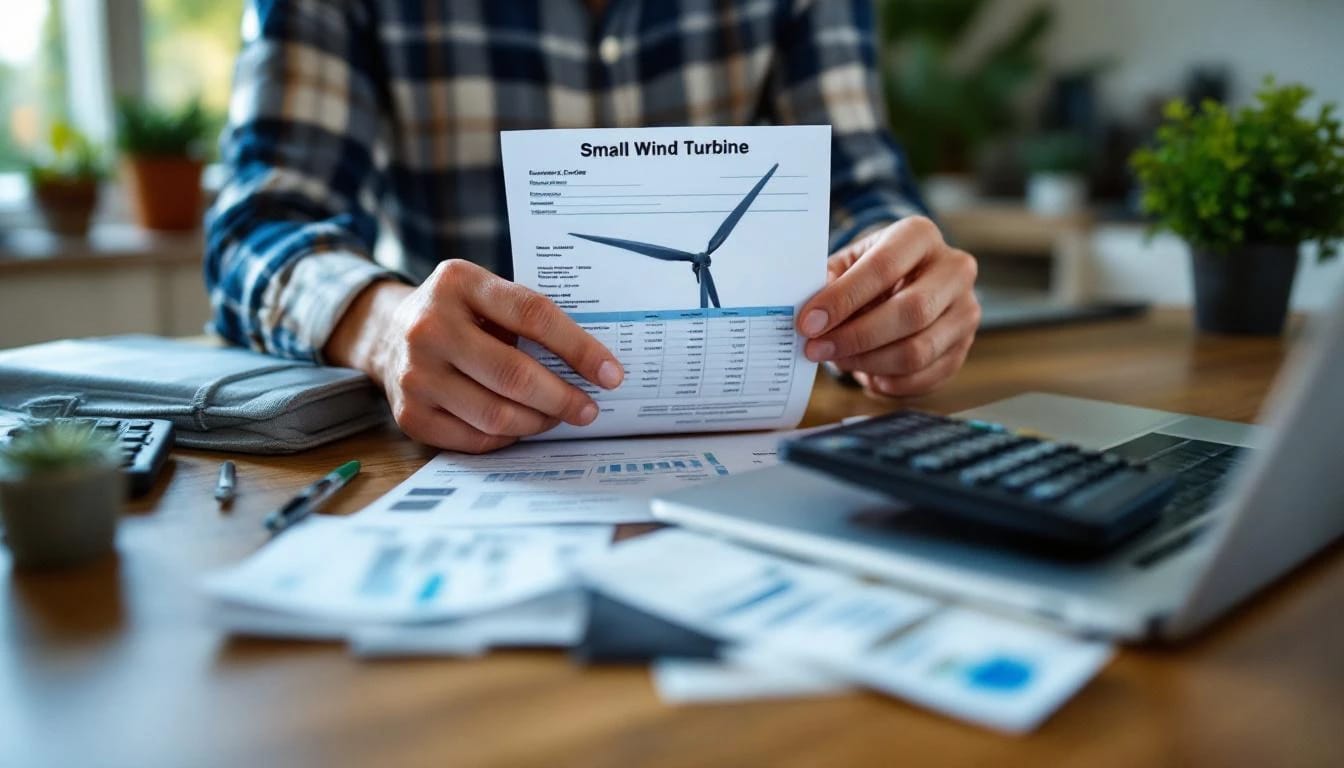
![INLINE: Homeowner reviewing IRS Form 5695 with small wind turbine visible through window]
Eligible expenses that count toward the credit
The 30% applies to the total installed cost, which goes well beyond the turbine itself. Eligible expenses include the turbine assembly, tower or mounting hardware, inverter, charge controller if using battery storage, balance-of-system wiring, foundation or concrete pad, guy-wire anchors, grounding rods and conductors per NEC Article 705, installation labor, engineering assessments, FAA Part 77 aeronautical studies if required near airports, permit and inspection fees, and applicable sales tax.
Storage batteries installed in conjunction with the turbine became eligible starting in 2023 under the Inflation Reduction Act amendments. Previously, only solar-charged batteries qualified. Now a homeowner pairing a 5-kilowatt Bergey Excel with a lithium iron phosphate bank can claim both in the same tax year.
Excluded costs include any expense paid by a utility rebate, state grant, or other subsidy. Only your out-of-pocket cost qualifies. If a state program reimburses $2,000 of a $20,000 system, you claim 30% of $18,000, not $20,000. Maintenance agreements, extended warranties purchased separately after installation, and monitoring subscriptions are also excluded.
How to claim the credit using Form 5695
File IRS Form 5695, Residential Energy Credits, with your federal income tax return for the year the system was placed in service. Part I calculates the credit. Line 1 asks for qualified fuel cell property costs—leave blank unless you also installed fuel cells. Lines 14a through 14d cover wind energy property.
Enter the total installed cost on line 14a. Multiply by 0.30 on line 14b. The result carries to line 15, then flows to line 51 of your Form 1040, reducing your federal tax liability dollar-for-dollar. Unlike a deduction, which reduces taxable income, the credit directly reduces taxes owed.
The credit is nonrefundable but carries forward indefinitely. If your 2024 tax liability is $5,000 and your wind credit is $7,500, you reduce 2024 taxes to zero and carry the remaining $2,500 forward to 2025. The carryforward continues until fully used. There is no income cap and no lifetime limit on the number of qualifying installations, as long as each serves a different dwelling or is installed in a different tax year at the same dwelling.
Documentation required for IRS compliance
The IRS does not require pre-approval, but audits happen. Keep the manufacturer's certification statement confirming the turbine meets applicable performance and safety standards. This may be a letter on company letterhead or a datasheet referencing IEC 61400-2, the international standard for small wind turbines, or equivalent testing.
Retain the itemized invoice from your installer showing equipment, labor, and materials separately. If you self-installed, keep all receipts organized by category. Photograph the installation at key stages: foundation pour, tower erection, turbine mounting, electrical interconnection, and the final operational setup. Take a clear shot of the utility meter with the net-metering agreement visible if applicable.
Store the signed electrical permit, final inspection certificate from your authority having jurisdiction, and any interconnection agreement with your utility. Some jurisdictions require a licensed electrician to complete the final connection per NEC Article 705.12, which mandates dedicated circuit breakers, rapid shutdown controls, and grounding electrode systems. A letter from that electrician confirming code compliance is useful during an audit.
FAA Part 77 determinations, if your site is within five nautical miles of an airport or near a heliport, should also be filed. Structures exceeding 200 feet above ground level require notification, but most residential turbines on 80- or 100-foot towers do not trigger FAA review unless near an aeronautical facility.
State and utility incentives that stack with the federal credit
Many states offer additional rebates, property tax exemptions, or sales tax exemptions that work alongside the federal credit. The Database of State Incentives for Renewables & Efficiency (DSIRE) tracks current programs. Montana, for instance, exempts small wind systems from property tax increases. New York has historically offered per-watt rebates through NYSERDA, though funding fluctuates.
Utility net-metering policies determine how you are compensated for excess electricity fed into the grid. Some states mandate retail-rate crediting; others allow utilities to pay wholesale rates or avoided-cost rates. This does not affect federal tax credit eligibility but dramatically changes payback period. A 5-kilowatt Primus Air 40 in a retail-net-metering state recoups costs faster than the same turbine in a state with restrictive interconnection rules.
Production-based incentives, where you earn per kilowatt-hour generated, are rare for small wind but exist in select municipal utility territories. These payments count as taxable income but do not reduce your eligible expenses for the IRC §25D credit.
Changes from previous iterations of the federal wind credit
IRC §25D previously covered wind systems from 2006 through 2021, lapsing at the end of 2021 before being reinstated and expanded by the Inflation Reduction Act in August 2022. The current 30% rate runs through 2032, a significant improvement over the previous schedule that had already stepped down to 26% in 2020 and 22% in 2021.
The Inflation Reduction Act removed the cap that once limited the credit to specific dollar amounts per technology. Early versions capped wind at $4,000. Now there is no maximum credit amount—a homeowner installing a $50,000 Bergey Excel 10 with a 120-foot tower and battery storage claims $15,000, not $4,000.
Battery storage eligibility, added in the 2022 amendments, applies retroactively to systems placed in service after December 31, 2022. Homeowners who installed a turbine and batteries in early 2023 but filed taxes before the IRS updated Form 5695 instructions can amend their return using Form 1040-X to claim the battery portion.
| Aspect | 2006–2019 credit | 2020–2021 credit | 2023–2032 credit (current) |
|---|---|---|---|
| Credit percentage | 30% | 26% (2020), 22% (2021) | 30% |
| Maximum credit cap | $4,000 (varied by year) | No cap | No cap |
| Battery storage eligible | No | Solar only | Wind and solar |
| Carryforward allowed | Yes | Yes | Yes, indefinite |
| Expiration date | Dec 31, 2019 | Dec 31, 2021 | Dec 31, 2034 |
Common mistakes that reduce or disqualify the credit
Claiming the credit before the system is operational is a frequent error. "Placed in service" means the turbine is generating electricity and connected to your home electrical panel or battery system. Ordering a turbine in December 2024 but completing installation in February 2025 means you claim the credit on your 2025 return, not 2024.
Failing to subtract rebates and grants from your cost basis is another red flag. If a state or utility pays part of your expense, the IRS considers that a reduction in your qualifying cost. Double-dipping—claiming both the subsidy and the full pre-subsidy cost—invites penalties.
Using the credit for a rental property that you never occupy is disallowed. A vacation home where you spend two weeks annually qualifies. A property rented year-round with no personal use does not, even if you own it. The dwelling must serve you as a residence.
Misclassifying components causes confusion. A standalone battery bank purchased separately, charged only by grid electricity and never by the turbine, does not qualify. The battery must be "integral to the operation of" the renewable system. If you install a 10-kilowatt-hour battery and use it with both a wind turbine and rooftop solar, allocate the battery cost proportionally or demonstrate it was purchased for and first charged by the renewable sources.
Inflating labor costs with unrelated work, such as reroofing done at the same time, or including the cost of a new utility service panel required for unrelated electrical upgrades, draws scrutiny. Only labor directly tied to the wind system installation qualifies.
Interaction with commercial and business incentives
Homeowners operating a home-based business cannot claim the IRC §25D residential credit for the portion of electricity used in business. If 30% of your home square footage is a dedicated office claimed on Schedule C, and the turbine powers the entire home, technically 30% of the system cost should not be claimed under §25D. In practice, many taxpayers claim the full residential credit and then allocate energy usage through separate business deductions, but a conservative approach is to reduce the §25D claim proportionally and explore the commercial Investment Tax Credit under IRC §48 for the business portion.
Farm operations similarly complicate matters. A small wind turbine serving both a farmhouse and barn may be split between residential and agricultural use. Consult a tax professional experienced in renewable energy for operations that cross personal and business lines.
S-corporations, partnerships, and LLCs cannot pass the IRC §25D credit through to individual partners or shareholders. The credit is strictly for individuals filing Form 1040. Businesses claim the IRC §48 Investment Tax Credit or IRC §45 Production Tax Credit, both structured differently and subject to separate rules.
Planning your installation timeline to maximize the credit
The step-down schedule creates urgency. A system placed in service by December 31, 2032, receives 30%. Wait until 2033, and you get 26%. Wait until 2034, and it drops to 22%. After 2034, the credit expires unless Congress extends it.
Homeowners with low current-year tax liability benefit from the indefinite carryforward. A retiree with $2,000 in annual federal tax can install a $20,000 system, claim the $6,000 credit, wipe out three years of tax liability, and still have credit remaining. This makes the incentive accessible even for those on fixed incomes, provided they have some federal tax liability each year.
Combining installation with other energy upgrades—such as a heat pump, rooftop solar, or window replacement—can yield multiple stacked credits and deductions in the same tax year, but remember that the IRC §25D credit only applies to solar, wind, geothermal, battery storage, and fuel cells. Insulation and efficient windows fall under different, less generous programs.
Some installers offer turnkey financing where monthly payments approximate current electric bills, allowing homeowners to pursue the credit without large upfront cash. The homeowner still claims the full credit based on the contract price, not just the down payment, because ownership transfers at installation even if payments stretch over years.
Can I claim the credit if I install the turbine myself?
Yes. DIY installations qualify as long as the system meets all performance and safety standards and complies with NEC Article 705. You claim the equipment cost and any paid subcontractor fees, but not the value of your own labor. Electrical interconnection must still meet local code, typically requiring a licensed electrician to complete the final panel connection and inspection.
Does the credit apply if I live off-grid with no utility connection?
Yes. The credit does not require grid interconnection. Off-grid homeowners using a small wind turbine with battery storage and an inverter for AC loads are fully eligible, provided the system serves their primary or secondary residence in the United States.
What happens if I move before the credit is fully used?
The carryforward stays with you, not the property. If you claim $3,000 of a $10,000 credit in year one, then move, you continue claiming the remaining $7,000 on subsequent returns. The new property owner cannot claim any unused credit from your installation.
Can I claim a turbine installed on adjacent land I own?
Yes, if the electricity serves your dwelling. A turbine 300 feet from your house on the same parcel, or on a separate parcel you own, qualifies as long as the power feeds your residence. A turbine on a neighbor's property where you have an easement but do not own the land does not qualify, even if you own the turbine equipment.
Do I need to amend my return if the IRS changes Form 5695 after I file?
Only if the change affects your credit amount. The IRS updated battery storage eligibility mid-2023, and taxpayers who filed early without claiming batteries were advised to file Form 1040-X. Minor formatting changes to the form do not require amended returns.
Bottom line
The IRC §25D credit reduces the net cost of a qualifying small wind turbine by 30% through 2032, covering everything from the turbine and tower to installation labor and batteries. File Form 5695 with your return, keep detailed receipts, and confirm your system meets IRS equipment standards. [Compare eligible small wind turbines for residential use] and [understand net metering policies in your state] before committing to a model. Work with a licensed electrician for NEC Article 705 compliance and a tax professional if business use or other complexities apply. With proper documentation, this credit turns a $25,000 installation into a $17,500 net investment—often the difference between a ten-year and a fifteen-year payback.
Share this article
windturbinehome.com/s/f39a5c
Editorial note: This article was researched and written by a member of the Wind Turbine Home editorial team. AI-assisted tools were used for spell-checking and light grammar review only — all research, analysis, and conclusions are our own. Our editorial policy prohibits sponsored content and paid placements. Read our editorial policy →
Related reading

cost roi incentives
Wind Turbine Federal Tax Credit Deadline 2026: What to File When
The 30% federal Residential Clean Energy Credit for home wind turbines drops after 2032. Learn filing deadlines, eligible costs, and IRS Form 5695 requirements.

cost roi incentives
Wind Turbine ITC Step-Down Schedule: 2025-2034 Timeline
The federal Investment Tax Credit for residential wind turbines drops from 30% to 26% in 2033, then 22% in 2034. Learn how to maximize savings before each deadline.
cost roi incentives
Federal ITC for Residential Wind: What 30% Really Covers
The 30% federal residential clean energy tax credit covers turbine hardware, installation labor, and electrical work—but excludes permits, land prep, and repairs.

cost roi incentives
State Rebates and Net-Metering for Small Wind Turbines (2024)
State-by-state guide to rebates, tax credits, and net-metering programs for residential wind turbines. Compare IRS 30% federal credit with local incentives.

cost roi incentives
Home Wind Turbine Cost in Ireland: SEAI Grants & ESB Networks
Installing a home wind turbine in Ireland costs €8,000-€35,000 including ESB Networks paperwork. SEAI grants cover up to €2,100, but NC6/NC7 approvals add 4-8 weeks to your timeline.

cost roi incentives
Home Wind Turbine Rebates Canada: Greener Homes & Provincial Programs
Canadian homeowners can access federal Greener Homes grants up to $5,000 plus provincial rebates for small wind turbines, though eligibility varies by region and system size.

cost roi incentives
Home Wind Turbine Cost in Iowa: Utility Programs and Federal Stack
Iowa homeowners can cut small wind turbine costs 30-50% through federal tax credits, net metering, and regional utility programs—here's the complete incentive stack.

cost roi incentives
Home Wind Turbine Cost in Texas: Incentives, Install & Payback
Texas home wind turbines cost $4,000–$65,000 installed. Federal 30% tax credit cuts upfront expense. Site-specific wind and tower height drive payback timelines of 12–25 years.

cost roi incentives
Wind Turbine Payback Period Calculation: Step-by-Step Math
Learn how to calculate small wind turbine payback period using real costs, energy production data, and incentives. Detailed formulas and examples included.