Wind Turbine Permits in Wyoming: PSC Interconnection and Zoning
Wyoming homeowners installing small wind turbines need Wyoming Public Service Commission interconnection approval, county building permits, and zoning compliance before connecting to the grid.
Share this article
windturbinehome.com/s/68f7ce
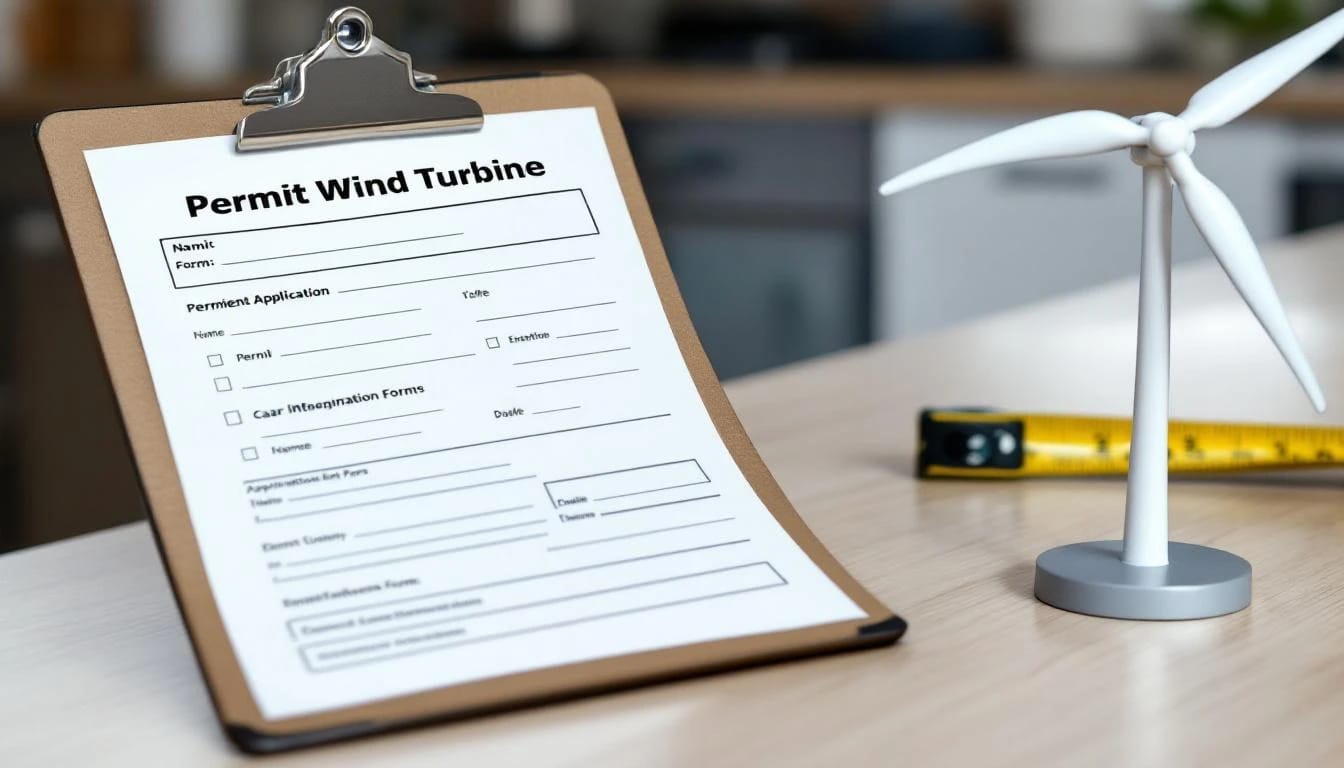
Wyoming homeowners installing small wind turbines face a straightforward but mandatory permitting process. The state requires interconnection approval through your utility's submission to the Wyoming Public Service Commission, county building permits following NEC Article 705 standards, and local zoning clearance that varies dramatically by county—some rural areas allow towers over 100 feet with a simple variance, while others cap residential structures at 35 feet. Most installations take 45-90 days from application to grid connection, assuming the property has adequate wind resources and sufficient setback from property lines.
Wyoming Public Service Commission interconnection requirements
The Wyoming Public Service Commission governs how homeowners connect distributed generation systems, including small wind turbines, to investor-owned utility grids. Wyoming does not mandate net metering statewide, leaving interconnection terms to individual utilities and PSC approval. Rocky Mountain Power, Black Hills Energy, and Cheyenne Light Fuel and Power each operate under different interconnection agreements approved by the PSC.
For systems under 25 kW—typical for a single-family home using a Bergey Excel 10 or Primus Air 40—most utilities offer simplified interconnection. Rocky Mountain Power's Schedule 135 Net Metering Service allows residential systems up to 25 kW to interconnect with an application, proof of electrical inspection, and liability insurance verification. Black Hills Energy requires a signed interconnection agreement and external disconnect switch accessible to utility personnel without entering private property.
The PSC reviews and approves utility tariffs that define technical requirements. Expect anti-islanding protection (IEEE 1547 compliant inverter), a lockable AC disconnect visible from the meter, and potential transformer upgrades if the local distribution circuit lacks capacity. Utilities typically conduct a site evaluation within 30 days of application submission.
![INLINE: Wyoming wind farm with residential turbine installation in foreground showing utility meter and disconnect box]
County building permits and structural review
Every Wyoming county enforces building codes, though adoption of the International Building Code varies. Laramie County, Campbell County, and Natrona County actively enforce permit requirements; some frontier counties with populations under 5,000 have minimal enforcement staff but still require permits on paper.
A building permit application for a wind turbine installation requires engineered foundation drawings stamped by a Wyoming-licensed professional engineer. Tower manufacturers like Bergey and Primus provide generic foundation specs, but Wyoming's frost line depth (48-60 inches depending on elevation) and seismic zone classifications mean site-specific engineering is non-negotiable. The county building department reviews structural calculations to verify the tower can withstand 90 mph wind loads per ASCE 7 standards and ice accumulation common in Wyoming winters.
Electrical work must comply with NEC Article 705 (Interconnected Electric Power Production Sources). A licensed Wyoming electrical contractor must pull the permit, install the system, and schedule inspections. The typical installation includes a dedicated branch circuit, appropriately sized overcurrent protection, and grounding per NEC 250. Inspectors verify proper conductor sizing—often requiring 10 AWG or larger for turbine-to-inverter runs exceeding 100 feet—and bonding of the tower structure to the grounding electrode system.
Permit fees range from $150-$400 for building review plus $75-$200 for electrical inspection. Campbell County charges $0.08 per square foot of foundation area; for a typical 6-foot diameter pier foundation, expect roughly $225. Processing takes 14-30 business days once engineered drawings are submitted.
Zoning ordinances and height restrictions
Wyoming's 23 counties set their own zoning rules, and the variance between jurisdictions is substantial. Laramie County limits accessory structures in residential zones (R1, R2) to 35 feet without a variance, effectively prohibiting viable wind turbines in most of Cheyenne's incorporated areas. The county planning commission can grant variances, but neighbors within 500 feet receive written notice and may contest the application at public hearings.
Natrona County allows agricultural structures up to 80 feet on properties zoned A-1 (agricultural residential) without special permits, provided the tower sits at least 1.5 times its height from any property line. For a 60-foot tower, that's a 90-foot setback—manageable on 2+ acre rural lots common outside Casper city limits.
Unincorporated areas in Sublette, Sweetwater, and Lincoln counties often lack restrictive height ordinances, but all Wyoming counties require compliance with FAA Part 77 regulations. Any structure exceeding 200 feet above ground level requires FAA notification through the FAA's online Notice Criteria Tool. Residential turbines rarely approach this threshold—most top out at 120 feet for hub height—but tilt-up towers on ridge-top installations occasionally trigger review.
Incorporated municipalities write their own ordinances. The town of Jackson restricts turbine installations within town limits to industrial zones, while Sheridan allows residential turbines under 60 feet with administrative approval (no public hearing) in zones R-3 and R-4. Obtain a zoning compliance letter from the county or city planning department before purchasing equipment; discovering height restrictions after delivery wastes time and money.
Homeowner association and covenant restrictions
Roughly 12% of Wyoming housing units fall within subdivisions governed by homeowner associations or restrictive covenants recorded in county deed records. These private agreements frequently prohibit structures exceeding residential rooflines or explicitly ban "windmills, wind turbines, or other power generation equipment visible from adjacent lots."
Wyoming law does not include a solar or wind access rights statute comparable to California's Solar Rights Act. HOAs hold broad authority to enforce architectural restrictions. Before signing a purchase agreement in a planned subdivision, review the Declaration of Covenants, Conditions, and Restrictions (CC&Rs) filed with the county clerk. Search for terms like "structure height," "antennas," "towers," or "alternative energy."
Some newer developments in Teton County and Laramie County include green building provisions that specifically permit small wind turbines if they meet aesthetic guidelines (tower color, blade reflectivity limits). Request written confirmation from the HOA architectural review board before investing in equipment.
Properties outside subdivisions—common in Wyoming's rural areas—typically have no covenant restrictions. Always run a title search through a licensed title company to verify no utility easements or mineral rights agreements prohibit surface structures over certain heights.
Federal Aviation Administration notification
Wyoming's high plains and basin geography mean fewer airspace obstacles than forested or urban states, but FAA notification remains mandatory for structures exceeding 200 feet above ground level. Most residential turbines on 80-100 foot towers do not trigger FAA review unless sited within 20,000 feet of a public airport's runway or within glide slope approach zones.
Jackson Hole Airport, Casper/Natrona County International, and Cheyenne Regional apply airspace restrictions within a 5-mile radius. File FAA Form 7460-1 at least 45 days before construction if your property falls within these zones or if the tower exceeds 200 feet. The FAA issues a Determination of No Hazard within 30-45 days if the structure poses no conflict with instrument flight rules or visual flight paths.
Wyoming has 38 general aviation airports with varying runway lengths and approach patterns. Check the FAA's obstruction evaluation tool online to confirm your coordinates do not penetrate protected airspace. Turbines installed without required FAA clearance face mandatory removal orders and federal penalties up to $10,000 per day of non-compliance.
Electrical interconnection timeline and utility requirements
After obtaining building permits and zoning clearance, the interconnection process with your utility begins with submitting application forms, proof of insurance, and system specifications. Rocky Mountain Power processes applications in 30-45 days for systems under 25 kW. Black Hills Energy requires a site visit to assess transformer capacity and protective relay settings before approving connection.
Utilities mandate specific technical requirements. The inverter must comply with IEEE 1547 (anti-islanding, voltage regulation, frequency ride-through). Popular small wind inverters like the Schneider Electric XW Pro and SMA Windy Boy meet these standards, but verify certification before purchasing. The utility may require an external lockable AC disconnect mounted within 10 feet of the meter, accessible to utility personnel 24/7.
Net metering availability varies by utility. Rocky Mountain Power offers 1:1 net metering credits for excess generation, with kilowatt-hour bank rollover month-to-month and annual true-up in April. Black Hills Energy provides net metering in its Wyoming service territory but compensates excess generation at avoided cost rates (roughly 3.5-4.2 ¢/kWh)—substantially below retail rates of 11.2-12.8 ¢/kWh. Review Schedule 135 (Rocky Mountain Power) or Schedule C-7 (Black Hills Energy) tariffs for specific terms.
Wyoming-specific incentive programs and tax benefits
Wyoming offers no state-level rebates or tax credits for small wind installations as of 2024. Homeowners rely on the federal Residential Clean Energy Credit under IRC §25D, providing a 30% tax credit for equipment and installation costs through 2032. For a $25,000 installed system (typical for a 10 kW Bergey Excel on a 100-foot tower), the credit reduces federal tax liability by $7,500. File IRS Form 5695 with your annual return; the credit applies to system costs including turbine, tower, inverter, installation labor, and electrical upgrades required for interconnection.
No sales tax applies to renewable energy equipment in Wyoming per W.S. 39-15-105(a)(viii)(N), saving roughly 4-6% depending on county rates. Property tax treatment varies; some counties assess wind turbines as real property improvements (increasing assessed value), while others classify them as personal property exempt under agricultural equipment provisions if the property qualifies for agricultural exemption.
Check the DSIRE database maintained by North Carolina State University for updates on Wyoming incentives, though the state historically avoids renewable energy subsidies. Local utilities occasionally offer pilot programs; contact your provider's distributed generation coordinator to inquire about connection fee waivers or expedited interconnection queues.
Installation contractor licensing and insurance requirements
Wyoming requires electrical contractors to hold a state-issued license (journeyman or master electrician) to perform interconnection work. The Wyoming Department of Fire Prevention and Electrical Safety maintains the licensing database. Unlicensed installation voids your interconnection agreement with the utility and creates liability if a system fault causes grid disturbances.
General contractors performing tower foundation and erection work need no state-level licensing in Wyoming, but most counties require commercial general liability insurance proof ($1 million minimum) before issuing building permits for structures over 40 feet. Homeowner's insurance typically excludes coverage for wind turbines; obtain an endorsement or separate policy covering turbine equipment, tower collapse, and third-party injury. Annual premiums range from $400-$800 for a 10 kW system with $50,000 equipment value.
Bergey Windpower and Primus Windpower maintain networks of certified installers who handle permitting, foundation engineering, erection, and electrical interconnection. Turnkey installations from certified crews cost 15-25% more than purchasing equipment separately but reduce permitting delays and code violations. Verify the installer carries Wyoming workers' compensation insurance and bonding before signing contracts; tower work involves fall protection, crane operation, and high-voltage electrical systems.
Comparison of Wyoming utility interconnection policies
| Utility | Service Territory | System Size Limit | Net Metering | Application Fee | Typical Approval Time |
|---|---|---|---|---|---|
| Rocky Mountain Power | Southwest & south-central WY | 25 kW residential | 1:1 credit, annual true-up | $50-$125 | 30-45 days |
| Black Hills Energy | Northeast & east-central WY | 25 kW residential | Avoided cost for excess (~4¢/kWh) | $100 | 45-60 days |
| Cheyenne Light Fuel & Power | Cheyenne metro | 10 kW residential | 1:1 credit, monthly rollover | $75 | 30 days |
| Rural electric co-ops (various) | Rural areas statewide | Varies (10-25 kW) | Varies by co-op | $0-$200 | 30-90 days |
Rural electric cooperatives—including Powder River Energy, Carbon Power & Light, and Tri-County Electric—each set interconnection policies through their boards. Contact your co-op's engineering department for distributed generation interconnection agreements. Some co-ops offer more favorable net metering than investor-owned utilities; others prohibit interconnection entirely or require purchase of all generated power at wholesale rates.
Wind resource assessment and siting for Wyoming properties
Wyoming ranks first nationally for wind energy potential, but ground-level wind speeds vary dramatically by location and terrain. The National Renewable Energy Laboratory's wind resource maps classify most of Wyoming as Class 4-7 (7.0+ m/s average annual wind speed at 50 meters), but localized turbulence, shading from ridges, and microclimatic effects make on-site measurement essential before purchasing a turbine.
Install an anemometer at hub height (typically 60-100 feet for small turbines) and record data for 12 months minimum. The Onset HOBO MX data logger with NRG 40C anemometer costs roughly $1,200 and provides sufficient accuracy for residential site assessment. Wyoming's prevailing winds blow from west-southwest; position the tower to minimize turbulence from buildings, trees, and terrain features upwind.
Properties in the Laramie Basin, Casper area, and along the I-80 corridor from Rawlins to Rock Springs consistently show Class 5-6 wind resources (8.0-9.5 m/s average). Mountain valleys and areas immediately east of the Wind River Range experience more variable wind and localized downdrafts. A site with 5.5 m/s average wind speed (12.3 mph) supports marginal economics for a Bergey Excel 10; bump that to 6.5 m/s (14.5 mph) and annual production increases 40-50%.
Noise ordinances and setback calculations
Wyoming counties rarely enforce specific decibel limits on agricultural or residential property, but good neighbor relations require adequate setback from occupied dwellings. The Bergey Excel 10 produces approximately 44 dBA at 50 feet during 25 mph winds—comparable to a household refrigerator. Most ordinances default to property line setbacks equal to 1.0-1.5× tower height, which automatically creates sufficient distance to attenuate noise below ambient rural levels (35-40 dBA nighttime).
Vertical-axis turbines like the Pikasola 5 kW or Aeolos-V 3 kW produce less blade whoosh noise than horizontal-axis designs but generate mechanical noise from gearboxes and bearings. Newer direct-drive permanent magnet alternators eliminate gearbox whine. If neighbors express concern during the variance process, offer to install only direct-drive models or agree to operate the turbine in low-speed mode (via controller settings) during nighttime hours.
Check for county noise ordinances in municipal code sections covering "nuisance" or "disturbing the peace." Laramie County caps residential zone noise at 60 dBA during daytime, 55 dBA at night, measured at property lines. Most small wind turbines comply easily with these limits when sited appropriately.
Off-grid installations and battery backup systems
Wyoming's grid reaches most developed properties, but off-grid wind installations remain common on remote ranch land, hunting cabins, and communication sites. Off-grid systems require battery storage to provide power during calm periods; Wyoming's wind regime often delivers 2-5 days of low-wind conditions even in high-resource areas.
A 10 kW Bergey Excel paired with 48V battery bank (24 kWh usable capacity) costs $45,000-$65,000 installed, including charge controllers, inverter/chargers, and backup generator integration. Lead-acid batteries (Rolls Surrette, Trojan L16) cost less initially ($8,000-$12,000 for 24 kWh) but require replacement every 5-8 years. Lithium iron phosphate batteries (Simpliphi, Discover) cost $15,000-$20,000 but last 12-15 years with minimal maintenance.
Off-grid systems avoid interconnection permitting with utilities but still require county building permits and electrical inspections. NEC Article 705 applies only to grid-tied systems; off-grid installations follow NEC 690 (Solar) and 710 (Stand-Alone) with some local jurisdictions applying wind-specific interpretations. A licensed electrical contractor familiar with standalone power systems is essential; improperly sized battery cabling or charge controller settings lead to premature battery failure or fire hazards.
Does Wyoming require net metering for small wind turbines?
Wyoming has no statewide net metering mandate. Rocky Mountain Power offers 1:1 net metering voluntarily through tariff Schedule 135, while Black Hills Energy compensates excess generation at avoided cost rates (3.5-4.2 ¢/kWh). Rural electric cooperatives set their own policies. Confirm your utility's distributed generation policy before assuming net metering availability; some Wyoming co-ops prohibit interconnection entirely or purchase power only at wholesale rates substantially below retail electricity prices.
How tall can I build a wind turbine tower in Wyoming without a variance?
Height limits vary by county and zoning district. Laramie County restricts accessory structures to 35 feet in residential zones without variance. Natrona County allows agricultural structures up to 80 feet on A-1 zoned properties. Unincorporated areas in many counties lack specific height limits but require setbacks of 1.0-1.5× tower height from property lines. FAA notification is mandatory for structures exceeding 200 feet above ground level or within 20,000 feet of airport runways. Contact your county planning department for jurisdiction-specific height restrictions before purchasing equipment.
What wind speed do I need for a viable small wind turbine in Wyoming?
A site needs minimum 5.0 m/s (11.2 mph) average annual wind speed at hub height for marginal viability; 6.0 m/s (13.4 mph) or higher provides better economics. Wyoming's average wind speeds range from 6.5-9.5 m/s depending on location, but install an anemometer at planned hub height for 12 months to confirm site-specific conditions. Localized terrain, vegetation, and buildings create turbulence and reduce production. Laramie Basin, Casper vicinity, and I-80 corridor locations consistently deliver Class 5-6 wind resources suitable for small turbines.
Do I need a professional engineer's stamp for a Wyoming wind turbine permit?
Yes. Every Wyoming county building department requires foundation drawings stamped by a Wyoming-licensed professional engineer before issuing permits. Generic foundation specifications from turbine manufacturers do not satisfy this requirement. Site-specific soil conditions, frost depth (48-60 inches), seismic classification, and wind load calculations per ASCE 7 standards require professional engineering review. Budget $1,200-$2,500 for engineering services. Licensed electrical contractors must design and install electrical interconnection systems following NEC Article 705 standards and pull electrical permits for inspection.
Can homeowner associations prohibit wind turbines in Wyoming?
Yes. Wyoming has no solar or wind access rights statute limiting HOA authority to restrict turbines through covenants, conditions, and restrictions (CC&Rs). HOAs can prohibit turbines outright or impose height, visibility, and aesthetic restrictions that make installation impractical. Review subdivision CC&Rs filed with the county clerk before purchasing property if you plan to install a turbine. Properties outside subdivisions typically have no covenant restrictions, but always run a title search to verify no easements or mineral rights agreements prohibit tall structures on the surface.
Bottom line
Wyoming's abundant wind resources and relatively permissive rural zoning make the state favorable for small wind turbine installations, but success requires navigating county building permits, utility interconnection agreements approved by the Wyoming Public Service Commission, and FAA airspace review for taller towers. Budget 60-120 days for the full permitting process and $400-$800 in application fees, engineering stamps, and inspection costs. Property owners in unincorporated rural areas face fewer restrictions than those in subdivisions or incorporated towns; verify zoning height limits and setback requirements before committing to equipment purchases. The federal 30% tax credit remains the only significant financial incentive, as Wyoming offers no state-level rebates or property tax exemptions for wind installations.
Share this article
windturbinehome.com/s/68f7ce
Editorial note: This article was researched and written by a member of the Wind Turbine Home editorial team. AI-assisted tools were used for spell-checking and light grammar review only — all research, analysis, and conclusions are our own. Our editorial policy prohibits sponsored content and paid placements. Read our editorial policy →
Related reading

permits zoning hoa
FAA Tower Marking and Lighting Requirements for Small Wind Turbines
Small wind turbines over 200 feet AGL trigger FAA Part 77 notice requirements. Most residential units stay under thresholds, but taller towers near airports need marking or lighting.

permits zoning hoa
When the HOA Blocks Your Wind Turbine: Legal Options in 2026
HOA rejection isn't always final. State solar-access laws, variance petitions, and FCC's OTARD rule offer paths forward—plus practical workarounds for wind turbines.

permits zoning hoa
Home Wind Turbine Planning Permission UK: PD Rights vs Full Application
UK homeowners can install small wind turbines under Permitted Development rights if specific conditions are met. Otherwise, full planning permission is required from your Local Planning Authority.
permits zoning hoa
Wind Turbine Permits in Iowa: State, County, and Zoning Rules
Iowa wind turbine permits stack three layers: state exemptions below 25 kW (Iowa Code 476.48), county conditional-use or special-exception tracks, and local setback ordinances that trump state law.
permits zoning hoa
Wind Turbine Permits in Texas: TCEQ, County, and HOA Layers
Navigate Texas wind turbine permitting—TCEQ exemptions, county setback rules, HOA restrictions, and FAA notification. Everything homeowners need before installing small wind.

permits zoning hoa
HOA Rules for Wind Turbines: Laws That Override Restrictions
Homeowners associations can restrict wind turbines, but state solar/wind access laws in 20+ states limit those bans. Learn which rules override HOA covenants.

permits zoning hoa
Permit Requirements for a Home Wind Turbine in the USA
Most US homeowners need building, electrical, and possibly FAA permits before installing a residential wind turbine—here's the complete regulatory checklist.
permits zoning hoa
Wind Turbine Distance From Property Line: Setback Rules by Jurisdiction
Setback requirements for residential wind turbines range from 1.1× to 2.5× tower height depending on your jurisdiction. Learn state rules, local ordinances, and FAA limits.
permits zoning hoa
Zoning Laws for Home Wind Turbines USA: What to Check First
Before installing a home wind turbine, check local height restrictions, setback requirements, and noise ordinances. Most residential turbines need 1+ acre and zoning approval.