5 kW Home Wind Turbine Systems: Brands, Output & Costs 2026
Five-kilowatt residential wind turbines cost $15,000–$40,000 installed. Compare Bergey Excel, Primus Air, and certified brands for output, tower height, and grid-tie options.
Share this article
windturbinehome.com/s/e39613
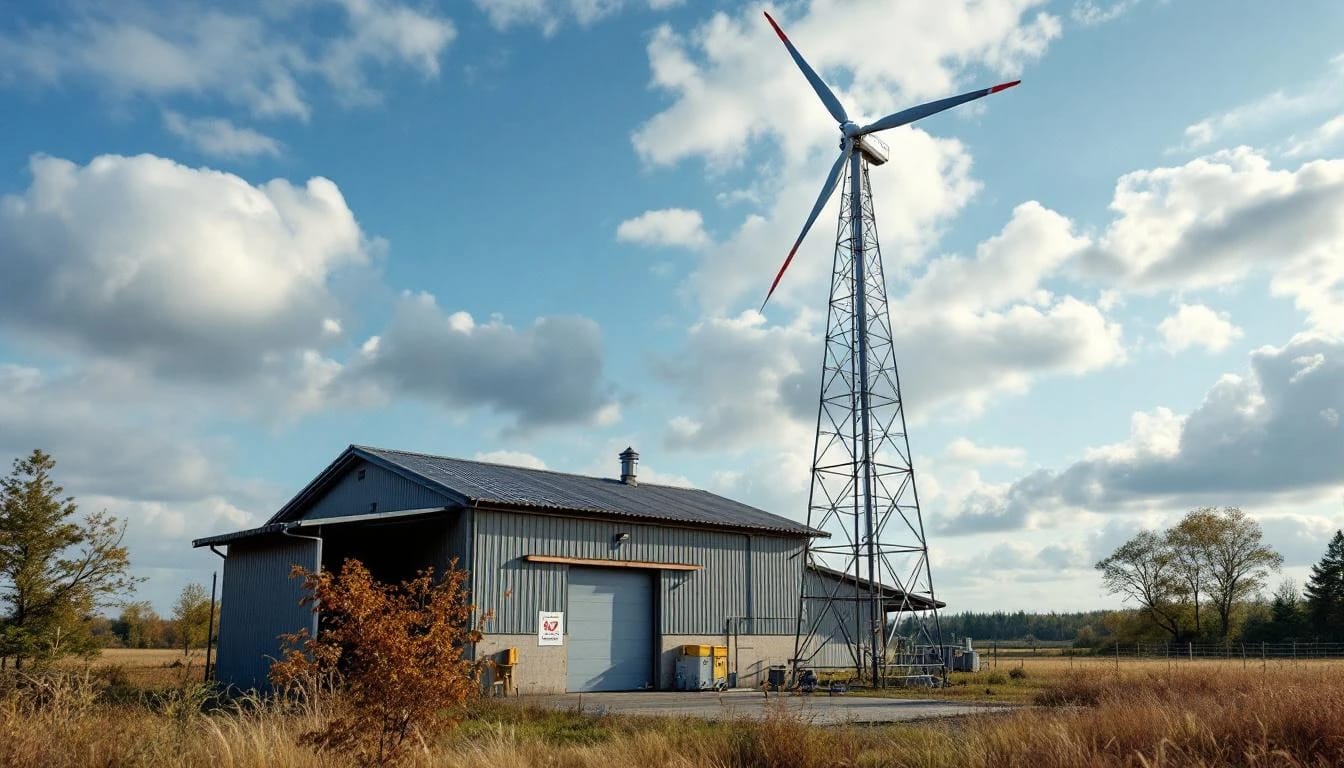
A 5 kW home wind turbine can generate 600–1,500 kWh per month under good wind conditions—enough to offset a substantial portion of an average American household's electricity bill. Installed costs range from $15,000 to $40,000 depending on tower height, grid-tie or battery configuration, and site preparation. The 30% federal Residential Clean Energy Credit (IRC §25D) makes these systems more accessible, though local zoning, FAA Part 77 height limits, and National Electrical Code Article 705 interconnection requirements shape feasibility. This guide profiles the leading brands, breaks down real-world power output, and explains what drives total project cost.
Who manufactures 5 kW residential wind turbines
Bergey Windpower remains the dominant name in small-turbine manufacturing. The Bergey Excel 10 produces a rated 10 kW but is often down-rated or paired with smaller controllers for 5 kW grid-tie applications; installed price typically falls between $28,000 and $38,000 on a 100-foot guyed lattice or tilt-up tower. Bergey turbines carry AWEA 9.1 (now ANSI C212.0) certification, a mark of third-party performance and safety validation that few competitors achieve.
Primus Wind Power offers the Air X and Air Breeze series for marine and off-grid use; these units top out around 400–600 W and are not 5 kW machines, but the company's WindCharger 1500 (1.5 kW) scales into small farms when buyers stack multiple units. True 5 kW alternatives from Primus remain limited.
Aeolos Wind Energy manufactures the Aeolos-H 5 kW horizontal-axis turbine in China and ships to U.S. distributors; pricing starts near $8,000 for the turbine and inverter, but total installed cost rises to $18,000–$25,000 once tower, foundation, and electrician fees enter the picture. Aeolos machines lack AWEA certification, which can complicate permit approval and interconnection agreements with certain utilities.
Southwest Windpower (formerly) produced the popular Skystream series, but the company ceased operations in 2013. Used Skystream 3.7 units (2.4 kW rated, 3.7 kW peak) appear on resale markets for $3,000–$6,000; buyers should budget another $5,000–$8,000 for tower refurbishment and modern inverter upgrades to meet current NEC standards.
Vertical-axis turbines in the 5 kW range—brands like Pikasola and unbranded Savonius/Darrieus imports—promise lower cut-in wind speeds and omnidirectional operation, but field data consistently show 30–50% lower annual energy production than horizontal-axis machines of equivalent rated capacity.
Realistic power output: what 5 kW really means
Nameplate rating assumes the turbine operates at its design wind speed—typically 11–13 m/s (25–29 mph) for small residential machines. Average wind speeds in most inhabited U.S. regions hover between 4 and 6 m/s at 10 meters height, rising to 5–7 m/s at 30 meters (the minimum recommended hub height for a 5 kW turbine).
A Bergey Excel 10 installed on a 100-foot (30 m) tower in a Class 3 wind resource area (annual average 6.5 m/s) will produce approximately 10,000–14,000 kWh per year—roughly 830–1,170 kWh per month. In Class 2 sites (5.5 m/s average), annual output drops to 6,000–9,000 kWh. The U.S. Energy Information Administration reports the average American home consumes about 10,500 kWh annually, so a well-sited 5 kW turbine can meet 60–130% of household demand.
Power curves are non-linear. A turbine generating 500 W at 6 m/s might produce 2 kW at 8 m/s and hit full 5 kW output only at 11 m/s or higher. Because energy is the cube of wind speed, small increases in average speed yield disproportionate gains in annual kWh. This cube-law relationship explains why an extra 10 feet of tower height—lifting the rotor into less turbulent, faster air—can boost production by 15–25%.
Monthly and seasonal variation
Winter months in the Great Plains, upper Midwest, and coastal New England deliver the highest wind speeds; a 5 kW system might produce 1,800 kWh in January and only 400 kWh in July. Battery-backed systems smooth this variability, but grid-tied installations rely on net metering or time-of-use billing to balance seasonal surplus against summer shortfalls. Check your state's net-metering rules via the Database of State Incentives for Renewables & Efficiency (DSIRE) before committing to a grid-connected design.
Tower height and type
Hub height is the single largest performance lever a homeowner controls. The NREL Distributed Wind program and independent field studies consistently show that every additional 10 feet of tower height in open terrain increases annual energy capture by 10–15%, because wind speed rises logarithmically with altitude and turbulence decreases.
Guyed lattice towers (triangular or square cross-section) cost $3,000–$6,000 for a 100-foot system, require guy-wire anchors at three or four points, and demand a cleared radius equal to the tower height. They are the least expensive option and simplest to climb for maintenance, but zoning boards often object to the visual footprint.
Monopole (freestanding tubular) towers eliminate guy wires and shrink the footprint to the pole diameter plus a concrete pier, but engineering and material costs jump to $8,000–$15,000 for 100 feet. Monopoles are easier to permit in suburban parcels with limited setback.
Tilt-up towers (guyed or hinged monopole variants) lower the turbine to ground level for rotor service or storm protection, adding $1,500–$3,000 to base tower cost. This feature appeals to owner-maintainers who want to inspect blade leading edges or replace yaw bearings without hiring a bucket truck.
FAA Part 77 requires owners to notify the agency of any structure exceeding 200 feet above ground level or penetrating defined approach surfaces near airports. Most 5 kW residential installations stay below 120 feet and trigger no FAA review, but local ordinances may cap tower height at 80 or 100 feet regardless of federal rules.
Grid-tie versus battery-backup configurations
Grid-tied systems feed excess power into the utility grid through a grid-following inverter that synchronizes voltage, frequency, and phase. NEC Article 705 mandates a dedicated 240 V AC disconnect, overcurrent protection, and anti-islanding circuitry so the turbine shuts down during grid outages. Installed cost for the electrical balance-of-system—inverter, disconnect, metering, and labor—runs $2,500–$5,000 for a 5 kW machine.
Net metering policies vary by state. Forty-one states plus D.C. maintain some form of net metering, but credit rates range from full retail (one-to-one kWh banking) to avoided-cost wholesale rates. California's NEM 3.0, for example, values exported solar and wind at 5–10 ¢/kWh rather than the 25–35 ¢/kWh retail tier, eroding payback economics for grid-tied wind.
Battery-hybrid systems store surplus generation in lithium iron phosphate (LiFePO₄) or lithium nickel manganese cobalt (NMC) banks, providing backup during outages and peak-shaving capability. A 10 kWh battery adds $6,000–$10,000; a 20 kWh bank (sufficient for two-day autonomy at average consumption) costs $12,000–$18,000. Hybrid inverter-chargers from Outback Power, Schneider Electric, or SMA integrate wind input, battery management, and grid or generator fallback in a single enclosure, priced $3,000–$6,000.
Off-grid designs eliminate utility interconnection but require oversized generation and storage to cover low-wind weeks. Budget 150–200% of grid-tied turbine capacity and three to five days of battery autonomy, pushing total system cost above $50,000 for true energy independence.
Component and installation cost breakdown
| Line item | Low estimate | High estimate | Notes |
|---|---|---|---|
| 5 kW turbine + controller | $8,000 | $18,000 | Bergey, Aeolos, or equivalent HAWT |
| Tower (80–120 ft) | $3,000 | $15,000 | Guyed lattice vs. monopole |
| Foundation & anchors | $1,500 | $4,000 | Engineered concrete pier or helical anchors |
| Inverter (grid-tie) | $1,200 | $2,500 | String or micro-inverter |
| Electrical BOS | $1,500 | $3,000 | Disconnect, breaker panel, wiring, conduit |
| Installation labor | $3,000 | $8,000 | Crane rental, electrician, tower erection crew |
| Permitting & engineering | $500 | $2,500 | Structural stamp, zoning variance, utility interconnection |
| Total installed | $18,700 | $53,000 | Wide range reflects tower choice and site complexity |
The 30% federal Residential Clean Energy Credit (formerly Investment Tax Credit, updated under Inflation Reduction Act provisions) applies to equipment and installation labor. A $30,000 installed system yields a $9,000 credit claimed on IRS Form 5695, reducing net cost to $21,000. State and utility rebates vary; check DSIRE for local programs—some rural electric cooperatives offer additional $0.50–$2.00/watt incentives.
Zoning, permitting, and interconnection
Most jurisdictions treat residential wind turbines as accessory structures subject to setback, height, and noise ordinances. Typical zoning requirements include:
- Setback: 1.1–1.5× tower height from property lines and occupied structures.
- Height limit: 80–120 feet in rural zones; 35–60 feet in suburban/urban districts.
- Noise: 45–55 dBA at property line, measured per ANSI S12.9 or IEC 61400-11 protocols.
- Visual impact: Some municipalities require a visual rendering or "balloon test" (helium balloon flown at proposed hub height for public review).
Utility interconnection agreements follow state Public Utility Commission templates. Expect a one-page application for systems under 10 kW, with approval in two to eight weeks. Larger systems or those in areas with high distributed-generation penetration may trigger grid-impact studies and upgraded transformers at the owner's expense.
A licensed electrician must perform all work downstream of the turbine's AC output terminals, and the local authority having jurisdiction will inspect the installation before issuing a certificate of occupancy or final approval. NEC Article 705 specifies wire sizing, overcurrent protection, and labeling; non-compliance voids interconnection agreements and insurance coverage.
Maintenance and lifespan
Horizontal-axis turbines require annual inspections of blade leading edges, yaw bearing, slip-ring or wireless data connections, and tower bolts. Bergey turbines use permanent-magnet alternators with no brushes or gearbox, reducing service intervals; expect $300–$600 per year for owner-performed checks or $800–$1,500 for a technician visit that includes tower climb and torque verification.
Blade replacement every 10–15 years costs $1,500–$3,000 for a matched set. Bearing and controller electronics may need replacement at year 12–18, budgeting another $2,000–$4,000. Total 20-year maintenance and major-component cost averages $12,000–$20,000, or roughly $600–$1,000 annually.
Insurance riders for wind turbines add $150–$400 per year to homeowner policies, covering turbine damage, tower collapse, and third-party liability. Insurers require annual maintenance logs and may mandate tower base inspections every five years.
Comparing 5 kW turbines to rooftop solar
A 5 kW solar array occupies 300–400 square feet of south-facing roof, costs $12,000–$18,000 installed after the federal credit, and produces 6,000–8,500 kWh per year in most U.S. climates. Wind turbines deliver higher capacity factors in windy regions—Great Plains, coastal zones, mountain passes—where annual average wind speed exceeds 6 m/s. Solar wins in calm, sunny climates (Southwest, Southern California) and on properties with insufficient space for tower setbacks.
Combining wind and solar creates a hybrid system that smooths seasonal and diurnal variability: wind often peaks in winter and at night, solar in summer and midday. A 3 kW wind turbine plus a 4 kW solar array, sharing a battery bank and hybrid inverter, can achieve 75–85% annual energy self-sufficiency on well-sited properties.
For detailed solar-wind hybrid design, see our guide to pairing small wind turbines with rooftop solar.
Real-world case studies
Montana ranch
A Bergey Excel 10 on a 120-foot monopole tower, grid-tied with net metering, produced 16,200 kWh in year one at a Class 4 site (7.2 m/s average). Installed cost: $42,000 ($29,400 after federal credit). Annual savings: $1,800 at $0.11/kWh; simple payback 16 years. The owner values energy security and inflation hedge over pure financial return.
Ohio suburb
A Primus WindCharger 1500 (1.5 kW) on an 80-foot tilt-up tower, paired with 10 kWh lithium battery, generated 3,400 kWh per year in a Class 2 site (5.3 m/s average). Total cost: $22,000 ($15,400 after credit). The system covers backup loads during grid outages but requires grid import for 60% of annual consumption.
Vermont off-grid cabin
An Aeolos-H 5 kW on a 100-foot guyed tower, combined with 30 kWh battery bank and 2 kW solar, powers a small cabin year-round. Installed cost: $48,000. The turbine delivers 9,800 kWh annually; solar adds 2,500 kWh. No utility bill, but maintenance and battery replacement (every 10 years, $15,000) yield effective cost of $0.22/kWh over 20 years—competitive with rural line extension at $30,000–$60,000 per mile.
Learn more about off-grid wind and solar design in our standalone microgrid systems guide.
Financing and incentive stacking
The 30% federal credit applies to systems placed in service through December 31, 2034, with no lifetime cap for residential installations. Homeowners with insufficient tax liability in year one can carry the credit forward for up to five years.
State incentives include:
- New York: NYSERDA residential wind rebates up to $3,000 for certified turbines.
- Massachusetts: MassCEC small wind grants covered 15–30% of project cost (program currently suspended; check DSIRE for reactivation).
- Iowa: Property tax exemption for wind energy systems.
- Montana, Wyoming, North Dakota: Sales-tax exemptions on turbine equipment.
USDA REAP grants (Rural Energy for America Program) fund up to 25% of project cost for rural small businesses and agricultural producers; residential properties are ineligible, but farm-home hybrids qualify if the turbine powers ag operations.
Many regional banks and credit unions offer green-energy loans at 3.5–6.5% APR for 10–15 year terms. A $24,000 loan at 5% over 12 years costs $225/month; if the turbine saves $150/month on electricity, net out-of-pocket is $75/month during the loan period, dropping to $0 (minus maintenance) thereafter.
For a deep dive into state programs, visit DSIRE's wind incentive database.
Choosing the right brand
Select a turbine certified under AWEA 9.1 / ANSI C212.0 or the international IEC 61400-2 standard. Certification confirms third-party testing of power curves, safety systems, noise, and duration. Bergey, Northern Power Systems (now defunct, but used units remain certified), and select European imports meet this bar. Uncertified Chinese turbines may perform adequately but complicate utility interconnection and insurance underwriting.
Check the manufacturer's warranty. Bergey offers five years on the turbine and controller, extendable to ten years. Aeolos provides three years standard. Shorter warranties signal higher expected failure rates.
Ask for local service networks. Bergey has two dozen authorized service partners across the U.S.; Aeolos relies on importers with variable technical depth. A turbine without nearby support becomes a liability when the yaw bearing seizes or the controller faults at midnight.
Review the power curve. Compare manufacturer-claimed output at 5, 7, and 9 m/s against independent test reports. The Small Wind Certification Council published performance data for dozens of models before its 2017 closure; archived reports remain available through the Distributed Wind Energy Association.
For vertical-axis turbine considerations, read our VAWT versus HAWT comparison.
How much land do I need for a 5 kW wind turbine?
A 100-foot tower with guy wires requires a cleared radius of approximately 100–120 feet, or about 0.7–1.0 acre for a circular footprint. Freestanding monopoles reduce the footprint to 0.2–0.3 acre. Zoning setbacks—often 1.5× tower height from property lines—may push the effective land requirement to 2–5 acres in suburban zones.
Can I install a 5 kW turbine myself?
Turbine and tower assembly is possible for mechanically skilled owners, but erecting a 100-foot tower requires a crane or gin-pole lift, guy-wire tensioning tools, and fall-protection equipment. Electrical interconnection must be performed by a licensed electrician to meet NEC Article 705 and pass inspection. DIY foundation work (concrete pier or helical anchors) is feasible but should follow stamped engineering drawings. Budget 60–100 hours of owner labor for a self-install, saving $4,000–$8,000 over turnkey pricing.
What wind speed do I need for a 5 kW turbine to be worthwhile?
Annual average wind speed of 5.5 m/s (12.3 mph) at hub height is the break-even threshold for most residential installations; below that, solar panels deliver better cost per kWh. Class 3 sites (6.5 m/s or higher) offer strong economics, especially in states with robust net metering. Use the NREL WindWatts tool or the AWS Truepower wind maps to estimate your site's resource.
Do wind turbines work in low-wind or urban areas?
Small turbines cut in at 2.5–3.5 m/s but produce minimal power below 5 m/s. Urban and suburban environments suffer from turbulence caused by buildings and trees, reducing effective wind speed and increasing mechanical stress. Rooftop installations rarely succeed because turbulence and structural loading create noise, vibration, and premature component wear. Rural or coastal sites with open fetch are essential for reliable performance.
How long does a 5 kW wind turbine last?
Manufacturer-specified design life is 20 years, but proper maintenance can extend service to 25–30 years. Major components—blades, bearings, controllers—require replacement at 10–15 year intervals. Compare this to solar panels, which carry 25-year performance warranties and need only inverter replacement at year 12–15. Wind turbines demand more active stewardship but offer higher output in suitable locations.
Bottom line
Five-kilowatt residential wind turbines occupy the sweet spot for homeowners with one to five acres, average annual wind speeds above 5.5 m/s, and a willingness to navigate zoning and utility interconnection. Installed costs of $18,000–$40,000 net of federal incentives yield simple paybacks of 10–20 years, improving where state rebates and high retail electricity rates apply. Bergey remains the gold standard for certified reliability; Aeolos and other imports offer lower upfront cost but demand closer vetting of power curves and service support. Measure your site's wind resource, secure a structural engineer's stamp for the tower foundation, and hire a licensed electrician for all AC wiring—three non-negotiable steps that separate successful installations from expensive lawn ornaments. For personalized feasibility analysis, explore the resources at NREL's Distributed Wind program or consult a NABCEP-certified wind installer.
Share this article
windturbinehome.com/s/e39613
Editorial note: This article was researched and written by a member of the Wind Turbine Home editorial team. AI-assisted tools were used for spell-checking and light grammar review only — all research, analysis, and conclusions are our own. Our editorial policy prohibits sponsored content and paid placements. Read our editorial policy →
Related reading
small wind turbines
Furling vs Pitch Control on Small Wind Turbines: Rotor Protection Explained
Small wind turbines use furling or pitch control to protect rotors in high winds. Furling turns the turbine sideways; pitch feathers the blades. Compare costs, reliability, and best applications.
small wind turbines
Capacity Factor for Small Wind Turbines: Realistic Numbers by Site
Most residential wind turbines deliver 10–25% capacity factor in average sites, 25–35% in excellent wind. Learn what those numbers mean for your energy bills.

small wind turbines
Tip Speed Ratio for Residential Turbines: What to Spec
Tip speed ratio determines how efficiently your small wind turbine extracts energy. Learn optimal TSR ranges for HAWT vs VAWT, why it matters for residential installs, and how to match turbine specs to your site conditions.
small wind turbines
Betz Limit Explained: Why No Turbine Extracts More Than 59.3%
The Betz limit proves no wind turbine can convert more than 59.3% of wind's kinetic energy into electricity—a fundamental physics constraint that shapes every rooftop and backyard turbine design.
small wind turbines
IEC 61400-2 Standard Explained: Small Wind Turbine Safety Guide
IEC 61400-2 sets the global safety and performance rules for wind turbines under 200 kW. This guide explains certification requirements, structural tests, and what compliance means for U.S. homeowners.
small wind turbines
What a 5 kW Turbine Produces in Different Wind Classes
A 5 kW small wind turbine generates 6,000-15,000 kWh/year depending on wind class. Class 3 sites (13-15 mph average) deliver 9,000-11,000 kWh annually—enough for most homes.
small wind turbines
Best Small Wind Turbines 1kW-10kW for Homes (2026 Guide)
Compare the top small wind turbines from 1kW to 10kW for residential properties. Real-world output, installed costs, and manufacturer specs—updated 2025.

small wind turbines
Permanent Magnet vs Induction Wind Generator: Which to Spec
Permanent magnet generators dominate residential wind turbines because they self-excite at low RPM and need no grid connection, while induction generators require grid tie and higher wind speeds.
small wind turbines
Best 3 kW Home Wind Turbines 2026: Cost and ROI Compared
Real prices, installation costs and payback for the Bergey Excel 1, Primus Air 40 and Aeolos-H 3kW, so US homeowners see which 3 kW turbine is worth it.