How to Lubricate Wind Turbine Bearings: Schedule & Grease Guide
Learn proper bearing lubrication schedules, NLGI grade selection, and access methods for residential wind turbines to prevent costly failures and extend service life.
Share this article
windturbinehome.com/s/c8f2e0

Bearing lubrication represents the single most critical scheduled maintenance task for residential wind turbines. Manufacturers specify intervals ranging from 500 hours for vertical-axis systems to 2,000 hours for sealed horizontal-axis units, but site conditions—coastal salt exposure, desert dust, temperature extremes—can cut those windows in half. Missing a lubrication cycle invites metal-on-metal contact, exponential wear, and catastrophic failure at rotor speeds where a failed bearing can destroy the generator stator, nacelle housing, and blade assembly in seconds.
Why bearing lubrication determines turbine lifespan
Wind turbines subject bearings to continuous cyclic loads, vibration, and environmental contamination that conventional sealed-for-life industrial bearings never face. The main shaft bearing in a horizontal-axis turbine absorbs radial thrust from the rotor plus axial loads during yaw maneuvers. Vertical-axis systems distribute loads across upper and lower pivot bearings that see constant rotational stress at variable speeds.
Grease serves three functions: it reduces friction between rolling elements and races, carries heat away from contact surfaces, and forms a barrier against moisture and particulate intrusion. When grease film thickness drops below 0.3 microns, metal asperities touch, generating wear particles that accelerate surface degradation. Fresh grease restores film thickness, flushes contaminants, and resets the lubrication clock.
Premium synthetic greases with molybdenum disulfide or PTFE additives extend intervals 30-50% beyond conventional lithium complex formulations, but they cost $40-75 per 14 oz cartridge versus $12-18 for standard grades. The math favors synthetic: a Bergey Excel 10 requires approximately 6 oz per full service—two cartridges cover three cycles, totaling $150 over six years versus $108 for conventional grease requiring twice-annual service.
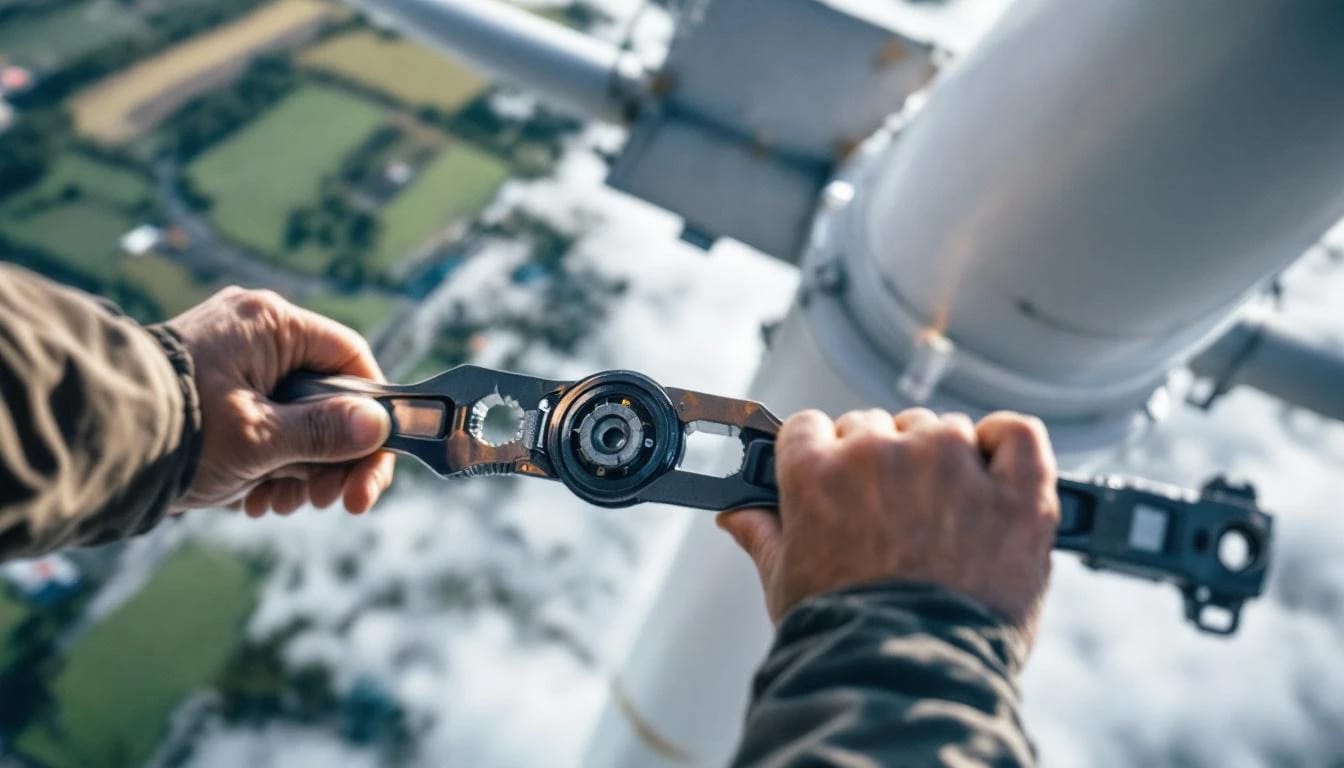
![INLINE: Technician applying grease gun to wind turbine main shaft bearing fitting through nacelle access panel]
Recommended lubrication schedules by turbine type
Horizontal-axis turbines (HAWTs) use tapered roller or deep-groove ball bearings in the main shaft assembly. Bergey specifies annual service for Excels and BWC systems; Primus Air 40 documentation calls for 18-month intervals in temperate climates. Direct-drive permanent-magnet generators eliminate gearbox lubrication entirely, leaving only the main rotor bearing and yaw mechanism.
Count operating hours rather than calendar months. A turbine averaging 12 mph winds runs 7,300-8,000 hours annually; one in a marginal 8 mph site logs 4,500-5,500 hours. Hour meters (available as aftermarket additions for $85-140) provide accurate service triggers.
Vertical-axis turbines (VAWTs) require more frequent attention. The top bearing in a Pikasola 600W Savonius design carries the entire rotor weight while spinning, generating higher contact pressures than horizontal configurations. Manufacturers recommend 500-1,000 hour intervals for units under 2 kW, 1,000-1,500 hours for 3-5 kW models.
Aeolos-V 3 kW vertical turbines use a lower thrust bearing plus mid-shaft support bearing, each needing independent service. Total grease volume: 8-10 oz per full system service.
Geared systems add planetary or helical gearbox lubrication. These require ISO VG 220 gear oil (not grease) changed every 2,000-3,000 hours or when magnetic drain plugs show metallic accumulation. Gearbox maintenance falls outside this discussion but demands equal vigilance—a failed gear train destroys bearings within minutes through shock loading.
Selecting the correct grease grade and specification
NLGI Grade 2 represents the industry standard for wind turbine bearings: soft enough to pump through grease guns at freezing temperatures, stiff enough to stay in place at 160°F bearing surface temps. Grade 1 suits extreme cold climates (Alaska, northern tier states in winter) where Grade 2 turns waxy below 0°F; Grade 3 applies only to high-temperature industrial applications irrelevant to residential turbines.
Base oil matters more than brand. Synthetic polyalphaolefin (PAO) or polyurea greases outperform lithium complex formulations in three areas:
- Temperature range: PAO remains fluid to -40°F and stable to 350°F versus lithium's -10°F to 250°F window
- Oxidation resistance: Synthetic oils resist breakdown from heat and oxygen exposure, extending drain intervals
- Water washout: PAO greases shed moisture rather than emulsifying, critical for towers in humid or coastal zones
Specific product recommendations: Mobil Polyrex EM (-40°F to 350°F, $68 per 14 oz cartridge), Chevron Ulti-Plex Synthetic EP2 ($54), or Magnalube-G NLGI 2 for budget builds ($22, mineral-based but adequate for dry inland sites). Avoid automotive wheel bearing grease—it lacks the extreme-pressure additives required for constant vibration environments.
Compatibility warning: Never mix polyurea and lithium greases. The thickener systems react chemically, forming sludge that blocks passages and accelerates wear. When switching formulations, purge bearings completely—pump new grease until color changes from old to new (typically 3-4 full strokes past specified volume).
Accessing bearing points on horizontal-axis turbines
Most small HAWTs position the main shaft bearing inside the nacelle, requiring tower access and partial disassembly. This presents the chief obstacle to owner-performed maintenance—working 30-120 feet above ground on a narrow platform while the unit rocks in wind gusts.
Tilt-up towers (popular for Bergey and Southwest Windpower retrofits) simplify access. Lower the tower to horizontal using the supplied gin pole and cable winch system. With the nacelle at waist height, locate the grease zerk fitting on the upwind bearing housing. This requires two people minimum: one operating the winch brake, one performing the actual work. Budget 90-120 minutes from start to turbine-operational.
Fixed monopole or guyed towers demand climbing. NEC Article 705 doesn't address tower work directly, but OSHA 1910.269 standards apply to small wind maintenance when performed commercially. Owner-operators fall outside OSHA jurisdiction but should follow the same protocols: full-body harness, twin-lanyard fall arrest, and rescue plan. If that sentence causes hesitation, hire certified tower technicians at $400-650 per service call.
Nacelle covers on Primus and Bergey models use 6-8 stainless bolts (typically 5/16" or 8mm hex head). Remove the downwind cover for main bearing access; keep the upwind section installed as a windbreak. The zerk fitting faces either down or to the side—shine a flashlight into the cavity to locate it before fumbling with the grease gun.
Yaw bearings on free-yawing turbines rarely have grease fittings. The simple sleeve bushing design relies on initial assembly grease lasting 10-15 years. Active yaw systems (uncommon in residential class) use slew ring bearings with dedicated fittings requiring annual service.
Vertical-axis turbine bearing access procedures
VAWTs concentrate bearing points at ground level or low on the tower, eliminating climb requirements. The tradeoff: top bearings often sit inside sealed housings requiring complete rotor removal for service.
Savonius and H-rotor designs mount a thrust bearing at the top of the central shaft. Access procedure:
- Disconnect the generator (lockout/tagout per NEC 705.22 requirements)
- Remove the guy wire upper attachment points if applicable
- Unbolt the blade-to-shaft connections (4-6 bolts per blade, typically 3/8" or 10mm)
- Lift the rotor assembly vertically off the shaft (requires two people for units above 1 kW—rotor weight ranges from 35 lbs for 400W models to 180 lbs for 5 kW)
- Wipe the bearing race clean with lint-free rags and isopropyl alcohol
- Apply 2-4 oz fresh grease with a brush or spatula (not a grease gun—pressure can crack sealed VAWT bearing housings)
- Reassemble in reverse order
Darrieus-style VAWTs use lower pivot bearings accessible through base cover plates. These accept grease gun service without disassembly. Pump grease until a small bead appears around the bearing seal (typically 1-2 oz). Over-greasing wastes product and creates cleanup work; under-greasing leaves gaps where moisture enters.
Grease gun technique and volume calculation
Manual lever-action grease guns deliver approximately 0.7 oz per full stroke. Electric cordless models (Milwaukee M12, Makita 18V) push 1.2-1.5 oz per trigger pull but cost $180-280 versus $25-45 for hand versions. For annual service on one or two turbines, manual guns suffice.
Proper technique:
- Wipe the zerk fitting clean before attachment—a single grain of sand introduced with fresh grease ruins bearing surfaces
- Thread or press the coupler firmly onto the fitting (air gaps waste grease and create mess)
- Pump slowly—one stroke every 2-3 seconds allows grease to flow through internal passages rather than blowing out seals
- Stop when resistance increases noticeably or when the specified volume is delivered (count strokes: 3 strokes ≈ 2 oz for manual guns)
Volume specifications vary by bearing size:
- 400W-1kW turbines: 1.5-2 oz per bearing
- 1-3 kW: 2-4 oz
- 5-10 kW: 4-8 oz
- 10+ kW: consult manufacturer documentation (these often use automatic lubrication systems)
When manufacturer specs are unavailable, use this formula: bearing bore diameter (mm) × 0.002 = ounces per service. A 40mm bore requires approximately 0.08 oz, but double that for heavily loaded applications like main shaft bearings (yields 0.16 oz minimum, round up to 2 oz for safety margin).
Environmental factors that alter service intervals
Coastal installations within 3 miles of saltwater need 50% shorter intervals. Salt fog penetrates seals and accelerates corrosion even in supposedly sealed bearings. Inspect fittings quarterly for green verdigris (copper corrosion) or orange rust streaks indicating seal failure. Switch to marine-grade greases (Lubriplate SFL or Mobil XTC) formulated with corrosion inhibitors.
Desert environments introduce fine dust that acts as grinding compound. Turbines in Arizona, New Mexico, West Texas should add felt dust seals (available from bearing suppliers for $8-15 per seal) behind factory lip seals. Cut intervals by 30% unless the site shows zero dust accumulation inside nacelle covers during annual inspections.
Temperature extremes affect grease viscosity. In northern states where winter temps drop below 0°F, use cold-weather formulations year-round rather than seasonal switching—the hassle and contamination risk of twice-annual grease changes outweigh the modest performance gain.
Turbines that ice up in winter face extra bearing stress from imbalanced rotor loads. Budget 50-75% higher annual grease consumption and inspect for bearing noise (grinding, squealing) after major ice events.
When to replace bearings instead of regreasing
Grease maintenance extends bearing life but doesn't reverse wear. Replace bearings when:
- Noise develops: Grinding, clicking, or humming audible from ground level indicates race pitting or ball spalling
- Play exceeds spec: Grab the rotor hub and attempt to rock it perpendicular to the shaft axis; movement beyond 1-2mm suggests bearing clearance growth
- Temperature rises: IR thermometer readings above 160°F during normal operation (ambient + 40°F is typical; above that indicates friction heat)
- Grease shows metal: Dark gray color or gritty texture when purging old grease during service
Bearing replacement costs run $200-450 in parts for small turbines (under 5 kW) plus $600-1,200 in labor for tower access and press-fit installation. Owners with machine shop access can DIY using bearing pullers and hydraulic presses, but misalignment during installation destroys new bearings immediately. This is a legitimate "hire a pro" task unless prior experience exists.
Creating a maintenance log and setting reminders
Document every service event: date, hour meter reading, grease type/quantity, person performing work, and observations (noise, play, temperature). A simple spreadsheet or paper logbook preserves the data needed to spot developing problems.
Wind turbines qualify for the federal 30% Residential Clean Energy Credit under IRC §25D when placed in service. Detailed maintenance logs support the professional-installation requirement if claiming the credit for a DIY system with contracted electrical hookup (consult tax professionals—IRS guidance remains murky on this edge case).
Use phone calendar apps or dedicated maintenance software (Fiix, Limble) to trigger email/SMS reminders at the hour threshold. Apps like "Hour Meter" (iOS/Android) integrate with smart plugs on turbine control panels to track runtime automatically.
Common mistakes that void bearing warranties
Manufacturers specify grease formulations for reason—substituting automotive or general-purpose products voids coverage. Bergey explicitly requires Mobil Polyrex EM; using alternatives converts any bearing claim into an out-of-pocket expense.
Over-greasing ranks second. Excessive grease increases churning resistance, raises operating temperature, and can blow out seals. Pump the specified volume, stop. More is not better.
Mixing grease types forms the third common error. When purchasing a used turbine, assume the previous owner used unknown grease. Before first service, pump fresh grease continuously until 100% of the old product is purged (identified by color/consistency change), then add the normal service volume.
Delaying service because "the turbine seems fine" destroys bearings. Metal fatigue occurs invisibly over thousands of hours. By the time noise develops, damage is done. Stick to the schedule regardless of apparent performance.
Internal resources for ongoing wind turbine maintenance
Readers managing multiple turbines or considering service business expansion should review wind turbine maintenance cost estimates for annual budgeting, troubleshooting bearing noise in residential wind turbines, and when to replace versus repair small wind turbine components. Those new to tower work should prioritize wind turbine tower climbing safety equipment and techniques before attempting any elevated maintenance.
Off-grid system operators should cross-reference battery bank maintenance schedules for wind-solar hybrid systems since bearing service and battery equalization cycles often align annually. For turbines in severe-weather zones, check preparing wind turbines for hurricane and high-wind events for additional stress factors affecting bearing longevity.
Can I use regular automotive wheel bearing grease in my wind turbine?
Automotive grease lacks the extreme-pressure additives and vibration resistance required for continuous-duty wind applications. It will appear to work initially but breaks down 3-5 times faster under cyclic loading, leading to premature bearing failure. Spend the extra $30 on wind-rated grease—bearing replacement costs 10-20 times more than proper lubrication.
How do I know if I've added enough grease during service?
Count grease gun strokes and compare to manufacturer specifications (typically 3-4 strokes for small turbine bearings using manual guns). Alternatively, pump until you see a small bead of fresh grease appear around the bearing seal, then stop. Over-greasing wastes product and increases friction; under-greasing leaves dry spots where wear accelerates.
Should I grease bearings more often in coastal locations?
Yes—cut standard intervals by 50% for turbines within 3 miles of saltwater. Salt fog penetrates seals and promotes corrosion even in supposedly weatherproof housings. Inspect quarterly for rust or corrosion around fittings and consider marine-grade greases with enhanced corrosion inhibitors for extended protection in harsh seaside conditions.
What tools do I need for DIY bearing lubrication?
A manual lever-action grease gun ($25-45), two 14 oz cartridges of NLGI Grade 2 synthetic grease ($40-75 each), clean lint-free rags, isopropyl alcohol for cleaning, and basic hand tools (wrenches/sockets for nacelle cover removal). For elevated work, add full-body harness, twin lanyards, and appropriate climbing gear. Budget $200-350 total for first-time setup; subsequent services cost only grease replacement.
Can I schedule bearing service around my annual safety inspection?
Combining tasks makes excellent sense for tilt-up towers where lowering the unit creates the main logistical burden. Perform bearing lubrication, blade inspection, electrical connection checks, and guy wire tension verification in a single session. For fixed towers requiring climbing, coordinate with professional inspection services to split access costs across multiple maintenance items—typical bundled service runs $450-700 versus $400 inspection + $400 bearing service separately.
Bottom line
Bearing lubrication separates turbines that deliver 20-year service lives from those requiring major repairs at year 8. Use the correct synthetic NLGI Grade 2 grease, follow manufacturer schedules adjusted for local conditions, and maintain detailed logs. Tower access remains the primary challenge for horizontal-axis systems—invest in proper safety equipment or hire certified technicians for elevated work. Calculate your turbine's annual operating hours and set service reminders now, before metal-on-metal contact converts a $50 maintenance task into a $2,000 bearing replacement.
Share this article
windturbinehome.com/s/c8f2e0
Editorial note: This article was researched and written by a member of the Wind Turbine Home editorial team. AI-assisted tools were used for spell-checking and light grammar review only — all research, analysis, and conclusions are our own. Our editorial policy prohibits sponsored content and paid placements. Read our editorial policy →
Related reading
maintenance troubleshooting
Winterizing Your Home Wind Turbine: Pre-Winter Checklist
Prepare your residential wind turbine for winter with this comprehensive maintenance checklist covering blade inspection, electrical systems, and tower safety.

maintenance troubleshooting
How to Balance Homemade Wind Turbine Blades Without Lab Equipment
Balance DIY wind turbine blades using household items: paint stirrers, fishing line, and sandpaper. Static and dynamic methods reduce vibration by 70-90%.

maintenance troubleshooting
Charge Controller Fault Codes: What They Actually Mean
Decode your wind turbine charge controller fault codes with this practical guide covering overcurrent, overvoltage, temperature errors, and sensor failures.

maintenance troubleshooting
A Realistic Annual Maintenance Schedule for Small Wind Turbines
Monthly visual checks, quarterly bolt torque, semi-annual blade inspections, and annual electrical testing keep small wind turbines safe and productive for 20+ years.

maintenance troubleshooting
Wind Turbine Ice on Blades: Detection, Mitigation & Shutdown
Ice buildup on wind turbine blades reduces efficiency by 20-80% and increases structural stress. Learn detection methods, heating systems, and safe shutdown protocols.

maintenance troubleshooting
Wind Turbine Slip Ring Replacement: Signs, Steps, Cost
How to tell when a residential wind turbine slip ring needs replacing, plus the tools, safety steps, and typical cost for both HAWT and VAWT setups.

maintenance troubleshooting
Wind Turbine Yaw Motor Not Working: Diagnosing and Fixing
Yaw motor failures lock turbines facing the wrong direction, costing 30-70% of power. Learn to diagnose controller faults, seized bearings, and wiring issues.

maintenance troubleshooting
How to Brake a Runaway Wind Turbine Safely | Emergency Stop
Learn three proven methods to stop a runaway residential wind turbine: dynamic braking, manual furling, and emergency disconnect. Quick action prevents damage.

maintenance troubleshooting
Wind Turbine Blade Cracked: Repair or Replace Guide (2024)
Discovered a crack in your wind turbine blade? Learn when repair is viable versus replacement, sourcing options for parts, and safety protocols before climbing towers.