Winterizing Your Home Wind Turbine: Pre-Winter Checklist
Prepare your residential wind turbine for winter with this comprehensive maintenance checklist covering blade inspection, electrical systems, and tower safety.
Share this article
windturbinehome.com/s/cf0109
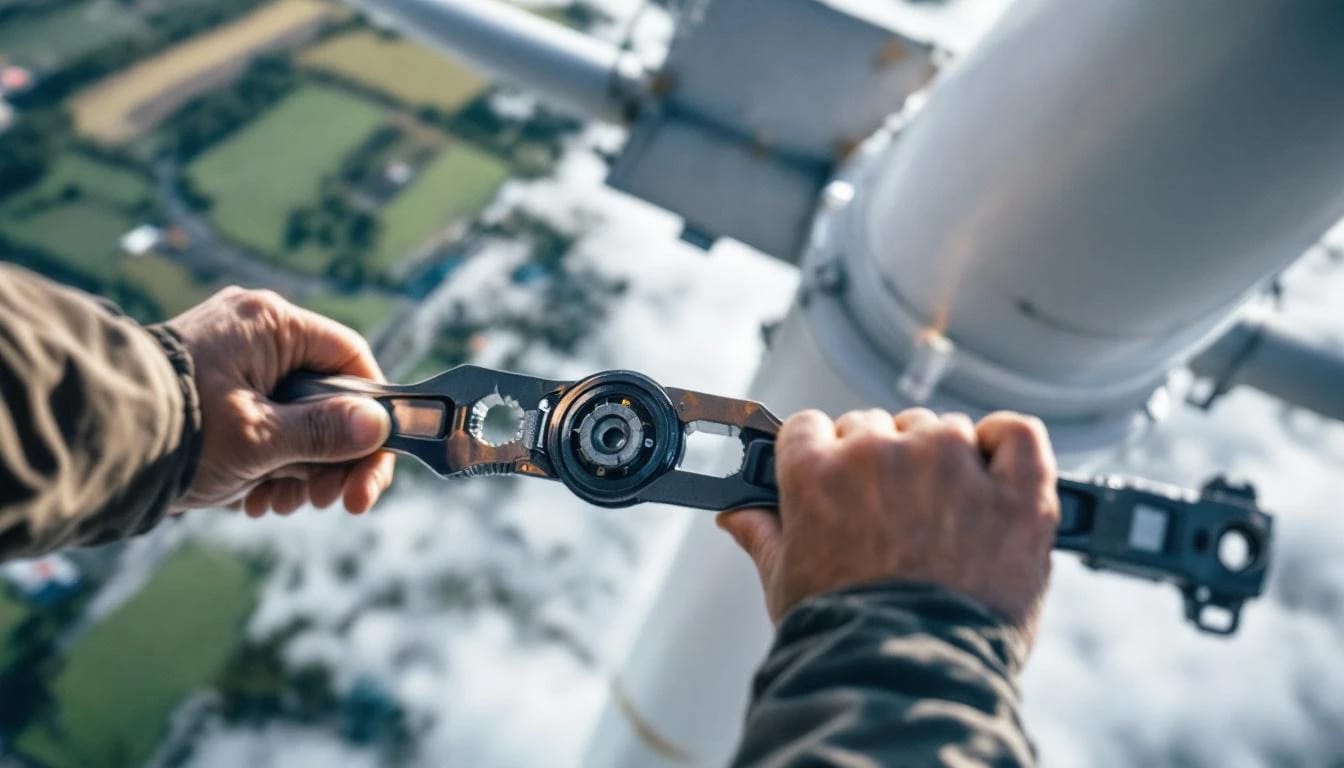
Cold weather creates unique mechanical and electrical stresses that small wind turbines must withstand for months. A pre-winter inspection reduces forced shutdowns, prevents ice-related damage, and maintains energy production when heating loads peak. This checklist walks through blade condition, electrical connections, tower hardware, brake systems, and manufacturer-specific cold-weather protocols—giving turbine owners a systematic approach before the first freeze.
Blade Inspection and Balance Verification
Winter wind carries debris, ice particles, and higher average velocities that accelerate blade wear. Walk the turbine down or use binoculars to examine each blade for:
- Leading-edge erosion or pitting that traps moisture and promotes ice buildup
- Trailing-edge delamination in composite blades (common on Primus Air 40 and older Bergey Excel models)
- Bolt-hole elongation at the hub attachment points
- UV crazing on fiberglass surfaces that can crack under freeze-thaw cycles
Balance drift manifests as vibration or noise at specific RPM ranges. Static-balance each blade on a horizontal bar or use a digital inclinometer at the blade root; manufacturers specify tolerances between ±0.5° and ±2° depending on diameter. Out-of-balance blades cause bearing wear and tower oscillation that worsens when ice unevenly coats one blade.
Vertical-axis turbines (Pikasola 600W, Aeolos-V series) require inspection of all vertical struts and crossarm bolts. Check for hairline cracks where struts meet the central shaft—a failure point under torsional loads when ice sheds asymmetrically.
Electrical Connection Audit
Temperature cycling expands and contracts metals at different rates, loosening terminal screws and wire ferrules. Perform a thermal-imaging scan or manual torque check on:
- Turbine head junction box: Retorque phase leads to manufacturer spec (typically 8-12 in-lb for 12 AWG copper)
- Tower-base disconnect: Verify all lugs and busbar contacts; apply Noalox or equivalent on aluminum conductors
- Inverter DC terminals: Check polarity, torque, and wire insulation for rodent damage near ground level
- Grounding electrode conductor: Confirm continuous bonding from turbine frame to ground rod (NEC 250.52); measure resistance below 25 ohms
Cold weather increases resistance in lead-acid and AGM batteries; lithium iron phosphate handles low temperatures better but still needs charge-controller low-temperature cutoffs. If the system uses a battery bank, verify the controller is programmed to reduce charge current below 32°F to prevent lithium plating or sulfation in lead-acid cells.
Grid-tied inverters (SMA Windy Boy, Ginlong Solis) should display error logs from the prior season. Clear nuisance faults but investigate recurring ground-fault or arc-fault trips—these often indicate moisture intrusion that will worsen when snow melts and refreezes.
External wiring conduit must drain; drill weep holes at low points if not already present. Water inside EMT or PVC conduit freezes, expands, and cracks the jacket of THWN-2 wire, creating ground faults that shut down the system until spring.
Tower Structural and Hardware Check
Guy wires stretch over time and sag more in cold temperatures. Use a Loos tension gauge or the deflection method to verify each guy wire meets the manufacturer's specified tension—typically 10-15% of breaking strength. On a Bergey 10 kW with 7×19 aircraft cable, this translates to roughly 400-600 pounds per guy. Uneven tension allows tower sway that fatigues welds and anchor points.
Walk the guy-wire anchor radius and confirm:
- Turnbuckles are safetied with lock wire (not just cotter pins, which vibrate loose)
- Ground anchors show no heave or settlement
- Guy wires clear snow-shed zones from building roofs
Inspect the tower base plate or hinge assembly for:
- Rust bloom around bolt holes (indicates water infiltration and freeze-thaw cracking)
- Elongated holes in the base plate or anchor bolts
- Cracked welds at the hinge pin or pivot tube
Tilt-up towers (common for Primus, Southwest Windpower, and homebrew installs) need hinge-pin lubrication with marine-grade grease. Frozen hinges prevent emergency lowering during an ice storm.
Free-standing lattice towers (Rohn 25G, 45G) require inspection of all bolted joints. Check torque on every leg-to-crossmember connection; ice loading quadruples lateral forces compared to summer wind loads.
Brake and Overspeed Protection Systems
Most small turbines use one or more braking methods: aerodynamic stall (furling tail), electrical dynamic braking, or mechanical disc/drum brakes. Each has winter vulnerabilities.
Furling systems (Bergey Excel, ARE 442) rely on a spring-loaded tail vane that rotates the turbine out of the wind at high speed. Inspect:
- Tail hinge bearing for corrosion or seizing (spray with dry PTFE lubricant, not oil that attracts moisture)
- Furling spring tension and attachment bolt torque
- Limit stops that prevent over-rotation
Frozen tail bearings cause runaway events. If the turbine lacks an automatic brake, the only shutdown is manual or a dead-short across the output terminals—both dangerous in icing conditions.
Dynamic braking uses a dump resistor or short-circuit relay to load the alternator and stop rotation. Verify the brake resistor (often a grid of wire-wound coils) shows no corrosion or loose terminals. Measure resistance; a 5-ohm resistor that drifts to 7 ohms won't dissipate enough energy to hold the turbine stopped in a 40 mph gust.
Mechanical disc brakes (common on larger Aeolos and Bergey models) need pad thickness inspection and caliper piston freedom. Apply silicone brake grease to the caliper slide pins—never petroleum grease, which swells rubber seals. Brake lines must be bled if air entered during summer maintenance; compressible air in hydraulic lines causes brake fade when the fluid chills.
Test the brake by activating it from the controller or manual switch while the turbine spins in light wind. It should stop within two rotor revolutions; longer stopping indicates pad wear or insufficient hydraulic pressure.
Cold-Weather Lubricants and Seal Replacement
Most turbine manufacturers specify ISO VG 68 or VG 100 synthetic gear oil for yaw bearings and gearboxes. Petroleum oils thicken below 20°F, increasing startup torque and causing dry-start wear. Drain the old oil and refill with cold-weather synthetic (Mobil SHC 634, Castrol Optigear BM series) if the turbine operates below 10°F.
Main-shaft bearings often use sealed cartridge units (6200-series deep-groove ball bearings on small turbines). These are "lubed for life" but benefit from external grease fittings if the manufacturer installed them. Pump two strokes of NLGI Grade 2 synthetic grease with low-temperature additive into each bearing housing; excess will purge through the seals.
Rubber shaft seals harden and crack in freezing temperatures. If the turbine shows oil weeping around the main shaft, replace the seal before winter. A $12 seal replacement in October prevents a $600 alternator rewind in February when moisture infiltrates the stator windings.
Vertical-axis turbines require inspection of the top bearing housing where the central shaft exits. Snow and ice melt into this housing; ensure the weather cap is secure and the drain hole is clear.
Ice Management Strategies and Sensor Calibration
Ice accumulation on blades reduces efficiency and creates imbalanced loads that damage bearings and shafts. Three approaches exist:
Passive shedding relies on blade flex and centrifugal force. This works for turbines above 4 kW in rotor diameter but fails on smaller units with rigid blades. No action is required, but expect 30-50% output loss during icing events.
Heated blades (rare on residential turbines, available as aftermarket for Bergey 10 kW and larger) use resistive heating elements embedded in the leading edge. These draw 500-1,500 watts—often more than the turbine generates in icing conditions. Budget for grid draw or battery discharge to power heating elements.
Manual deicing involves shutting down and lowering the turbine, then chipping ice off blades. This is practical only for tilt-up towers and must be done after the ice storm passes (attempting it during active icing risks refreeze and personal injury).
Anemometer icing is a hidden problem. Cup anemometers freeze solid, sending zero-wind signals to the controller and preventing startup even when 20 mph winds are available. Heated anemometers (RM Young 5103, NRG Systems IceFree3) draw 5-10 watts continuously but prevent false shutdowns. Alternatively, install a wind vane as a backup; most controllers accept dual input and will defer to the working sensor.
Recalibrate cut-in and cut-out speeds if the controller allows. Raising cut-in from 7 mph to 9 mph prevents stall cycles in gusty winter winds; lowering cut-out from 35 mph to 32 mph reduces stress on cold-embrittled components.
Controller Firmware and Data Logging Review
Inverters and charge controllers receive periodic firmware updates that improve cold-weather performance. Check the manufacturer's website for:
- Low-temperature charge algorithms (critical for lithium battery systems)
- MPPT tracking adjustments for higher air density (winter air is 10-15% denser, increasing power at a given wind speed)
- Arc-fault detection sensitivity tuning (reduces nuisance trips from static buildup on dry, cold days)
Download the previous winter's data logs (if equipped with Modbus, WiFi, or cellular monitoring). Look for:
- Repeated shutdown codes during specific temperature ranges
- Power output drop-off at wind speeds that should produce rated output (indicates blade icing or bearing drag)
- Voltage sags that correlate with freeze-thaw cycles (suggests wiring or connection issues)
Identifying patterns now allows targeted fixes. A turbine that shuts down every time temperature crosses 28°F likely has a moisture-infiltrated sensor or relay that freezes.
FAA Lighting and Marking Compliance (Towers >200 Feet AGL)
Residential turbines rarely exceed 200 feet above ground level, but if your tower plus terrain puts the top in airspace requiring FAA notification (Part 77), verify that aviation obstruction lighting is functional. Replace incandescent bulbs with LED units rated to -40°F. Photocell controls must be cleaned of dust and debris; snow cover can trick the sensor into thinking it's daylight, leaving the light off at night.
Paint or marking materials fade under UV and weather. Red and white banding or solid aviation orange must meet Federal Standard 595 color specs. Repaint every three years or after inspectors note fading.
Documentation and Permit Renewals
Some jurisdictions require annual turbine inspections or recertification. Pull the permit file and verify:
- Structural inspection due dates (common in coastal counties with hurricane exposure)
- Electrical inspection intervals (rare for residential but required in some California counties)
- Homeowner's insurance rider for wind turbines (standard policies exclude turbine damage; expect $200-400/year for a rider covering a 5-10 kW unit)
Document the pre-winter inspection with dated photos of blades, tower base, guy wires, and electrical connections. If a failure occurs during a winter storm, insurers and manufacturers request proof of maintenance to honor warranties.
Should I shut down the turbine during severe winter storms?
Most manufacturers recommend leaving the turbine running unless sustained winds exceed the rated survival speed (typically 110-120 mph for residential units). The alternator provides electromagnetic braking that damps oscillation. Shutting down in high wind requires manual braking or a dead-short, both difficult in active storms. If ice accumulation causes severe imbalance (audible thumping or visible tower sway), activate the brake immediately and inspect after the storm passes.
How do I prevent rodents from nesting in the tower base or controller enclosure during winter?
Seal all conduit entries with expanding foam or wire mesh. Place mothballs or peppermint oil-soaked rags (replaced monthly) inside the controller enclosure. Rodents chew wire insulation for the soy-based plasticizers, causing short circuits. Elevated turbine electronics (mounted 6+ feet high) are less vulnerable than ground-level inverters. If nesting occurs, clean debris and inspect all wire insulation before re-energizing.
Can I replace blades or perform major repairs in winter, or should I wait until spring?
Composite blade repairs (epoxy, fiberglass layup) require minimum 50°F curing temperatures for 24-48 hours. Attempting repairs below freezing produces weak bonds that fail under centrifugal loads. Mechanical repairs (bearing replacement, bolt torquing) are acceptable in cold weather if you use thread-locking compounds rated for low-temperature application (Loctite 243 works to -65°F; standard 242 gels below 20°F). Schedule major work for spring or rent a heated enclosure for critical winter repairs.
Do I need a licensed electrician for the electrical inspection, or can I DIY?
NEC Article 705 governs interconnection of on-site electric power sources. While homeowners can perform their own electrical work in most states, the utility requires a licensed electrician's signature for grid-tied system inspections before granting permission to operate. Off-grid systems fall under local building codes; many rural counties allow homeowner electrical work with an inspector's sign-off. Insurance claims for electrical fires are routinely denied if unlicensed work is discovered, regardless of legality.
What's the expected payback period on winterization maintenance costs?
A thorough pre-winter inspection costs $200-400 in parts (lubricants, fasteners, blade repair materials) plus 8-12 hours of labor if you DIY, or $800-1,200 for professional service. Preventing a single bearing failure ($600-1,500 repair) or blade replacement ($1,200-3,000 per blade for a 5 kW turbine) pays for the inspection multiple times over. More importantly, maintaining 80-90% winter uptime instead of 50-60% adds 600-1,200 kWh over a four-month heating season—worth $72-180 at $0.12/kWh, or $300-600 if offsetting propane heat at $3.00/gallon equivalent.
Comparison of Cold-Weather Turbine Features
| Turbine Model | Cold-Weather Lubrication | Heated Anemometer | Ice Shedding Method | Operating Temp Range |
|---|---|---|---|---|
| Bergey Excel 10 | VG 68 synthetic (factory fill) | Optional NRG IceFree ($425) | Passive + furling | -40°F to 140°F |
| Primus Air X | Not specified (upgrade to Mobil SHC) | Not available | Passive (manual shutdown recommended <20°F) | -20°F to 120°F |
| Aeolos-H 5kW | ISO VG 100 (requires change <10°F) | Included (heated cup type) | Passive + mechanical brake | -30°F to 130°F |
| Pikasola 2kW Vertical | Sealed bearings (no service) | Not applicable (uses wind vane) | Active shedding (flex blades) | -4°F to 104°F |
Bottom Line
A systematic pre-winter inspection prevents 80% of cold-weather failures while extending component lifespan by three to five years. Focus on blade balance, electrical connection torque, tower hardware tension, and brake functionality—these four areas account for the majority of winter shutdowns and repair costs. If your turbine is more than five years old or operates in temperatures below 0°F, budget for a professional inspection every other year to catch fatigue cracks and wear patterns that visual checks miss. Schedule the work for October before weather turns; most turbine service companies are booked solid once snow flies.
Share this article
windturbinehome.com/s/cf0109
Editorial note: This article was researched and written by a member of the Wind Turbine Home editorial team. AI-assisted tools were used for spell-checking and light grammar review only — all research, analysis, and conclusions are our own. Our editorial policy prohibits sponsored content and paid placements. Read our editorial policy →
Related reading

maintenance troubleshooting
How to Balance Homemade Wind Turbine Blades Without Lab Equipment
Balance DIY wind turbine blades using household items: paint stirrers, fishing line, and sandpaper. Static and dynamic methods reduce vibration by 70-90%.
maintenance troubleshooting
Charge Controller Fault Codes: What They Actually Mean
Decode your wind turbine charge controller fault codes with this practical guide covering overcurrent, overvoltage, temperature errors, and sensor failures.

maintenance troubleshooting
A Realistic Annual Maintenance Schedule for Small Wind Turbines
Monthly visual checks, quarterly bolt torque, semi-annual blade inspections, and annual electrical testing keep small wind turbines safe and productive for 20+ years.

maintenance troubleshooting
Wind Turbine Ice on Blades: Detection, Mitigation & Shutdown
Ice buildup on wind turbine blades reduces efficiency by 20-80% and increases structural stress. Learn detection methods, heating systems, and safe shutdown protocols.

maintenance troubleshooting
Wind Turbine Slip Ring Replacement: Signs, Steps, Cost
How to tell when a residential wind turbine slip ring needs replacing, plus the tools, safety steps, and typical cost for both HAWT and VAWT setups.

maintenance troubleshooting
How to Lubricate Wind Turbine Bearings: Schedule & Grease Guide
Learn proper bearing lubrication schedules, NLGI grade selection, and access methods for residential wind turbines to prevent costly failures and extend service life.

maintenance troubleshooting
Wind Turbine Yaw Motor Not Working: Diagnosing and Fixing
Yaw motor failures lock turbines facing the wrong direction, costing 30-70% of power. Learn to diagnose controller faults, seized bearings, and wiring issues.

maintenance troubleshooting
How to Brake a Runaway Wind Turbine Safely | Emergency Stop
Learn three proven methods to stop a runaway residential wind turbine: dynamic braking, manual furling, and emergency disconnect. Quick action prevents damage.

maintenance troubleshooting
Wind Turbine Blade Cracked: Repair or Replace Guide (2024)
Discovered a crack in your wind turbine blade? Learn when repair is viable versus replacement, sourcing options for parts, and safety protocols before climbing towers.