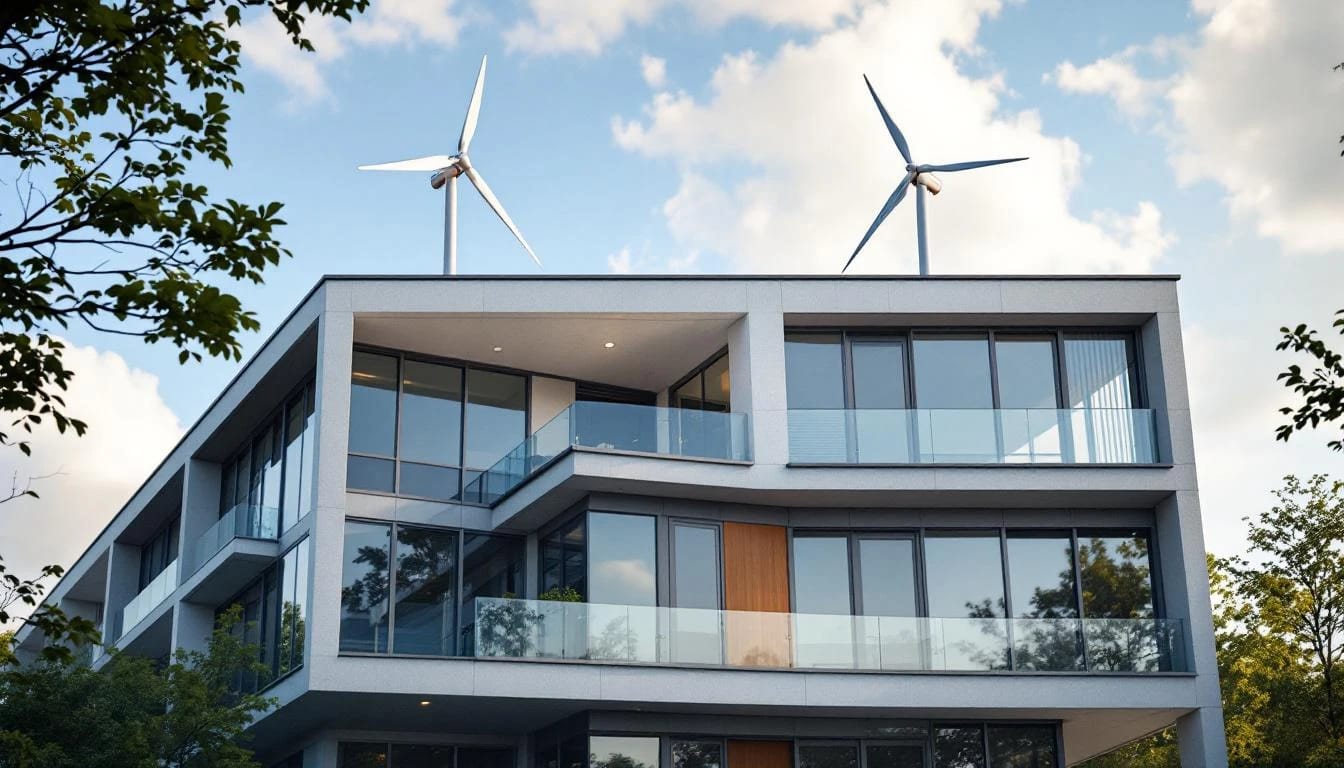
Parapet-Mounted Wind Systems for Low-Rise Commercial Buildings
Parapet wind turbines offer flat-roof solutions for 1-4 story offices, warehouses, and retail. Learn mounting, FAA limits, output, and cost for commercial rooftop installations.
Share this article
windturbinehome.com/s/389d1c
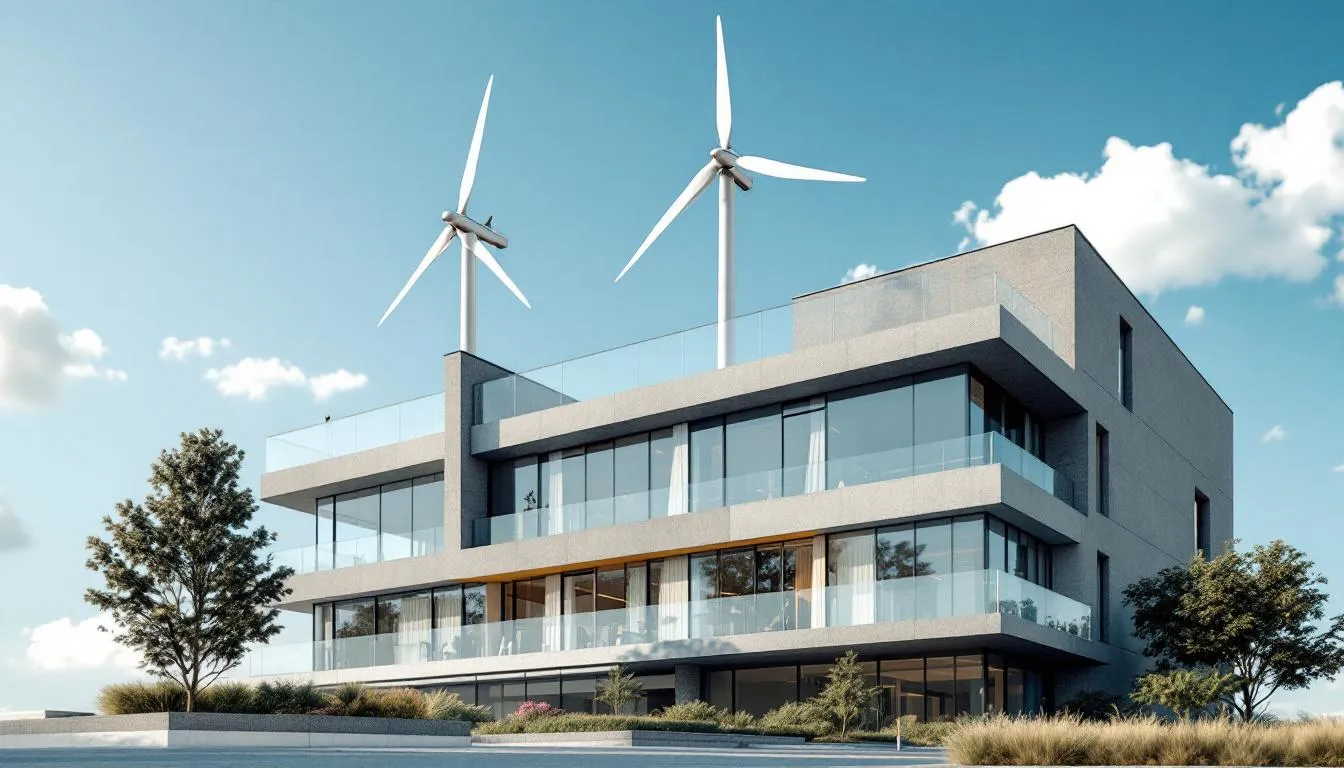
Parapet-mounted wind systems install small horizontal-axis or vertical-axis turbines along the raised edge walls of flat commercial roofs, typically on buildings one to four stories tall. The parapet acts as a pre-existing anchor structure, eliminating the need for standalone tower foundations while positioning turbines where accelerated wind flow over the building's edge increases energy capture by 20-40% compared to open ground sites. Properly engineered systems rated 1-10 kW can offset 8-22% of a low-rise commercial building's annual electricity demand in NREL Class 3+ wind areas (average speeds above 6.0 m/s at hub height), with ROI periods ranging from 9 to 16 years before incentives.
Parapet Wind Turbine Design Fundamentals
The parapet serves as both a structural mounting platform and a flow accelerator. Building codes require parapet walls at least 30 inches tall on flat roofs; most commercial parapets reach 36-60 inches, providing a robust attachment point for wind turbine support brackets. Turbines mount directly to the parapet's inner face using through-bolted steel channels, or to independent posts bolted through the parapet cap.
Vertical-axis wind turbines (VAWTs) dominate parapet applications because they accept wind from any direction and present lower aerodynamic loads than horizontal-axis designs. Savonius and Darrieus configurations from manufacturers such as Aeolos and Pikasola typically measure 1.2-2.4 meters in diameter and 1.5-3.0 meters tall, fitting within the setback zones most jurisdictions require for rooftop equipment. Horizontal-axis turbines work on parapets but demand yaw control systems and stronger lateral bracing to resist thrust forces during high winds.
Building-edge flow acceleration occurs when wind encounters the building's facade, compresses as it climbs the wall, then expands rapidly over the parapet. Wind speed increases by a factor of 1.2 to 1.6 at the roof edge in a zone extending roughly one building-height downwind from the parapet. Parapet turbines capture this augmented flow, but placement requires careful calculation—too close to the edge generates excessive turbulence; too far inboard loses the acceleration benefit.
![INLINE: Schematic diagram showing wind flow acceleration over a commercial building parapet with turbine mounting zone highlighted]
Structural and Electrical Requirements
Commercial roof structures must support static turbine weight (60-220 lb per unit) plus dynamic loads from wind thrust, vibration, and gyroscopic precession. A structural engineer licensed in the jurisdiction must evaluate existing parapet capacity and design the mounting interface. Most parapets use concrete masonry units (CMU) or cast concrete, both suitable for turbine loads with proper fastening.
Through-bolt connections require epoxy-set anchors rated for 3,000 lbf minimum pull-out resistance per fastener location. Four to eight fasteners typically secure each turbine bracket. Stainless steel hardware resists corrosion from roof membrane off-gassing and HVAC condensate. Vibration isolation pads between bracket and parapet reduce structure-borne noise transmission into occupied spaces below—critical in office and retail settings.
NEC Article 705 governs interconnection of turbine output to the building electrical system. Turbines rated above 100 kVA require utility notification and possible dedicated transformer; systems below this threshold tie into existing service panels via a dedicated 20-40 amp breaker. Install a lockable AC disconnect within sight of the turbine and another at the main service entrance. Conduit runs from rooftop turbines to electrical rooms must maintain watertight integrity and include expansion fittings to accommodate building movement.
Inverters convert turbine AC or DC output to grid-synchronous 120/208V or 277/480V three-phase power matching the building's service. Grid-tie inverters meeting UL 1741 standards automatically disconnect during utility outages, preventing islanding hazards for line workers. Microinverters mounted near each turbine simplify wiring and allow independent MPPT (maximum power point tracking) when multiple turbines share a roof.
A licensed electrician must perform all electrical work, and the installation must pass inspection by the authority having jurisdiction (AHJ). Local amendments to the NEC apply.
Site Assessment and Wind Resource
Commercial parapet installations require annual average wind speeds above 5.5 m/s at turbine hub height to achieve positive economics. Urban and suburban buildings face significant wind shading from nearby structures, requiring site-specific modeling rather than generic wind maps.
Tools for commercial wind assessment:
| Method | Cost | Accuracy | Time Required |
|---|---|---|---|
| On-site anemometer (30-day min.) | $400-$1,200 | ±12% | 90-180 days |
| Professional wind study | $3,000-$8,000 | ±8% | 60-120 days |
| CFD simulation (if building plans available) | $2,500-$6,000 | ±10% | 30-60 days |
| NREL Wind Toolkit database extrapolation | Free | ±18% | Immediate |
Mount anemometers at proposed turbine hub height using temporary masts that do not penetrate the roof membrane. Record wind speed and direction in 10-minute intervals; upload data to analysis software such as Windographer or RETScreen to generate frequency distributions and power density estimates.
Parapet installations suffer from two site-specific challenges: turbulence intensity and directional variability. Turbulence intensity (TI) above 25% reduces turbine lifespan and power output. Buildings surrounded by structures of similar height create chaotic flow regimes with TI exceeding 30%. Standalone buildings in industrial parks or big-box retail sites with large parking lots perform better, with TI in the 15-20% range.
Directional variability matters for horizontal-axis turbines on parapets, which must yaw to face changing wind directions. Urban sites show 140-270° directional spread, causing frequent yaw events that degrade gearbox components. VAWTs eliminate this concern.
System Sizing for Commercial Applications
Commercial buildings consume 10-30 kWh per square foot annually depending on use type, HVAC configuration, and operating hours. A 10,000 sq ft office averaging 15 kWh/sq ft demands 150,000 kWh yearly. A 5 kW parapet turbine in a Class 3 wind site produces 7,000-11,000 kWh annually, offsetting 5-7% of the building's load.
Multiple turbines improve coverage. Three 3.5 kW turbines spaced 12-18 meters apart along a 60-meter parapet perimeter generate 18,000-27,000 kWh combined, assuming minimal wake interference. Turbine spacing of 5-7 rotor diameters in the prevailing wind direction prevents upstream units from starving downstream turbines of wind energy.
Realistic capacity factors for parapet VAWTs:
- Class 2 wind site (5.0-5.5 m/s): 8-12%
- Class 3 wind site (5.5-6.0 m/s): 12-18%
- Class 4 wind site (6.0-6.5 m/s): 18-24%
Horizontal-axis turbines achieve 15-30% higher capacity factors in the same wind regimes but require more robust mounting hardware. Primus Air 40 and Bergey Excel 1 models suit parapet installations on buildings in rural or coastal zones with clean wind flow.
Permitting, Zoning, and FAA Considerations
Municipal zoning ordinances limit rooftop structure height above the building's primary roof line. Typical allowances range from 5 to 15 feet, excluding HVAC equipment and antennas. Parapet-mounted turbines add 5-12 feet depending on model, often fitting within existing exemptions for mechanical equipment.
Obtain a building permit covering structural attachment, electrical interconnection, and rooftop accessibility. Some jurisdictions classify wind turbines as "non-essential equipment" requiring seismic restraint per ASCE 7 Chapter 13. Submit structural calculations sealed by a PE (professional engineer) licensed in the state.
FAA Part 77 mandates notification for any structure exceeding 200 feet above ground level, or any structure within glide slopes, heliport zones, or near airports. Most low-rise commercial buildings with parapet turbines remain below 60 feet total height and avoid FAA filing. However, properties within 20,000 feet of a public airport runway threshold require FAA Form 7460-1 filing regardless of height. The FAA replies within 45 days, often issuing a "Determination of No Hazard" without lighting requirements.
Historic districts and architectural review boards may restrict turbine visibility from public rights-of-way. Dark-colored VAWT blades reduce visual impact compared to light-colored HAWTs. Screening turbines behind parapet walls taller than the rotor diameter eliminates sightline concerns while reducing energy capture by 10-18%.
Installation Process and Timeline
Professional installation by contractors experienced in both roofing and wind systems prevents membrane damage and ensures warranty compliance. Typical installation sequence:
- Pre-installation roof inspection (1 day): Verify membrane integrity, locate structural deck fasteners, identify penetration locations.
- Structural prep and bracket installation (2-3 days): Core drill parapet for anchor bolts, install epoxy anchors, bolt brackets to parapet, install vibration pads.
- Electrical rough-in (2-4 days): Run conduit from turbine locations to electrical room, pull wire, install disconnects and combiner boxes.
- Turbine assembly and mounting (1 day per turbine): Assemble tower/mast sections, lift and secure to brackets, install rotor assembly.
- Electrical finish and commissioning (1-2 days): Connect turbine leads to inverter, configure monitoring system, test grid interconnection, obtain AHJ final inspection.
Total project duration: 2-4 weeks for a 3-5 turbine installation, assuming no weather delays. Schedule work during low wind periods (below 15 mph sustained) and avoid rooftop activity when lightning is within 10 miles.
Roof membrane penetrations require pitch pans or flashed curbs to maintain weatherproof integrity. Some installers use ballasted mounting frames that rest on the roof surface without penetrations, distributing load over a large area. Ballasted systems require structural analysis to confirm adequate roof capacity—typically 20-40 psf additional load.
Cost Analysis and Financial Incentives
Parapet wind system costs vary with turbine count, structural complexity, and electrical run distances. Budget estimates:
| Component | Cost per Turbine (3-5 kW VAWT) |
|---|---|
| Turbine and controller | $6,000-$12,000 |
| Mounting brackets and hardware | $800-$1,800 |
| Structural engineering | $1,500-$3,000 (entire project) |
| Electrical installation | $2,000-$4,500 |
| Permitting and inspection | $500-$1,200 |
| Total per turbine | $10,800-$21,500 |
A three-turbine parapet array costs $32,400-$64,500 installed. Add 12-18% for horizontal-axis turbines due to more complex mounting and yaw systems.
Federal Investment Tax Credit (ITC) under IRC §25D provides a 30% credit for small wind systems on commercial properties through 2032, then stepping down to 26% in 2033 and 22% in 2034. The credit applies to equipment and installation costs but not permit fees or structural engineering. File IRS Form 5695 with your annual return or consult a tax professional for commercial depreciation strategies under the Modified Accelerated Cost Recovery System (MACRS).
State incentives through DSIRE vary widely:
- California: SGIP (Self-Generation Incentive Program) offers $0.50-$0.85 per watt for projects in PG&E, SCE, SoCalGas, and SDG&E territories
- New York: NY-Sun Commercial Solar and Wind incentive provides $0.40-$0.70/W declining over time
- Massachusetts: SMART program includes wind in renewable generation incentives
- Oregon: Energy Trust of Oregon offers $0.40-$0.75/W for business customers
Check your state's DSIRE page and contact your utility company's commercial renewables department. Some utilities buy surplus wind generation at wholesale rates (2-5¢/kWh) or net-metering retail rates (8-18¢/kWh), significantly affecting ROI calculations.
Performance Monitoring and Maintenance
Parapet turbine systems require ongoing monitoring to verify output matches projections and identify component degradation. Most modern inverters include built-in monitoring with web or mobile access showing:
- Real-time power output (kW)
- Daily and monthly energy production (kWh)
- Wind speed at turbine hub (if sensor equipped)
- System alerts and fault codes
Compare monthly production to wind speed data from nearby weather stations to detect performance decline. A 15% or greater drop in expected output warrants inspection.
Annual maintenance checklist:
- Visual inspection of rotor blades for cracks, erosion, or loose fasteners
- Gearbox oil level check (HAWTs only)
- Electrical connection torque verification at turbine, disconnect, and inverter
- Inverter firmware updates
- Mounting bracket inspection for corrosion or loose bolts
- Vibration sensor readings to detect bearing wear
Budget $300-$700 annually for professional maintenance. Manufacturer warranties typically cover parts for 5 years and generator/alternator for 10 years. Rotor blades on VAWTs last 12-18 years in typical parapet installations; HAWTs require blade replacement or resurfacing every 10-15 years.
Parapet turbines face higher bird strike risk than ground-mounted units because roof edges concentrate insect activity that attracts birds. Mark rotor swept areas with reflective tape patterns that break up the visual plane, reducing collisions by 40-60% according to independent studies.
Comparing Parapet Systems to Alternative Commercial Wind Solutions
| Installation Type | Typical Cost | Annual Output (per kW rated) | Best Application |
|---|---|---|---|
| Parapet VAWT | $3,200-$4,300/kW | 1,100-1,800 kWh | 1-4 story flat-roof buildings, urban |
| Parapet HAWT | $2,800-$3,900/kW | 1,400-2,400 kWh | 1-3 story buildings, suburban/rural |
| Ground-mount monopole | $2,200-$3,200/kW | 1,600-2,800 kWh | Properties with 1+ acre open space |
| Building-integrated (facade) | $4,500-$6,800/kW | 800-1,400 kWh | High-rises, architectural statement |
Parapet systems cost 15-30% more per installed kilowatt than ground-mount towers but avoid land use conflicts and simplify maintenance access. Ground-mounted commercial turbines deliver better capacity factors but require zoning variances, wildlife surveys, and shadow flicker analysis.
Building-integrated facade turbines mount between columns or in ventilation openings, creating architectural interest but producing 30-50% less energy than parapet units due to disrupted flow patterns. Reserve facade integration for projects where aesthetic impact justifies the performance penalty.
Real-World Performance Examples
A 12,000 sq ft dental office in Amarillo, Texas installed four Aeolos-V 3kW turbines along the south and west parapets in 2019. The site receives Class 4 winds (6.4 m/s annual average at 10 meters). Over 48 months, the system generated 38,200 kWh, offsetting 19% of the building's 201,000 kWh annual consumption. Total installed cost was $47,800 before incentives; the 30% federal credit reduced net cost to $33,460. At $0.114/kWh retail electricity rate, annual savings reach $4,355. Simple payback: 7.7 years.
A 22,000 sq ft warehouse in Portland, Oregon installed three Primus AIR 40 (2.5 kW) HAWTs on its parapet in 2018. Portland's Class 2 wind resource (5.2 m/s at hub height) limited annual output to 6,100 kWh total, just 4% of the building's load. The $31,200 installed cost saw 10-year payback even with Oregon incentives, demonstrating that marginal wind sites produce marginal returns regardless of technology.
Can parapet turbines damage the roof membrane?
Properly engineered mounting brackets distribute loads across multiple fasteners and include vibration isolation, eliminating point loads that stress membranes. However, any roof penetration creates potential leak paths. Use flashed curbs or pitch pans at all conduit entries, and inspect seals annually. Some membrane manufacturers void warranties when turbines attach to parapets; verify coverage before installation.
Do parapet wind turbines create noise problems for building occupants?
VAWTs operating at 150-250 RPM generate 38-48 dBA at 10 meters distance, comparable to moderate rainfall. Building occupants rarely hear rooftop turbines through insulated roof decks. However, structure-borne vibration can transmit through parapet walls if brackets lack isolation pads. Tenants in top-floor offices directly below turbines may perceive low-frequency hum during high-wind events. Require vibration isolation rated for 18-25 Hz frequency range.
What wind speeds shut down parapet turbines?
Most small turbines have cut-in speeds around 2.5-3.5 m/s (5.6-7.8 mph) and cut-out speeds of 20-25 m/s (45-56 mph). Above cut-out speed, the controller activates aerodynamic or electromagnetic brakes to prevent overspeed damage. Turbines resume operation when sustained winds drop below 18 m/s for 30 seconds. Parapet installations see cut-out activation 2-6 times per year in most U.S. locations.
How long do parapet wind turbines last?
Manufacturer-specified design life for small wind turbines ranges from 20 to 25 years. Parapet installations face accelerated component wear from higher turbulence intensity, reducing practical lifespan to 15-20 years. Gearboxes (HAWTs) and main bearings require replacement at 10-12 years. Generator/alternator rewinds extend life another 5-8 years. Budget for major overhaul or replacement at year 15.
Are there insurance implications for parapet wind installations?
Commercial property insurance typically covers wind turbines as building equipment after underwriter review. Notify your carrier before installation; expect 2-8% premium increase depending on turbine count and building occupancy. Some insurers require engineering certification that turbine weight and wind loads comply with building code. Liability coverage protects against blade throw incidents, though modern turbines use fail-safe braking systems that make catastrophic blade separation extremely rare.
Bottom Line
Parapet-mounted wind systems deliver meaningful energy production for low-rise commercial buildings in NREL Class 3+ wind zones, with realistic expectations of 5-12% annual load offset per turbine and 8-12 year payback periods after federal incentives. Vertical-axis models minimize permitting friction and maintenance demands, while horizontal-axis units achieve higher output where clean wind flow justifies their complexity. A professional wind assessment costing $3,000-$8,000 prevents expensive mistakes on marginal sites. Start by requesting proposals from installers with verifiable commercial parapet experience and structural engineering partnerships.
Share this article
windturbinehome.com/s/389d1c
Editorial note: This article was researched and written by a member of the Wind Turbine Home editorial team. AI-assisted tools were used for spell-checking and light grammar review only — all research, analysis, and conclusions are our own. Our editorial policy prohibits sponsored content and paid placements. Read our editorial policy →