VAWTs on Office Buildings: What the ROI Actually Looks Like
Real-world ROI for vertical-axis wind turbines on office buildings ranges 12-25 years in most US locations, driven by capacity factor, local rates, and incentives.
Share this article
windturbinehome.com/s/4a20f7
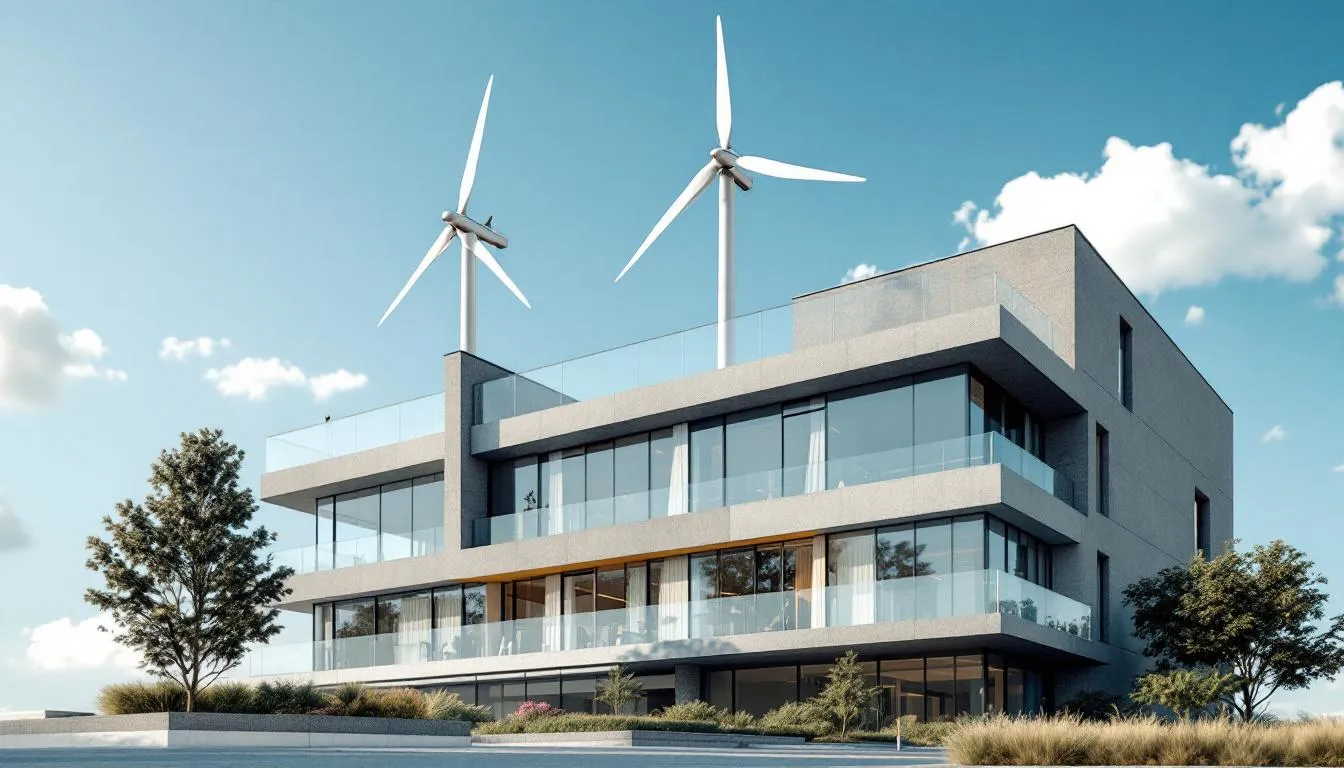
Installing a vertical-axis wind turbine on an office building typically delivers a payback period between 12 and 25 years across the continental United States, assuming average wind resource and electricity rates between $0.11 and $0.16 per kWh. That range tightens or stretches depending on three variables: effective capacity factor after building-induced turbulence (usually 8–18% at roof height), upfront cost after federal and state incentives, and the building's demand profile match with wind production. A suburban two-story office in Dallas with 9 mph average annual wind sees a different outcome than a six-story downtown Minneapolis tower exposed to 12 mph flows.
Federal incentives shift the calculation immediately
The Investment Tax Credit under IRC §25D offers a 30% credit on the installed cost of a qualifying small wind system placed in service through 2032. For a $35,000 turnkey installation—typical for a 5 kW VAWT with structural engineering, inverter, and interconnection—that credit reduces net outlay to $24,500. The system must be sited at the business owner's property and used to offset consumption; excess generation can be net-metered in states that permit it, but the ITC applies only to the portion serving onsite load.
IRS Form 5695 is the filing mechanism. Owners must retain manufacturer certification that the turbine meets the performance and safety requirements outlined in AWEA 9.1 or IEC 61400-2. Few desktop VAWTs carry that certification; Aeolos-V, Pikasola, and certain Primus Air models do. Without it, the credit is disallowed upon audit.
State programs layer on top. California's Self-Generation Incentive Program has paid $0.20 per watt for distributed wind, though 2025 allocations prioritize storage and fuel cells. New York's NY-Sun stepped-incentive remains open for commercial solar and wind hybrids. Massachusetts SMART pays per kWh generated, effectively shortening payback by 3–5 years. DSIRE maintains the canonical database; consult it before signing contracts.
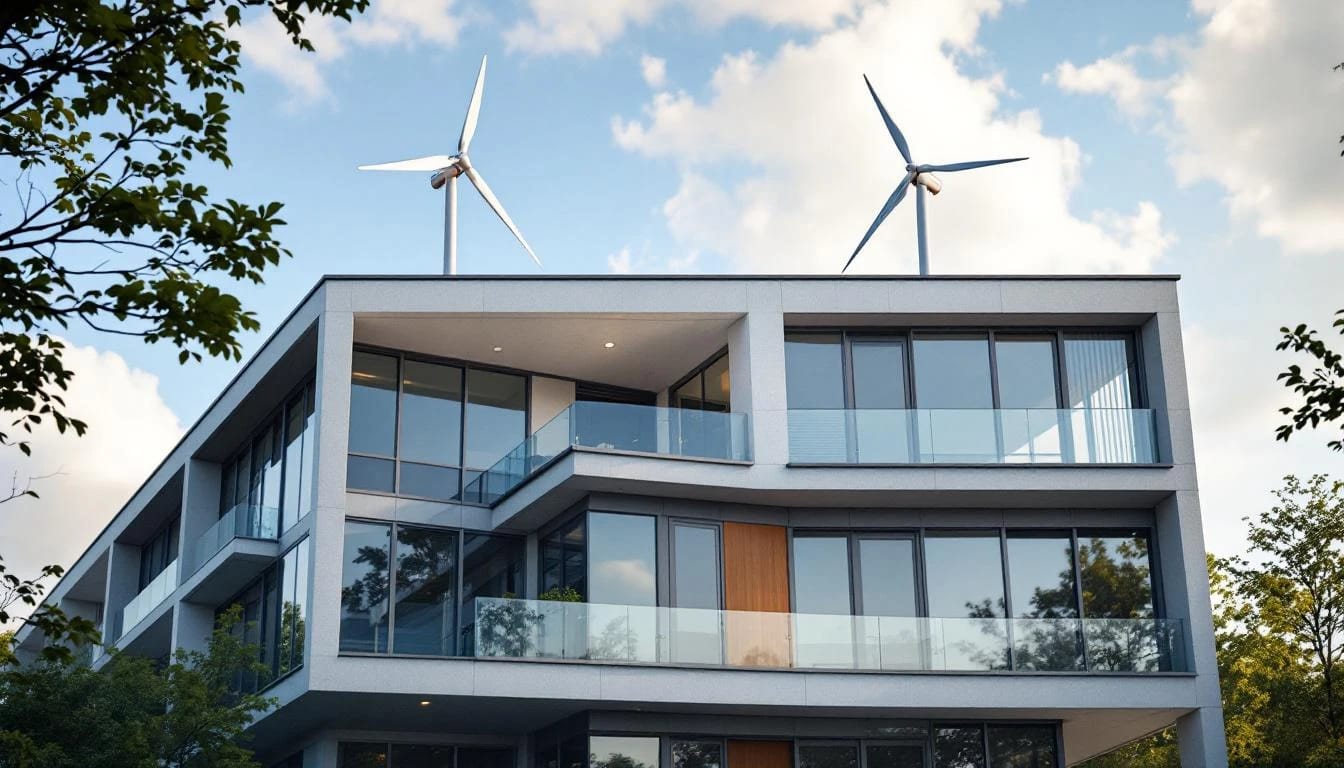
![INLINE: Vertical-axis wind turbine mounted on office building rooftop with downtown skyline]
Capacity factor on a roof is not what the spec sheet promises
Manufacturers quote rated output at 11 or 12 m/s wind speed, a condition office rooftops rarely sustain. The National Renewable Energy Laboratory's WindWatts resource assessment tool incorporates computational fluid dynamics to model how building geometry alters flow. A flat-roof suburban office generates significant wake and downwash; a turbine mounted two meters above the parapet sees 20–40% less effective wind speed than the same height on open ground.
Most real-world capacity factors for 3–10 kW VAWTs on commercial buildings fall between 8% and 18%. A 5 kW unit operating at 12% capacity factor produces roughly 5,300 kWh annually. At $0.13 per kWh, that offsets $689 in utility costs. Gross payback on a $24,500 net installation is 35 years—economically unattractive without additional revenue streams or higher wind resource.
Siting matters more than turbine brand. Corner and edge locations exploit acceleration zones where wind compresses around the building mass. Modeling by NREL's Distributed Wind Research group shows that turbines placed at the upwind corner of a rectangular building can see 15–25% higher average wind speed than center-roof locations. That translates to 50–90% more energy, since power scales with the cube of velocity.
Local anemometer data beats regional estimates. A thirty-day roof-level measurement campaign with a calibrated cup or sonic anemometer costs $800–$1,500 and provides the only reliable input for financial models. FAA Part 77 applies to any structure exceeding 200 feet above ground or within the imaginary surfaces around airports; turbines rarely trigger filing requirements, but verify before installation.
Electrical integration and code compliance add cost
NEC Article 705 governs interconnection of power sources operating in parallel with the utility. The turbine's inverter must meet UL 1741 and include anti-islanding protection. Many small VAWTs ship with grid-tie inverters; verify the model is listed and matches your voltage. Three-phase service common in commercial buildings requires a compatible inverter or a transformer step.
Installation labor runs $80–$150 per hour for a licensed electrician. Plan 16–24 hours for rooftop mounting, conduit run, service panel integration, and utility interconnection. Structural engineering review is mandatory; the turbine plus tower exerts lateral and uplift forces that exceed typical rooftop unit allowances. Budget $1,200–$3,000 for PE-stamped load calculations and mounting detail drawings.
Net metering rules vary by state and utility. Twenty-eight states offer aggregate net metering that allows commercial customers to offset multiple meters with a single turbine. Surplus generation in a given month usually rolls forward as a kWh credit; some utilities cash out annually at wholesale rates ($0.03–$0.05 per kWh), destroying economic value. Confirm policy before sizing the system.
Maintenance drives long-term economics
VAWTs experience lower tip-speed ratios and smoother torque curves than horizontal-axis machines, but bearings and the generator still require service. Manufacturer-specified intervals call for annual inspections, semi-annual bolt torque checks in high-wind zones, and bearing replacement every 5–8 years. Budget $300–$600 annually for inspections plus $1,200–$2,000 for bearing service.
Blade leading-edge erosion is less severe on VAWTs because relative velocity is lower, but UV degradation of composite skins remains a concern. Expect to repaint or apply protective film every 7–10 years at $800–$1,500. Controller and inverter electronics have a 10–15 year expected life; replacement costs $1,800–$4,000 depending on capacity.
Insurance riders for rooftop turbines add $200–$500 annually to a commercial property policy. Liability coverage is essential; a detached blade or tower failure that damages adjacent property triggers claims in the mid-five figures. General liability policies often exclude "power generation equipment" without an endorsement.
Realistic ROI scenarios across building types
Low-wind scenario: 8 mph annual average, $0.11/kWh, 5 kW VAWT, 9% capacity factor
- Gross cost: $35,000
- Net after 30% ITC: $24,500
- Annual generation: 3,942 kWh
- Annual savings: $434
- Simple payback: 56 years
- Conclusion: uneconomic without additional incentives
Mid-wind scenario: 10.5 mph annual average, $0.14/kWh, 5 kW VAWT, 14% capacity factor, state rebate $2,000
- Gross cost: $35,000
- Net after ITC + state: $22,500
- Annual generation: 6,132 kWh
- Annual savings: $858
- Simple payback: 26 years
- Conclusion: marginal; depends on building ownership horizon
High-wind scenario: 13 mph annual average, $0.16/kWh, 10 kW VAWT, 18% capacity factor, demand-charge offset
- Gross cost: $62,000
- Net after ITC: $43,400
- Annual generation: 15,768 kWh
- Annual savings: $2,523 energy + $1,200 demand reduction
- Simple payback: 12 years
- Conclusion: viable for long-term owners in favorable locations
| Scenario | Wind Speed | kWh/yr | $/kWh | Payback (yr) |
|---|---|---|---|---|
| Low | 8 mph | 3,942 | $0.11 | 56 |
| Mid | 10.5 mph | 6,132 | $0.14 | 26 |
| High | 13 mph | 15,768 | $0.16 | 12 |
Demand-charge reduction deserves attention. Commercial rate structures penalize peak 15-minute intervals; a turbine generating during afternoon wind events can shave those peaks by 2–5 kW, saving $10–$18 per kW per month in many utility territories. That adds $240–$1,080 annually beyond energy offset.
Buildings with on-site EV charging see compounding value. A 10 kW VAWT running at 15% capacity factor generates enough to support roughly 35,000 miles of employee EV charging annually. If the building operator charges $0.25 per kWh at the EVSE and sources wind power at $0.16, margin accrues.
When to walk away
Roof structures with existing weight or wind-load issues fail economic and engineering tests. Adding 600–1,200 pounds of turbine, tower, and concrete ballast to a roof built in the 1970s often requires reinforcement that doubles project cost. Structural surveys cost $800–$1,500; perform one before proposals.
Buildings surrounded by taller structures see negligible wind. A three-story office hemmed by six-story neighbors sits in a wind shadow; turbine output drops 40–70%. Desktop wind maps from NREL or state energy offices provide preliminary screening, but an anemometer is the only proof.
HOA covenants and zoning overlays in mixed-use districts sometimes prohibit rooftop turbines. Verify allowable use with municipal planning departments. Noise is rarely an issue—VAWTs at 5 kW produce 35–45 dBA at ten meters, quieter than HVAC—but visual complaints and perceived property-value impacts trigger disputes.
Leased buildings complicate capital improvements. Unless the tenant holds a long-term lease (15+ years) and negotiates a pass-through or rent reduction for energy savings, the landlord captures the benefit. Split-incentive problems kill most commercial renewable projects.
Hybrid systems improve utilization
Pairing a VAWT with rooftop solar produces complementary generation. Wind peaks in winter and overnight; solar peaks in summer and midday. A 10 kW VAWT plus 15 kW solar array on a 12,000 square-foot office in Colorado offsets 80–90% of annual consumption and flattens demand peaks.
Battery storage shifts wind generation to high-value hours. A 20 kWh lithium-ion bank charged by nighttime wind and discharged during afternoon demand peaks reduces utility costs more than direct consumption. Battery incentives (ITC at 30%, state grants) apply when paired with renewable generation. Installed cost for a 20 kWh commercial system runs $12,000–$18,000.
Microgrids for campus-style office parks benefit from distributed wind. NREL's Microgrids, Infrastructure Resilience, and Advanced Controls Launchpad research demonstrates that transactive control algorithms optimize generation dispatch across multiple assets. A three-building office park with 25 kW total wind, 60 kW solar, and 50 kWh storage can island during utility outages and sell ancillary services in deregulated markets.
For deeper analysis of microgrid integration, see commercial wind microgrids for office parks. Hybrid solar-wind system design considerations are covered in pairing VAWTs with rooftop solar arrays.
Financing structures that make marginal projects viable
Power purchase agreements (PPAs) eliminate upfront cost. A developer installs and owns the turbine; the building owner buys electricity at a fixed rate below retail for 15–20 years. PPAs work when the developer can aggregate multiple sites, capture tax equity, and achieve economies of scale. Few PPA providers focus on sub-50 kW wind due to transaction costs.
Commercial PACE (Property Assessed Clean Energy) programs in 38 states allow turbine costs to be repaid through property tax assessments over 10–20 years. Payments transfer with the property, solving the tenant-landlord problem. Typical PACE rates run 5–7% APR; net present value still depends on electricity savings exceeding payment.
Lease-to-own programs from manufacturers or regional installers reduce initial outlay to $1,500–$3,000 plus monthly payments. Read contracts carefully; effective interest rates often exceed 10%, and the lessee bears maintenance risk. Ownership transfers after five years in most structures.
For businesses in Opportunity Zones, accelerated depreciation under MACRS can be combined with the ITC. Wind systems qualify for five-year depreciation; paired with bonus depreciation at 60% (phasing down annually), taxable income reduction in year one can approach 50% of system cost for profitable entities. Consult a tax professional to model.
External resources on commercial wind incentives:
- DSIRE incentive database
- DOE Wind Energy Technologies Office project examples
- NREL Distributed Wind Research
- IRS Form 5695 instructions
Do VAWTs perform better than horizontal-axis turbines on buildings?
VAWTs tolerate turbulent, multi-directional wind better than horizontal-axis machines, which makes them better suited to rooftop environments. Efficiency remains 5–15 percentage points lower at rated wind speed, but real-world capacity factor differences narrow when HAWTs spend energy yawing. Neither type delivers manufacturer-rated output on a roof; advantage VAWT by a small margin in built environments.
Can a turbine offset an entire office building's load?
Not in most cases. A 15 kW VAWT at 15% capacity factor produces roughly 20,000 kWh annually. A 10,000 square-foot office uses 80,000–120,000 kWh per year. Wind can offset 15–35% of load depending on size and site. Full offset requires a wind farm or hybrid system with significant solar and storage.
What happens if the building is sold before payback?
The turbine becomes a capital improvement that adds to property value. Appraisers discount renewable assets by 30–60% of installed cost due to uncertainty around future performance. Buyers may value the energy savings; negotiate language in the purchase agreement that reflects projected cash flows. Leased equipment complicates sale and may require buyer assumption or buyout.
Are permits required for rooftop VAWTs?
Most jurisdictions require electrical and sometimes building permits. The electrical permit covers NEC Article 705 interconnection and service panel modifications. Building permits address structural loads, zoning height limits, and setbacks. FAA notification applies if total height (building plus turbine) exceeds triggering thresholds near airports. Budget 4–8 weeks for permit approval.
How loud are VAWTs on office buildings?
VAWTs produce 35–48 dBA at ten meters in moderate wind, comparable to a residential air conditioner. Vibration coupling to the building structure through mounting hardware can amplify noise inside the top floor; use isolation pads and avoid direct attachment to occupied spaces. Neighbors rarely complain about rooftop turbines; verify local noise ordinances during evening hours.
Bottom line
VAWTs on office buildings deliver positive ROI only in wind regimes above 10.5 mph annual average, combined with electricity rates over $0.13 per kWh and the full 30% federal tax credit. Payback falls between 12 and 18 years under those conditions—acceptable for owner-occupied properties with long hold periods, unworkable for leased or speculative assets. Measure wind at roof height for thirty days before committing capital, and hire a structural engineer early to avoid expensive surprises.
Next step: Use NREL's Residential Energy Cost Estimator to model your specific building's wind resource and run a pro-forma with actual utility rate structures. Request manufacturer certification documents and verify ITC eligibility before signing contracts.
Share this article
windturbinehome.com/s/4a20f7
Editorial note: This article was researched and written by a member of the Wind Turbine Home editorial team. AI-assisted tools were used for spell-checking and light grammar review only — all research, analysis, and conclusions are our own. Our editorial policy prohibits sponsored content and paid placements. Read our editorial policy →