Best Wind Turbines for Kansas Homes: 2026 Costs & Models
Kansas sits in Class 3-4 wind, strong enough for home turbines. Compare residential models built for those speeds, real costs, and net metering rules.
Share this article
windturbinehome.com/s/4ad898
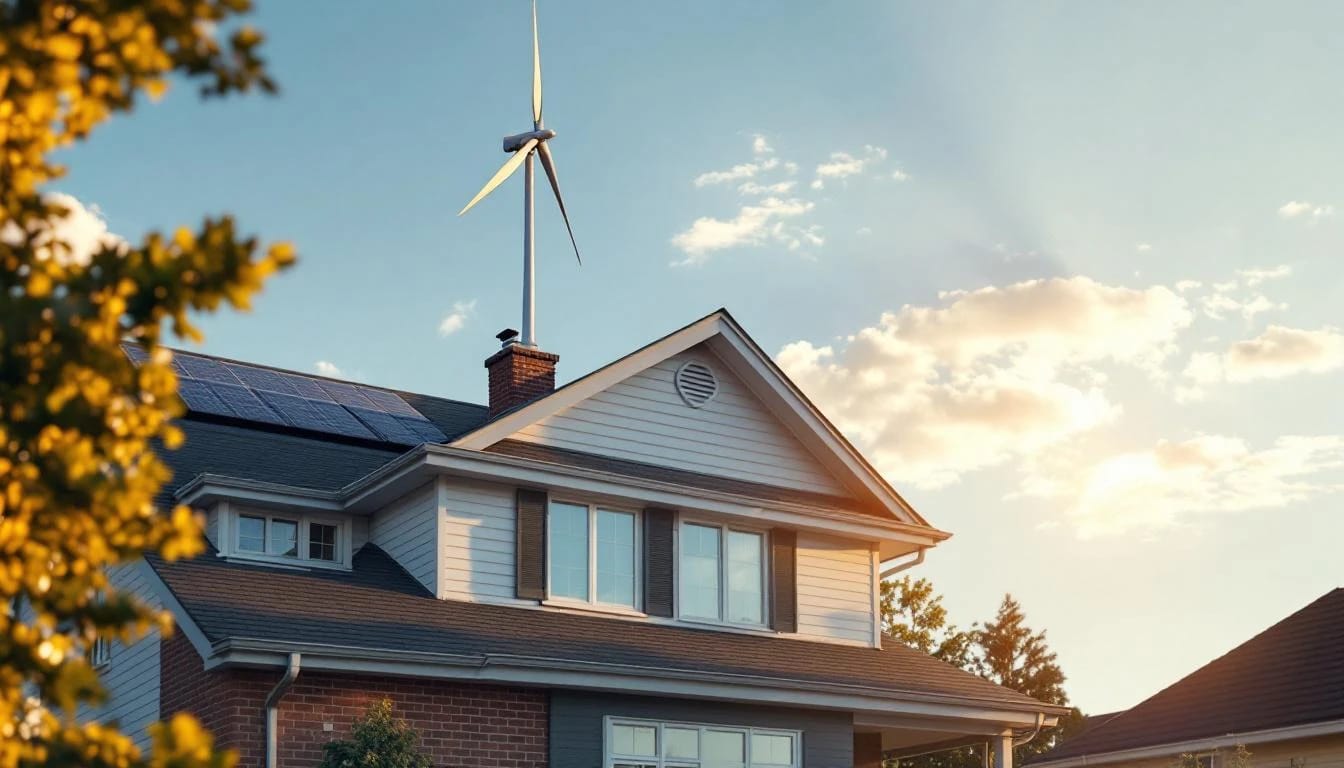
Kansas ranks among the top five states for home wind power potential. The Sunflower State's Great Plains geography delivers consistent Class 3 and Class 4 wind resources—4.4 to 7.0 meters per second at 30 meters—making residential turbines a practical supplement to grid power or a full off-grid solution. The best turbines for Kansas homes include the Bergey Excel 10 (10 kW horizontal-axis), Primus Air 40 (2.5 kW horizontal-axis), and the SD6+ from SD Wind Energy (6 kW horizontal-axis). Each model suits different property sizes, wind conditions, and budget constraints. Net metering availability, the 30% federal Residential Clean Energy Credit, and streamlined permitting in rural counties further enhance the financial case for Kansas homeowners willing to invest $15,000–$60,000 upfront.
Why Kansas Wind Conditions Favor Residential Turbines
Kansas benefits from unobstructed plains topography, few large forested areas, and consistent southerly and northwesterly airflow year-round. According to Department of Energy WINDExchange 30-meter residential wind speed maps, the western two-thirds of Kansas register annual average speeds between 5.0 and 6.5 m/s, with pockets in Cheyenne, Sherman, and Wallace counties exceeding 6.5 m/s. Eastern counties—from Douglas to Cherokee—see 4.0–5.0 m/s averages, still sufficient for properly sited small turbines.
Class 3 wind (5.8–6.4 m/s) supports turbines rated 2.5 kW and above when mounted on towers 80–100 feet tall. Class 4 wind (6.4–7.0 m/s) unlocks the full capacity of 10 kW systems, the practical ceiling for residential installations before utility-scale permitting and interconnection requirements apply. Homeowners in western Kansas enjoy a significant advantage: higher average speeds reduce payback periods by 20–30% compared to marginal wind sites in neighboring Missouri or Oklahoma.
Seasonal variation matters. Kansas wind peaks in spring (March–May) when cold northern air masses collide with warm Gulf moisture. Winter and summer speeds drop by roughly 15%, yet remain above the 4 m/s threshold for economical generation. Turbine selection must account for both annual averages and worst-case lulls during July and August.
![INLINE: Kansas wind resource map showing western plains with Class 3-4 shading and eastern tier with Class 2-3 zones]
Top Horizontal-Axis Turbines for Kansas Homes
Horizontal-axis wind turbines dominate the residential market because they extract more energy per dollar than vertical-axis designs. Three models stand out for Kansas conditions.
Bergey Excel 10 delivers 10 kW rated output at 11 m/s, targeting large homes, workshops, or small farms. The three-blade rotor spans 7 meters and requires a minimum 80-foot guyed lattice or monopole tower. Bergey specifies Class 3 wind sites or better. Installed cost runs $48,000–$60,000, including tower, inverter, and grid-tie equipment. The Excel 10 qualifies for NEC Article 705 interconnection when paired with a UL 1741-listed inverter. Expected lifespan exceeds 25 years with biennial inspections and blade balancing every five years. Kansas homeowners using 1,500–2,000 kWh monthly find this turbine offsets 60–80% of consumption in favorable locations.
Primus Air 40 (formerly Windside Air 40) offers 2.5 kW rated output at 12.5 m/s, suitable for modest homes, cabins, or hybrid solar-wind systems. The 4.2-meter rotor mounts on towers 40–60 feet tall. Primus designs this model for both grid-tie and battery-based systems, appealing to off-grid homeowners in rural Finney, Grant, and Kearny counties. Installed cost approximates $15,000–$22,000. Annual output in Class 3 wind reaches 4,000–5,500 kWh, offsetting roughly 40% of a typical 1,000 kWh/month household load. The Air 40's lighter weight and shorter tower reduce foundation costs and simplify permitting compared to 10 kW systems.
SD Wind Energy SD6+ bridges the gap at 6 kW rated output, appealing to families using 1,200 kWh monthly. The 5-meter rotor requires a 60–80 foot tower. SD Wind Energy markets this turbine specifically for Great Plains states, incorporating automatic furling to protect against Kansas spring storm gusts exceeding 100 mph. Installed cost ranges $28,000–$38,000. The SD6+ features a direct-drive permanent-magnet generator, eliminating gearbox maintenance—a meaningful advantage given Kansas's distance from factory service centers on either coast. Annual output in Class 3.5 wind averages 8,500–10,000 kWh.
| Model | Rated Output | Rotor Diameter | Tower Height | Installed Cost | Annual Output (Class 3) |
|---|---|---|---|---|---|
| Bergey Excel 10 | 10 kW | 7 m | 80–100 ft | $48,000–$60,000 | 14,000–18,000 kWh |
| SD Wind Energy SD6+ | 6 kW | 5 m | 60–80 ft | $28,000–$38,000 | 8,500–10,000 kWh |
| Primus Air 40 | 2.5 kW | 4.2 m | 40–60 ft | $15,000–$22,000 | 4,000–5,500 kWh |
Are Vertical-Axis Turbines Viable in Kansas?
Vertical-axis wind turbines remain niche products. Models like the Aeolos-V 3 kW and Pikasola 600W attract homeowners seeking lower visual impact and quieter operation. Kansas building codes treat vertical-axis turbines identically to horizontal-axis designs—no permitting advantage exists despite marketing claims.
Performance lags horizontal-axis peers by 30–50% in open terrain because vertical-axis rotors generate less torque per square meter of swept area. The Aeolos-V 3 kW produces roughly 2,000 kWh annually in Class 3 wind, half the output of the similarly priced Primus Air 40. Vertical-axis turbines suit urban or suburban lots with height restrictions, turbulent rooflines, or aesthetic covenants prohibiting tall towers. Rural Kansas homeowners with acre-plus parcels gain nothing from vertical-axis compromises.
One exception: hybrid solar-vertical-axis-wind systems for off-grid cabins. A Pikasola 600W turbine paired with 2 kW of solar panels and 10 kWh battery storage provides adequate power for lighting, refrigeration, and well pumps in locations where grid extension costs exceed $25,000.
Kansas Net Metering and Interconnection Rules
Kansas enacted net metering in 2009, covering investor-owned utilities (Evergy, Kansas City Power & Light), rural electric cooperatives, and municipal utilities. Systems up to 200 kW qualify, far above typical residential turbine capacity. Net metering credits excess generation at the retail rate, banked month-to-month, with annual reconciliation each April. Unused credits expire without cash payment—design systems to match annual consumption, not overproduce.
Evergy and KCP&L require IEEE 1547-compliant interconnection applications, processed within 30 business days for systems under 25 kW. The utility installs a bidirectional meter at no charge. Homeowners must carry $1 million general liability insurance naming the utility as additional insured. Rural co-ops enforce similar policies but processing times vary; contact the co-op engineering department six months before installation.
Municipal utilities in Wichita, Topeka, and Lawrence maintain separate net metering tariffs with slight variations. Wichita caps systems at 100 kW and imposes a $100 annual metering fee. Topeka and Lawrence waive fees for systems below 10 kW. Always confirm local tariff details before purchasing equipment.
Federal and State Financial Incentives
The federal Residential Clean Energy Credit (IRC §25D) allows Kansas homeowners to claim 30% of installed costs—including turbine, tower, inverter, wiring, and labor—as a nonrefundable tax credit on IRS Form 5695. A $40,000 installation generates a $12,000 credit, directly reducing federal tax liability. The credit applies to primary and secondary residences, expires December 31, 2034, and carries forward unused portions to subsequent tax years if current-year liability falls short.
Kansas offers no state income tax credit for residential wind, a gap compared to Oklahoma's 25% state credit. Property tax exemptions vary by county. Finney, Ford, and Grant counties exempt renewable energy equipment from assessed value, lowering annual property tax by $150–$300 for typical 6–10 kW systems. Check with the county appraiser before installation to confirm exemption procedures—some counties require a separate application within 30 days of the turbine going online.
The Database of State Incentives for Renewables & Efficiency (DSIRE) lists no active Kansas rebates for residential wind as of 2025. Past programs from Midwest Energy and Westar (now Evergy) ended in 2019.
Permitting, Zoning, and FAA Notification
Rural Kansas counties typically regulate wind turbines under agricultural or accessory structure codes. Minimum setbacks range from 1.1× to 1.5× total height (tower plus rotor radius) from property lines, ensuring a toppled turbine remains on-site. Sedgwick County enforces 1.5× setback and 100-foot minimum distance from occupied structures. Unincorporated areas of western counties often apply agricultural exemptions for structures under 120 feet, streamlining permits to a single building department review.
City zoning within Wichita, Lawrence, Topeka, and Overland Park restricts or prohibits residential turbines outright. Wichita's unified zoning code permits turbines only in agricultural zoning districts and requires special-use permits in residential zones—seldom granted due to noise and shadow-flicker complaints. Homeowners in city limits face steep odds; relocating the installation to a rural parcel 15 miles outside city boundaries solves the issue.
FAA Part 77 notification applies to structures exceeding 200 feet above ground level or located near airports. Residential turbines on 100-foot towers fall below Part 77 thresholds unless within a 20,000-foot radius of a public airport. Confirm airport proximity using the FAA's online Notice Criteria Tool before ordering equipment.
Installation Costs and Professional Requirements
Turnkey installation by a certified contractor costs $3.50–$6.00 per installed watt for horizontal-axis turbines. A 6 kW system totals $21,000–$36,000; a 10 kW system reaches $35,000–$60,000. Cost variation depends on tower type (guyed lattice vs. tilt-up monopole), soil conditions (clay vs. sandy loam), and distance from electrical service entrance. Foundation excavation in Kansas's expansive clay soils adds $2,000–$4,000 to standard installations.
NEC Article 705 governs electrical interconnection. Licensed electricians must size conductors, install disconnects, and configure inverters to meet utility anti-islanding requirements. Kansas requires state-licensed master or journeyman electricians for grid-tie work; unlicensed installations void equipment warranties and utility interconnection agreements. Budget $2,500–$5,000 for electrical labor separate from mechanical installation.
Tower erection demands specialized skills. Guyed lattice towers require concrete deadman anchors, turnbuckle tensioning, and periodic guy cable retensioning. Tilt-up monopoles simplify maintenance but cost 30% more upfront. Homeowners equipped for heavy equipment operation occasionally self-install with rented gin poles and telehandlers, saving $8,000–$12,000 in labor. Most choose professional installation to preserve warranties and avoid injury.
Maintenance Requirements and Lifespan
Residential turbines require biennial inspections covering blade balance, bearing lubrication, electrical connections, and guy cable tension. Annual inspections suit harsher environments—Kansas spring hail and ice storms justify the extra scrutiny. Bergey, Primus, and SD Wind Energy publish detailed maintenance schedules in owner manuals; following prescribed intervals preserves warranties.
Common wear items include blade tip erosion from airborne dust, generator brushes (if equipped), and inverter capacitors. Blade resurfacing costs $300–$600 per blade every 7–10 years. Brushless permanent-magnet generators eliminate brush replacement, a significant advantage in remote installations. Inverter replacement every 10–12 years adds $2,000–$3,500.
Tower maintenance includes guy cable retensioning annually and bolt torque checks every two years. Monopole towers require less frequent attention—inspect base welds and anchor bolts every three years. Budget $500–$800 annually for DIY maintenance or $1,200–$1,800 for contractor service calls.
Expected turbine lifespan ranges 20–25 years with proper care. Towers outlast turbines by decades. Plan for turbine replacement or upgraded models at year 20; tower foundations and electrical infrastructure remain reusable, halving future installation costs.
Real-World Performance in Kansas Installations
Western Kansas case studies illustrate practical outcomes. A Finney County homeowner installed a Bergey Excel 10 in 2019 on a 100-foot tilt-up tower. The site averages 6.2 m/s at hub height. Annual generation reached 16,500 kWh in year one, 17,200 kWh in year two, and 15,800 kWh in year three (a below-average wind year). Monthly household consumption averages 1,400 kWh; the turbine offset 98% of grid purchases over three years. Net metering credits rolled forward April to April, expiring with minimal loss. Total installed cost was $54,000; after the 30% federal credit, net cost dropped to $37,800. At $0.13/kWh retail rate, annual savings approximate $2,100, projecting an 18-year simple payback.
A Riley County installation presents a more modest outcome. A Primus Air 40 on a 50-foot tower at a Class 2.5 site (4.8 m/s) generated 3,200 kWh annually, offsetting 25% of the household's 1,050 kWh monthly consumption. Net cost after federal credit: $13,000. Annual savings: $416. Payback extends beyond the turbine's expected lifespan—this installation illustrates the penalty for marginal wind resources.
The lesson: wind speed trumps equipment choice. A premium turbine in poor wind underperforms a budget model in excellent wind.
Financing Options for Kansas Homeowners
Cash purchases remain most common, allowing homeowners to claim the full federal tax credit in year one. Home equity loans and lines of credit provide lower interest rates (6.5–8.5%) than unsecured personal loans (10–15%). Solar-specific lenders like Mosaic and GoodLeap now finance wind turbines, offering 10- and 15-year terms with rates starting at 7.99%. Verify the lender includes wind equipment in underwriting; some programs restrict financing to solar panels only.
USDA Rural Energy for America Program (REAP) grants cover agricultural operations and rural small businesses, not residential installations—homeowners do not qualify. Property Assessed Clean Energy (PACE) financing exists in select Kansas counties but focuses on energy efficiency upgrades; wind turbines seldom qualify.
Leasing and power purchase agreements, common in residential solar, do not exist for small wind turbines due to high maintenance variability and limited service networks.
How to Size a Turbine for Your Kansas Home
Start with 12 months of utility bills. Calculate total annual consumption in kilowatt-hours. Divide by 12 for average monthly usage. A Kansas household consuming 1,200 kWh monthly uses 14,400 kWh annually.
Match turbine output to 60–90% of annual consumption. Over-sizing wastes capital; net metering credits expire annually, converting surplus generation to zero-value donations to the utility. A 6 kW turbine in Class 3 wind produces roughly 9,000 kWh, covering 62% of the 14,400 kWh example household. Pairing the turbine with energy efficiency upgrades (LED lighting, heat pump water heater) reduces consumption, increasing the offset percentage without buying a larger turbine.
Request a site assessment from a certified installer. Anemometer data logged for 6–12 months at the proposed hub height provides accurate wind speed averages. Installers use the data in modeling software (HOMER, RETScreen) to project turbine-specific output. This step costs $800–$2,000 but prevents expensive mismatches between turbine capacity and actual wind resources.
Do Kansas homeowners need special permits for wind turbines?
County building permits apply in most jurisdictions. Rural counties process permits within 2–4 weeks for turbines under 100 feet. Cities enforce zoning restrictions; obtain zoning confirmation before purchasing equipment. FAA notification requirements trigger only for structures exceeding 200 feet or near airports. Electrical interconnection requires utility approval and NEC-compliant wiring by a licensed electrician.
How much does a home wind turbine cost in Kansas after the federal tax credit?
Installed costs range $15,000–$60,000 before incentives. The 30% federal Residential Clean Energy Credit reduces net cost to $10,500–$42,000 depending on turbine size and tower type. A typical 6 kW system costs $28,000 installed; after the credit, net cost drops to $19,600. No Kansas state tax credits exist for residential wind as of 2025.
What wind speed do I need for a home turbine in Kansas?
Annual average wind speeds of 4.4 m/s (Class 2.5) at 30 meters represent the minimum for economical generation. Class 3 wind (5.8 m/s and above) dramatically improves payback periods. Western Kansas regularly delivers Class 3 and Class 4 resources. Eastern Kansas sites require careful assessment; many locations fall into marginal Class 2 territory where turbines underperform financial models.
Can I install a wind turbine myself in Kansas?
Mechanical assembly and tower erection are legal for homeowners, though rigging a 100-foot tower safely requires equipment and experience. Electrical interconnection must be performed by a Kansas-licensed electrician to comply with NEC Article 705 and secure utility approval. DIY installation voids most manufacturer warranties unless documented by a licensed professional. Budget 40–80 hours of labor for self-installation of a 6 kW system.
How does Kansas net metering work for home wind turbines?
Kansas law requires utilities to credit excess generation at the retail rate. Credits roll month-to-month, reconciling each April. Unused credits expire without cash payment. Systems up to 200 kW qualify. Homeowners must carry $1 million general liability insurance. Bidirectional meters are installed at no charge. Net metering applies to investor-owned utilities, rural co-ops, and most municipal utilities; confirm tariff details with your specific provider.
Bottom Line
Kansas delivers some of the nation's best residential wind resources, particularly across the western two-thirds of the state where Class 3 and Class 4 winds make turbines economically compelling. The Bergey Excel 10, SD Wind Energy SD6+, and Primus Air 40 represent proven options for Kansas homeowners willing to invest $15,000–$60,000 after the 30% federal tax credit. Success hinges on accurate site assessment—marginal wind locations stretch payback periods beyond the turbine's useful life. Obtain 6–12 months of anemometer data at proposed hub height, confirm county zoning allows turbines, and hire a licensed electrician for NEC-compliant interconnection. Homeowners in excellent wind locations enjoy 15–20 year paybacks, decades of reduced electric bills, and meaningful carbon emissions reductions. Request quotes from certified Kansas turbine installers to start the site evaluation process and lock in 2025 federal tax credit eligibility.
Share this article
windturbinehome.com/s/4ad898
Editorial note: This article was researched and written by a member of the Wind Turbine Home editorial team. AI-assisted tools were used for spell-checking and light grammar review only — all research, analysis, and conclusions are our own. Our editorial policy prohibits sponsored content and paid placements. Read our editorial policy →
Related reading
residential wind power
Home Wind Turbine: A Comprehensive US Buyer's Guide 2024
Explore the realities of owning a home wind turbine in the US, covering costs, energy output, installation requirements, and available federal and state incentives for homeowners considering small-scale wind power.
residential wind power
Home Wind Turbine Systems: A Complete 2024 Buyer's Guide
Explore the realities of a home wind turbine system for residential power, covering installation, costs, grid-tie considerations, and US federal incentives.
residential wind power
First-Year Mistakes New Home Wind Turbine Owners Regret Most
New home wind turbine owners make costly first-year errors—from poor site assessment to skipping permits. Learn the eleven most common mistakes and how to avoid them.
residential wind power
Grid-Tied vs Battery-Backed Wind Turbine Systems for Homes
Grid-tied systems feed excess wind power directly to the utility for credits, while battery-backed configurations store energy for outages and off-grid use.
residential wind power
How to Right-Size a Wind Turbine for Your House in 2026
Match your home wind turbine to your actual energy use and site conditions. Learn the sizing formula, power curves, and common mistakes to avoid before you buy.
residential wind power
Best Wind Turbines for Australian Homes: STCs & 2026 Picks
Small wind turbines can earn STCs under the SRES, but few models sold in Australia meet AS 4509.1. Compare Bergey, Primus and proven vertical-axis picks.
residential wind power
Best Wind Turbines Under $5000 for Home Use (2026 Guide)
Compare the top small wind turbines under $5000 for residential use in 2026. Real performance data, installation costs, and ROI analysis for US homeowners.
residential wind power
Best Wind Turbines for Iowa Homes: Bergey vs Primus (2026)
Iowa averages 5.5-7.5 m/s wind at 30m, enough for a home turbine. Compare the Bergey Excel 10, Primus AIR 40 and VAWT options for grid-tied or off-grid use.
residential wind power
Best Wind Turbines for Texas Homes: 1-10 kW Picks (2026)
Compare 1-10 kW small wind turbines for Texas homes, including which models suit your local wind zone, what they cost, and which incentives you can claim.