Cable Sizing from Tower to Charge Controller: Voltage Drop Math
Calculate wire gauge for wind turbine tower-to-controller runs using voltage drop formulas. Step-by-step math prevents energy loss and meets NEC 705.
Share this article
windturbinehome.com/s/72cee3
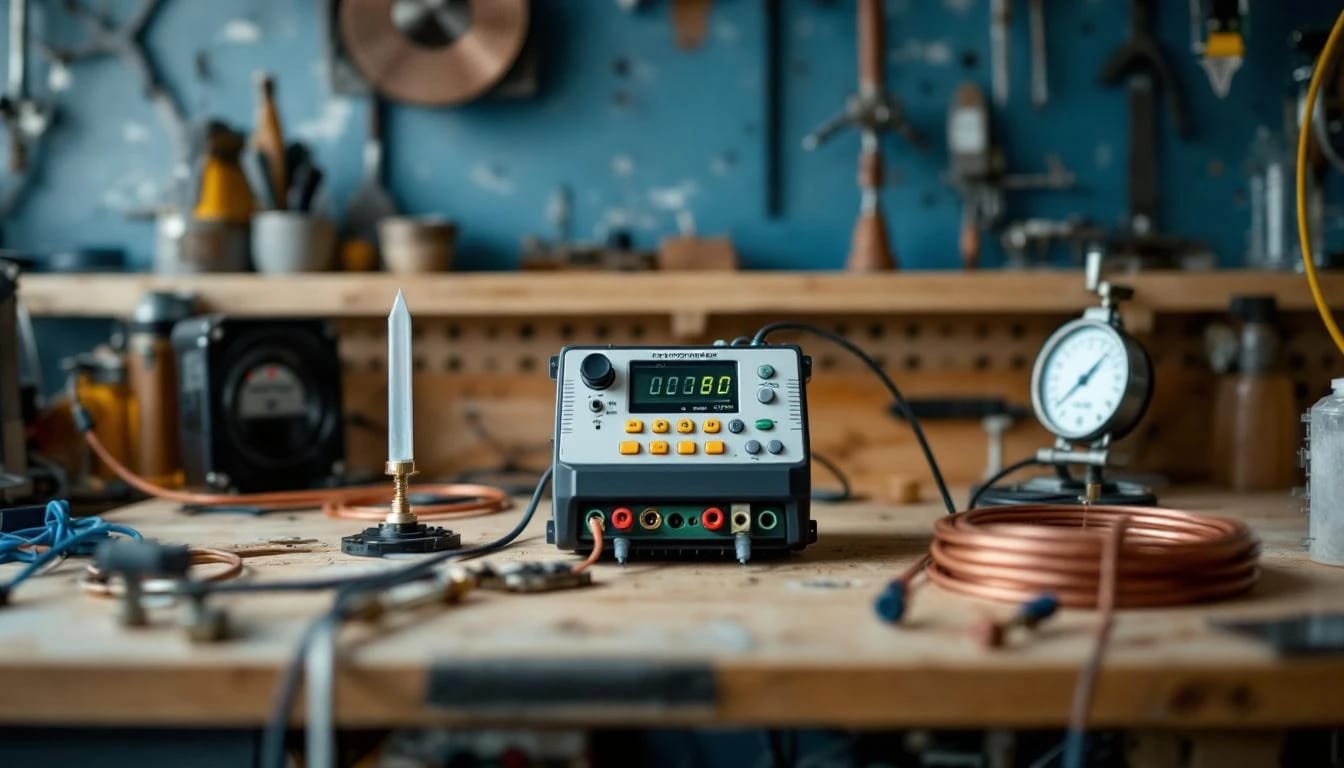
Undersized cable between your tower and charge controller wastes energy you already fought gravity and weather to capture. A 48V Bergey Excel 1 producing 8A at full tilt loses 3.8V—almost 8% of system voltage—across 150 feet of 10 AWG copper, dumping cash into resistive heating instead of your battery bank. Calculate wire gauge using voltage-drop formulas before you trench, and you'll recoup the cost of heavier cable in months through eliminated losses. This guide walks through the algebra, provides lookup tables for common turbine voltages, and shows how to reconcile electrical reality with NEC Article 705 requirements for interconnected renewable generation.
Why voltage drop matters more for wind than solar
Photovoltaic arrays deliver predictable current under steady sun; small wind turbines swing between zero and rated output in seconds as gusts hit. Peak current surges stress undersized conductors, heating copper and magnifying resistive loss exactly when you want maximum harvest. A Primus Air 40 rated 2.5 kW at 48V nominal can push 60A momentarily during a hard gust—if your wire can't carry it without shedding volts, the charge controller sees sagging input voltage, enters current-limit mode, and clips power.
NEC Article 705.12 mandates that conductors supplying inverter or controller inputs handle 125% of maximum rated current without exceeding temperature limits, but the code says nothing about efficiency. You can legally run 10 AWG for a 30A circuit and still violate the spirit of good design by losing 5% to heat. Aim for 2% voltage drop or less on tower-to-controller runs; accept 3% only when cable cost genuinely prohibits better.
Wind systems compound the challenge with tall towers. A roof-mount solar array might need 25 feet of home-run; a 100-foot guyed lattice tower demands 100 feet vertically plus horizontal run to the building, often totaling 120–150 feet. Distance multiplies resistance, and resistance multiplies loss.
![INLINE: Copper wire coiled beside a wind turbine tower base with conduit entry point]
The voltage-drop formula and what each variable does
Voltage drop in a DC circuit follows Ohm's law expressed as:
V_drop = (2 × K × I × L) / CM
- V_drop: voltage lost in the cable, in volts
- 2: factor for round-trip (positive and negative conductors)
- K: resistivity constant—12.9 for copper, 21.2 for aluminum at 75°C
- I: current in amperes
- L: one-way cable length in feet
- CM: circular mils of conductor cross-section
Circular mils are an archaic unit still baked into American wire tables. One circular mil equals the area of a circle with 1-mil (0.001 inch) diameter. For AWG sizes, you look up CM in a reference table rather than calculate. 10 AWG copper has 10,380 CM; 6 AWG has 26,240 CM; 2 AWG has 66,360 CM.
Rearrange to solve for minimum CM when you know acceptable V_drop:
CM = (2 × K × I × L) / V_drop
Then consult an AWG table to find the next standard gauge with equal or greater CM, and confirm ampacity meets NEC 125% rule.
Step-by-step example: 48V turbine, 120-foot run
A homeowner installs an Aeolos-H 3 kW turbine atop a 100-foot tilt-up tower. Horizontal run from tower base to the charge controller inside the garage is 20 feet, total 120 feet. Turbine specs: 48V nominal, 65A maximum output. Charge controller (Midnite Classic 150) accepts up to 96V input. Target 2% voltage drop at full 65A.
- Calculate allowable drop: 2% of 48V = 0.96V.
- Plug into formula:
CM = (2 × 12.9 × 65 × 120) / 0.96 = 209,250 CM - Find wire: 209,250 CM requires 4/0 AWG (211,600 CM). Next size down—2/0 at 133,100 CM—undershoots by 36%.
- Check ampacity: NEC Table 310.16 rates 4/0 copper (75°C insulation, ambient ≤30°C) at 230A. Required capacity = 65 × 1.25 = 81.25A. 4/0 is wildly oversized for ampacity but necessary for voltage.
- Reality check: 4/0 costs roughly $6–8/foot. 120 feet × 2 conductors × $7 = $1,680 material. At $0.15/kWh and 3 kW average for 12 hours/month peak season, 2% saved loss equals 0.72 kWh/month or $1.30. Payback in 108 years suggests accepting 3% (1.44V drop) or moving controller closer.
Recalculate at 3%:
CM = (2 × 12.9 × 65 × 120) / 1.44 = 139,500 CM → 1/0 AWG (105,600 CM undershoots; 2/0 at 133,100 still shy; 3/0 at 167,800 CM works). 3/0 costs $4/foot, total $960, payback 61 years. Still painful.
Solution: Mount controller in a NEMA 3R enclosure at tower base (15 feet), run 1/0 AWG for $360 material, achieve 1.8% drop, then use existing 120-foot AC branch circuit or shorter DC run to battery in garage.
Quick-reference table: maximum cable length for common turbines
Table below assumes 2% voltage drop, copper conductors, and maximum continuous turbine output. Always apply NEC 125% ampacity multiplier separately.
| Turbine voltage | Max current | AWG | CM | Max one-way length (ft) |
|---|---|---|---|---|
| 24V | 20A | 10 | 10,380 | 33 |
| 24V | 40A | 6 | 26,240 | 42 |
| 48V | 20A | 10 | 10,380 | 67 |
| 48V | 40A | 6 | 26,240 | 84 |
| 48V | 65A | 2 | 66,360 | 131 |
| 120V | 20A | 10 | 10,380 | 167 |
| 120V | 30A | 6 | 26,240 | 223 |
Divide the "Max length" by your actual one-way run; if result <1.0, go to next heavier gauge. Example: 48V, 40A, 100-foot run → 100/84 = 1.19; need 4 AWG (41,740 CM) for 106-foot capability.
For 3% drop, multiply table lengths by 1.5; for 5% by 2.5 (not recommended except for charging systems where MPPT can compensate).
Aluminum versus copper: when the weight savings make sense
Aluminum costs half as much per foot and weighs one-third of copper for equivalent ampacity, but its resistivity (K = 21.2) is 64% higher. To match copper's voltage drop, you need roughly 1.6× the circular mils—effectively one gauge size heavier.
A 120-foot run in 3/0 copper (K=12.9, 167,800 CM) carrying 65A at 48V drops:
V = (2 × 12.9 × 65 × 120)/167,800 = 1.20V (2.5%)
Equivalent aluminum at 250 kcmil (250,000 CM):
V = (2 × 21.2 × 65 × 120)/250,000 = 1.33V (2.8%)
Aluminum 4/0 (211,600 CM) would drop 1.58V (3.3%), too high. So you save $480 on wire but gain termination headaches—aluminum oxidizes, requiring anti-ox compound and crimp lugs rated AL-CU. Vibration from tower movement can loosen mechanical connections over years, creating hot spots.
Recommendation: Use copper for tower-side runs exposed to vibration and moisture. Consider aluminum for static indoor portions if budget is tight and you can install compression lugs properly.
NEC Article 705 compliance and conductor ampacity
NEC 705.12(B)(1) treats wind turbines as "interactive" sources if tied through an inverter, requiring feeder conductors rated for 125% of inverter maximum continuous output or charge-controller pass-through current. For off-grid systems feeding battery banks, 705.12(D) still mandates overcurrent protection sized to conductor ampacity.
Your voltage-drop calculation might yield 2/0 AWG, but if turbine can deliver 70A and NEC requires 87.5A capacity, Table 310.16 (75°C column) shows 2/0 handles only 175A—far more than needed. The binding constraint is almost always voltage drop, not ampacity, once you exceed 30A loads.
Install a fused disconnect at the tower base matching conductor rating (not turbine rating). A 3/0 conductor for 65A turbine gets a 100A fuse to protect wire; turbine's internal controller manages its own current limit. Grounding electrode conductor must follow 705.50 and 250.166: #6 copper minimum for turbine frame bond, connected to tower ground ring and building grounding electrode system, creating a continuous path per 250.50.
Local authority having jurisdiction (AHJ) interprets NEC; some inspectors balk at seeing 4/0 cable feeding a "65A" device. Bring your voltage-drop worksheet and highlight that you're preventing energy waste, not overbuilding for ampacity.
How charge controller MPPT changes the equation
Maximum power-point tracking controllers step down high open-circuit turbine voltage (often 90–150V on a 48V turbine during runaway or cut-in) to battery voltage, increasing current proportionally minus conversion loss. If turbine delivers 2,000W at 90V (22.2A) and controller outputs 48V, battery sees 2,000W / 48V × 0.96 efficiency ≈ 40A.
This means tower-side cable sees lower current than battery-side cable in high-wind moments. Design for worst case:
- High-voltage turbines (120V+ nominal): Use turbine's rated current at operating voltage for tower cable; calculate battery-side current as (turbine watts × MPPT efficiency) / battery voltage.
- Low-voltage turbines (24–48V): Tower and battery currents are nearly equal; MPPT steps voltage minimally.
Midnite Classic and Morningstar TriStar MPPT units tolerate up to 5% input voltage sag before efficiency drops noticeably. If you accept 3% drop on the tower run, you're still in the safe zone. Do not stack voltage drops—if tower cable loses 3% and controller-to-battery cable loses another 3%, total 6% sag can trip low-voltage disconnect (LVD) during marginal-wind periods when turbine barely charges.
Real-world adjustments for temperature and conduit fill
NEC Table 310.15(B)(1) (now renumbered 310.15(C) in 2023 code) applies derating factors when ambient exceeds 30°C (86°F) or when more than three current-carrying conductors share a raceway. Tower-mounted cable inside conduit in full sun can hit 50°C (122°F) in desert climates; apply 0.82 temperature multiplier to ampacity. Voltage-drop math remains unchanged—resistance increases with temperature, but using the 75°C K constant already accounts for that.
Conduit fill rarely binds for two-conductor DC home runs unless you're pulling multiple circuits. PVC Schedule 40 2-inch conduit allows two 4/0 cables (40% fill rule) comfortably. Metallic conduit forms a Faraday cage; alternate positive and negative to cancel magnetic fields and minimize induced losses—practically insignificant at DC but good practice if you later parallel strings.
When to hire an electrician versus DIY
Calculating wire size is straightforward algebra. Installing it safely requires understanding torque specs on lugs, proper crimping technique, sealing cable glands against water ingress, and coordinating tower grounding with the building's electrodes—all code-enforced details that carry liability.
Hire a licensed electrician if:
- Tower exceeds 60 feet (fall risk, specialized tools).
- Your system interconnects with grid (NEC 705.12 interactive requirements, utility approval).
- Local jurisdiction requires permit sign-off by a PE or master electrician.
DIY is feasible if:
- Off-grid battery system, tower <40 feet, you're comfortable with basic electrical and have a competent helper for tower work.
- You pull permits and request inspections (some AHJs allow homeowner permits for standalone renewable systems).
- You've practiced crimping lugs on scrap cable and verified resistance with a multimeter.
Even on DIY installs, budget $300–600 for a post-installation review by an electrician or renewable-energy contractor. Catching a loose lug before it arc-welds itself is cheaper than replacing a melted controller.
Can I use welding cable instead of THWN building wire?
Welding cable (Class K stranding, rubber jacket) flexes beautifully and tolerates vibration, but NEC 400.12 restricts flexible cords to temporary use or listed applications. For exposed tower runs, inspectors want sunlight-resistant THWN-2 or USE-2 in conduit. Welding cable works legally for the short jumper between turbine slip-ring and conduit entry if you secure it against chafing and UV. Don't run 120 feet of welding cable underground and call it code-compliant.
Does wire gauge change if I use 24V instead of 48V turbines?
Lower voltage requires proportionally higher current for the same wattage (P = V × I). A 1,000W turbine at 24V draws 41.7A; at 48V only 20.8A. Plug the higher current into the voltage-drop formula and you'll find 24V systems need heavier wire for identical loss percentage, often jumping two AWG sizes. This is why off-grid wind favors 48V minimum and why modern grid-tie microinverters step voltage up immediately at the nacelle.
How much does voltage drop cost me in annual energy loss?
Multiply average power output (kW) by percentage drop and operating hours. If a Primus Windpower Air Breeze averages 50W over 6,000 hours/year and cable loses 3%, you waste 50W × 0.03 × 6,000h = 9 kWh/year, worth $1.35 at $0.15/kWh. Minimal. But a Bergey Excel 10 averaging 1,500W over 5,000 hours with 3% drop wastes 1.5 × 0.03 × 5,000 = 225 kWh/year, costing $33.75 annually. At $2,000 incremental cable cost, payback stretches to 53 years—balance loss against upfront wire spend.
Should I oversize wire now for future turbine upgrades?
Only if the upgrade is concrete (purchased or budgeted within two years). Wire rated for 100A costs double that for 50A; speculation wastes capital that could earn returns elsewhere. If you genuinely plan to jump from a 1kW Aeolos-V to a 5kW Windtura within 24 months, size conduit for 2/0 but install 6 AWG now and pull heavier wire later. Empty conduit is cheap insurance; unused copper in the ground is an interest-free loan to future you.
Can I splice tower cable mid-run to save money on heavy gauge?
NEC 300.13 allows splices in accessible junction boxes with proper connectors, but every splice adds contact resistance (typically 0.001–0.01Ω depending on quality) and another failure point. If your math says you need 100 feet of 2/0 but only 40 feet see peak current, you can install 2/0 for the first 40 feet and 1/0 for the remaining 60 feet, meeting the combined voltage-drop target. Document your calculation and mark the splice box clearly for future troubleshooting. Inspectors may ask questions; be ready with the math.
Bottom line
Correctly sized cable between turbine and controller preserves hard-won energy and prevents nuisance faults when the wind finally blows. Use the circular-mil formula, target 2% voltage drop for runs under 100 feet, and verify NEC 705 ampacity requirements separately. When wire cost threatens project viability, relocate the controller closer to the tower rather than accept 5% losses that bleed revenue for decades. Pull permits, request inspections, and keep your voltage-drop worksheet stapled to the permit—it proves you designed for performance, not just code minimum.
Next step: Measure your actual tower-to-building distance with a tape (don't guess), look up your turbine's maximum continuous output in the manual, and run the numbers. If wire cost stings, price a weatherproof enclosure for tower-base mounting before you trench.
Share this article
windturbinehome.com/s/72cee3
Editorial note: This article was researched and written by a member of the Wind Turbine Home editorial team. AI-assisted tools were used for spell-checking and light grammar review only — all research, analysis, and conclusions are our own. Our editorial policy prohibits sponsored content and paid placements. Read our editorial policy →
Related reading
accessories towers
Best Charge Controllers for Small Wind Turbines in 2026
Compare the top wind turbine charge controllers for off-grid and hybrid systems in 2026, from budget PWM units to advanced MPPT models with dump-load protection.
accessories towers
Guyed vs Freestanding Towers: Pick by Site, Not by Price
Guyed towers cost less but need 50–75% more land. Freestanding monopoles fit tight lots. Choose by space, soil, and local zoning—not sticker price alone.
accessories towers
Guyed Tower vs Monopole Tower: Cost and Footprint Compared
Guyed towers cost $3,000–$8,000 less than monopole towers but need 4× the land. Compare installation, maintenance, and long-term economics for home turbines.
accessories towers
Wind Turbine for a Chicken Coop: Tiny Systems for Small Loads
A 100-400W micro wind turbine can power chicken coop lights, fans, and heaters, typically costing $150-$800 installed. Learn how to size, mount, and wire small systems for off-grid poultry operations.
accessories towers
Wind Turbine for a Shed: What Fits and What Makes Sense
Shed wind turbines need 400W–1kW capacity, 10–20 ft poles, and off-grid controllers. Learn sizing rules, installation costs, and whether grid-tie beats battery.