Can You Put a Wind Turbine on a Roof? Engineering Reality
Rooftop wind turbines face structural, vibration, and wind-quality challenges that make them impractical for most homes. Tower-mounted systems deliver better performance.
Share this article
windturbinehome.com/s/c4bcb9
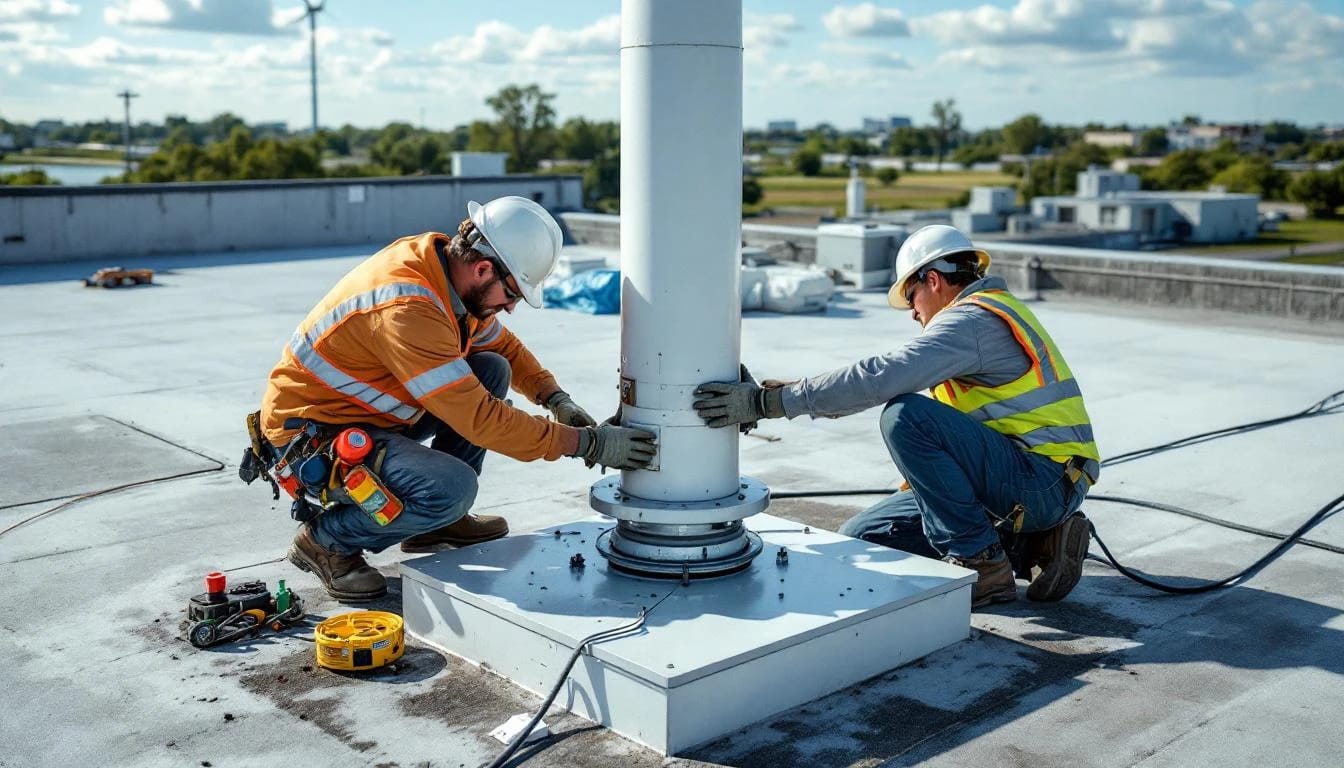
Mounting a wind turbine directly on a residential roof is technically possible but rarely advisable. Structural load concerns, vibration transfer, turbulent airflow near rooflines, and permitting complexity make rooftop installations underperform compared to freestanding tower systems. Most manufacturers and the Department of Energy's Small Wind Guidebook recommend pole-mounted turbines elevated 30 feet above nearby obstructions within 500 feet to capture clean, laminar wind.
Why Rooftop Wind Turbines Struggle
Residential rooftops create turbulent airflow. As wind encounters a building, it decelerates, swirls, and changes direction unpredictably. The layer of chaotic air extends 10–15 feet above the roofline, precisely where a roof-mounted turbine operates. Turbulence reduces energy capture by 30–50% and accelerates wear on bearings, blades, and yaw mechanisms.
Structural loading adds another barrier. A 1 kW turbine with a 6-foot rotor diameter weighs 40–80 pounds, excluding the mast. Dynamic loads during high winds generate lateral forces exceeding 200 pounds. Standard residential trusses built to IRC Chapter 8 specifications support static snow and dead loads, not oscillating lateral stress. A licensed structural engineer must evaluate rafter capacity, connection points, and tributary load paths before any turbine installation. Retrofitting reinforcement—steel brackets, through-bolted plates, or truss sister bracing—costs $1,200–$3,500 depending on access and existing framing.
Vibration transmission matters more than weight. Even a well-balanced turbine produces low-frequency oscillations (5–20 Hz) that travel through mounting hardware into the roof deck, attic joists, and wall studs. Residents report humming, rattling windows, and resonance in ductwork. Vibration isolation mounts reduce but do not eliminate transmission, and repeated stress can loosen fasteners or crack drywall joints over time.
![INLINE: Turbulent wind patterns around a residential building showing eddies and reduced velocity zones near the roofline]
Vertical-Axis vs. Horizontal-Axis on Roofs
Vertical-axis wind turbines (VAWTs) appear frequently in rooftop marketing because their omnidirectional design sounds ideal for chaotic urban wind. Models like the Pikasola 600W or generic Savonius-style units mount on short poles and promise quiet operation. In practice, VAWTs suffer from lower efficiency—Betz limit realizations of 15–25% compared to 35–45% for horizontal-axis turbines (HAWTs)—and most rated outputs assume clean, steady wind at hub height. Actual rooftop performance rarely exceeds 30% of nameplate capacity.
Small HAWTs such as the Primus Air 40 or Rutland 914i demand tail-fin yaw systems and generate higher tip-speed ratios, making them noisier and more vibration-prone when roof-mounted. Their longer blades (3–6 feet) require greater clearance from parapets, vents, and HVAC equipment. Both turbine types face the same aerodynamic penalty on rooftops: insufficient clean wind.
Zoning, Permits, and FAA Part 77
Local zoning codes often classify rooftop turbines as "accessory structures" subject to height restrictions measured from grade, not roofline. A turbine mounted 8 feet above a roof on a two-story home may exceed the 35-foot residential height limit common in suburban ordinances. Variances require public hearings, neighbor notification, and approval timelines of 60–120 days.
Building permits invoke NEC Article 705 for interconnection and require mechanical, electrical, and structural plan reviews. Inspectors verify that the turbine's overcurrent protection, disconnect switches, and grounding comply with NEC 690.4 and 705.12, which govern distributed generation. If the total rooftop structure exceeds 200 square feet (including mast and guy-wire footprints), some jurisdictions require sealed stamped drawings from a licensed PE.
FAA Part 77 mandates notification for any structure exceeding 200 feet AGL or located near airports. A 40-foot tower on a two-story home (ridge height ~24 feet) remains well below this threshold, but local airport overlay zones may impose stricter limits. Filing FAA Form 7460-1 takes 45 days for determination.
Homeowner association covenants frequently prohibit "windmills" or "towers" outright. Review CC&Rs before purchasing equipment. Some states, including California and Colorado, have solar/wind access laws that limit HOA restrictions, but enforcement involves litigation.
Structural Engineering Requirements
A rooftop turbine attachment must transfer three load types into the building frame: dead load (static weight), lateral wind load (thrust on blades), and dynamic cyclic load (vibration). The International Residential Code (IRC) Section R802 specifies rafter and truss design for gravity loads, not cantilever bending. Engineers use ASCE 7-22 Chapter 29 wind load calculations to model forces on the turbine and mounting hardware, then compare demand against member capacity.
Typical residential roof trusses use 2×4 or 2×6 lumber at 24-inch spacing. Concentrated loads exceeding 150 pounds require load-spreading strongbacks or sister joists. Through-bolted mounting plates should penetrate at least three truss members, and fasteners must be galvanized or stainless steel to resist corrosion. Expect engineering fees of $800–$2,000 plus $1,500–$4,000 in reinforcement materials and labor.
Flat commercial roofs with steel bar joists or engineered wood I-joists offer better attachment options, but parapet walls and rooftop HVAC units create additional turbulence zones. Ballasted mounting systems (concrete blocks) avoid roof penetrations but add 300–800 pounds of dead load, which must be verified against live load capacity per IBC Section 1607.
Wind Resource at Roof Height
Wind speed increases logarithmically with height above ground. The wind shear exponent in residential areas typically ranges from 0.25 to 0.40, meaning a 10 mph ground-level wind becomes 14–16 mph at 30 feet and 18–20 mph at 60 feet. Rooftop turbines operate 15–25 feet above grade—often below the height where wind escapes ground clutter.
The Department of Energy's WINDExchange toolkit recommends tower heights of 30 feet above any obstruction within 500 feet. A two-story home surrounded by mature trees, fences, and neighboring houses sits in a wind shadow that extends 50–100 feet downwind. Even on the roof, the turbine captures only the disturbed, decelerated flow.
Annual energy production scales with the cube of wind speed. Reducing average wind speed from 12 mph to 8 mph cuts energy output by 58%, not 33%. This cubic relationship makes siting critical. A turbine on a 40-foot tower in open terrain generates 3–5 times more electricity than the same turbine mounted on a 20-foot rooftop pole in a treed neighborhood.
Installation and Maintenance Challenges
Accessing a rooftop turbine for annual maintenance—checking fasteners, greasing bearings, inspecting blades—requires ladder work or scaffolding. OSHA fall protection rules apply to commercial installations; residential DIY work carries liability if a contractor is injured. Warranty service often excludes rooftop installations because technicians cannot safely reach the unit without expensive lift equipment.
Guy wires for taller rooftop masts (over 15 feet) must anchor to structural elements, not just roof decking. Anchor points spread 120 degrees around the mast require through-bolting into rafters or exterior wall plates, creating additional penetration points and leak risk. Proper flashing and sealant maintenance become ongoing tasks. Wind-driven rain can exploit any gap around a mounting bolt, leading to rot in the roof deck or insulation saturation.
Grid interconnection requires an AC disconnect within sight of the electric meter per NEC 705.12(D). Running conduit from a rooftop turbine down an exterior wall to the service panel adds $400–$900 in electrical labor. The turbine's inverter or charge controller typically mounts indoors (garage, basement) to avoid weather exposure, necessitating a second conduit run from the turbine to the inverter location.
Comparison: Roof-Mount vs. Tower-Mount Systems
| Criterion | Roof-Mounted | Tower-Mounted |
|---|---|---|
| Hub height | 15–25 feet AGL | 30–80 feet AGL |
| Wind quality | Turbulent, reduced velocity | Laminar, higher average speed |
| Annual output | 30–60% of rated capacity | 60–90% of rated capacity |
| Structural cost | $1,500–$4,000 reinforcement | $2,000–$6,000 foundation + tower |
| Vibration | Transmitted to living space | Isolated at base |
| Maintenance access | Ladder, scaffold, or lift | Tilt-up or climb with safety gear |
| Permit complexity | Building + electrical + zoning variance | Zoning + electrical, often streamlined |
| Lifespan | 8–12 years (accelerated wear) | 15–25 years (rated lifespan) |
Manufacturers like Bergey Windpower and Primus Wind Power explicitly recommend against rooftop mounting in their installation manuals. The Bergey Excel 1 and Primus AIR X turbines specify freestanding towers with concrete foundations or helical anchors for guy wires.
When Rooftop Wind Might Work
Three scenarios suit rooftop turbines: flat commercial buildings in coastal wind regimes, microgeneration for off-grid sensors or communications equipment, and demonstration projects where educational value outweighs energy production.
A 10,000-square-foot warehouse roof in a coastal plain with consistent 15+ mph winds and minimal nearby obstructions can support small VAWT arrays for supplemental power. The building's steel structure absorbs vibration, and roof height places turbines above one-story surroundings. Annual output remains modest—500–1,200 kWh per turbine—but aggregated across multiple units, it offsets lighting or HVAC loads.
Microgeneration (under 100 watts) for remote telemetry, weather stations, or security cameras works on rooftops when solar panels are impractical due to shading. Turbines like the Rutland 504 or Marlec Rutland 914i provide trickle charging for 12V battery banks. Vibration and noise are less critical when no one occupies the building overnight.
Schools and environmental centers install rooftop turbines as teaching tools despite poor performance. The visibility and accessibility support STEM curriculum, and data-logging real-time output versus theoretical calculations offers tangible lessons in aerodynamics and siting.
Alternative Mounting Strategies
If rooftop mounting appeals due to lot size constraints, consider these alternatives:
Ground-mount on short tower: A 30-foot freestanding lattice or monopole tower on a 6-foot-square concrete pad (4,000 psi mix, 36-inch frost depth) costs $2,500–$4,500 installed. Clearance from property lines varies by jurisdiction (often 1.5× tower height), but most quarter-acre suburban lots can accommodate this footprint in a back corner. The turbine sits above the roofline, capturing cleaner wind without structural load on the house.
Tilt-up tower: Bergey and Southwest Windpower offer tilt-up tower kits that hinge at the base, allowing one person to raise or lower the turbine for maintenance. A winch and gin pole simplify the process. Tilt-up towers suit DIY installers and eliminate the need for a crane during blade replacement or inverter service.
Building-integrated mounts: Gable-end walls on two-story homes provide a vertical surface that minimizes vibration transmission compared to roof decking. A turbine mounted on a 10-foot mast through-bolted to wall studs and collar ties places the unit 35+ feet AGL while distributing loads along the wall plane. This approach requires the same structural engineering as rooftop mounting but reduces noise transmission into living spaces.
Shared community tower: Neighbors can pool resources to erect a single 60–80-foot tower on common property or a willing participant's lot. A 10 kW turbine produces enough electricity for 3–5 homes, and cost-sharing brings per-household investment down to $4,000–$8,000 including tower, turbine, interconnection, and legal agreements. Community wind projects qualify for the federal Investment Tax Credit (30% under IRC §25D) and streamline permitting through single-applicant processes.
Federal Tax Incentives and Economics
The Residential Clean Energy Credit (IRC §25D) provides a 30% federal income tax credit for qualified small wind systems placed in service through December 31, 2032, then stepping down to 26% in 2033 and 22% in 2034. Eligible costs include the turbine, tower, inverter, wiring, and installation labor. Claim the credit on IRS Form 5695 and attach it to Form 1040. The credit is nonrefundable but carries forward to subsequent tax years if it exceeds current liability.
A $12,000 tower-mounted system (turbine, foundation, installation) generates a $3,600 credit, reducing net cost to $8,400. If the turbine produces 3,500 kWh annually in a region with $0.14/kWh retail rates, annual savings reach $490. Simple payback extends 17 years before incentives, 11 years after, assuming no O&M costs and 20-year turbine life. Net metering programs that credit excess generation at retail rates improve economics; states with feed-in tariffs (California, Oregon) accelerate payback to 8–12 years.
Rooftop installations cost $7,000–$10,000 (equipment, reinforcement, labor) but produce 40–50% less energy due to siting compromises. The $2,100–$3,000 tax credit lowers net cost to $4,900–$7,000, but reduced output extends payback to 15–25 years—beyond typical equipment life. Tower-mounted systems deliver superior return on investment.
State-level incentives vary. DSIRE (Database of State Incentives for Renewables & Efficiency) catalogs rebates, property tax exemptions, and sales tax waivers. New York offers $1.50/watt rebates up to $9,000 through NYSERDA. Massachusetts exempts small wind systems from property tax increases. Vermont's Small Scale Renewable Energy Incentive Program provides $0.06/kWh performance payments for 10 years.
Noise, Aesthetics, and Neighbor Relations
Rooftop turbines amplify perceived noise because the building structure acts as a resonance chamber. A turbine generating 45 dBA at 5 meters in open air may produce 55–60 dBA inside adjacent bedrooms due to vibration coupling. Most municipal noise ordinances cap residential sound at 50–55 dBA at property lines during daytime, 45 dBA at night. Complaints trigger code enforcement, and remediation involves costly vibration isolation retrofits or turbine removal.
Tower-mounted turbines 50+ feet from the house reduce interior noise to 35–40 dBA (comparable to a refrigerator). Setback distances, typically 1.5× tower height from property lines, prevent noise transmission to neighbors. Discuss plans with adjacent homeowners before installation; goodwill defuses objections during permit hearings.
Aesthetics remain subjective. Some homeowners embrace the visible statement of renewable energy; others find rotating blades unsightly. Rooftop turbines are more conspicuous than ground-mounted units screened by landscaping. HOAs cite "visual uniformity" to block installations, and few states have "right to generate" laws that override covenants for small wind.
Insurance and Liability
Homeowner insurance policies exclude coverage for business activities, and selling electricity back to the grid can trigger commercial classification. Notify your carrier before installing a turbine. Most insurers add small wind as an endorsement for $50–$150/year, covering turbine replacement cost and liability for property damage (e.g., blade detachment). Rooftop installations may require a separate structural rider, and some carriers refuse coverage due to increased risk of roof damage and interior vibration claims.
Liability exposure includes blade throw (ice or failure), tower collapse, and electromagnetic interference with neighbors' electronics. A 5-foot blade detaching at 300 RPM travels 100+ feet. Setbacks mitigate risk, and regular maintenance per manufacturer schedules (annual inspections, five-year bearing replacement) demonstrates due diligence. Document all service in a logbook to support claims defense.
Off-Grid and Battery Storage Integration
Off-grid rooftop turbines pair with solar panels and battery banks to provide 24-hour power in remote cabins or RVs. Hybrid charge controllers (e.g., Morningstar TriStar MPPT 600V) manage inputs from both sources, prioritizing whichever generates more at the moment. Wind complements solar during winter months and nighttime, improving autonomy.
A 400W rooftop VAWT producing 500 kWh/year combines with 1,200W of solar panels (1,500 kWh/year) to meet a 2,000 kWh/year load. A 48V, 400 Ah lithium battery bank (19.2 kWh usable) provides three days of storage for critical loads. Total system cost: $9,000–$14,000. Off-grid systems avoid interconnection complexity but require careful load management and backup propane or gasoline generators for extended cloudy, calm periods.
Grid-tied battery backup systems (e.g., Tesla Powerwall, LG Chem RESU) store wind and solar energy for use during outages or peak-rate periods. NEC 705.12(B) limits backfed breaker size to 120% of busbar rating, and battery inverters must disconnect during grid faults per IEEE 1547. A 13.5 kWh battery cycling daily absorbs 4,000–5,000 cycles over 10–15 years, storing turbine output that would otherwise be curtailed by net metering caps.
Can I install a wind turbine on my roof without a permit?
No jurisdiction allows unpermitted wind turbine installation. Building codes require structural, electrical, and zoning approval to ensure safety and code compliance. Operating without permits risks stop-work orders, fines, forced removal, and voided homeowner insurance. Some municipalities offer over-the-counter permits for microgeneration systems under 100W, but standard residential turbines (400W–10 kW) always need full review.
How much electricity can a rooftop wind turbine generate?
Actual rooftop generation averages 30–50% of nameplate capacity due to turbulence, wind shear, and obstructions. A 1 kW turbine (rated at 11 m/s or 24 mph wind) on a suburban roof produces 400–700 kWh/year, offsetting $50–$100 in electricity costs annually at $0.12–$0.14/kWh. The same turbine on a 40-foot tower in open terrain generates 1,200–1,800 kWh/year, saving $145–$250. Use the DOE Wind Resource Maps and local airport ASOS data to estimate average wind speed at hub height, then apply manufacturer power curves with a 50% derating for rooftop siting.
Will a rooftop wind turbine damage my home?
Improper installation or inadequate structural reinforcement causes damage. Vibration loosens fasteners, cracks interior drywall, and stresses roof trusses. Water infiltration through mounting bolt penetrations rots decking and saturates insulation. A licensed structural engineer must design load-appropriate attachments, and a qualified roofer must flash and seal all penetrations. Annual inspections catch fastener loosening and sealant degradation before they escalate. Budget $200–$400/year for maintenance and $1,000–$2,500 every five years for bearing replacement and blade inspection.
Are vertical-axis turbines better for rooftops than horizontal-axis?
VAWTs handle turbulent wind from any direction, making them theoretically suited for rooftops. In practice, their lower efficiency (15–25% vs. 35–45% for HAWTs) and poor performance in gusty conditions result in similar or worse energy yields. VAWTs still transmit vibration, weigh 40–70 pounds, and require structural support. Neither turbine type overcomes the fundamental problem: rooftops sit in turbulent, low-velocity wind. Tower mounting improves both VAWT and HAWT performance, and HAWTs dominate the residential market due to proven track records from Bergey, Southwest Windpower, and Primus.
What is the typical payback period for a rooftop wind turbine?
Rooftop systems payback in 15–30 years due to high installation costs ($7,000–$12,000) and low energy production (400–1,000 kWh/year). After the 30% federal tax credit, net cost is $4,900–$8,400. At $0.14/kWh, annual savings range $56–$140, yielding simple payback of 35–150 years—well beyond equipment life. Tower-mounted systems costing $10,000–$15,000 produce 1,500–3,000 kWh/year, saving $210–$420 annually. After credits, net cost drops to $7,000–$10,500, with payback in 17–25 years. Economics improve in high-wind sites (12+ mph average) with retail net metering, where payback shortens to 10–15 years for tower systems. Rooftop installations rarely justify their cost unless energy production is secondary to educational or demonstration goals.
Bottom Line
Rooftop wind turbines deliver poor energy returns due to turbulence, structural complexity, and vibration issues. Tower-mounted systems on freestanding poles 30–60 feet tall outperform rooftop installations by 3:1 or more, avoid building damage, and simplify permitting. Homeowners serious about wind energy should consult local zoning codes, hire a structural engineer for tower foundation design, and claim the 30% federal tax credit. Next step: request a free site assessment from NABCEP-certified installers to measure wind speed at multiple heights and model realistic energy production.
Share this article
windturbinehome.com/s/c4bcb9
Editorial note: This article was researched and written by a member of the Wind Turbine Home editorial team. AI-assisted tools were used for spell-checking and light grammar review only — all research, analysis, and conclusions are our own. Our editorial policy prohibits sponsored content and paid placements. Read our editorial policy →
Related reading
rooftop installation
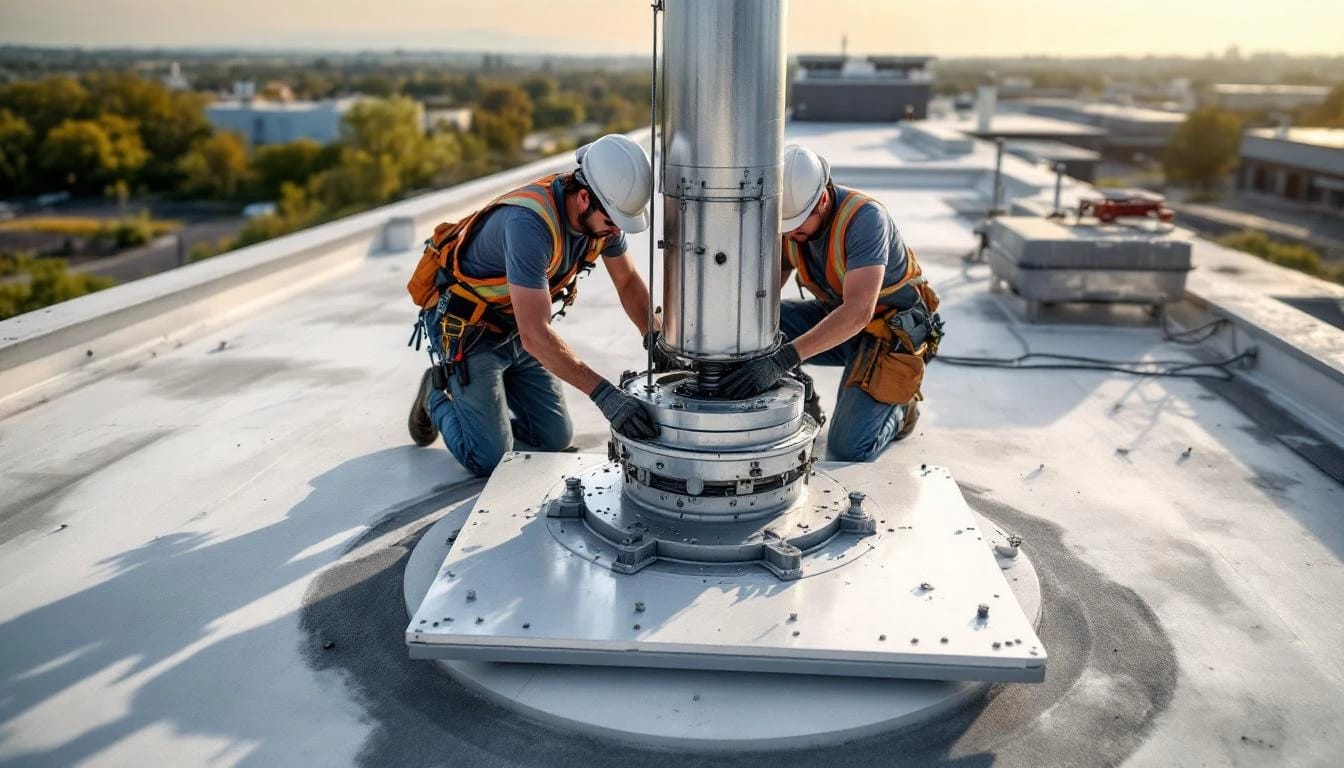
Pitched-Roof Turbine Mounting: Structural Load & Rafter Sizing
Learn how to calculate wind loads, dead loads, and rafter span requirements for mounting small wind turbines on residential pitched roofs safely and to code.
rooftop installation
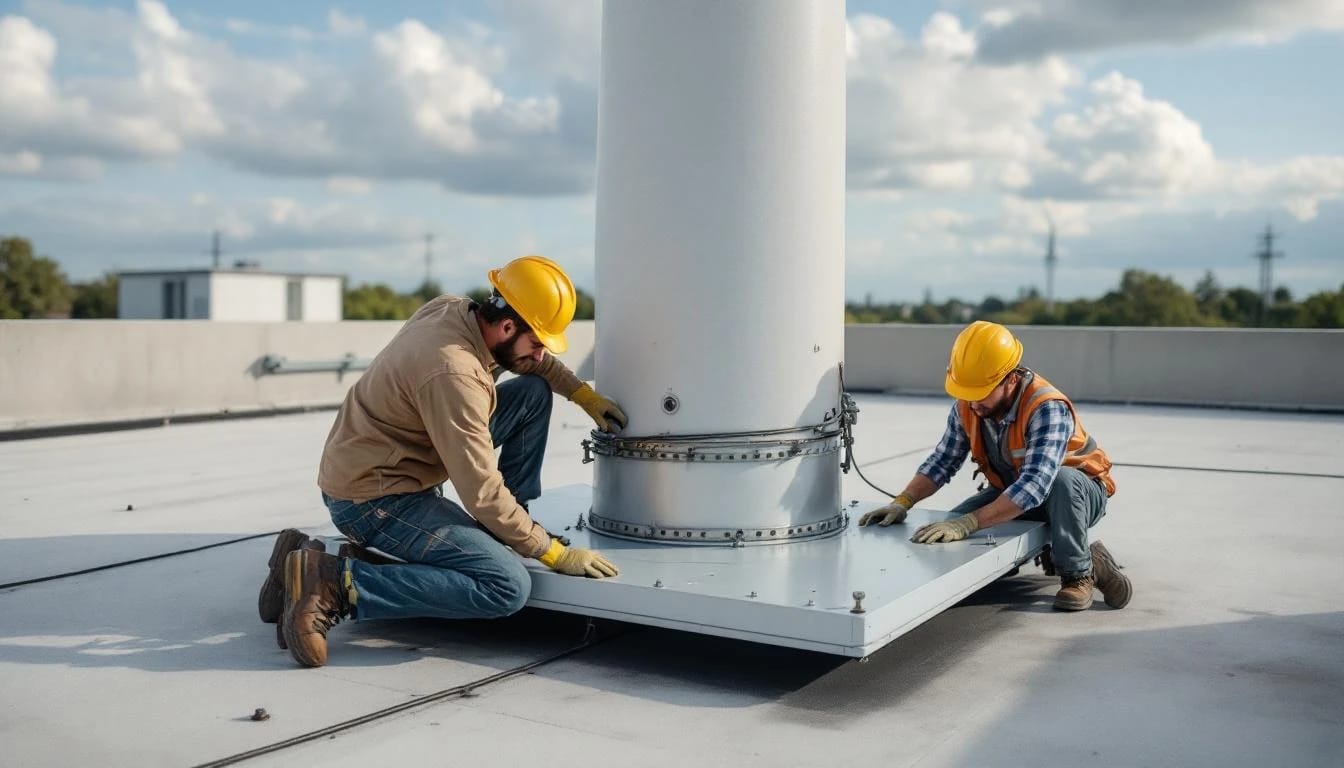
Ballasted Flat-Roof Mounts for Vertical-Axis Turbines Guide
Ballasted flat-roof mounts secure vertical-axis wind turbines without roof penetration using concrete blocks or water ballast, ideal for commercial buildings with membrane roofs.

rooftop installation
Roof-Mounted Wind Turbines for Homes: The Honest Verdict (2026)
Roof-mounted wind turbines rarely work for homes. Turbulence, noise, vibration, and structural limits undermine performance. Here's what the data shows.