Roof-Mounted Wind Turbines for Homes: The Honest Verdict (2026)
Roof-mounted wind turbines rarely work for homes. Turbulence, noise, vibration, and structural limits undermine performance. Here's what the data shows.
Share this article
windturbinehome.com/s/d4a715

Roof-mounted wind turbines promise clean power right where you live, but the reality disappoints most homeowners. Turbulence from the roof itself cuts energy capture by 40–70%, vibration wears bearings prematurely, and structural loads exceed residential framing standards. Ground-mounted or pole-mounted turbines on properties with at least one acre consistently deliver 300–500% more annual output than identical units bolted to a rooftop. The Department of Energy's Small Wind Guidebook confirms that elevated, unobstructed placement matters more than convenience.
This verdict examines manufacturer claims against field data, local code barriers, and actual cost-per-kilowatt-hour for rooftop installations across the United States.
Why rooftop wind turbines underperform
A roof creates turbulence. Air tumbles over shingles, chimneys, vents, and roof peaks, arriving at the turbine blades in chaotic swirls rather than smooth laminar flow. Wind speed at rooftop level is typically 20–40% lower than at the same height in open terrain, and that drop compounds because power output scales with the cube of wind speed. Halve the wind speed and energy production plummets to one-eighth.
Vertical-axis turbines (Savonius or Darrieus designs) tolerate turbulent flow better than horizontal-axis machines, but tolerance does not equal efficiency. A 1 kW-rated vertical unit on a suburban roof may generate 150–300 kWh per year in a site averaging 10 mph wind, far below the 800–1,200 kWh typical for the same turbine on a 30 ft pole in the same backyard. Bergey and Southwest Windpower (now discontinued) both caution that rooftop mounting voids performance warranties unless wind speed is independently verified at hub height.
Vibration travels through the mounting bracket into rafters and wall studs. Even small turbines under 2 kW produce low-frequency hum that propagates through wood framing, audible in bedrooms as a persistent drone. Rubber isolators and spring mounts reduce but do not eliminate this coupling. Local noise ordinances in many jurisdictions limit residential sound levels to 50–55 dBA at the property line; a rooftop turbine can push you over that threshold when the wind exceeds 15 mph.
![INLINE: Turbulent airflow swirling over a peaked residential roof, disrupting wind turbine blade rotation]
Structural and code compliance hurdles
NEC Article 705 governs interconnection of on-site generators, but it does not address mechanical loads. Roof framing is engineered for snow, ice, and occasional maintenance traffic—not continuous dynamic torque from a spinning rotor. A 400 W turbine and mount weigh 40–60 lb; that static load is manageable. The problem is gyroscopic precession and harmonic resonance during gusts. Trusses flex, fasteners loosen, and shingles crack around the mounting feet.
Building departments in many counties require a stamped structural letter from a licensed PE before issuing a permit. That letter costs $800–$2,500 and often concludes that reinforcement is necessary, adding another $1,200–$4,000 in carpentry. Homeowners who skip permitting risk red flags during resale inspections and potential denial of homeowner's insurance claims if wind damage occurs.
FAA Part 77 requires notification for any structure exceeding 200 ft above ground level, but rooftop turbines stay well below that. HOA covenants and municipal zoning overlays are stricter obstacles. Many residential zones cap accessory structures at 15 ft above the roofline or prohibit "industrial equipment" visible from the street. Variance applications take 60–120 days and cost $300–$1,200 in filing fees, with no guarantee of approval.
Realistic power output and payback
A 1 kW rooftop turbine priced at $2,800 plus $1,500 installation yields perhaps 250 kWh/year in a 9 mph average site. At $0.14/kWh retail electricity cost, annual savings total $35. The 30% federal Residential Clean Energy Credit (IRC §25D, claimed on IRS Form 5695) reduces net cost to $3,010. Simple payback stretches past 85 years, three times the turbine's expected lifespan.
Ground mounting the same turbine on a 35 ft tower adds $2,200 for the tower and foundation but lifts output to 900 kWh/year. Annual savings jump to $126, payback to 45 years after the tax credit—still marginal but approaching breakeven in high-wind rural sites or when paired with battery storage to offset time-of-use rates.
Vertical-axis models like the Pikasola 600 W ($1,400) or Aeolos-V 1 kW ($2,600) are marketed for rooftops because their omnidirectional design eliminates yaw mechanisms. Real-world yield remains poor. Owner reports on forums document 80–200 kWh/year for rooftop Pikasolas, roughly 5–10% of rated capacity. Manufacturers rate turbines at 25–28 mph wind, a condition rooftops see only during severe storms when the turbine furls or brakes for safety.
| Scenario | Turbine | Mounting | Total Cost | Annual kWh | Annual Savings | Payback After Tax Credit |
|---|---|---|---|---|---|---|
| Suburban rooftop | Pikasola 600 W | Roof bracket | $2,900 | 150 | $21 | 135 years |
| Rural rooftop | Bergey Excel 1 | Roof bracket | $6,800 | 400 | $56 | 84 years |
| Rural pole mount | Bergey Excel 1 | 35 ft tower | $9,200 | 1,200 | $168 | 38 years |
| Open farmland pole | Primus Air 40 | 45 ft tower | $4,800 | 950 | $133 | 25 years |
Costs current as of Q2 2025; savings assume $0.14/kWh average U.S. residential rate.
When rooftop mounting makes sense (rarely)
Three narrow use cases justify rooftop turbines. First, flat commercial roofs in coastal wind corridors where steady 14+ mph averages minimize turbulence and structural capacity is already engineered for HVAC units. A commercial building in coastal Texas or the Great Plains can support an array of 1–2 kW units and write off the expense under the Investment Tax Credit (ITC) rather than the residential credit.
Second, off-grid cabins in alpine zones above the tree line where wind is consistent and any onsite generation is better than running a diesel generator. A 400 W turbine mounted on the ridge of a metal roof at 8,000 ft elevation can trickle-charge a battery bank, reducing generator runtime by 30–50%.
Third, educational or demonstration projects where the goal is public engagement rather than ROI. A school or museum might install a rooftop turbine to visualize renewable energy, accepting that cost-per-kilowatt-hour exceeds grid power by a factor of ten.
For the typical suburban or rural homeowner, roof mounting sacrifices 60–80% of potential generation without a proportional cost reduction. The savings from skipping tower installation (roughly $1,800–$3,500) evaporate when you account for lost output.
Maintenance access and safety
Blades must be inspected every 12–18 months for leading-edge erosion, and bearings regreased or replaced every 24–36 months. A rooftop turbine requires a ladder, harness, and fall-arrest anchor—or hiring a contractor at $150–$250 per visit. Pole-mounted turbines with tilt-down towers (Bergey Excel 1, Primus Air 40) lower to waist height for maintenance on the ground, saving time and risk.
Blade failures happen. A 5 ft diameter rotor at 400 RPM releases fiberglass shrapnel when a blade cracks. On a roof, that debris lands on neighboring properties or vehicles. Liability insurance may not cover "non-standard energy equipment" without a rider.
Interconnection and net metering
Grid-tie inverters for small wind must meet UL 1741 and IEEE 1547 standards. Most jurisdictions require AC disconnect switches accessible to utility crews, anti-islanding protection, and a production meter separate from the consumption meter. Utility interconnection applications can take 30–90 days and incur engineering review fees of $0–$500 depending on the provider.
Net metering policies vary by state. Consult the DSIRE database (Database of State Incentives for Renewables & Efficiency) for your location. Thirty-eight states offer some form of net metering, but monthly rollover credits and annual true-ups differ. In California, NEM 3.0 values exported solar and wind at wholesale rates (roughly $0.03–$0.05/kWh), slashing payback economics for small systems. Texas has competitive retail choice but no statewide net metering mandate; homeowners must negotiate with their chosen REP.
A licensed electrician familiar with NEC Article 705 is mandatory for grid-tie installation. Budget $800–$1,800 for electrical work, permitting, and inspection.
Alternatives that work better
If your property has one acre or more and average wind speeds above 10 mph at 30 ft, a ground-mounted or pole-mounted small wind turbine on a 35–50 ft tower delivers three to five times the output of a rooftop unit for 40–60% more upfront cost. The incremental payback difference is 20–30 years, still long but approaching the lifespan of the equipment.
Hybrid systems pairing a 1–3 kW turbine with a 3–5 kW solar array and battery storage smooth generation across the day. Wind often peaks at night when solar is zero, improving system capacity factor. Tesla Powerwall, LG Chem RESU, and Enphase IQ batteries integrate with wind charge controllers through DC coupling or AC coupling topologies.
For homeowners without adequate land or wind, rooftop solar remains a better investment. Levelized cost of energy for residential solar in 2025 averages $0.09–$0.12/kWh versus $0.30–$0.60/kWh for rooftop wind. Solar-plus-storage provides resilience and economic return that rooftop turbines cannot match.
State incentives and financing
The 30% federal tax credit applies to small wind systems under 100 kW through December 31, 2032, then steps down to 26% in 2033 and 22% in 2034. Eligible costs include the turbine, tower, inverter, wiring, and installation labor. You must own the equipment; leased systems do not qualify.
State-level incentives have contracted since 2015. New York offers $1.50/watt through NYSERDA for systems under 2 kW, capped at $3,000. Oregon provides a residential energy tax credit of $1,500–$6,000 depending on system size. Montana exempts small wind from property tax valuation. Most other states folded their programs or redirected funds to solar and storage.
Property-assessed clean energy (PACE) financing is available in 36 states, allowing homeowners to repay system costs through a special property tax assessment over 15–20 years. PACE does not require upfront capital but adds a lien that must be disclosed and satisfied at resale. Interest rates range from 5.5%–8.5%.
Realistic expectations checklist
Before signing a contract, verify the following:
- Average annual wind speed at 30 ft above ground (use anemometer data, not web calculators)
- Zoning allows structures at proposed height
- HOA approval in writing
- Structural letter from a PE
- Utility interconnection pre-approval
- Installer provides written kWh production estimate, not just nameplate capacity
- Manufacturer warranty survives rooftop mounting (many do not)
- Noise ordinance compliance
- Homeowner's insurance notified of accessory structure
Absent clear "yes" to all nine, pause the project.
Do roof-mounted wind turbines really work?
They work in the sense that blades spin and electrons flow, but annual energy production is 40–70% lower than the same turbine on a pole due to turbulence. Cost-per-kilowatt-hour exceeds grid rates by a factor of three to five, making them economically unviable for most homes.
Which brand makes the best rooftop turbine?
No major manufacturer recommends rooftop mounting as the primary installation method. Bergey Excel 1 and Primus Air 40 tolerate it with caveats, but both specify pole mounting for warranty coverage. Budget vertical-axis units from Pikasola and Aeolos are marketed for rooftops but produce minimal output.
Can I install a wind turbine myself?
NEC Article 705 requires a licensed electrician for grid interconnection. Mechanical installation can be DIY if you have fall-arrest training and tools, but most jurisdictions require a building permit and PE-stamped structural letter for rooftop mounts. Pole installations require concrete footings and ginpole or crane lifting.
How long do rooftop wind turbines last?
Manufacturer-specified lifespans are 15–20 years, but rooftop vibration accelerates bearing wear and blade fatigue. Expect 8–12 years before major component replacement. Ground-mounted turbines with proper maintenance reach 20–25 years.
Does the 30% federal tax credit apply to rooftop wind?
Yes, the Residential Clean Energy Credit (IRC §25D) covers wind turbines, towers, inverters, and installation labor through 2032. Claim it on IRS Form 5695. State incentives vary; check DSIRE for your location.
Bottom line
Roof-mounted wind turbines underdeliver because turbulence, structural limits, and noise constraints outweigh convenience. Homeowners with adequate land achieve three to five times better performance by pole-mounting the same turbine at 30–50 ft in open terrain. If land or zoning blocks that option, rooftop solar delivers superior economics and fewer headaches. The verdict: skip rooftop wind unless you live above the tree line in a coastal wind corridor with a commercial-grade flat roof and low electricity prices make off-grid autonomy your sole priority.
For homeowners serious about wind energy, start with a comprehensive site assessment and a conversation with installers experienced in small wind system design.
Share this article
windturbinehome.com/s/d4a715
Editorial note: This article was researched and written by a member of the Wind Turbine Home editorial team. AI-assisted tools were used for spell-checking and light grammar review only — all research, analysis, and conclusions are our own. Our editorial policy prohibits sponsored content and paid placements. Read our editorial policy →
Related reading
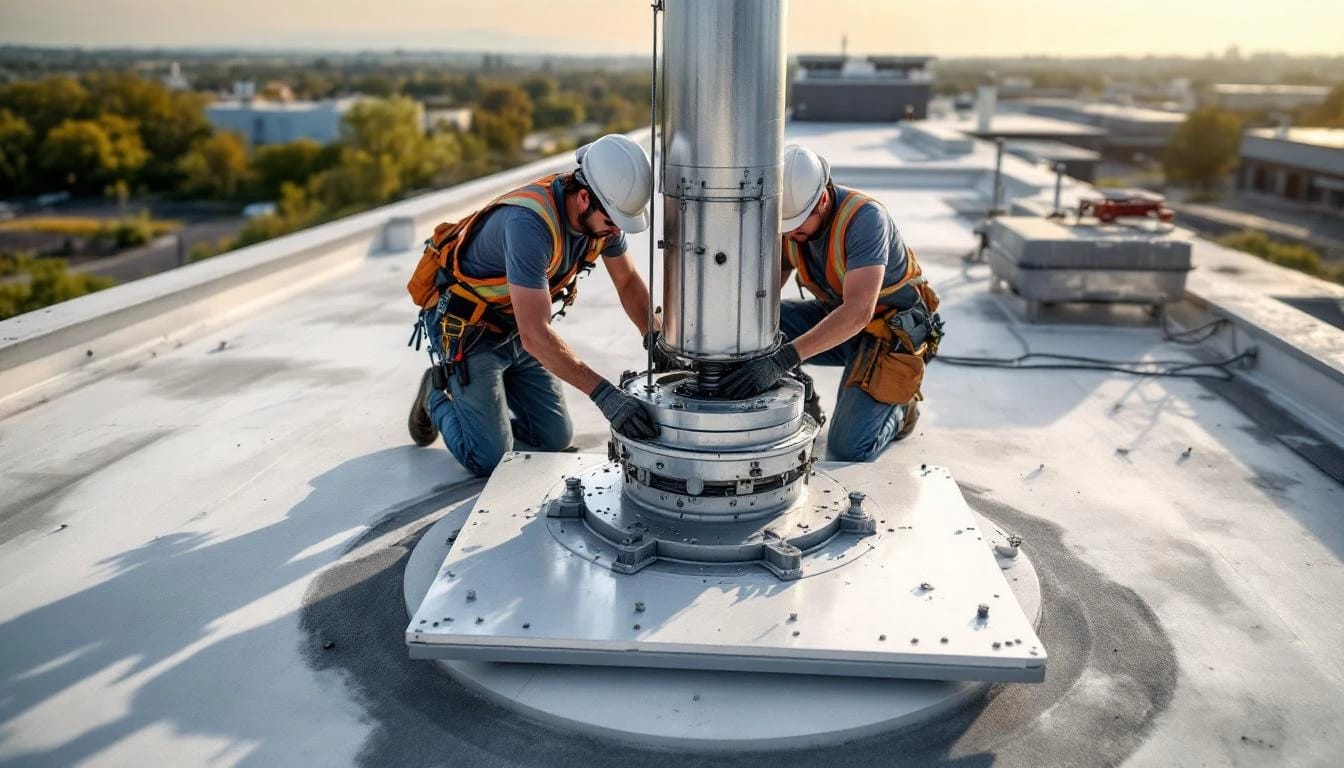
rooftop installation
Pitched-Roof Turbine Mounting: Structural Load & Rafter Sizing
Learn how to calculate wind loads, dead loads, and rafter span requirements for mounting small wind turbines on residential pitched roofs safely and to code.
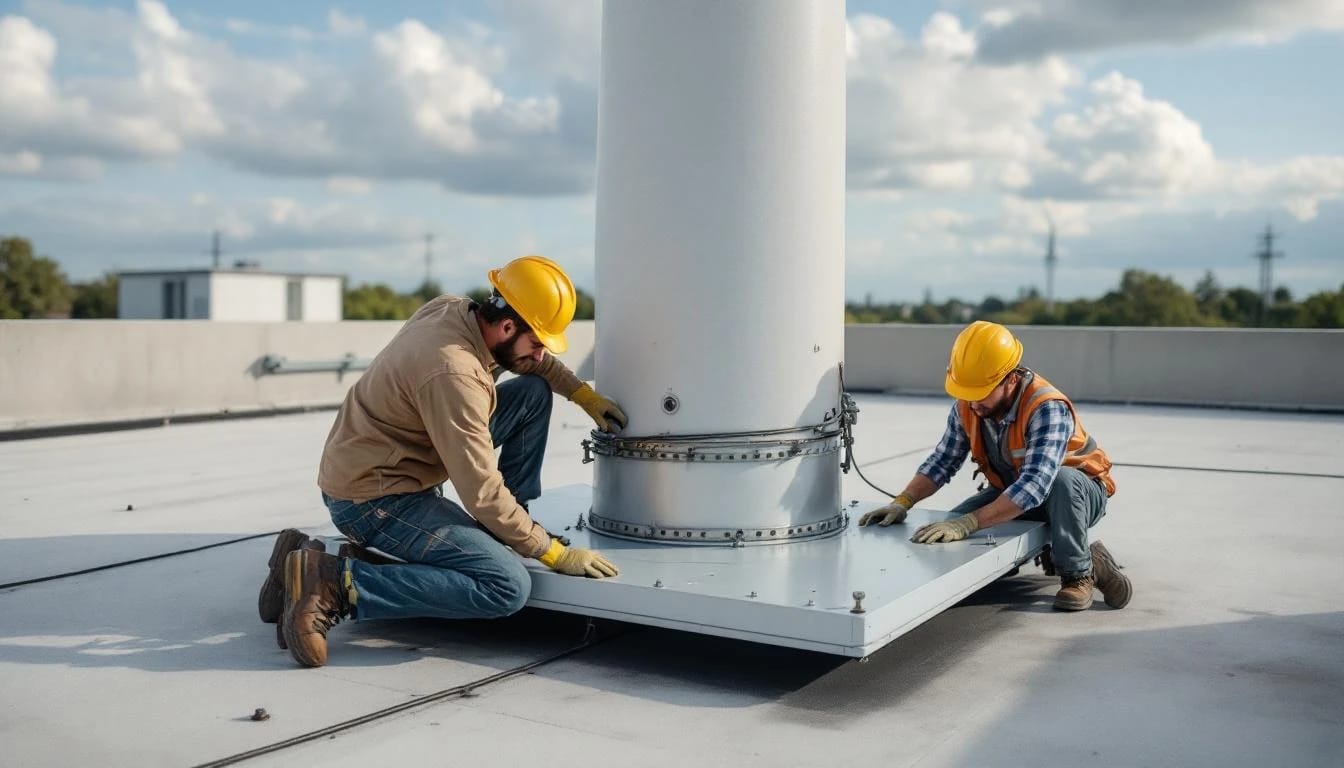
rooftop installation
Ballasted Flat-Roof Mounts for Vertical-Axis Turbines Guide
Ballasted flat-roof mounts secure vertical-axis wind turbines without roof penetration using concrete blocks or water ballast, ideal for commercial buildings with membrane roofs.
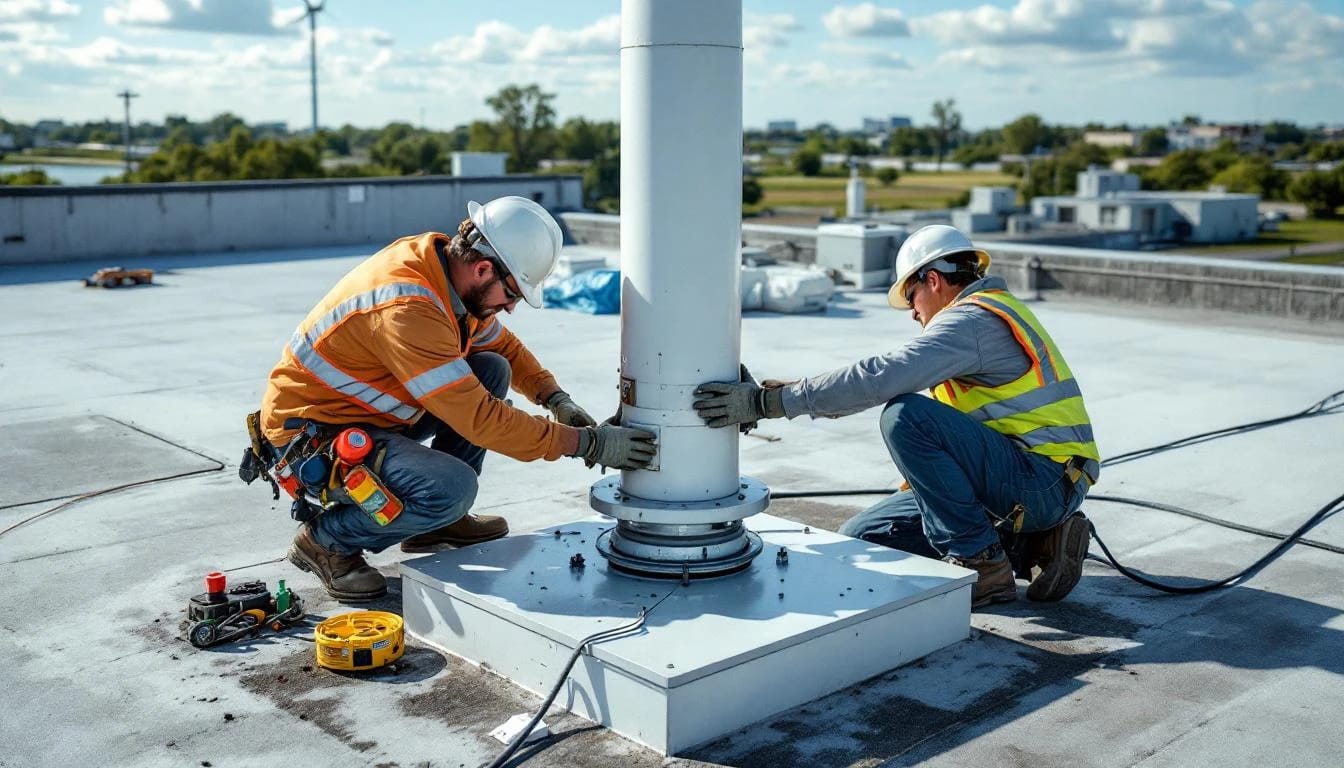
rooftop installation
Can You Put a Wind Turbine on a Roof? Engineering Reality
Rooftop wind turbines face structural, vibration, and wind-quality challenges that make them impractical for most homes. Tower-mounted systems deliver better performance.