Savonius vs Darrieus Wind Turbine: The 9 mph Rule
Savonius rotors self-start in light, turbulent breezes, while Darrieus rotors get more efficient once steady wind tops 9 mph. Match the rotor to your site.
Share this article
windturbinehome.com/s/99cc65
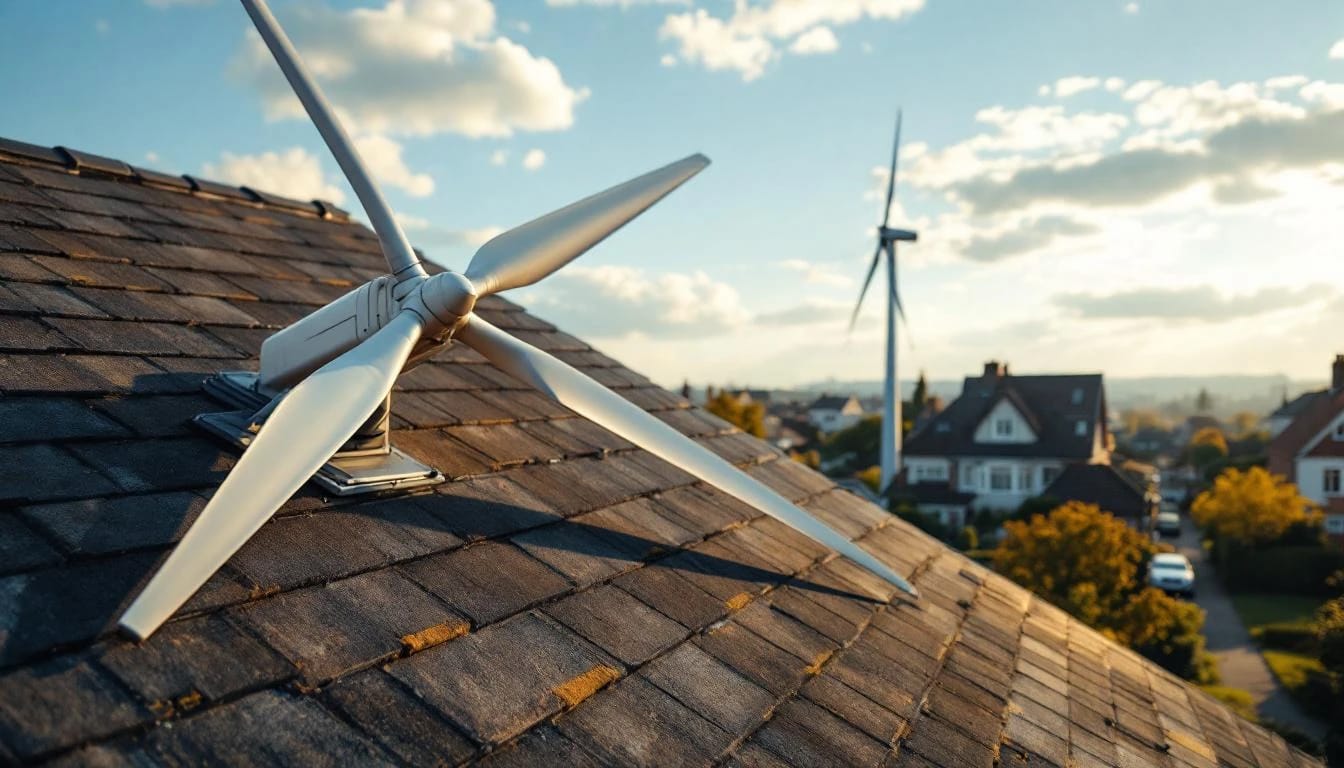
![HERO: Split view comparison showing a Darrieus H-rotor turbine on the left with thin vertical blades and a Savonius barrel-style turbine on the right, both mounted on residential properties]
Both Darrieus and Savonius turbines spin on a vertical axis, but they solve different problems. A Darrieus rotor uses airfoil-shaped blades to achieve efficiency comparable to small horizontal-axis machines—typically 35-40% at rated wind speed—making it suitable for open rural sites with consistent wind. A Savonius design relies on drag cups that catch wind from any direction, self-starting in winds as low as 4-5 mph and tolerating the chaotic gusts found in suburban and urban environments, though peak efficiency rarely exceeds 20%. Choosing between them comes down to your site's average wind speed, turbulence level, and whether consistent generation or reliable starting matters more for your application.
Understanding the Darrieus Rotor Design
The Darrieus turbine, named after French aeronautical engineer Georges Darrieus, uses two or three curved or straight vertical blades that resemble an eggbeater (traditional "troposkien" shape) or an H-frame (straight-blade variant). These blades operate on aerodynamic lift, the same principle that keeps aircraft aloft. As wind flows over the airfoil profile, differential pressure creates a force perpendicular to the wind direction, causing rotation.
The H-rotor variant dominates the residential market because straight extruded blades cost less to manufacture than compound curves. Manufacturers like Aeolos and Pikasola offer H-rotor models from 600W to 5kW, with blade spans ranging from 1.2m to 3.5m. These machines achieve peak efficiency at tip-speed ratios between 4 and 6—meaning blade tips move four to six times faster than the wind itself.
This high rotational speed translates to compact generator design and higher power output per swept area compared to Savonius rotors. A 2kW Darrieus might use a rotor only 2.4m tall and 1.6m wide, while a Savonius of equivalent rating would need nearly double the swept area. The downside: Darrieus turbines don't self-start reliably. Most models need wind speeds above 7-9 mph to overcome static friction and begin spinning, and some require a small motor for initial acceleration.
Modern solutions include helical blade twists (inspired by the Gorlov design) that improve starting torque by ensuring some blade section always presents an optimal angle of attack. The QR5 Quiet Revolution turbine uses this approach, though it remains a commercial/light-industrial product rather than a true residential option.
How Savonius Rotors Work Differently
Finnish engineer Sigurd Savonius patented his drag-based design in 1929, and the core principle hasn't changed: two or more offset half-cylinders create scoops that catch wind. The convex side experiences more drag than the concave side, producing net torque. Because this mechanism relies on drag rather than lift, a Savonius rotor always turns slower than the wind—typically achieving tip-speed ratios around 1.0.
This inherent speed limitation caps efficiency. Even optimized designs with twist angles, endplates, and carefully tuned overlap ratios struggle to exceed 25% efficiency at their design point. Real-world residential units—like the Helix Wind Savonnius and various Chinese imports sold under brand names including Automaxx and Windmill 1500W—typically operate between 15% and 18% efficiency at their rated wind speed.
What they lack in efficiency, Savonius rotors gain in starting performance. The drag-cup configuration means static torque exists at any blade position. A well-balanced Savonius begins turning in winds as low as 4 mph, making it viable for sites where a Darrieus would sit motionless for hours or days. The slow rotation also runs quieter—blade tips moving at wind speed produce far less aerodynamic noise than tips slicing through air at five times ambient velocity.
The penalty is size. To generate 1kW in a 20 mph wind, a Savonius might require a rotor 1.5m in diameter and 2.5m tall, sweeping 3.75 square meters. A Darrieus producing the same output might sweep only 2.2 square meters. Larger rotors mean more material cost, higher wind loading on the mounting structure, and greater visual impact.
Comparing Efficiency and Power Curves
Manufacturer-specified power curves reveal the practical difference. A typical 1kW Darrieus H-rotor shows minimal output below 8 mph, then climbs steeply through its operating range:
| Wind Speed (mph) | Darrieus H-Rotor (W) | Savonius Barrel (W) |
|---|---|---|
| 5 | 0 | 15 |
| 10 | 180 | 140 |
| 15 | 520 | 380 |
| 20 | 1,000 | 720 |
| 25 | 1,450 | 1,050 |
| 28 (furling) | 1,500 | 1,100 |
These numbers come from composite data across multiple small manufacturers, not controlled lab testing. Real-world performance varies with blade quality, bearing friction, generator efficiency, and controller losses. The pattern holds: Darrieus machines produce more power at moderate and high speeds, while Savonius designs capture energy other turbines miss during light-wind hours.
Annual energy production depends on your site's wind speed distribution, not peak output. A location averaging 10 mph but experiencing frequent 5-8 mph periods may harvest more kilowatt-hours from a Savonius, even though the Darrieus would win in a 15 mph steady breeze. The WINDExchange Small Wind Guidebook emphasizes evaluating your local wind resource before selecting any turbine type—vertical or horizontal axis.
Site Turbulence and Vertical-Axis Advantages
Both rotor styles share the vertical-axis benefit: omnidirectional operation without yaw mechanisms. A horizontal-axis turbine needs a tail vane or active motor to point into the wind; VAWTs accept wind from any direction equally. This matters enormously in turbulent environments.
Urban and suburban sites experience high turbulence intensity—wind direction changes every few seconds due to buildings, trees, and terrain features. A small HAWT constantly hunting for wind direction wastes energy in yaw motion and suffers power loss when briefly misaligned. A VAWT simply keeps spinning regardless of which compass point the gust originates from.
Savonius rotors handle turbulence better than Darrieus designs because drag forces remain consistent even when wind direction shifts mid-revolution. A Darrieus blade relies on sustained airflow over its profile; rapid direction changes can create momentary stall conditions that reduce instantaneous power. Neither turbine shuts down, but the Savonius maintains more consistent torque.
Local codes still apply. NEC Article 705 governs the electrical interconnection regardless of rotor type, requiring a lockable AC disconnect, proper grounding per NEC 690 and 250, and utility-approved inverters. FAA Part 77 notification applies to any structure exceeding 200 feet above ground level, but most residential VAWTs install on towers or rooftop mounts under 50 feet where notification isn't required (verify with your airport if within five nautical miles).
Before installation, check municipal zoning for height limits, setback requirements, and whether wind turbines are permitted as accessory structures. Some HOAs prohibit all turbines; others allow low-profile VAWTs while banning tall HAWTs. Savonius models often slip through aesthetic restrictions due to their compact, cylindrical form.
Noise Levels and Neighbor Relations
Tip-speed ratio directly correlates with aerodynamic noise. Darrieus blades cutting through air at 60-80 mph (in a 15 mph wind) generate a rhythmic whoosh, typically measured at 45-52 dB at 10 meters—comparable to moderate rainfall or a quiet conversation. This sound carries farther than its decibel level suggests because the frequency pattern stands out against ambient background noise.
Savonius rotors produce 38-42 dB at the same distance, often masked entirely by wind rustling through trees. The lower frequency rumble from larger-diameter Savonius units can transmit through mounting structures as vibration, so proper isolation matters: neoprene pads, spring isolators, or a freestanding tower rather than rooftop mounting.
For urban installations where a neighbor's bedroom window sits 25 feet from your turbine, a Savonius offers a peace-of-mind advantage. Rural properties with 200-foot setbacks can accommodate either type without neighbor complaints, making efficiency the deciding factor.
Structural and Mounting Considerations
Darrieus turbines impose pulsating loads. Each blade passing through the downwind position (the "dead zone" behind the tower or central shaft) experiences a momentary load spike, creating a vibration frequency equal to blade count times RPM. A three-blade rotor spinning at 180 RPM generates a 9 Hz structural impulse. Mounting hardware must resist these cyclic stresses without fatigue failure.
Manufacturers specify guy-wire tensions and foundation dimensions, but actual engineering varies with local wind exposure (ASCE 7 categories) and soil conditions. A professional structural engineer should evaluate any tower over 30 feet or any rooftop mount, regardless of turbine weight. Homeowners insurance typically requires this documentation.
Savonius rotors create steadier torque with less vibration amplitude. The overlapping barrel design and slower rotation smooth out force variations. However, their larger diameter means greater overturning moment at the tower base. A 1.5m-diameter Savonius in a 70 mph survival wind experiences higher lateral force than a 1.0m-wide Darrieus of equivalent power, even though peak rotational stress is lower.
Both designs use similar tower types: freestanding monopoles, guyed lattice towers, or tilt-up poles for service access. Roof mounting appeals to urban users wanting to avoid ground-level towers, but structural attachment to rafters or trusses requires professional assessment. NEC 690.15(B) mandates rapid shutdown capability for rooftop systems, adding controller complexity and cost.
Cost Comparison and Economic Reality
Residential vertical-axis turbines occupy an awkward market position. Small horizontal-axis machines from Bergey and Primus dominate the proven-reliability segment, while solar photovoltaics often deliver better economics in moderate wind sites. VAWTs appeal to buyers wanting less visual impact or facing zoning barriers to HAWTs, but few manufacturers operate at the scale that drives costs down.
Expect to pay $3,500-$5,800 for a 1kW Darrieus system including turbine, controller, and basic tower—roughly $3.50-$5.80 per watt before installation. Savonius units cost slightly less per watt for the turbine itself ($2.80-$4.50/W) but often require larger towers due to size and weight, equalizing total system cost. Installation labor runs $2,000-$4,500 depending on tower height, site access, and whether trenching is needed for underground electrical runs.
The federal Residential Clean Energy Credit (IRC §25D) provides a 30% tax credit on equipment and installation through 2032, stepping down to 26% in 2033 and 22% in 2034. This applies to both grid-tied and off-grid systems. Check DSIRE for state and utility incentives—some states offer additional rebates or sales tax exemptions, while others provide net metering at retail rates that significantly improve payback.
A 1kW Darrieus in a 12 mph average wind site might generate 1,400-1,800 kWh annually. At $0.14/kWh retail electricity cost, that's $196-$252 in avoided purchases. After tax credit, net system cost around $4,000 yields a 16-20 year simple payback—extending to 22-28 years if production falls short of projections. A Savonius generating 1,000-1,300 kWh annually faces similar economics: better capture of light winds rarely compensates for lower peak efficiency.
Economic viability improves in high-wind locations (13+ mph average), remote sites where grid extension costs $15,000-$30,000 per pole, and states with net metering plus time-of-use rates that credit exported power at peak prices. For most suburban applications, acknowledge that a small wind turbine represents an energy independence statement more than a strict financial investment.
Maintenance Requirements and Longevity
Vertical-axis designs avoid the mechanical complexity of yaw bearings and pitch-control systems, reducing maintenance compared to sophisticated HAWTs. Still, all turbines need periodic service:
Annual inspections should check guy-wire tension, bolt torque, blade leading-edge condition, bearing noise, and vibration levels. Budget 2-4 hours for an owner-performed inspection or $250-$400 for professional service.
Bearing replacement typically occurs at 8-12 years for Darrieus machines running at higher RPM, 12-18 years for Savonius units. Cost: $400-$900 including labor if the turbine can be accessed without a crane.
Generator rewind or replacement becomes necessary after 15-20 years or if moisture infiltrates the housing. Prices range from $600 (rewinding a small permanent-magnet alternator) to $1,800 (replacing a sealed generator assembly).
Darrieus blades experience erosion at their leading edges from airborne dust and rain. In arid or coastal environments, expect to refinish or replace blades every 12-15 years ($800-$1,400 per set). Savonius barrels degrade more slowly because they operate at lower speeds, but UV exposure eventually cracks gelcoat or powder coating. Plan for refinishing at 10-12 years ($400-$700).
Controllers and inverters follow electronics reliability patterns: solid-state components last 10-15 years, then capacitors age and switching circuits fail. Budget $600-$1,200 for replacement. Keeping the controller in a weatherproof NEMA 3R or 4 enclosure extends lifespan significantly compared to outdoor exposure.
Real-World Installation Scenarios
Suburban lot, 0.3 acres, moderate tree cover: A Savonius makes more sense. Site turbulence from surrounding houses and vegetation would prevent a Darrieus from running efficiently, and the low height limits (often 35 feet maximum in residential zones) keep the turbine in the disrupted boundary layer. A 400W Savonius on a 30-foot pole might generate 300-450 kWh/year, offsetting a small portion of lighting and phantom loads. Expect neighbors to barely notice the slow-turning barrel.
Rural farmhouse, 5 acres, open terrain: A Darrieus H-rotor captures the available resource more effectively. With setback room for a 50-foot tower and steady prevailing winds, a 2kW Darrieus could produce 2,500-3,500 kWh annually. The higher tip-speed noise remains acceptable at 150+ foot property line distances. Pair with a grid-tied inverter for net metering, or configure for battery charging if the site lacks utility service.
Commercial building rooftop, light industrial area: Either design faces challenges. Rooftop wind resources are notoriously unpredictable—HVAC units, parapets, and adjacent buildings create turbulence that hammers turbines and reduces output 30-50% below free-stream expectations. If proceeding anyway, a Savonius tolerates the chaos better and imposes less vibration on the structural mounting. Verify building permits explicitly allow rooftop turbines; many jurisdictions prohibit them due to fire-access concerns.
Off-grid cabin, forested mountain site: Savonius for battery charging. Light, gusty winds filtering through trees won't sustain Darrieus operation, but a rugged Savonius can trickle-charge a 24V battery bank during windy periods. Combine with solar panels for a hybrid system—wind contributes more in winter when solar production drops and storm systems increase wind speeds. Use a charge controller rated for the combined input, and follow NEC 690.10 for standalone system wiring.
Each scenario requires measurement, not guessing. Install a data-logging anemometer for at least three months (ideally twelve) at the proposed turbine height before purchasing equipment. The U.S. DOE's WINDExchange program offers free anemometer loans to evaluate residential sites.
Hybrid and Future Technologies
Some manufacturers combine both rotor types on a single shaft, hoping to achieve Savonius starting performance with Darrieus high-speed efficiency. These hybrid designs remain niche products with mixed results. The overlapping swept areas and differing optimal tip-speed ratios create aerodynamic interference, often delivering worse performance than either rotor alone.
More promising: helical Darrieus variants and Savonius models with variable-geometry blades. These technologies haven't yet reached residential price points, remaining in the research or commercial-prototype stage.
The elephant in the room is solar photovoltaics. System prices below $2.50/W installed for grid-tied solar versus $5-$8/W for small wind systems make the financial case challenging. Wind makes sense where solar is weak (northern latitudes, heavy cloud cover, winter peak loads) or where wind resources are exceptional. For most applications, a hybrid approach—solar for primary generation, a small wind turbine for diversification—offers better resilience than either technology alone.
Can a Darrieus turbine work on a rooftop like a Savonius?
Technically yes, but rooftop wind conditions degrade performance more severely for Darrieus turbines because they require smooth, consistent flow to maintain lift-based rotation. Savonius rotors tolerate turbulence better due to their drag-based operation. Both types should be mounted at least 30 feet above the nearest obstacle within 300 feet for reasonable output. Structural engineering is mandatory regardless of rotor type—peak wind forces during survival conditions (70-100 mph depending on location) create massive overturning moments that standard roof framing isn't designed to handle without reinforcement.
Do I need a building permit for a vertical-axis wind turbine?
Yes, virtually all jurisdictions require permits for permanent structures, and a wind turbine on a tower qualifies. The permit process typically involves submitting foundation engineering, electrical plans compliant with NEC Article 705, and proof of liability insurance (many insurers require $300,000-$500,000 coverage). Setback variances may be necessary if your tower height exceeds the accessory structure limits—common requirements include setbacks equal to 1.5x or 2x tower height from property lines. Apply for permits before purchasing equipment; denial would leave you with an unusable turbine.
Which rotor type lasts longer in harsh weather?
Savonius rotors generally prove more durable in extreme conditions because slower rotational speeds reduce centrifugal stress, and the barrel configuration has no thin airfoil edges to erode. Darrieus blades spinning at high tip-speed ratios suffer leading-edge pitting from sand, ice, and rain, especially in desert or coastal environments. However, Savonius units with larger diameter experience higher static wind loads during shutdown—a parked 2m-diameter Savonius acts like a sail in hurricane-force winds. Both designs require over-speed protection (braking systems or blade-pitch mechanisms) to survive winds exceeding 55-60 mph.
Can I connect either turbine type to my home's electrical panel?
Yes, with proper equipment. Grid interconnection requires a grid-tied inverter with integrated anti-islanding protection to disconnect during utility outages (NEC 705.12 requirement). The inverter must meet UL 1741 or IEEE 1547 certification, and your utility needs to approve the installation through their interconnection process—expect a $150-$600 application fee and 4-12 weeks processing time. The turbine feeds DC into the inverter, which outputs 240V AC synchronized with the grid. Net metering policies determine whether you receive retail-rate credit for exported power or a lower wholesale rate; check your state's regulations as this significantly affects economics.
How do I decide which is right for my property?
Measure first, decide second. Install an anemometer at your proposed turbine height for at least three months, recording wind speed every 10 minutes. If average wind speed exceeds 10 mph and turbulence intensity stays below 20%, a Darrieus will generate more annual energy. If average wind speed is 7-10 mph or turbulence exceeds 20% (common in developed areas), a Savonius captures more of the available resource despite lower peak efficiency. Also consider noise tolerance—if your nearest neighbor is within 100 feet, Savonius is quieter. If you have acres of buffer space, Darrieus efficiency wins. Request multiple quotes from installers who will model production using your actual wind data, not generic assumptions.
Bottom Line
Darrieus turbines suit open rural sites with consistent winds above 9 mph, delivering better efficiency and power density when conditions match their design requirements. Savonius rotors work best in variable, turbulent environments where self-starting capability and quieter operation matter more than peak efficiency. Most residential users overestimate their site's wind resource and underestimate turbulence—measure before buying. Neither technology competes economically with solar photovoltaics in moderate wind sites, but a small VAWT adds energy diversity to a home renewable system and provides generation during winter months when solar production drops. Talk to a licensed electrician for NEC-compliant wiring, confirm your local zoning allows turbines, and verify your homeowner's insurance covers the installation before committing to either rotor type.
Share this article
windturbinehome.com/s/99cc65
Editorial note: This article was researched and written by a member of the Wind Turbine Home editorial team. AI-assisted tools were used for spell-checking and light grammar review only — all research, analysis, and conclusions are our own. Our editorial policy prohibits sponsored content and paid placements. Read our editorial policy →
Related reading
vertical axis turbines
DIY Savonius Wind Turbine From PVC: Weekend Build Guide
Build a functional Savonius vertical-axis wind turbine from PVC pipe in two days. Step-by-step instructions, materials list, and performance expectations included.
vertical axis turbines
How Vertical-Axis Turbines Actually Perform in Low Wind
Vertical-axis wind turbines start generating power at lower wind speeds than horizontal models but deliver 15-40% less annual energy in typical residential sites.
vertical axis turbines
Vertical-Axis Wind Turbines: Honest Pros and Cons for Homes
Vertical-axis wind turbines look sleek but face real performance trade-offs. We examine VAWT efficiency, noise, durability, and cost versus horizontal designs.
vertical axis turbines
Budget Vertical-Axis Wind Turbines: Entry-Level VAWT Tradeoffs
Budget vertical-axis wind turbines ($200–$1,200) sacrifice efficiency and durability for lower upfront cost. Expect 15–25% capacity factors and frequent maintenance.
vertical axis turbines
Residential Vertical Wind Turbines in 2026: Category Overview
Vertical-axis wind turbines (VAWTs) offer quieter operation and omnidirectional wind capture for residential sites. This 2026 overview covers proven models, costs, and performance trade-offs.
vertical axis turbines
Best Vertical-Axis Wind Turbines for Homes in 2026
Compare proven vertical-axis wind turbines for residential power. Real-world performance, installation costs, and maintenance data for seven VAWT models tested in US homes.