Do Wind Turbines Work in Low Wind Areas? Performance Analysis
Small wind turbines need minimum 9-10 mph average wind to generate meaningful power. Low-wind sites under 8 mph often produce 30-40% of rated output, making payback periods exceed 25 years.
Share this article
windturbinehome.com/s/6d1ad0

Wind turbines technically operate in low wind areas, but economics rarely make sense below 9 mph average annual wind speed. Most residential turbines begin generating power at cut-in speeds of 6-8 mph, yet a site averaging 8 mph will produce only 30-40% of the turbine's rated capacity over a year. At 10 mph average—the minimum the Department of Energy recommends for small wind viability—a properly sited turbine can offset 25-50% of a typical home's electricity use, though payback periods still stretch 15-20 years without incentives.
Understanding Small Wind Power Curves
Every wind turbine has a power curve showing electricity output at different wind speeds. The Bergey Excel 10 (10 kW rated) begins producing power at 5.6 mph but doesn't reach even half its rated output until wind hits 22 mph. The Primus Air 40 (2.5 kW) cuts in at 6.7 mph and achieves rated power only at sustained 29 mph winds.
The critical number is average annual wind speed at hub height, not peak gusts. A site with 20 mph gusts but 7 mph average will underperform a site with 11 mph steady winds. Wind power increases with the cube of velocity—doubling wind speed from 10 mph to 20 mph produces eight times more power. This exponential relationship means low-wind sites face steep production penalties.
The Department of Energy's Small Wind Guidebook states that wind systems become practical only when "there is enough wind where you live," defining adequate resources as Class 2 or higher: minimum 9.8 mph annual average at 30 meters. Sites below Class 2 generate insufficient annual energy to justify typical system costs of $4,000-$8,000 per installed kilowatt.
How Low Wind Affects Different Turbine Types
Horizontal-axis wind turbines (HAWTs) dominate the residential market because they extract energy more efficiently than vertical-axis designs. The Southwest Windpower Skystream 3.7, a popular 2.4 kW HAWT, needs 8 mph to begin useful generation but won't produce its rated 400 kWh monthly output unless average speeds exceed 12 mph.
![INLINE: Side-by-side comparison of horizontal-axis and vertical-axis small wind turbines showing blade orientations and wind-capture zones]
Vertical-axis wind turbines (VAWTs) like the Pikasola 600W claim better low-wind performance, advertising cut-in speeds of 4.5 mph. Field data shows these claims misleading. A VAWT rated at 600W in 24 mph winds might produce 40-60W at 8 mph—barely enough to charge a phone. VAWTs excel in turbulent urban environments where wind direction changes rapidly, not in consistently low-speed conditions.
Manufacturers often publish optimistic power curves based on ideal laminar flow in wind tunnels. Real-world installations experience turbulence, temperature variations, and icing that reduce output 15-25% below manufacturer specifications. Low-wind sites have less margin to absorb these losses.
Calculating Expected Energy Production in Low Wind
Annual energy output depends on the site's wind speed frequency distribution, not just the average. A Weibull distribution analysis reveals how many hours per year the wind blows at each speed. The formula combining turbine power curve with site wind distribution determines realistic production.
For a Bergey Excel 10 at a site averaging 9 mph:
- Expected annual output: 7,500-9,000 kWh
- Typical home consumption: 10,800 kWh
- System cost: $45,000-$55,000 installed
- Simple payback at $0.13/kWh: 38-55 years
The same turbine at a 12 mph site produces 16,000-18,000 kWh annually, cutting payback to 19-25 years. The three-mph difference doubles energy production.
| Average Wind Speed | Bergey Excel 10 Annual Output | % of 10,800 kWh Home | Payback Period (No Incentives) |
|---|---|---|---|
| 8 mph | 4,800-6,000 kWh | 44-56% | 55-75 years |
| 10 mph | 10,000-12,000 kWh | 93-111% | 22-28 years |
| 12 mph | 16,000-18,000 kWh | 148-167% | 15-19 years |
| 14 mph | 22,000-25,000 kWh | 204-231% | 11-14 years |
These calculations assume zero grid fees and full net metering—conditions increasingly rare as utilities impose connection charges and reduce buyback rates.
The Height Solution for Marginal Sites
Wind speed increases with height above ground as friction from terrain decreases. The wind shear exponent for open farmland typically ranges 0.14-0.20, meaning wind at 100 feet blows 15-25% faster than at 30 feet.
A site measuring 8.5 mph at 33 feet (10 meters) might reach 10.2 mph at 100 feet (30 meters)—the difference between uneconomical and marginal viability. Taller towers cost more ($12,000-$18,000 for a guyed 100-foot tower versus $6,000-$9,000 for a 60-foot tower) but capture substantially more energy in low-wind areas.
Zoning often limits residential tower heights to 35-65 feet, particularly in suburban areas where neighbors oppose visual impact. The Department of Energy recommends towers 30 feet taller than obstacles within 500 feet, a standard impossible to meet in wooded lots or near buildings. Check county ordinances before purchasing equipment—many low-wind homeowners discover after the fact that codes prohibit towers tall enough to make their systems economical.
FAA Part 77 requires notification for structures exceeding 200 feet, though small wind towers rarely approach this height. Local regulations matter more than federal rules for residential installations.
Low-Wind Technologies and Optimizations
Some turbine designs target low-wind conditions through larger rotor diameters. The Aeolos-H 3kW horizontal-axis turbine uses a 3.2-meter rotor on a 3kW generator, producing rated power at 25 mph but generating usable current starting at 5.6 mph. Larger rotors capture more swept area at lower speeds but increase tower loading and ice-throw risk.
Permanent magnet alternators generate power at lower RPMs than older induction generators, improving low-wind performance. Direct-drive generators eliminate gearboxes that introduce friction losses at low speeds. The Primus Air Breeze marine turbine (12V, 200W) uses a six-blade design optimized for 10-15 mph winds common in coastal areas—sacrificing high-wind output for better performance in the manufacturer's target range.
No technological optimization overcomes inadequate wind resources. A turbine optimized for 8-12 mph winds still produces minimal power at a 7 mph site.
Measuring Your Site Before Buying
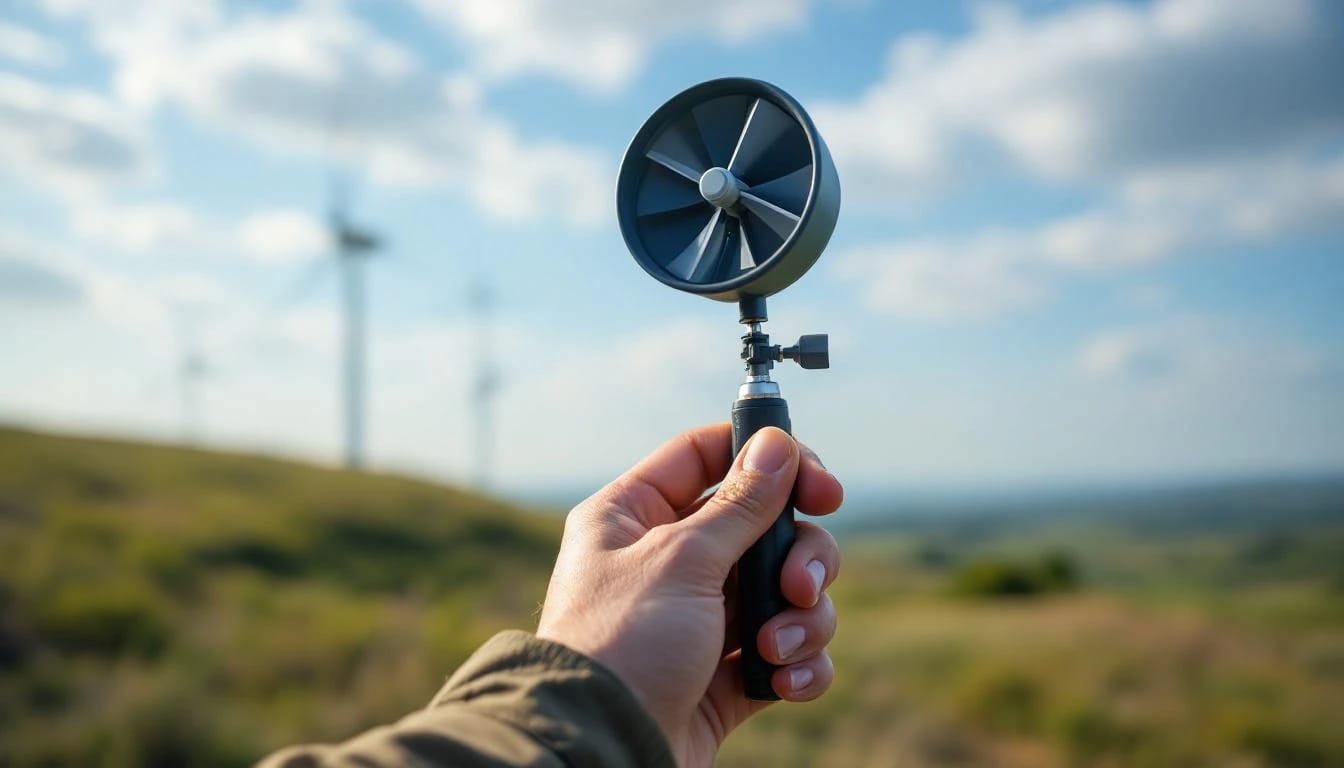
Install an anemometer at hub height for twelve months before purchasing a turbine. One-month measurements miss seasonal variations. Spring and winter winds often exceed summer speeds by 30-40%, yet summer cooling loads determine self-consumption rates in grid-tied systems.
The National Renewable Energy Laboratory's wind resource maps provide screening-level data at 30-80 meter resolution. These maps indicate regional potential but can't account for local terrain, tree cover, or buildings. A ridge-top site surrounded by Class 3 wind might achieve Class 4 speeds; a valley property in the same colored zone might measure Class 1.
Professional site assessments cost $2,000-$5,000 and include 6-12 months of on-site data collection plus computer modeling. For systems costing $40,000+, the assessment prevents expensive mistakes. Learn more about wind resource mapping from the Department of Energy WINDExchange program.
Grid Connection Requirements for Low Output
NEC Article 705 governs interconnection of small wind to utility systems. Grid-tied inverters must meet UL 1741 standards and include anti-islanding protection. Utilities review interconnection applications through processes varying by state—some require engineering stamps, liability insurance, and external disconnect switches accessible to utility workers.
Net metering policies determine whether low production makes financial sense. Full retail credit for exported power improves economics; "net billing" at wholesale rates (2-4 cents/kWh versus 12-15 cents/kWh retail) destroys payback calculations. States with unfavorable net metering penalize systems that underproduce.
A low-wind turbine generating 6,000 kWh annually might produce 300 kWh in July but 800 kWh in February when household consumption is lowest. Without one-to-one annual credit banking, summer overproduction is lost. Verify your utility's rollover policy before installation—DSIRE maintains state-by-state policy databases.
Installation requires a licensed electrician familiar with NEC Article 705. Expect electrical work to cost $3,000-$6,000 including service panel upgrades, dedicated breakers, and metering equipment.
Federal and State Incentives Impact
The IRC §25D Residential Clean Energy Credit provides a 30% federal tax credit for small wind systems installed through 2032 (stepping down to 26% in 2033, 22% in 2034). For a $50,000 system, the credit reduces net cost to $35,000. File IRS Form 5695 with your tax return. The credit applies only if you have sufficient tax liability to absorb it—no carryforward to future years beyond one year.
Some states offer additional incentives. New York's NY-Sun program historically provided $1.00-$1.50/W for residential wind. California's SGIP focused on energy storage but paired with wind systems. Massachusetts offered SMART program incentives. Budget constraints have eliminated or reduced many state programs since 2020. Check current availability through DSIRE rather than relying on outdated information.
Without the federal credit, most low-wind installations never achieve positive return on investment. A $45,000 system producing $600 annually in electricity savings needs 75 years to break even. The 30% credit cuts payback to 53 years—still beyond equipment lifespan.
Off-Grid Applications in Low Wind
Battery-backed off-grid systems make sense when grid extension costs exceed $15,000-$25,000 per pole, common in properties more than a half-mile from existing lines. Low-wind sites require oversized turbines, solar hybrid systems, and larger battery banks to maintain power through calm periods.
A cabin using 5 kWh daily (150 kWh monthly) might pair a 1 kW wind turbine with 2 kW of solar panels and 20 kWh of lithium battery storage. The wind turbine contributes 80-120 kWh monthly at an 8 mph site—20-30% of annual demand. Solar and stored energy fill gaps. Propane generator backup handles extended low-production periods.
Off-grid wind-solar hybrids cost $15,000-$35,000 depending on daily load. Compare this to grid extension quotes plus 30 years of utility bills before committing. Batteries last 10-15 years; replacement costs $5,000-$12,000.
When to Walk Away
Skip wind power if your site averages below 9 mph annual wind speed at affordable tower heights (60-80 feet). The mathematics don't work regardless of equipment choice or incentives. Solar photovoltaics generate predictable power even on overcast days and scale effectively to small installations. A 5 kW solar array costs $12,000-$18,000 after federal credits and produces 6,000-8,000 kWh annually across most of the continental U.S.—competitive with low-wind turbines at a fraction of the cost.
Other warning signs include:
- Zoning that limits tower height below 60 feet
- Heavily wooded lots where clearing would cost $8,000+
- HOA covenants prohibiting towers
- Net metering unavailable or capped at wholesale rates
- Trees or buildings within 500 feet that exceed proposed tower height
- Budget under $15,000 for equipment and installation
Enthusiasm for wind power can't overcome physics. Honest assessment of wind resources, total costs, and realistic production prevents financial disappointment.
What is the minimum wind speed for a home wind turbine to work?
Most residential turbines begin rotating at 5-8 mph (cut-in speed) but generate negligible power until winds reach 9-11 mph. Economically viable sites need 9.8+ mph annual average wind speed at hub height to justify the $30,000-$60,000 total system cost. Below 9 mph, annual production rarely exceeds 40% of rated capacity, extending payback periods beyond equipment lifespan.
Can vertical-axis turbines perform better than horizontal-axis turbines in low wind?
No. While vertical-axis wind turbines handle turbulent, multi-directional wind better than horizontal designs, they extract less energy at all wind speeds due to inferior aerodynamic efficiency. VAWTs marketed for low-wind use often produce 30-50% less power than comparable-cost HAWTs. The Bergey Excel 1 horizontal turbine generates 1,500 kWh annually at 10 mph sites; similar-priced VAWTs produce 900-1,200 kWh.
How tall does my tower need to be in a low-wind area?
Minimum 60 feet in open terrain; 80-100 feet in areas with trees or buildings. The Department of Energy recommends tower height 30 feet above any obstacle within 500 feet. Wind speed increases approximately 15-25% from 30 feet to 100 feet in typical residential areas due to reduced ground friction. Check county zoning—many jurisdictions cap residential towers at 35-65 feet, potentially making low-wind sites unviable.
Do small wind turbines work in suburban neighborhoods?
Rarely well. Suburban areas combine marginal wind resources (houses and landscaping create turbulence), restrictive height limits, and neighbor opposition. A study of 26 urban small wind installations in the UK found actual output averaged 17% of manufacturer-rated capacity. Unless your property sits on an exposed hilltop or open farmland with 10+ mph average winds, solar panels deliver better return on investment.
Will a wind turbine eliminate my electric bill in a low-wind area?
Unlikely. A turbine sized to offset 100% of your consumption at an 8-9 mph site would cost $65,000-$90,000 before incentives and require a 100+ foot tower, substantial acreage, and favorable zoning. Most low-wind residential installations offset 15-35% of annual electricity use. Better strategy: improve home efficiency first, then add appropriately sized renewable generation that matches your wind resource reality.
Bottom Line
Wind turbines generate some power at any site, but low-wind locations (below 10 mph average) rarely justify the investment in equipment, towers, and installation labor. Expect simple payback periods exceeding 30-50 years without exceptional incentives or expensive grid extension scenarios. Site assessment through twelve months of on-site wind measurement prevents costly mistakes—professional evaluation costs $2,000-$5,000 but saves tens of thousands in mismatched equipment. For most homeowners in marginal wind zones, solar photovoltaics, improved insulation, and efficient appliances deliver faster financial returns than small wind turbines. Before purchasing, measure your wind resource, calculate realistic production using conservative assumptions, and compare total lifecycle costs against alternatives.
Share this article
windturbinehome.com/s/6d1ad0
Editorial note: This article was researched and written by a member of the Wind Turbine Home editorial team. AI-assisted tools were used for spell-checking and light grammar review only — all research, analysis, and conclusions are our own. Our editorial policy prohibits sponsored content and paid placements. Read our editorial policy →
Related reading
wind resource assessment
Weibull Distribution for Wind Energy: What k and c Actually Mean
Learn how Weibull k (shape) and c (scale) parameters define your site's wind profile and predict small turbine output. Real examples from 5-10 kW installations included.
wind resource assessment
Wind Shear Formula for Hub Height: Extrapolating Ground Data
Learn the power law wind shear formula to extrapolate 10m ground measurements to your turbine hub height. Includes coefficients, worked examples, and error ranges.
wind resource assessment
Wind Turbine Swept Area: Calculate Rotor Size & Power Output
Swept area determines how much wind energy a turbine can capture. Learn the formula, why rotor diameter matters more than blade count, and how to size a system.

wind resource assessment
How To Read the DOE WindExchange Map for Your Address (2026)
The DOE WindExchange map shows wind speed at your home—but only if you decode hub height, filter layers, and match your turbine class. Here's the exact process.
wind resource assessment
How to Measure Wind Speed at Your Property Before You Buy
Learn proven methods to assess wind resources on your property using anemometers, data loggers, and free tools—so you know if a turbine investment makes sense.
wind resource assessment
How Much Wind Do You Need for a Home Wind Turbine?
Home wind turbines need average wind speeds of 10+ mph (Class 2) to generate meaningful power. Most residential sites require 9-12 mph sustained winds to justify investment.