How Much Wind Do You Need for a Home Wind Turbine?
Home wind turbines need average wind speeds of 10+ mph (Class 2) to generate meaningful power. Most residential sites require 9-12 mph sustained winds to justify investment.
Share this article
windturbinehome.com/s/005b1d
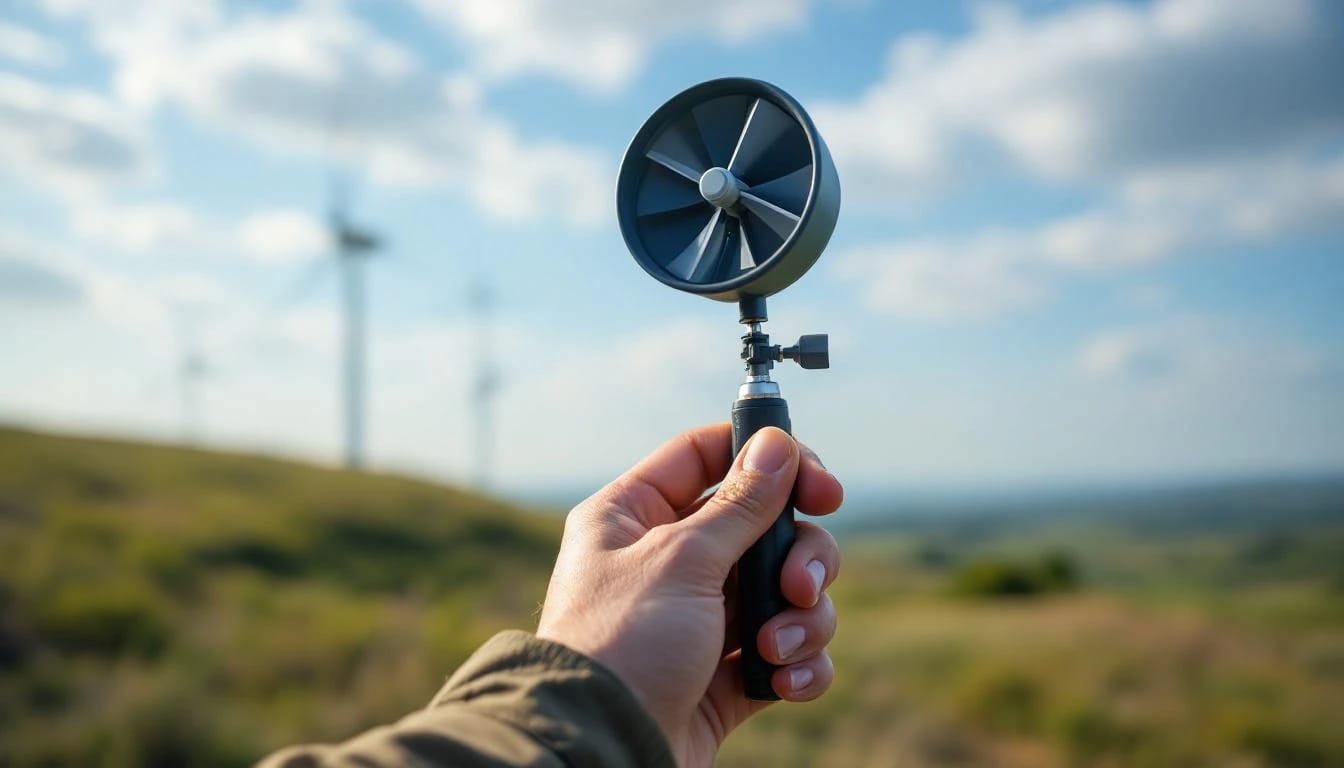
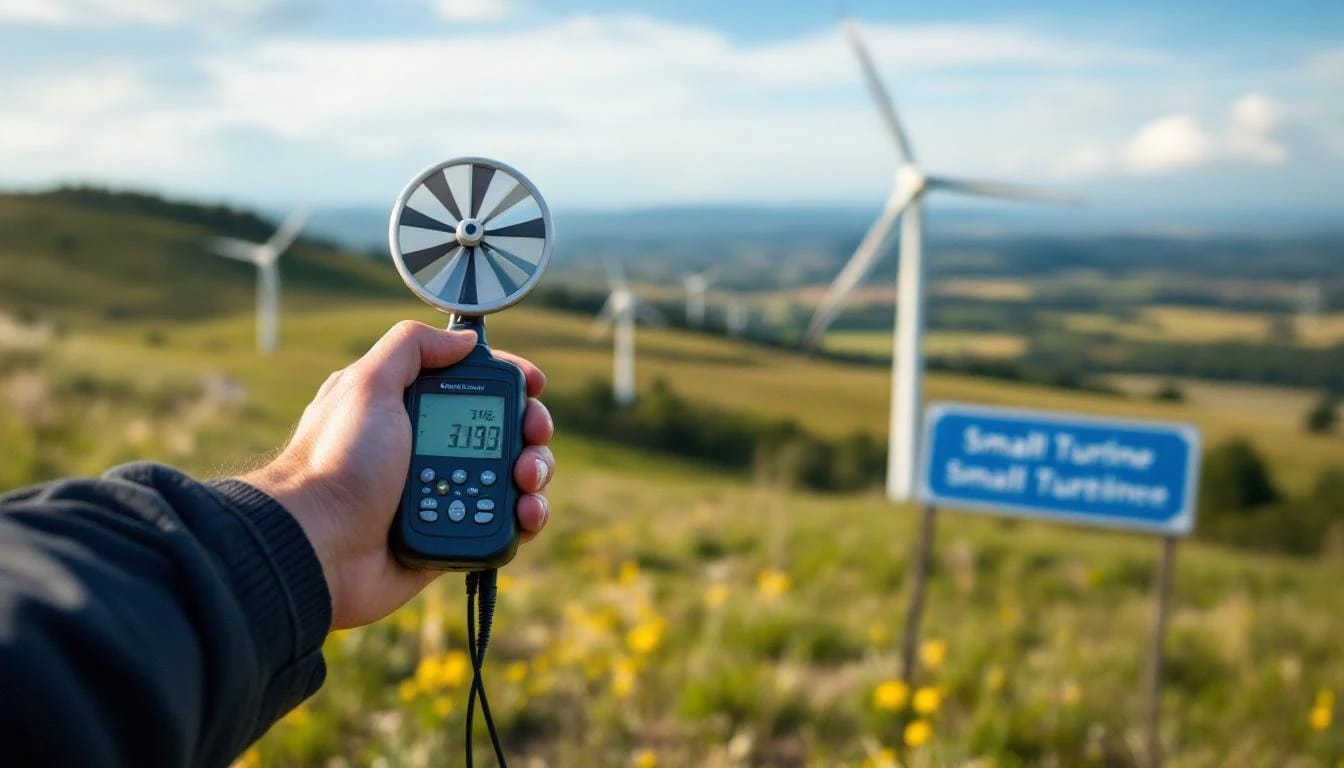
![HERO: Digital anemometer mounted on pole measuring wind speed in residential backyard with small horizontal-axis turbine visible in background]
Most residential wind turbines need average annual wind speeds of at least 10 miles per hour to produce enough electricity to offset installation costs. The Department of Energy recommends Class 2 wind resources (9.8–11.5 mph at 30 meters) as the minimum for viable home systems, though many installers argue that 11–12 mph yields far better economics. Below 9 mph average, even modern micro-turbines from Bergey or Primus will spend too many hours idle, stretching the payback period beyond the turbine's 20-year design life. Above 13 mph average, homeowners enter the sweet spot where a 1–10 kW turbine can offset 30–90% of household consumption depending on load, tower height, and local utility rates.
Wind speed fundamentals: Average versus instantaneous
Wind speed varies by the second, which makes assessing a site tricky. An anemometer reading 15 mph at 2 p.m. and 4 mph at midnight will show an average closer to 9 or 10 mph over 24 hours—yet that average determines annual kilowatt-hour output. Small wind turbines typically have a cut-in speed (the minimum wind needed to begin spinning the blades) of 6–9 mph, a rated speed (where the turbine hits its maximum continuous output) of 22–30 mph, and a cut-out or furling speed (where the controller shuts down or feathers the blades for safety) around 45–55 mph.
A site with frequent 20 mph gusts but long calm periods may deliver less annual energy than a site with steadier 12 mph winds. The cubic relationship between wind speed and power means that doubling wind speed multiplies available power by eight. A Bergey Excel 10 on a 120-foot tower in a 13 mph average site will generate roughly 1,500 kWh per month, while the same machine in a 9 mph site might barely crack 400 kWh.
Instantaneous speed varies with height, terrain, and time of day. Wind resource maps and on-site anemometry smooth these fluctuations into an annual average—the single most predictive number for turbine performance.
Wind resource classes and the Class 2 threshold
The National Renewable Energy Laboratory categorizes wind into seven classes, from Class 1 (poorest) to Class 7 (exceptional). Each class corresponds to a range of wind power density measured in watts per square meter and an associated average wind speed. The Department of Energy's WINDExchange guidebook pegs Class 2 as the entry point for small wind viability, equating to 9.8–11.5 mph at 30 meters (roughly 100 feet) above ground.
| Wind Class | Power Density (W/m²) at 50 m | Average Speed at 50 m | Residential Viability |
|---|---|---|---|
| Class 1 | 0–200 | <12.5 mph | Poor—avoid |
| Class 2 | 200–300 | 12.5–14.3 mph | Marginal—requires tall tower |
| Class 3 | 300–400 | 14.3–15.7 mph | Good—economics improve |
| Class 4 | 400–500 | 15.7–16.8 mph | Excellent for 5–10 kW systems |
| Class 5+ | >500 | >16.8 mph | Exceptional—rare at ground level |
Most homes sit at elevations and in neighborhoods that fall into Class 1 or low Class 2 territory, which explains why residential wind remains niche. A Class 3 site—common on ridge tops, coastal bluffs, or wide-open prairie—can justify a 10 kW horizontal-axis machine on a 100-foot tower, potentially delivering 12,000–18,000 kWh annually. Drop to Class 1 at the same location due to tree cover or terrain sheltering, and that output may collapse to 3,000 kWh, turning a ten-year payback into thirty.
How to measure wind speed on your property
Professional site assessment starts with an anemometer mounted as close as possible to the planned turbine hub height for at least one full year. Seasonal variation matters: summer doldrums in the Southeast can halve the annual average compared to winter months, while mountain sites may see the reverse pattern. Data loggers record ten-minute averages, which consultants use to calculate capacity factor and annual energy estimates.
Off-the-shelf anemometers cost $200–$600 and require a sturdy mast at 20–40 feet minimum, though that height understates what a 60- or 100-foot tower will experience. The wind shear exponent—typically 0.14 for open terrain, 0.20–0.30 for suburban or wooded areas—lets you extrapolate upward, but direct measurement at hub height remains gold standard. Remote sensing tools like SODAR or lidar can measure wind profiles from ground level to 200 meters, but rental fees run $3,000–$10,000 per month, practical only for larger commercial projects.
Many owner-builders skip the year-long monitoring and rely on NREL's Wind Prospector tool or state energy office wind maps. These models use terrain, surface roughness, and decades of weather station data to estimate average wind speeds at various heights. Accuracy varies—maps might show 11 mph at 80 meters, but a dense tree line 200 feet upwind can cut actual speeds by 30%. Maps work best as a first-cut screening tool; anything showing Class 1 or marginal Class 2 warrants skepticism unless the site is visibly exposed.
Tower height and its multiplier effect
Every additional ten feet of tower height in typical terrain adds 0.3–0.6 mph to average wind speed, and that increment cascades through the power curve. Bergey Windpower, which has manufactured small turbines since 1977, insists that 100-foot towers are the minimum for their 10 kW Excel model and strongly discourages anything under 80 feet. Shorter towers place the rotor in the turbulent boundary layer where buildings, trees, and ground friction chop and swirl airflow, increasing wear on bearings and reducing output.
A 5 kW Skystream (now discontinued but still common on the used market) on a 45-foot tower in a 10 mph site might generate 4,000 kWh per year, while the same turbine on an 80-foot tower in the same location could exceed 7,000 kWh. The taller installation costs an extra $8,000–$12,000 for guyed lattice or monopole steel, yet the additional energy often pays back that premium within five to seven years at $0.12–$0.15 per kWh retail rates.
Local zoning often caps tower height at 35 or 65 feet, particularly in subdivisions or near airports subject to FAA Part 77 obstruction rules. Part 77 requires notification to the FAA for any structure exceeding 200 feet above ground level, or structures near airports that penetrate imaginary surfaces protecting approach paths. Homeowners rarely hit that ceiling, but municipal setback rules—requiring towers to fall within property lines if they collapse—can make a 100-foot tower impossible on a half-acre lot. Always verify setback, height, and noise ordinances before purchasing equipment.
Turbine cut-in, rated, and survival speeds
Manufacturers list three or four critical speeds in specification sheets. Cut-in speed is the wind velocity at which blades begin to turn and the generator starts producing usable power, typically 6–9 mph for small horizontal-axis machines and 7–11 mph for vertical-axis models like the Aeolos-V. Below cut-in, the rotor freewheels or remains stationary, consuming standby power from the inverter and delivering nothing to the home.
Rated speed—often 22–28 mph—is where the turbine reaches its nameplate capacity (e.g., 10 kW). Beyond rated speed, the controller prevents overspeed by pitching blades, furling the turbine downwind, or activating electromagnetic braking. Survival speed or maximum design wind speed (commonly 110–120 mph) is the threshold the turbine can withstand while parked or furled. Exceeding survival speed risks blade failure or tower collapse, though such winds are rare outside hurricane and tornado zones.
A 5 kW Primus Air 40 cuts in at 7.8 mph, reaches rated output at 28 mph, and survives winds to 130 mph with blades fully furled. In a 12 mph average site, that turbine will spend roughly 40% of the year above cut-in, 8–12% near or above rated speed, and the remainder in light or calm conditions. The capacity factor—annual kWh divided by theoretical maximum if the turbine ran at nameplate 8,760 hours—typically lands between 15% and 30% for residential installs, compared to 35–50% for utility-scale wind farms in premier locations.
Matching turbine size to wind resource and load
A common rookie mistake is buying the largest turbine the budget allows and hoping for the best. In a marginal wind site, a 10 kW turbine will underperform relative to its cost, while a 1 kW micro-turbine might pay back faster even though it meets a smaller fraction of load. The DOE guidebook emphasizes calculating annual household consumption in kilowatt-hours (find it on your utility bill), then estimating what percentage a given turbine model can realistically supply.
For a home using 10,000 kWh per year in a 10 mph site, a Bergey Excel 1 (1 kW rated) on a 60-foot tower will generate roughly 1,200 kWh annually—12% of consumption. A Southwest Windpower Air X (400 W, now out of production but widely installed) might contribute 600 kWh, useful for offsetting always-on phantom loads but not air conditioning. Stepping up to a Bergey Excel 10 on a 100-foot tower in the same 10 mph site could yield 6,000–7,000 kWh, covering 60–70% of load if generation and consumption align temporally.
Wind generation peaks on windy winter nights when household demand may be lower (unless heating with electric resistance), while summer afternoon loads for air conditioning coincide with typical doldrums. Grid-tied systems export excess to the utility under net metering, banking credits for later use. Off-grid systems require battery storage sized for multiple windless days, adding $8,000–$20,000 to project cost and introducing round-trip efficiency losses of 10–20%.
Vertical-axis turbines like the Pikasola 600 W or Aeolos-V 1 kW models tolerate turbulent, low-speed winds better than horizontal-axis machines and are visually less obtrusive, but their lower efficiency and shorter track record make them a gamble. Most vertical-axis units perform best in urban or suburban canyons where wind direction shifts rapidly, though even there, average speeds often remain below the Class 2 threshold.
How terrain, obstacles, and surface roughness steal wind
Smooth, unobstructed flow is rare at residential elevations. Trees, buildings, hills, and even parked vehicles create turbulence and slow average wind speed. The rule of thumb: site a turbine at least 30 feet above any obstacle within 500 feet. A two-story house (25 feet tall) 200 feet upwind means the tower should exceed 55 feet to escape the wake. A mature oak (60 feet) 300 feet away demands a 90-foot tower.
Ridge tops and coastal bluffs accelerate wind through compression and elevation effects, boosting speeds 20–40% compared to valleys or sheltered slopes 500 feet away. Open farmland in Iowa or Kansas offers Class 3 or Class 4 resources at 80 feet, while a quarter-acre wooded lot in Georgia may never break Class 1 no matter the tower height. Surface roughness—quantified in aerodynamic models by a roughness length parameter—can double the wind shear exponent, forcing turbines even higher to capture clean air.
Seasonal foliage compounds the problem. Deciduous trees in full leaf add drag and turbulence from May through October, precisely when turbines need wind to offset air conditioning loads. Winter leaf-off conditions improve flow, but many temperate zones also see lighter average winds in winter compared to spring. Evergreen forests create year-round barriers. Coastal and prairie sites avoid this seasonality, which explains why wind farms cluster in those regions.
Estimating annual energy production with online tools and consultants
NREL's System Advisor Model (SAM) is free software that combines hourly wind speed data, turbine power curves, and system losses (wiring, inverter efficiency, blade soiling, icing) to project annual kWh. Users input a wind resource file—either measured or synthesized from a nearby weather station—and SAM outputs monthly generation, capacity factor, and economic metrics. The tool assumes a level of technical fluency; hiring a certified small wind installer or energy auditor to run the analysis costs $500–$2,000 but delivers a third-party reality check.
DIY estimation relies on the manufacturer's power curve (watts output versus wind speed) and a Rayleigh or Weibull distribution of wind speeds around the site's annual average. If the average is 11 mph, a Rayleigh distribution shows wind at 6 mph roughly 12% of the year, 11 mph around 18%, and 20 mph about 6%. Multiply the turbine's output at each speed by the hours per year at that speed, sum across the curve, then subtract 10–15% for system losses. This back-of-envelope method gets within 20% of reality if the average is accurate.
State energy offices in high-wind regions—Montana, Wyoming, North Dakota, Oklahoma, Texas—sometimes offer free or subsidized site assessments through programs funded by DSIRE (Database of State Incentives for Renewables & Efficiencies). These programs have shrunk since 2015 as federal production tax credits expired for small wind, but checking your state DSIRE page remains worthwhile. A few utilities also provide wind resource maps at finer resolution than NREL's national datasets.
Wind speed requirements by turbine class
Micro-turbines (50–1,000 W) are marketed for battery charging on boats, RVs, or remote cabins. They cut in around 7–9 mph and rarely exceed 400 W even in 25 mph gusts. Annual output in a 9 mph site might be 300–600 kWh, enough to run LED lighting and electronics but not major appliances. Examples include the Air X, Rutland 914i, and Pikasola 400 W models. These suit niche off-grid applications, not whole-home power.
Small turbines (1–10 kW) cover most residential installs. A 1 kW unit like the Bergey Excel 1 needs 10–11 mph average to justify its $7,000–$12,000 installed cost. A 5 kW Primus Air 40 or Southwest Windpower Whisper 500 targets 11–12 mph sites, while the 10 kW Bergey Excel 10—perhaps the most proven residential turbine in North America—demands 12 mph minimum, preferably 13–14 mph, to deliver 10,000–15,000 kWh per year.
Mid-scale turbines (10–100 kW) bridge residential and commercial. Units like the Northern Power 100 or Endurance E-3120 suit farms, schools, or small industrial facilities with ample land and Class 3+ wind. These turbines need average speeds of 13 mph or higher and towers exceeding 120 feet. Installation costs climb to $50,000–$250,000, out of reach for typical homeowners but feasible for agricultural operations offsetting irrigation pumps or grain dryers.
Real-world case studies: When the wind is—and isn't—enough
A Vermont homeowner installed a Bergey Excel 10 on a 100-foot tilt-up tower in 2019 on a ridgeline site averaging 12.8 mph at hub height. First-year production hit 14,200 kWh, offsetting 92% of household consumption. Net metering banked excess winter generation against summer shortfalls, and the 30% federal IRS Form 5695 tax credit (IRC §25D Residential Clean Energy Credit, extended through 2034 at 30% for systems placed in service before 2033) reduced out-of-pocket cost from $58,000 to $40,600. Payback at $0.18/kWh is projected at 13 years, acceptable given the turbine's 20-year warranty.
Contrast that with a Texas suburban install: a 5 kW Skystream on a 45-foot monopole in a 9.2 mph site. First-year output was 3,400 kWh against an $18,000 installed cost. The turbine covered 21% of a 16,000 kWh annual load, saving $408 per year at $0.12/kWh. Even after the 30% federal credit, payback stretches beyond 30 years, and the inverter warranty expires at 10 years. The owner later added rooftop solar, which delivered better economics per dollar invested.
A Montana ranch installed an Aeolos-H 5 kW on an 80-foot guyed lattice tower in a 14 mph site two miles from the nearest utility pole. Off-grid design paired the turbine with 24 kWh of lithium iron phosphate batteries and a 3 kW propane generator for backup. Annual wind generation averages 8,500 kWh, covering 70% of load, with the genset filling winter gaps. Total project cost was $48,000, far less than the $85,000 quote to extend grid service, making wind the clear winner despite the added complexity.
Net metering, interconnection standards, and utility permission
Grid-tied small wind systems in the U.S. fall under NEC Article 705 (Interconnected Electric Power Production Sources), which mandates overcurrent protection, disconnect switches, and anti-islanding inverters that shut down when grid power fails. The utility reviews the interconnection application, verifying that the turbine's inverter is UL 1741-listed and that the installation meets local codes. Some utilities cap net metering at 10 kW or 25 kW, while others allow systems up to 100% of annual consumption.
Net metering rules vary by state. In states with strong net metering (California, Massachusetts, New Jersey, Maryland), excess generation earns full retail credit, effectively using the grid as free storage. In states with weak or no net metering (Alabama, Tennessee, parts of the South), excess power may be credited at wholesale rates (2–4 cents per kWh), slashing the economic case. A few utilities impose monthly standby charges or demand fees for grid-tied renewables, adding $10–$30 per month regardless of generation.
Interconnection timelines range from two weeks to six months. Larger utilities with established renewable programs process applications faster, while rural co-ops may require engineering studies and transformer upgrades at the homeowner's expense. Always submit the interconnection application before purchasing equipment. Some utilities have rejected turbines on aesthetic grounds, noise complaints, or obsolete insurance requirements, leaving owners with expensive equipment and no permission to connect.
Electrical installation and NEC Article 705 requirements
NEC Article 705 requires a dedicated circuit breaker in the main service panel for the turbine, sized at 125% of the inverter's maximum continuous output current. A 5 kW inverter at 240 VAC draws roughly 21 amps, so the breaker must be at least 26 amps (typically a 30 A breaker). The turbine's AC disconnect must be lockable and within sight of the meter, allowing utility workers to isolate the system during line work.
Wire sizing accounts for voltage drop over the run from tower base to service panel. A 200-foot run for a 5 kW turbine at 48 VDC from turbine to inverter might require 2/0 AWG copper to keep voltage drop below 2%. Long DC runs add cost; some installers place the inverter at the tower base, running 240 VAC to the house to reduce conductor size and loss.
Grounding and lightning protection follow NEC Article 250 and manufacturer specifications. A concrete pier foundation for the tower must include a grounding electrode, often a concrete-encased conductor or ground rods, bonded to the turbine frame and tower. Guy cables on lattice towers each require a grounding clamp at the anchor. Lightning strikes on exposed towers are common; surge protection devices at both the inverter DC input and AC output are non-negotiable.
Licensed electricians familiar with renewable systems charge $2,000–$6,000 for the electrical portion of a small wind install, separate from the tower and turbine. Local permitting often requires wet-stamped drawings from a professional engineer, adding another $1,500–$3,000 in rural jurisdictions or $4,000–$8,000 near cities with strict code enforcement.
When the numbers don't pencil: Alternatives to small wind
If average wind is below 10 mph or zoning forbids tall towers, rooftop solar almost always delivers better return on investment. Photovoltaic panels need no moving parts, work in all 50 states, have 25-year performance warranties, and benefit from mature supply chains that have dropped installed costs to $2.50–$3.50 per watt. A 5 kW solar array costs $12,500–$17,500 before the 30% federal credit and generates 6,000–8,000 kWh per year in most climates, rivaling a small wind turbine in a 12 mph site but without the tower expense.
Hybrid systems pair wind and solar, smoothing seasonal gaps: winter wind complements summer sun in northern climates, while coastal areas get strong winter storms and reliable summer sunshine. A 3 kW wind turbine plus 4 kW of solar shares inverter capacity, battery storage (if off-grid), and installation labor. Total cost runs higher than either system alone, but energy security and grid independence improve.
Energy efficiency retrofits—air sealing, insulation upgrades, heat pump HVAC, LED lighting—cost $5,000–$15,000 and permanently reduce consumption by 30–50%. A home dropping from 15,000 kWh to 9,000 kWh per year can meet the remaining load with a smaller, cheaper wind or solar system. The Department of Energy recommends the whole-building approach: efficiency first, then renewables sized to the reduced load.
Can a small wind turbine work with average wind speeds below 10 mph?
Technically yes, but economically no. Turbines will spin and produce some power at 8–9 mph average, but annual generation falls so low—often under 2,000 kWh for a 5 kW machine—that payback stretches beyond equipment lifespan. Manufacturers void performance warranties if site wind doesn't meet their minimum threshold, typically 10 mph at hub height. Better to invest in solar or efficiency upgrades in low-wind locations.
How do I measure wind speed accurately for a full year?
Mount a calibrated cup anemometer or ultrasonic sensor on a mast as close as possible to planned hub height, with a data logger recording ten-minute averages. Place the mast in an open area, away from buildings and trees, and let it run for 12 months to capture seasonal variation. Professional-grade equipment costs $300–$800. Alternatively, hire a wind resource consultant who will install and monitor equipment for $1,500–$3,000, then provide a formal report with energy projections.
Does higher tower height really make that much difference?
Absolutely. In typical suburban or rural terrain with trees and buildings, every 20 feet of additional tower height adds 1–2 mph to average wind speed, and because power scales with the cube of wind speed, that increment can double or triple annual energy output. A 5 kW turbine on a 45-foot tower might generate 4,000 kWh per year, while the same turbine on an 80-foot tower at the same site could produce 8,000 kWh. Taller towers cost more, but the energy gain usually justifies the investment within five to eight years.
What wind speed will damage or destroy a wind turbine?
Most small turbines are designed to survive winds up to 110–130 mph when parked or fully furled, well above the threshold for hurricane-force winds (74 mph). Active furling or blade-pitching systems protect the turbine at speeds above 45–55 mph by reducing rotor exposure. Catastrophic failures occur when controllers malfunction during extreme events, when guy cables corrode and fail, or when towers are improperly anchored. Proper installation and annual maintenance keep risk low even in tornado-prone regions.
Are vertical-axis turbines better for low or turbulent wind?
Vertical-axis designs (Savonius or Darrieus types) tolerate shifting wind direction and some turbulence better than horizontal-axis machines, and they operate at lower tip speeds, reducing noise. However, their overall efficiency is 15–25% lower, and they require stronger mounting structures because forces concentrate on the tower base. In truly low-wind sites (under 9 mph), vertical-axis turbines still underperform; they shine in gusty urban canyons or tight spaces where horizontal rotors would furl constantly. Track record remains thin compared to proven horizontal-axis models from Bergey or Primus.
Bottom line
Home wind turbines need average annual wind speeds of at least 10 mph at hub height to generate meaningful electricity, with 11–13 mph unlocking the best economics. Measure your site for a full year or consult high-resolution wind maps before buying equipment, and plan for the tallest tower that zoning and budget allow—height is the single biggest lever for performance. Sites with consistent Class 2 or better resources, paired with tall towers and favorable net metering policies, can offset 50–100% of household consumption and pay back within 10–15 years. If your location falls short, invest in rooftop solar or energy efficiency instead; no amount of wishful thinking will make a low-wind site pencil out.
Next step: Use the NREL Wind Prospector or contact your state energy office to request a preliminary site assessment, then budget for a year of on-site anemometry before committing to a turbine purchase.
Share this article
windturbinehome.com/s/005b1d
Editorial note: This article was researched and written by a member of the Wind Turbine Home editorial team. AI-assisted tools were used for spell-checking and light grammar review only — all research, analysis, and conclusions are our own. Our editorial policy prohibits sponsored content and paid placements. Read our editorial policy →
Related reading
wind resource assessment
Weibull Distribution for Wind Energy: What k and c Actually Mean
Learn how Weibull k (shape) and c (scale) parameters define your site's wind profile and predict small turbine output. Real examples from 5-10 kW installations included.
wind resource assessment
Wind Shear Formula for Hub Height: Extrapolating Ground Data
Learn the power law wind shear formula to extrapolate 10m ground measurements to your turbine hub height. Includes coefficients, worked examples, and error ranges.
wind resource assessment
Wind Turbine Swept Area: Calculate Rotor Size & Power Output
Swept area determines how much wind energy a turbine can capture. Learn the formula, why rotor diameter matters more than blade count, and how to size a system.

wind resource assessment
How To Read the DOE WindExchange Map for Your Address (2026)
The DOE WindExchange map shows wind speed at your home—but only if you decode hub height, filter layers, and match your turbine class. Here's the exact process.
wind resource assessment
How to Measure Wind Speed at Your Property Before You Buy
Learn proven methods to assess wind resources on your property using anemometers, data loggers, and free tools—so you know if a turbine investment makes sense.

wind resource assessment
Do Wind Turbines Work in Low Wind Areas? Performance Analysis
Small wind turbines need minimum 9-10 mph average wind to generate meaningful power. Low-wind sites under 8 mph often produce 30-40% of rated output, making payback periods exceed 25 years.