Downwind vs Upwind Turbines: How Yawing Affects Performance
Upwind turbines capture cleaner airflow but need active yaw control. Downwind designs self-align but suffer tower shadow losses. Learn how configuration affects your small wind system's output.
Share this article
windturbinehome.com/s/cd3af4
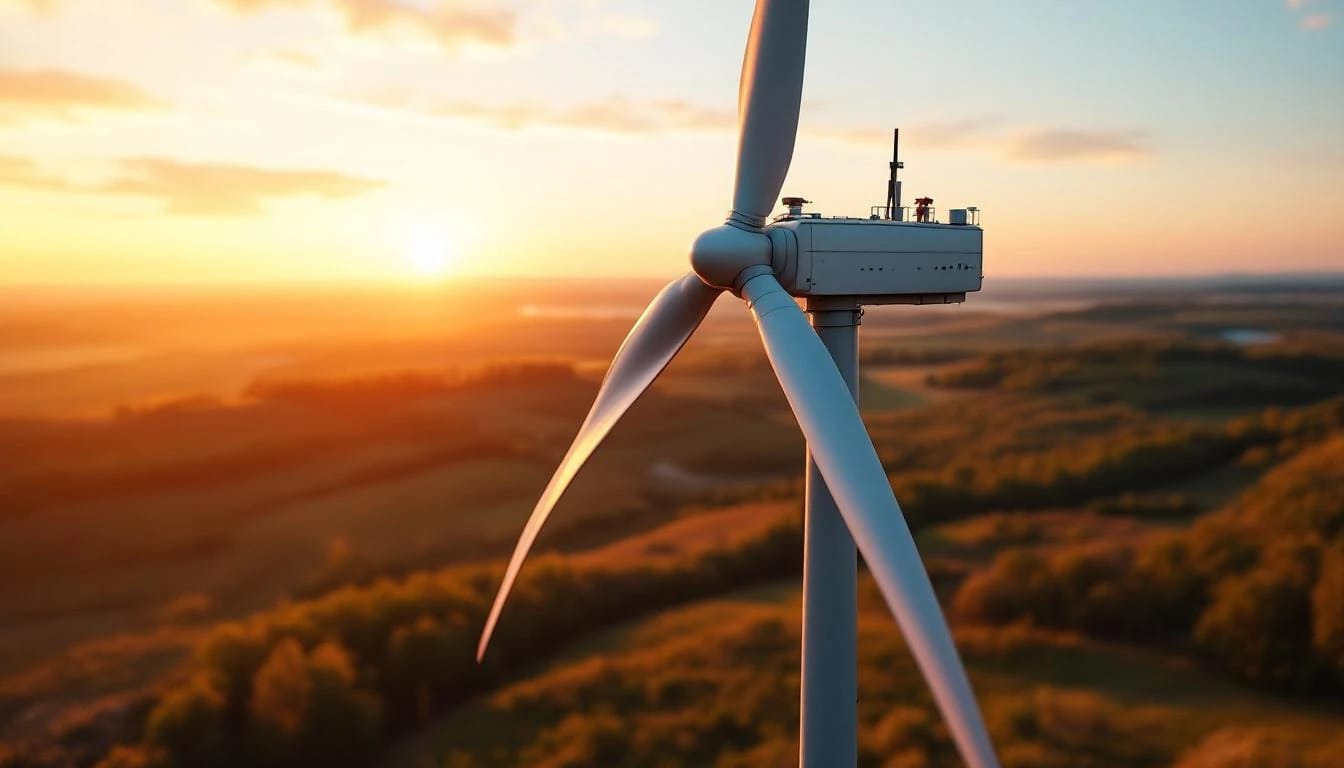
Upwind horizontal-axis turbines mount the rotor ahead of the tower and typically produce 5-10% more energy than downwind configurations, but require active yaw mechanisms that add $800-$2,500 to system costs. Downwind turbines place the rotor behind the tower, enabling passive yaw alignment through aerodynamic forces, yet experience power losses of 10-30% when blades pass through turbulent tower shadow. The choice between these designs fundamentally shapes performance, maintenance requirements, and total installed costs for residential systems.
How Upwind and Downwind Configurations Differ
Horizontal-axis wind turbines fall into two categories based on rotor position relative to the tower. Upwind turbines orient the blades into clean, undisturbed airflow before it encounters the tower structure. Most residential models from Bergey and Primus adopt this layout because it maximizes energy capture and reduces cyclic loading on components.
Downwind turbines reverse the arrangement. The nacelle and generator sit between the incoming wind and the rotor, which trails behind. This configuration appears in specialized applications where passive yaw alignment matters more than peak efficiency—remote telecommunications sites, for instance, where minimizing moving parts reduces maintenance visits.
The Department of Energy's Small Wind Guidebook notes that turbine blades are "aerodynamically designed to capture the maximum energy from the wind," but efficiency depends heavily on whether that wind arrives clean or disturbed by upstream obstacles.
Tower shadow creates the central performance difference. When a blade sweeps past the tower on a downwind machine, it encounters a velocity deficit and increased turbulence. Wind speed drops 20-40% in the wake immediately behind cylindrical towers, translating to proportional power losses during each blade passage. For a three-blade rotor at 200 RPM, that means 600 shadow events per minute—a continuous series of micro-stalls that reduce annual energy production and accelerate fatigue damage.
![INLINE: Close-up comparison showing upwind rotor positioned ahead of tower versus downwind rotor trailing behind, with airflow arrows indicating clean wind path for upwind and turbulent wake for downwind configuration]
Yaw Mechanisms and Their Performance Impact
Yaw control determines how the rotor tracks wind direction changes. Upwind turbines require forced yaw—active systems that sense wind direction and rotate the nacelle to maintain alignment. These systems add complexity but deliver precise tracking within ±3-5 degrees of optimal orientation.
Typical residential forced-yaw mechanisms include:
- Electric motor yaw drives: Bergey Excel and similar 7-15 kW turbines use electric motors controlled by wind vanes or electronic sensors. Response time: 30-90 seconds for a 180-degree rotation.
- Cable-actuated yaw: Smaller systems (1-5 kW) sometimes employ steel cables wound around the tower top, pulled by electric winches.
- Hydraulic yaw: Rare in residential installations, common in commercial turbines above 20 kW.
Downwind turbines rely on passive yaw—the rotor naturally weathervanes behind the tower like a flag. The tail fin or rotor offset from the tower centerline creates an aerodynamic moment that turns the assembly into the wind. No motors, no controllers, no power consumption.
Passive yaw sounds appealing but introduces lag. Wind direction shifts faster than mechanical inertia allows the rotor to follow. During gusty conditions, a downwind turbine may trail actual wind direction by 10-30 degrees, reducing the effective swept area and power output. The rotor essentially "hunts" for alignment, oscillating around the optimal heading.
Active yaw systems eliminate that lag when properly tuned. Modern controllers sample wind direction every 1-5 seconds and adjust incrementally, keeping the rotor perpendicular to the wind vector. This precision matters most in complex terrain where wind direction fluctuates rapidly—suburban sites near buildings, forested areas, or mountain valleys.
Tower Shadow Losses in Downwind Designs
Tower shadow represents the most significant performance penalty in downwind configurations. As wind encounters the tower, it forms a turbulent wake extending 3-8 tower diameters downstream. A 10-inch diameter tower creates a disturbed zone 30-80 inches wide where wind speed drops and vortices swirl.
Each blade passage through this zone triggers:
- Instantaneous power loss: Blade lift coefficient drops 30-50% in the shadow region, cutting power output proportionally for the affected blade.
- Blade load cycling: Alternating between clean air and turbulent wake flexes blade roots and hub components 600-1,200 times per minute (for typical 200-400 RPM rotors). This fatigue loading accumulates over the turbine's 15-25 year design life.
- Noise generation: Blades passing through turbulent zones create additional aerodynamic noise—a rhythmic "thump-thump-thump" that neighbors find more objectionable than steady broadband noise from upwind machines.
Manufacturers minimize tower shadow through lattice or truss towers that present less solid obstruction to airflow. A lattice tower with 60% open area reduces shadow losses by roughly half compared to a solid tubular tower. However, lattice towers cost 40-80% more and face stricter local permitting due to aesthetics and FAA Part 77 lighting requirements if exceeding 200 feet in certain locations.
Upwind Configuration Advantages
Upwind rotors harvest undisturbed wind before the tower interferes. This clean airflow delivers several measurable benefits:
Higher annual energy production: Field studies comparing identical turbine models in upwind versus downwind orientation show 5-10% greater kilowatt-hour output for upwind configurations. At $0.15/kWh, a 5 kW turbine producing 10,000 kWh annually gains $75-150 in annual energy value.
Smoother power output: Without blade-tower shadow interactions, upwind turbines produce steadier electrical output. This matters for grid-tie inverters, which operate more efficiently with stable input power, and for battery charging systems that prefer gradual charge rates.
Reduced mechanical stress: Eliminating cyclic loading from tower shadow extends blade fatigue life by 20-40% according to composite failure analysis. Fewer stress cycles mean lower probability of blade delamination or hub cracking over the system's 20-year service life.
Lower noise emissions: Blades operating in smooth air generate primarily aerodynamic noise from laminar airflow over the airfoil surfaces—a soft "whoosh" rather than the percussive thump of downwind designs. Residential installations typically face 45-55 dBA noise limits at property lines; upwind turbines meet these requirements more easily.
The trade-off comes in mechanical complexity. Forced yaw systems require:
- Electric motors or hydraulic actuators ($400-1,200 depending on turbine size)
- Wind direction sensors (mechanical vanes or ultrasonic anemometers, $150-600)
- Control electronics ($300-800)
- Slip rings or cable management systems to transmit power and signals through the rotating yaw bearing ($200-400)
Total added cost: $1,050-3,000 for residential systems. Maintenance includes periodic slip ring inspection and motor brush replacement every 3-5 years.
Downwind Configuration Advantages
Downwind turbines offer compelling simplicity. By eliminating active yaw components, they reduce both upfront costs and ongoing maintenance requirements—critical factors for remote installations where service visits cost $500-1,500 each.
Passive yaw reliability: No motors to fail, no controllers to malfunction, no sensors to calibrate. The turbine self-orients through basic aerodynamic forces that work in any conditions—ice storms, extreme heat, power outages.
Lower initial cost: Removing yaw drive components saves $1,000-2,500 on small turbines (1-5 kW) and $3,000-7,000 on mid-size units (7-15 kW). For budget-constrained residential projects, this difference often determines project feasibility.
Simplified installation: Fewer electrical connections mean faster tower-top assembly and reduced likelihood of wiring errors that plague first-time installers.
Blade-tower clearance: Downwind rotors typically run 10-20% larger diameters than upwind equivalents on the same tower because blade deflection toward the tower under load isn't a concern. Greater swept area can partially offset tower shadow losses in high-wind sites.
These advantages explain why downwind designs persist in niche markets: off-grid cabins where reliability trumps peak efficiency, telecom backup systems, and developing-world installations lacking technical support infrastructure.
Several manufacturers including Aeolos and Pikasola offer downwind residential models in the 1-3 kW range targeting these applications. Pricing runs $2,800-5,500 for the turbine alone, compared to $4,200-7,800 for equivalent upwind models.
Comparative Performance Metrics
Real-world performance differences between upwind and downwind configurations show up clearly in annual energy production calculations:
| Metric | Upwind Turbine | Downwind Turbine |
|---|---|---|
| Annual energy production (5 kW rated, 12 mph avg wind) | 9,500-10,500 kWh | 8,500-9,200 kWh |
| Capacity factor (ratio of actual to theoretical output) | 22-28% | 19-24% |
| Tower shadow power loss | 0-2% (minimal interaction) | 10-30% (repeated blade passages) |
| Yaw tracking accuracy | ±3-5° (active control) | ±10-30° (passive weathervaning) |
| Equipment cost (5 kW system, turbine only) | $14,500-18,500 | $11,200-14,800 |
| Annual maintenance hours | 3-5 hours (including yaw system checks) | 2-3 hours (no yaw components) |
| Component replacement cycle | Slip rings: 5-7 years; yaw motor brushes: 3-5 years | None yaw-specific |
These figures assume tubular steel towers. Lattice towers improve downwind performance by 3-5 percentage points but increase installed costs by $2,800-6,500 for typical 80-120 foot residential heights.
How Site Conditions Affect Configuration Choice
Terrain and obstruction patterns make certain configurations more suitable. Upwind turbines excel in complex environments where wind direction changes frequently:
Suburban and semi-urban sites: Buildings, trees, and topography create turbulent, shifting winds. Active yaw tracking maintains alignment despite rapid direction changes. A properly sited upwind turbine 30 feet above nearby obstacles can achieve 80-90% of its rated capacity factor.
Coastal locations: Sea breeze patterns often shift 180 degrees between day and night. Forced yaw systems respond within minutes, while passive downwind designs may lag by 15-45 minutes, losing substantial energy during transition periods.
Mountain ridges: Terrain-channeled winds shift with weather fronts. Upwind configurations track these changes precisely, maintaining optimal rotor orientation.
Downwind turbines perform better in:
Remote plains: Flat terrain with consistent wind direction reduces the yaw tracking advantage. The Midwest and High Plains regions often show less than 3% performance difference between configurations because prevailing winds hold steady for hours.
Off-grid installations: Eliminating yaw system power consumption (typically 15-45 watts continuous) matters more when every watt-hour comes from battery storage. Over a year, passive yaw saves 130-400 kWh—enough to run LED lighting for a small cabin.
Extreme environments: Arctic, desert, or tropical installations subject electronic yaw controls to temperature extremes (-40°F to +140°F) and humidity that cause premature failures. Passive mechanical systems tolerate these conditions better.
The site assessment process recommended by the Department of Energy should include wind direction variability analysis using data loggers that record both speed and direction at 10-minute intervals for 6-12 months. High directional variation (standard deviation exceeding 45 degrees) favors upwind designs; low variation (standard deviation under 30 degrees) allows downwind consideration.
Hybrid and Alternative Yaw Approaches
Some manufacturers blend forced and passive yaw elements:
Electrically assisted passive yaw: A small motor aids weathervaning during light winds when aerodynamic forces are weak, then disengages above 15 mph when natural yaw forces dominate. This approach (used in Bergey's smaller models) reduces lag without requiring full active control.
Tilt-up yaw control: Certain designs offset the rotor plane slightly from horizontal, using gravity to assist yaw alignment. The nacelle naturally seeks downwind orientation because the rotor's center of mass trails the yaw axis. This passive system works independently of wind force.
Free-yaw upwind designs: A few experimental turbines place the rotor upwind but allow free rotation around the tower without active control, relying on rotor offset and tail fins for passive alignment. These attempt to capture upwind efficiency without forced yaw costs, but most prototypes show unstable behavior in gusty conditions.
Commercial success has been limited for these hybrids. The residential market has consolidated around conventional forced-yaw upwind designs from established manufacturers (Bergey, Primus Wind) or simple passive-yaw downwind units from smaller suppliers.
Installation and Electrical Code Considerations
Both configurations face identical structural and electrical requirements under NEC Article 705 for interconnected power production sources. The installation must include:
- Disconnect switch: Manually lockable disconnect visible from the turbine tower base (NEC 705.22)
- Overcurrent protection: Circuit breakers or fuses sized for maximum turbine output current (NEC 705.30)
- Grounding: Equipment grounding conductor from turbine frame through tower to ground rod array (NEC 705.50)
Licensed electricians familiar with Article 705 requirements charge $2,500-5,500 for typical residential grid-tie installations, regardless of turbine configuration. The yaw mechanism doesn't affect electrical code compliance.
Tower permitting under local zoning ordinances may differ. Some jurisdictions restrict rotating components' height differently than fixed structures, potentially limiting upwind turbines with active yaw to lower heights than downwind models in certain zones. Check local regulations before purchasing equipment.
Federal incentives apply equally to both configurations. The IRC §25D 30% Residential Clean Energy Credit covers qualified small wind installations placed in service through 2034, with no distinction between upwind and downwind designs. IRS Form 5695 documents the credit calculation. Additional state incentives available through the DSIRE database may have specific equipment requirements; most focus on certification (Small Wind Certification Council standards) rather than configuration type.
Long-Term Performance and Maintenance Patterns
Twenty-year lifecycle comparisons reveal divergent maintenance needs:
Upwind turbines require regular yaw system attention. Slip rings develop wear grooves that cause electrical resistance and arcing after 4,000-6,000 hours of operation. Carbon brush replacement costs $180-350 in parts plus 2-3 hours labor. Yaw motor bearings fail after 8-12 years in continuous-duty applications, requiring nacelle removal ($800-1,500 labor) for replacement.
Total 20-year yaw-related maintenance: $2,800-5,200 beyond routine blade and generator service.
Downwind turbines eliminate these costs but concentrate stress in blade roots and hub components. The cyclic loading from tower shadow causes fatigue cracks to appear 15-25% sooner than in upwind equivalents. Blade replacement after 12-15 years instead of 15-20 years adds $3,500-7,500 to lifecycle costs for a residential 5 kW system.
The crossover point depends on site wind characteristics. High-turbulence locations with frequent yaw activity favor downwind durability; steady-wind sites favor upwind efficiency.
Insurance considerations sometimes affect configuration choice. Liability policies for residential wind systems may specify required maintenance intervals. Upwind turbines with documented yaw system failures could face coverage disputes if the failure contributed to an incident. Passive downwind systems have fewer specified maintenance requirements, simplifying insurance compliance.
Economic Payback Analysis
Configuration choice affects project economics through equipment costs, energy production, and maintenance expenses:
Scenario: 5 kW system, 12 mph average wind, $0.15/kWh retail electricity rate, $6,500 annual consumption
| Cost Category | Upwind Turbine | Downwind Turbine |
|---|---|---|
| Turbine equipment | $16,500 | $13,000 |
| Tower and installation | $18,500 | $18,500 |
| Electrical and permitting | $4,200 | $4,200 |
| Total installed cost | $39,200 | $35,700 |
| Annual energy production | 10,000 kWh | 8,800 kWh |
| Annual energy value | $1,500 | $1,320 |
| Annual maintenance cost | $280 | $180 |
| Net annual savings | $1,220 | $1,140 |
| Simple payback | 32 years | 31 years |
| 20-year net savings (before incentives) | $24,400 | $22,800 |
After applying the 30% federal tax credit:
- Upwind net cost: $27,440; 20-year savings: $24,400; final position: -$3,040
- Downwind net cost: $24,990; 20-year savings: $22,800; final position: -$2,190
Neither configuration achieves positive return at this wind speed and electricity rate. Payback improves substantially at sites with 14+ mph average winds where annual production increases 60-80%.
State incentives change the calculation significantly. New York's NY-Sun program, for example, adds $1.00-1.50/watt upfront incentive for qualified systems, reducing net costs by $5,000-7,500 and improving payback by 4-6 years. Check your state's DSIRE listing for current programs.
Performance Monitoring and Configuration Validation
Once installed, both configurations benefit from monitoring systems that track:
- Energy production: Compare actual kWh output to manufacturer power curves adjusted for measured wind speeds
- Yaw activity: Upwind systems should log yaw motor runtime and direction changes; excessive activity indicates poor siting or control problems
- Tower shadow signatures: Downwind turbines show characteristic power dips at blade-pass frequency (3x rotor RPM for three-blade designs); monitoring these patterns reveals tower shadow severity
Modern grid-tie inverters from manufacturers like SMA and Schneider Electric include built-in monitoring with smartphone apps. Standalone data loggers cost $400-900 and record turbine performance independent of the inverter.
Compare your first year's production to regional data from the National Renewable Energy Laboratory's wind resource maps. Underperformance exceeding 20% suggests either inadequate wind resource or configuration mismatch to site conditions. Some installers offer performance guarantees—verification monitoring is essential to document any warranty claims.
How to Select Between Configurations
Use these decision criteria when specifying your residential wind system:
Choose upwind if:
- Average wind speed exceeds 12 mph (higher energy production justifies additional cost)
- Wind direction varies significantly (standard deviation >45° requires active yaw)
- Site has nearby obstacles creating turbulent, shifting winds
- Grid-tie application prioritizes maximum energy production
- Local electrical rates exceed $0.14/kWh (improved efficiency has higher value)
- Maintenance support available within 50 miles
Choose downwind if:
- Average wind speed under 11 mph (marginal sites need lower upfront costs)
- Prevailing winds are consistent (Great Plains, coastal trade wind zones)
- Off-grid application where system simplicity matters most
- Budget constrained—need lowest installed cost
- Remote location makes maintenance visits expensive
- Extreme environment where electronic controls face reliability challenges
Many residential buyers default to upwind configurations because established manufacturers (Bergey, Primus) offer more model choices with better parts support. The downwind market consists largely of imported turbines with inconsistent documentation and variable quality control. Component reliability often matters more than theoretical configuration advantages.
Request references from installers who have serviced both configurations in your region for at least five years. Local experience reveals which designs tolerate your area's specific wind patterns, temperature extremes, and maintenance constraints.
Do downwind turbines really produce significantly less power than upwind designs?
Yes, when mounted on tubular towers. Field measurements show 10-15% lower annual energy production due to tower shadow losses, plus another 3-5% from inferior yaw tracking. Lattice towers reduce the penalty to 5-8% but cost substantially more. The efficiency gap narrows at sites with very consistent wind direction where yaw precision matters less.
Can I retrofit my downwind turbine to upwind configuration?
Not practically. The hub, rotor, and nacelle are designed specifically for their intended orientation. Blade pitch angles, hub cant angles, and tail fin positions differ between configurations. Retrofitting would require replacing most major components—essentially buying a new turbine. If performance disappoints, focus instead on tower height increases or site improvements that benefit any configuration.
Which configuration handles ice loading better?
Upwind turbines shed ice more effectively because centrifugal forces throw ice fragments away from the tower and down-wind. Downwind rotors fling ice toward the tower, occasionally causing impact damage. However, ice accumulation shuts down both configurations equally—ice adds weight and disrupts blade aerodynamics regardless of orientation. Residential systems in icing climates need heated blade leading edges or cold-weather shutdown controls per manufacturer specifications.
Do insurance companies charge different rates for upwind versus downwind turbines?
Most insurers don't distinguish between configurations in residential policies. Premiums depend instead on tower height, proximity to structures, and total system value. Some carriers require annual professional inspections for turbines exceeding 100 feet; yaw system condition is one inspection checkpoint for upwind models. Obtain quotes from insurers experienced with small wind—standard homeowner's policies often exclude wind turbines or impose restrictive sub-limits.
How does blade tip clearance from the tower differ between configurations?
Upwind turbines require greater clearance because blades deflect toward the tower under high wind loads. Manufacturers specify minimum clearances of 18-36 inches depending on blade flexibility and tower diameter. Downwind blades deflect away from the tower, allowing 8-15 inch clearances. This permits larger rotors on the same tower, partially offsetting the downwind configuration's efficiency penalty through increased swept area.
Bottom Line
Upwind turbines with active yaw control capture 8-15% more annual energy than downwind passive-yaw equivalents but cost $2,500-4,500 more upfront and require periodic yaw system maintenance. Sites with variable wind direction, average speeds exceeding 12 mph, and good access to maintenance support should default to upwind configurations from established manufacturers. Downwind designs make sense for remote off-grid installations prioritizing reliability over peak efficiency, or for budget-limited projects in areas with consistent prevailing winds. Start by measuring your site's wind resource for 6-12 months to determine if either configuration will deliver acceptable returns before committing to equipment purchases.
Share this article
windturbinehome.com/s/cd3af4
Editorial note: This article was researched and written by a member of the Wind Turbine Home editorial team. AI-assisted tools were used for spell-checking and light grammar review only — all research, analysis, and conclusions are our own. Our editorial policy prohibits sponsored content and paid placements. Read our editorial policy →
Related reading

horizontal axis turbines
Cut-In Wind Speed: What It Is and Why It Matters for Home Turbines
Cut-in wind speed determines when your turbine starts generating power. Learn why this 6-9 mph threshold affects your energy production and ROI more than rated power.
horizontal axis turbines
How Tall Should Your HAWT Tower Be? The 30-Foot Rule Explained
Tower height determines wind turbine output. The 30-foot rule—placing your turbine 30 feet above obstacles within 500 feet—maximizes energy capture and ROI.

horizontal axis turbines
Three-Blade vs Two-Blade Wind Turbine Rotors: Performance Guide
Three-blade rotors deliver smoother operation and better performance for residential wind turbines, while two-blade designs offer lower costs and simpler maintenance.

horizontal axis turbines
How High Does a Home Wind Turbine Need to Be? Tower Height Guide
Home wind turbines need 30+ feet of clearance above nearby obstacles within 500 feet. Most residential installations require 80-120 foot towers for adequate wind exposure.
horizontal axis turbines
HAWT vs VAWT for Residential Use: Which Turbine Wins on Your Roof
Horizontal-axis wind turbines (HAWTs) dominate residential installs with 40-60% efficiency vs. 25-40% for vertical-axis (VAWTs), but roof-mount VAWTs handle turbulent urban wind better.