How Tall Should Your HAWT Tower Be? The 30-Foot Rule Explained
Tower height determines wind turbine output. The 30-foot rule—placing your turbine 30 feet above obstacles within 500 feet—maximizes energy capture and ROI.
Share this article
windturbinehome.com/s/05fefc
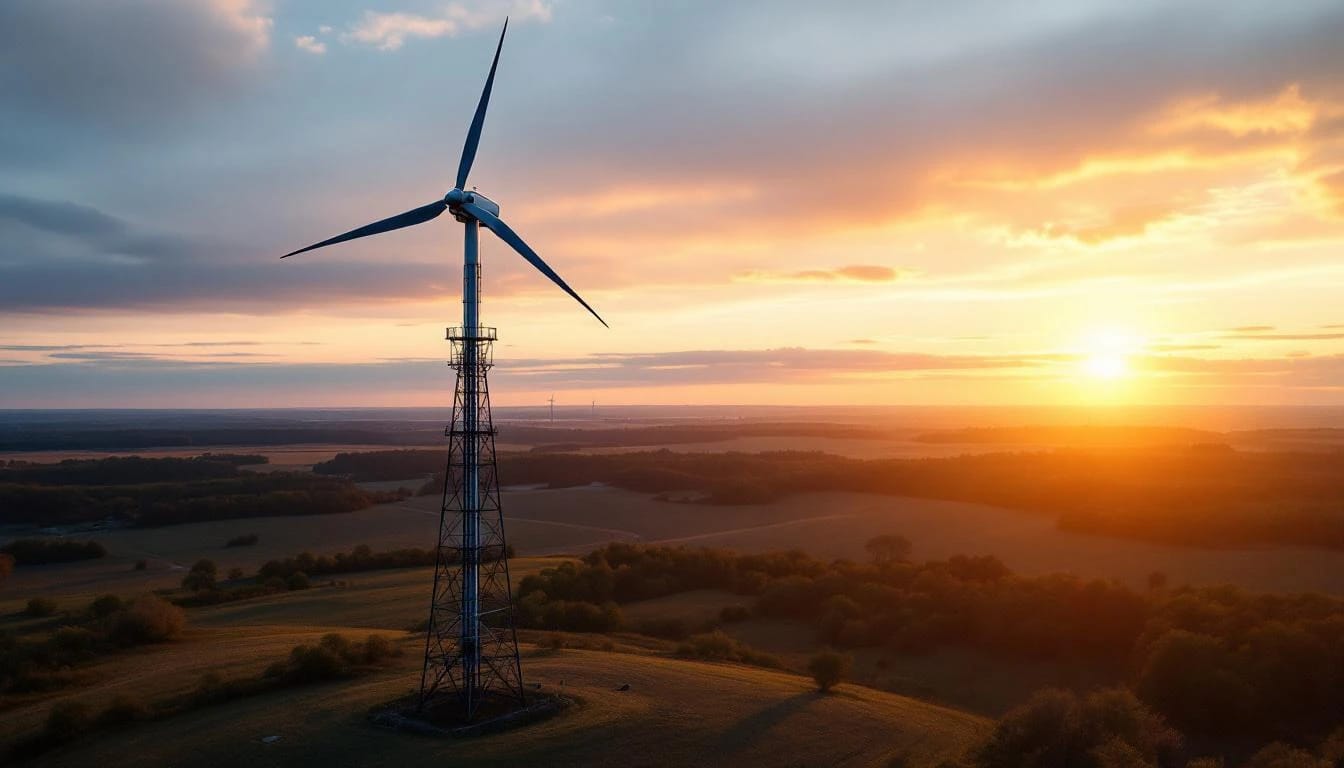
The single biggest mistake residential wind turbine buyers make is mounting their HAWT on a tower that's too short. A 10-kilowatt turbine on a 40-foot tower in suburban terrain will produce 30–50% less electricity than the same turbine on an 80-foot tower—effectively throwing thousands of dollars into obstructed air. The 30-foot rule offers a practical guideline: install your horizontal-axis wind turbine at least 30 feet above any obstacle (trees, buildings, silos) within 500 feet of the tower base. This clears the zone where turbulence kills performance and puts the rotor into laminar, faster-moving wind.
Why tower height matters more than turbine size
Wind speed increases with height because surface friction—from vegetation, structures, and terrain—slows air movement near the ground. Wind engineers call this the "boundary layer." At 20 feet, a turbine might see 8 mph average wind; at 80 feet, that same site could yield 12 mph. Because power output scales with the cube of wind speed, that 50% velocity increase translates to a 238% increase in available energy (1.5³ = 3.375). A Bergey Excel 10 rated at 10 kW will generate roughly 1,200 kWh per month on a properly sized tower in a Class 3 wind site, but barely 400 kWh on a stubby pole surrounded by trees.
Taller towers cost more upfront—expect $8,000–$15,000 for a guyed lattice tower versus $3,000–$6,000 for a short monopole—but the energy gain repays the investment in 3–7 years depending on electricity rates and the 30% federal Residential Clean Energy Credit (IRC §25D). Skimping on tower height is like buying a sports car and filling the tank with syrup.
The 30-foot rule decoded
The 30-foot rule states: tower height = obstacle height + 30 feet, where "obstacle" includes any structure or vegetation within a 500-foot radius. If your neighbor's barn is 25 feet tall and sits 300 feet from your proposed turbine location, your tower needs to be at least 55 feet. A mature oak 60 feet tall and 400 feet away requires a 90-foot tower. The 500-foot radius is not arbitrary—it corresponds to the distance downwind obstacles create turbulent eddies that disrupt rotor efficiency and accelerate bearing wear.
This guideline originated from decades of field observations by the National Renewable Energy Laboratory and small wind installers. Turbines mounted below the 30-foot threshold experience:
- Reduced capacity factor: Annual energy output drops 20–60% compared to manufacturer estimates based on clean wind.
- Increased vibration and noise: Turbulent air causes the blades to flex and stall unpredictably, producing cyclic loads and that characteristic "whup-whup" sound neighbors complain about.
- Shorter component life: Gearboxes, yaw bearings, and blade root fasteners fatigue faster under turbulent loading.
The American Wind Energy Association's small wind best practices document recommends the 30-foot rule for residential sites; the Department of Energy's Small Wind Guidebook reinforces it for homeowners, ranchers, and small business owners evaluating system viability.
Measuring obstacles and calculating required height
Walk or drive a 500-foot circle around your proposed tower location. Identify the tallest permanent obstacle in each direction—not just today's structures but anything likely to exist over the turbine's 20–25 year lifespan. Trees grow; a 40-foot spruce today will be 65 feet in 15 years. Conservative planning uses projected mature height for saplings and young stands.
Measuring obstacle height without climbing involves basic trigonometry. Stand a known distance from the tree or building, measure the angle to the top with a clinometer or smartphone inclinometer app, then calculate: height = distance × tan(angle) + eye height. For a tree 100 feet away at a 30-degree angle viewed from 5.5-foot eye level: 100 × tan(30°) + 5.5 ≈ 63 feet. Add 30 feet to get your minimum tower height of 93 feet.
Some installers use a simpler "thumb rule": extend your arm, align your thumbnail with the base of the obstacle, and note where the top of your fist falls relative to the obstacle's top. Each fist-width above your thumb represents roughly 10 feet of additional height at 100-foot distance. This method gives a ballpark figure; hire a professional survey for final tower design.
Tower types and their height limitations
Three tower designs dominate residential HAWT installations, each with distinct height and cost characteristics:
| Tower Type | Typical Height Range | Cost per Foot | Pros | Cons |
|---|---|---|---|---|
| Guyed lattice | 60–140 ft | $65–$90 | Least expensive per foot; tilt-up models ease maintenance | Requires guy anchor footprint 50–75% of tower height; not suitable for small lots |
| Monopole (freestanding) | 35–80 ft | $120–$180 | Minimal land footprint; clean appearance | Exponentially expensive above 80 ft; requires larger concrete foundation |
| Tilt-up tubular | 45–100 ft | $80–$130 | Combines monopole aesthetics with lattice serviceability | Guy anchors still needed; more complex gin-pole mechanism |
Guyed lattice towers offer the best cost-performance ratio for sites where land isn't constrained. A 100-foot Rohn 25G or equivalent tower with 5,000-lb rating runs $6,500–$9,000 plus installation. The guy anchors occupy a circle roughly 75 feet in radius, which rules out suburban lots under 0.5 acres but works fine for rural properties. Tilt-up versions like those from Texas Towers let one or two people lower the turbine for maintenance without a crane, saving $800–$1,500 per service visit.
Monopole towers suit constrained sites and homeowners associations with appearance covenants. A 60-foot monopole for a mid-size HAWT costs $7,000–$11,000 installed, but scaling to 80 feet pushes prices above $18,000 because wall thickness and foundation volume increase nonlinearly. Monopoles over 80 feet are rare in residential contexts due to cost and engineering complexity.
Tilt-up tubular towers split the difference. They satisfy aesthetic concerns better than lattice while retaining serviceability. The Bergey XL.1 often ships with a 70-foot tilt-up tower; aftermarket options from Surplus Wind Towers extend to 100 feet. Expect $8,000–$13,000 for a complete 80-foot tilt-up kit.
Wind shear and the power law exponent
The rate at which wind speed increases with height varies by terrain roughness. Open water has a low shear exponent (α ≈ 0.10); dense forest or urban areas have high shear (α ≈ 0.30–0.40). The power law formula estimates wind speed at your tower height:
V₂ = V₁ × (H₂ / H₁)^α
If you measured 9 mph at 30 feet in wooded terrain (α = 0.30), wind at 80 feet would be: 9 × (80/30)^0.30 ≈ 10.9 mph. That 21% speed boost yields 77% more power. In open farmland (α = 0.14), the same height increase gives only 12% more speed and 41% more power—still worthwhile but less dramatic.
This explains why coastal and Great Plains sites tolerate shorter towers than forested Appalachian or Pacific Northwest locations. A South Dakota turbine at 60 feet may outperform a Vermont turbine at 80 feet if the latter sits in a hardwood hollow. The Small Wind Guidebook from the Department of Energy recommends on-site anemometry at proposed hub height for 6–12 months before committing to a tower design, though many installers rely on wind atlas data and shear correction.
Zoning, setbacks, and FAA notification
Even if the 30-foot rule says you need a 90-foot tower, local zoning may cap tower height at 75 feet or impose setback multiples (e.g., tower must be 1.5× height from property lines). Urban and suburban jurisdictions often restrict towers to 35–50 feet, which effectively prohibits economically viable wind energy in treed neighborhoods. Before purchasing a turbine, confirm:
- Zoning district allowances: Agricultural and rural residential zones typically permit tall towers; suburban R-1 zones often don't. Request a zoning determination letter from your municipal planning department.
- Setback requirements: Most codes require towers to be setback at least one tower height (the "fall zone") from structures and property lines. A 100-foot tower needs 100 feet clearance, consuming significant acreage.
- Height permits: Structures over 35–50 feet may require variance hearings or special-use permits, adding 2–6 months and $500–$2,000 in fees.
Federal Aviation Administration Part 77 rules require notification—not approval—for any structure over 200 feet above ground level, or within certain distances of airports. Residential wind towers rarely trigger FAA obstruction review, but airport proximity can result in required lighting (red obstruction beacons), which irritates neighbors and consumes energy. Check the FAA Obstruction Evaluation Tool before finalizing tower height.
Some states and counties classify wind turbines as "accessory structures" subject to lighter regulation; others treat them as "industrial equipment" with onerous permitting. The Database of State Incentives for Renewables & Efficiency (DSIRE) lists state-specific rules, though it doesn't always capture county and municipal ordinances.
Cost vs. performance: Is extra height worth it?
An 80-foot tower adds $4,000–$8,000 over a 50-foot tower, depending on type. Whether that investment makes sense depends on your wind resource and electricity costs. Run a simple payback analysis:
- Estimate annual energy gain: Use the power law to calculate wind speed increase, cube it for power gain, multiply by turbine capacity factor. Example: 50-foot tower yields 8.5 mph average (4,200 kWh/year from a 5 kW turbine); 80-foot tower yields 10.2 mph (7,100 kWh/year). Gain: 2,900 kWh.
- Value the gain: At $0.14/kWh, that's $406/year.
- Account for incentives: The 30% federal tax credit reduces net tower cost. An $8,000 tower costs $5,600 after credit.
- Calculate payback: $5,600 / $406 = 13.8 years. If the electricity rate escalates 3% annually, payback drops to ~10 years.
Most owners find extra height pays off in Class 2+ wind sites (average ≥10 mph at 30 meters). In marginal Class 1 sites, even a tall tower may not deliver competitive returns, and solar panels become the better option.
Installers emphasize that manufacturer power curves assume clean, laminar wind. Real-world turbulent wind from a short tower can degrade performance by 40% or more—far worse than the curves suggest. Investing in tower height is investing in the wind quality that lets the turbine operate as designed.
Special cases: flat terrain and ridge-top installations
In Kansas wheat fields or North Dakota prairie, the landscape itself is the tower. Minimal obstacles mean wind shear is low and turbulence minimal, so the 30-foot rule simplifies to "get above the crop canopy and house rooflines." A 60-foot tower often suffices. Conversely, a ridge-top site with 360-degree exposure may allow shorter towers because the terrain funnels wind upward. Mountain ridges concentrate airflow, boosting speeds 20–40% compared to valleys.
However, ridges introduce gustiness. High turbulence intensity (TI) from terrain-induced eddies can exceed turbine design limits (most HAWTs are rated for TI ≤ 0.18). An anemometer study showing high TI suggests either picking a lower site or spec'ing a turbine with Class II or III IEC certification, which tolerates rougher conditions.
Coastal sites benefit from low surface roughness over water but suffer salt corrosion. A 70-foot tower might capture excellent wind, but plan on powder-coated or stainless hardware and annual corrosion inspections to avoid expensive failures.
Maintenance access and tower climbing safety
Taller towers concentrate risk. Climbing a 100-foot lattice tower to service a yaw motor or replace a slip ring requires fall-arrest systems, climbing harnesses, and ideally a certified tower climber or crane service. Annual maintenance visits average $400–$800 for professional service; DIY climbers save money but accept serious injury risk.
Tilt-up towers address this by bringing the turbine to ground level for service. A two-person crew can lower a 5–10 kW turbine in 30–60 minutes using a winch and gin pole, perform maintenance, and raise it back up. Over a 20-year lifespan, this saves $8,000–$16,000 in crane and climber fees, offsetting the $1,000–$2,000 premium for tilt-up hardware.
NEC Article 705 governs wind turbine electrical interconnection but doesn't specify tower height. Tower design falls under building codes (IBC, IRC) and requires a PE-stamped drawing in most jurisdictions. The engineer sizes the tower for peak wind loads, ice accumulation, and seismic factors; the resulting foundation and anchor specs often surprise DIYers with their scale—6–12 cubic yards of concrete for a 100-foot tower is common.
Real-world examples: Tower height and energy production
A Montana rancher installed a Primus Air 40 (2.5 kW rated) on a 50-foot monopole in a valley surrounded by 40-foot pines. First-year production: 1,800 kWh. After two years of disappointing performance, he added 30 feet of tower using a bolt-on extension kit ($3,200 installed). Second-year production at 80 feet: 4,100 kWh—a 128% increase for a 40% height increase. The extension paid for itself in 3.2 years.
A Vermont homeowner insisted on a 40-foot tower to "keep it low-profile" despite an installer's recommendation for 70 feet. The Skystream 3.7 produced 1,200 kWh annually instead of the projected 3,800 kWh. After selling the system at a loss, the new owner moved it to an 80-foot tilt-up tower on a more exposed site, where it now generates 4,200 kWh/year.
These anecdotes underscore a hard truth: The turbine is only half the system. The tower determines whether that turbine operates in the wind regime it was designed for or in the chaotic soup below the tree canopy.
When to exceed the 30-foot rule
Some situations justify going even higher:
- Dense forest with no clearing option: A 120-foot tower lifts the rotor above a 70-foot canopy plus 30 feet, capturing significantly faster wind. Economics are marginal unless the site has Class 3+ wind at height.
- High electricity rates: California and Hawaii residential rates ($0.28–$0.38/kWh) make the incremental kWh from extra height valuable. A $6,000 tower investment yielding 3,000 additional kWh annually saves $840–$1,140/year.
- Grant or incentive leverage: Some state and utility programs cap rebates as a percentage of total cost. A taller, more expensive system qualifies for a larger rebate, reducing net homeowner cost.
Conversely, don't overbuild. A 140-foot tower on flat farmland adds cost without energy gain if wind at 100 feet is already near turbine cut-out speed (typically 45–55 mph). Diminishing returns set in once you clear local turbulence and enter the "boundary layer top," often 80–120 feet depending on terrain.
How much does tower height affect my HAWT's output?
Each additional 10 feet of tower height in typical residential terrain increases average wind speed by 3–8%, which translates to roughly 9–26% more energy due to the cubic relationship between wind speed and power. In heavily wooded sites, the effect is even larger—moving from 40 to 70 feet can double production.
Can I add height to an existing tower later?
Monopole towers can sometimes accept bolt-on extensions if the foundation was over-designed initially, but many require a complete replacement to handle the added load. Guyed lattice towers are more adaptable; you can add sections and re-tension guy cables, though this may require engineering review and a new building permit. Budget $2,500–$5,000 for a 20-foot lattice extension including labor.
What if my zoning limits tower height below the 30-foot rule recommendation?
You have three options: apply for a variance (costs $500–$2,000, takes 2–6 months, success varies by jurisdiction), clear obstacles within 500 feet (tree removal typically $800–$2,500 per large tree), or accept reduced performance and run the economics. Some owners install the maximum allowed height, monitor production, and decide whether to pursue a variance based on real data.
Do I need FAA approval for a tall tower?
FAA notification is required for structures exceeding 200 feet above ground or within certain airport approach zones, but towers under 200 feet in non-airport areas generally do not require FAA clearance. You submit a Form 7460-1 if notification is required; the FAA reviews for obstruction hazards and may mandate lighting. Check the FAA OE/AAA tool for your specific location.
Is a tilt-up tower worth the extra cost?
If you plan to perform your own maintenance and your site isn't constrained by guy anchor space, yes. Tilt-up towers cost 15–30% more than fixed guyed lattice but eliminate crane rental ($600–$1,200 per visit) and professional climber fees. Over 20 years, the maintenance savings exceed the upfront premium. If you'll hire service regardless, a fixed tower is simpler and slightly cheaper upfront.
Bottom line
Tower height determines whether your HAWT meets, exceeds, or disappoints performance expectations. The 30-foot rule—placing the turbine 30 feet above obstacles within 500 feet—is not a suggestion; it's the threshold between viable and regrettable wind energy investment. Skimping on tower height to save $4,000 upfront routinely costs $15,000–$25,000 in foregone electricity over the turbine's life. Get a site assessment from a qualified installer, verify zoning before ordering equipment, and size the tower for the wind regime the turbine was engineered to exploit. Taller is almost always better, and the federal 30% tax credit softens the cost. Make tower height the first decision, not an afterthought.
Share this article
windturbinehome.com/s/05fefc
Editorial note: This article was researched and written by a member of the Wind Turbine Home editorial team. AI-assisted tools were used for spell-checking and light grammar review only — all research, analysis, and conclusions are our own. Our editorial policy prohibits sponsored content and paid placements. Read our editorial policy →
Related reading

horizontal axis turbines
Cut-In Wind Speed: What It Is and Why It Matters for Home Turbines
Cut-in wind speed determines when your turbine starts generating power. Learn why this 6-9 mph threshold affects your energy production and ROI more than rated power.
horizontal axis turbines
Downwind vs Upwind Turbines: How Yawing Affects Performance
Upwind turbines capture cleaner airflow but need active yaw control. Downwind designs self-align but suffer tower shadow losses. Learn how configuration affects your small wind system's output.

horizontal axis turbines
Three-Blade vs Two-Blade Wind Turbine Rotors: Performance Guide
Three-blade rotors deliver smoother operation and better performance for residential wind turbines, while two-blade designs offer lower costs and simpler maintenance.

horizontal axis turbines
How High Does a Home Wind Turbine Need to Be? Tower Height Guide
Home wind turbines need 30+ feet of clearance above nearby obstacles within 500 feet. Most residential installations require 80-120 foot towers for adequate wind exposure.

horizontal axis turbines
HAWT vs VAWT for Residential Use: Which Turbine Wins on Your Roof
Horizontal-axis wind turbines (HAWTs) dominate residential installs with 40-60% efficiency vs. 25-40% for vertical-axis (VAWTs), but roof-mount VAWTs handle turbulent urban wind better.