Farm-Scale Wind Turbines 10kW-50kW: Which Size Fits Your Operation
Choosing between 10kW, 25kW, or 50kW farm wind turbines depends on daily electrical demand, available land, and whether you net-meter or store power.
Share this article
windturbinehome.com/s/9dc174
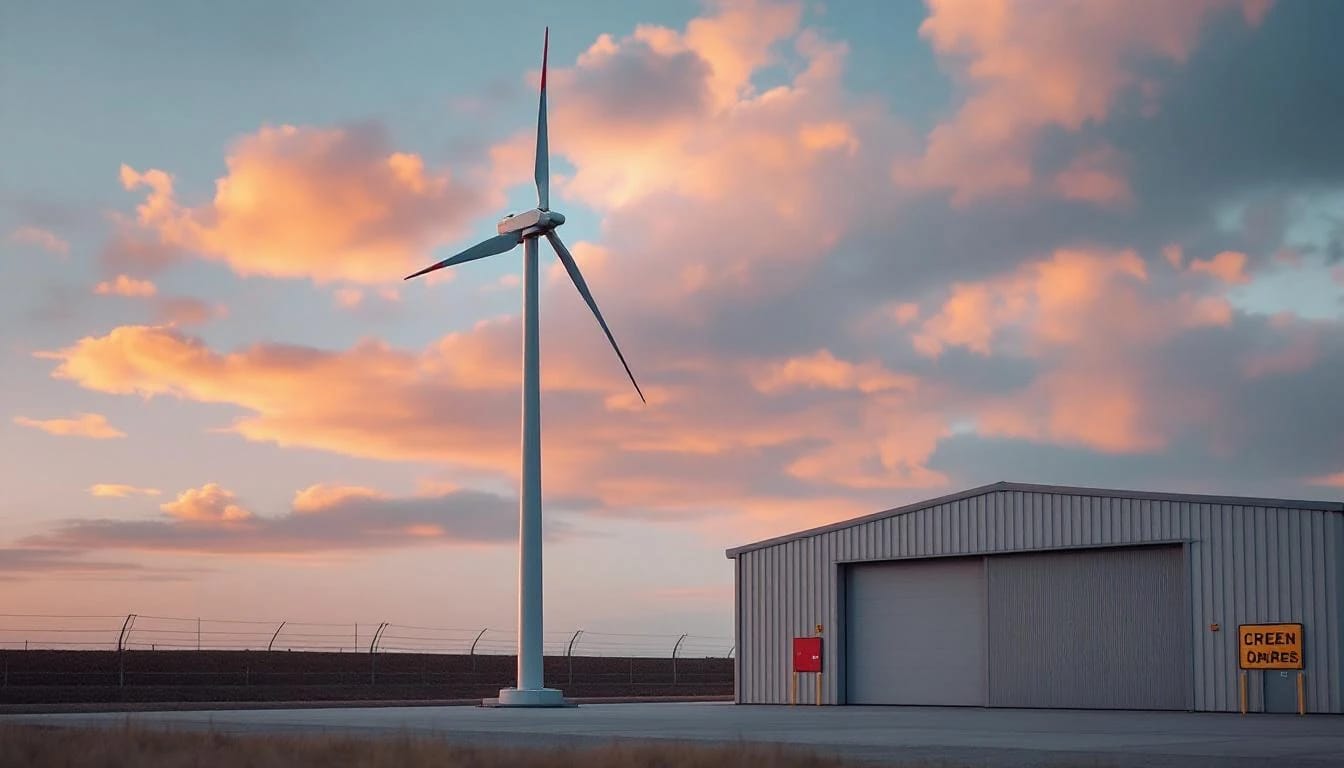
Farm-scale wind turbines in the 10 kW to 50 kW range serve as a middle ground between residential micro-wind and utility-scale projects—perfect for dairies, grain operations, greenhouses, and livestock facilities with substantial electrical loads. A 10 kW turbine typically meets the baseload of a small organic farm or hobby ranch with minimal infrastructure, while a 50 kW machine can offset most consumption on a 300-acre row-crop operation running irrigation pumps and grain dryers. The right size depends on your average daily kilowatt-hour draw, site wind resource (measured or modeled), interconnection capacity, and whether you plan to net-meter surplus or pair the turbine with battery storage.
Understanding the 10 kW to 50 kW capacity spectrum
Distributed wind turbines in this range occupy the space between backyard residential 5 kW systems and multi-megawatt commercial wind farms. The U.S. Department of Energy's Wind Energy Technologies Office recognizes distributed wind as turbines generating power for onsite use or nearby consumption, often installed behind the meter at agricultural, small industrial, or institutional sites. The National Renewable Energy Laboratory (NREL) maintains ongoing research into distributed wind systems, supporting manufacturers through certification evaluation and performance assessment tools designed to lower installed costs and improve reliability.
A 10 kW turbine produces approximately 15,000 to 25,000 kWh annually in a Class 3 wind resource (6.7–7.4 m/s at hub height), enough to cover lighting, refrigeration, and a workshop on a 50-acre diversified vegetable farm. The 25 kW bracket jumps to 40,000–65,000 kWh per year in similar conditions, serving operations with walk-in coolers, automated feeding systems, or modest irrigation. At 50 kW, annual production reaches 75,000–130,000 kWh in good wind sites, offsetting grain elevator conveyors, milking parlor vacuum pumps, and center-pivot systems.
Manufacturers in this space include Bergey (Excel 10 and 15 kW models), Northern Power Systems (now largely legacy inventory), Endurance Wind Power (E-3120 50 kW), and various international brands available through U.S. distributors. Always verify Small Wind Certification Council (SWCC) certification or equivalent IEC 61400-2 compliance to confirm performance claims and unlock some state incentive programs.
Matching turbine size to daily electrical consumption
Start with twelve months of utility bills to calculate average daily kWh. A 10 kW turbine producing 50 kWh per day in a moderate wind regime suits a farm consuming 40–60 kWh daily. If your operation runs 100–150 kWh per day—common for dairies with bulk tank refrigeration and automated scrapers—a 25 kW turbine moves closer to a one-to-one match. Facilities exceeding 200 kWh daily (large poultry houses, hydroponic greenhouses with sodium lamps) justify the jump to 50 kW.
Net metering policies vary by state and utility. In states with favorable net-metering rules (California, Massachusetts, New York, Vermont), sizing a turbine to generate 90–110% of annual consumption maximizes the value of surplus production credited at retail rates. States with less generous policies (Georgia, Alabama, Tennessee) pay avoided-cost wholesale rates for excess generation, making battery storage or load-shifting (running irrigation during windy nights) more economically attractive than oversizing the turbine.
The federal Investment Tax Credit under IRC §25D provides a 30% tax credit (stepped down to 26% in 2033, 22% in 2034) for qualified small wind energy property with a rated capacity of 100 kW or less. This applies to both residential and farm installations, covering turbine, tower, inverter, and balance-of-system costs. Modified Accelerated Cost Recovery System (MACRS) depreciation schedules allow businesses to depreciate the remaining 70% over five years, compounding the tax benefit. Check the DSIRE database for state-level production incentives, sales tax exemptions, and property tax abatements.
Site assessment: wind resource and clearance requirements
The DOE's WindWatts initiative has improved distributed wind resource modeling using computational tools and modern data. Still, on-farm measurement with a calibrated anemometer at proposed hub height for at least three months (ideally twelve) remains the gold standard. A Class 3 site at 30 meters provides workable economics for 10 kW machines; Class 4 (7.5–8.5 m/s) or better transforms the financial case for 50 kW turbines.
Hub height dictates production. A 10 kW turbine on a 24-meter tilt-up tower in open farmland captures less than one on a 30-meter guyed lattice tower. The rule of thumb: taller is better, and every additional five meters of height in flat terrain adds 5–10% to annual energy yield. For 50 kW machines, manufacturers specify hub heights of 37 to 43 meters to access stronger, steadier winds above surface friction.
Federal Aviation Administration Part 77 requires notice for any structure exceeding 200 feet AGL or penetrating an airport approach zone. Most 10–25 kW installations on 30-meter towers stay under 98 feet total (30 m hub + turbine radius), clearing FAA review. A 50 kW turbine on a 43-meter tower with a 24-meter rotor diameter can push total height to 143 feet, still below the automatic filing threshold but worth confirming with local airports.
Setback and sound ordinances differ dramatically across counties. Some agricultural zones allow turbines within 1.1 times tower height of property lines; others mandate 500 feet or more. Sound levels at 10 kW are modest (45–52 dBA at 100 meters), but 50 kW machines operating at rated output produce 55–58 dBA at the same distance—audible at night in quiet rural settings. Engage neighbors early and consider voluntary setbacks beyond minimum requirements to preserve goodwill.
Comparing turbine technologies: horizontal-axis dominates, vertical-axis niche
Horizontal-axis wind turbines (HAWTs) command the distributed wind market above 5 kW due to superior efficiency and decades of refinement. Three-blade upwind configurations extract 40–45% of available wind energy (Cp), while vertical-axis wind turbines (VAWTs) in this power range typically achieve 25–35% in field conditions. The Bergey Excel 10, a workhorse HAWT, has logged thousands of installations since the 1980s, with rotor swept area of 9.1 m² and cut-in speed of 2.5 m/s.
VAWTs do appear in the 10–15 kW bracket—models like the Windspire or certain Chinese imports—promoted for lower noise, omnidirectional operation, and simpler tower structures. These traits appeal to sites with turbulent or shifting winds (near tree lines, hilly terrain), but efficiency losses and higher per-kWh costs limit adoption. Few VAWTs above 25 kW exist in active production, making HAWT the default for 50 kW farm projects.
Gearless direct-drive generators reduce maintenance intervals but add upfront cost and weight. Geared drivetrains (planetary or single-stage) permit lighter nacelles and are easier to service, though gearboxes require oil changes every two to four years. Permanent-magnet alternators paired with grid-tie inverters dominate modern designs, replacing older induction generators that demanded reactive power compensation.
Blade materials matter for longevity. Fiberglass-reinforced epoxy withstands UV and freeze-thaw cycles better than early polyester composites. Leading-edge tape or erosion-resistant coatings extend blade life in sandy or coastal environments. Expect blades on a 50 kW turbine to last 15–20 years before requiring replacement or refurbishment, with smaller 10 kW blades often reaching 20–25 years if properly maintained.
Installation logistics and interconnection for mid-scale turbines
A 10 kW turbine on a tilt-up tower can be erected by a three-person crew in one day using a gin pole, assuming foundation work is complete and electrical prep is done. A 50 kW machine on a 43-meter lattice or monopole tower demands a crane (50–70 ton), professional rigging, and often two days onsite. Budget $15,000–$25,000 for a 10 kW installation (turbine, tower, foundation, inverter, labor) and $120,000–$180,000 for a turnkey 50 kW project, before incentives.
Foundation design depends on soil bearing capacity and tower type. Guyed towers use a central pier (typically 1.2 m diameter, 2.5 m deep for 10 kW) plus three or four concrete anchor pads for guy cables. Self-supporting lattice or monopole towers require a larger reinforced-concrete pedestal—up to 3.5 m wide and 3 m deep for 50 kW machines in soft soils. A geotechnical report ($800–$1,500) identifies bedrock depth and bearing pressure, preventing costly redesigns.
Interconnection to the utility grid follows NEC Article 705 (Interconnected Electric Power Production Sources), which mandates overcurrent protection, anti-islanding inverters, and a visible lockable disconnect accessible to utility personnel. Most inverters in this power range meet UL 1741 and IEEE 1547 standards, automatically shutting down within two seconds of grid loss. The utility's interconnection study ($500–$3,000 for systems under 50 kW) confirms whether local transformers and conductors can accept backfeed without voltage-rise issues.
Run of network analysis may reveal that a 50 kW turbine on a long rural feeder requires a transformer upgrade or line reconductoring, adding $10,000–$40,000 to project cost. Smaller 10 kW systems on robust three-phase lines rarely face these barriers. Processing timelines vary: municipal utilities sometimes approve in four weeks, while investor-owned utilities may take four months. Include this lag in project planning.
Economic modeling: payback periods and financing structures
Simple payback for a 10 kW system in a Class 3 site with $0.13/kWh electricity and full federal ITC ranges from 8 to 12 years. A 50 kW installation in a Class 4 site at $0.15/kWh achieves 10–14 year payback, though economies of scale slightly favor the larger turbine on a per-kWh-installed basis. Financing through USDA Rural Energy for America Program (REAP) grants (25% of eligible costs) and loan guarantees shortens payback by two to four years for qualifying agricultural producers and rural small businesses.
Levelized cost of energy (LCOE) for distributed wind in this range falls between $0.08 and $0.18 per kWh over a 20-year turbine life, assuming 2% annual O&M costs and modest wind resources. By comparison, grid retail rates in agricultural areas average $0.11–$0.16/kWh, making the economics marginal in low-wind states (Louisiana, Mississippi, Arkansas) but compelling in windier regions (Kansas, Oklahoma, Montana, North Dakota).
Operation and maintenance expenses include annual tower inspection ($300–$600), brake and yaw mechanism lubrication ($200–$400 for 10 kW; $800–$1,200 for 50 kW), inverter replacement every 10–12 years ($2,500–$7,000), and occasional blade repairs. Many owners purchase service contracts ($0.01–$0.02/kWh generated) from installers, transferring risk and ensuring priority response during outages.
Property insurance riders for wind turbines add $150–$400 annually for 10 kW systems and $600–$1,200 for 50 kW machines. Coverage should include lightning strike, blade throw, tower collapse, and business interruption. Some carriers require periodic tower inspections by a licensed structural engineer to maintain coverage.
| Turbine Size | Typical Annual kWh (Class 3) | Installed Cost | Federal ITC Benefit | Approx. Payback (without state incentives) |
|---|---|---|---|---|
| 10 kW | 18,000–22,000 | $50,000–$65,000 | $15,000–$19,500 | 9–12 years |
| 25 kW | 50,000–60,000 | $90,000–$125,000 | $27,000–$37,500 | 9–13 years |
| 50 kW | 95,000–120,000 | $160,000–$220,000 | $48,000–$66,000 | 10–14 years |
Hybrid systems: pairing wind with solar and battery storage
Wind production peaks in spring and fall across much of the U.S., while solar generation maxes out in summer. A 25 kW wind turbine combined with a 30 kW solar array smooths seasonal variability, improving year-round self-consumption. NREL's distributed wind research includes infrastructure for microgrid and hybrid power analysis, demonstrating that wind-solar-battery microgrids reduce diesel consumption by 70–90% in remote agricultural applications.
Battery integration allows farms to shift wind energy from overnight generation (when wind speeds are highest) to daytime loads (irrigation pumps, grain conveyors). A 100 kWh lithium iron phosphate (LiFePO₄) battery bank stores roughly one day's output from a 25 kW turbine in moderate wind, discharging during peak-rate hours if the utility employs time-of-use pricing. Batteries add $30,000–$50,000 to system cost but unlock additional savings in markets with demand charges or expensive on-peak rates.
Advanced controls research at NREL focuses on transactive energy systems where distributed generators bid into local energy markets or respond to grid signals. For now, most farm-scale systems operate under simpler net-metering or feed-in arrangements, but future opportunities may include selling ancillary services (frequency regulation, voltage support) to grid operators via aggregators.
Properly sized hybrid systems require load profiling and production modeling. Solar-wind hybrid sizing tools automate the iteration, suggesting turbine-to-solar ratios and storage capacity based on location, consumption patterns, and desired resilience during grid outages.
Permitting, zoning, and community engagement for farm wind
County-level zoning ordinances govern turbine height, setbacks, and noise limits. Agricultural zones in wind-friendly states (Iowa, Kansas, Wyoming) often have streamlined special-use permits for on-farm generation, requiring public hearings but minimal environmental review for turbines under 100 kW. Suburban-adjacent farmland faces stricter scrutiny, with some municipalities capping turbine height at 35 meters or banning commercial-appearing structures outright.
Conditional use permits typically cost $500–$2,000 in application fees and take two to six months. Prepare a site plan showing turbine location, setbacks, access roads, and electrical routing. Include a sound study if neighbors are within 500 meters; most consultants charge $1,200–$2,500 for a predictive analysis. Offering to host a public meeting before filing demonstrates transparency and often preempts opposition.
Shadow flicker—strobing sunlight through rotating blades—rarely affects residences beyond 500 meters but can be modeled if concerns arise. Mitigation includes setback increases, turbine shutdown timers during sensitive hours, or planting evergreen screening. Bird and bat impacts are lower for single distributed turbines than for wind farms, but sites near migratory flyways or known bat hibernacula may require wildlife surveys ($3,000–$8,000) to satisfy state environmental agencies.
Easements or lease agreements with adjacent landowners smooth turbine siting when guy anchors or underground cable trenches cross property lines. A standard guy-anchor easement covers a 3 m × 3 m pad and cable trench, compensated at $500–$1,500 per anchor depending on land value. Document all agreements in writing and record them with the county clerk.
Maintenance schedules and long-term performance optimization
Annual inspection checklists for 10–50 kW turbines include torque checks on tower bolts (every section joint), visual inspection of blades for cracks or leading-edge erosion, verification of yaw bearing rotation, brake function testing, and inverter error log review. Catch minor issues early—a loose blade bolt can progress to catastrophic failure within months under cyclic loading.
Guy cables on guyed towers require re-tensioning every three to five years as cable stretch and soil settling alter geometry. A tension meter ($200–$400) ensures each cable meets manufacturer specifications. Self-supporting towers need structural inspection by a licensed engineer every five years to certify weld integrity and foundation stability.
Inverters log performance data (kWh produced, voltage, frequency, fault events) accessible via web portal or local display. Monitor monthly production against predicted values; a drop of 15% or more signals blade soiling, yaw misalignment, or inverter derating. Some manufacturers offer remote diagnostics, pushing firmware updates or adjusting cut-out speeds based on observed wind distribution.
Blade cleaning every two to three years in dusty or agricultural environments restores 2–5% lost production. Use a bucket truck, soft brushes, and pH-neutral cleaner—never pressure washers above 1,500 psi, which can delaminate composite layers. Leading-edge tape replacement costs $400–$800 per blade for 10 kW turbines and $1,500–$2,500 per blade for 50 kW machines.
Regional wind patterns and turbine placement on diverse farm types
Great Plains states (Kansas, Oklahoma, Nebraska, South Dakota) deliver Class 3 to Class 5 wind resources over open wheat and sorghum fields, favoring 25 kW and 50 kW installations. Dairy and livestock farms in the Upper Midwest (Wisconsin, Minnesota) see excellent winter wind but must account for icing on blades, which can halt production for days and shed dangerous projectiles. De-icing systems (heated blade elements) add cost but extend the operating season.
Coastal and near-coastal regions (North Carolina, Oregon, coastal California) offer strong, consistent marine breezes, though salt spray demands corrosion-resistant coatings and more frequent maintenance. Orchard and vineyard sites in complex terrain (Napa Valley, Columbia River Gorge) exhibit turbulent flow, reducing turbine capacity factor by 10–20% compared to flat-land installations.
Row-crop operations with minimal obstacles benefit from straightforward siting—place the turbine upwind of prevailing wind direction, 300 meters from the nearest field edge, and at least 200 meters from tree lines to minimize wake turbulence. Livestock farms must balance turbine noise with animal sensitivity; cattle and sheep adapt quickly, while certain poultry breeds show stress responses to novel low-frequency sound. Anecdotal reports vary; controlled studies are limited.
Greenhouse operations with high nighttime electricity demand (supplemental lighting, climate control) align well with wind generation patterns, which often peak after sunset as thermal mixing layers collapse and wind speeds increase near the surface. Pairing a 25 kW turbine with LED grow lights and smart controllers achieves near-complete load matching during shoulder seasons.
What size wind turbine does a 200-acre grain farm need?
A 200-acre grain farm with typical irrigation and grain-drying loads consumes 80,000–120,000 kWh annually. A 50 kW turbine in a Class 3 wind site produces 100,000–120,000 kWh per year, covering most consumption. If net metering is available and electricity rates exceed $0.12/kWh, a 50 kW machine delivers the best return. Farms without irrigation can often meet needs with a 25 kW turbine.
Can I finance a farm wind turbine through USDA programs?
Yes. The USDA Rural Energy for America Program (REAP) offers grants up to 25% of eligible project costs and loan guarantees for renewable energy systems on farms and rural small businesses. Combined with the 30% federal Investment Tax Credit and MACRS depreciation, total incentives can exceed 50% of installed cost. Applications open annually; consult a USDA Rural Development office or qualified grant writer for assistance.
How much does it cost to replace a 10 kW turbine inverter?
Inverter replacement for a 10 kW grid-tie turbine costs $2,500–$4,000, including the unit and labor. Inverters have a rated life of 10–12 years, though some fail earlier in lightning-prone areas. Budget for one replacement over a 20-year turbine lifespan. Extended warranties ($500–$800) cover parts but rarely labor.
Do wind turbines interfere with farm equipment GPS signals?
Rotating turbine blades can reflect GPS signals, causing brief loss of RTK correction within 50 meters of the tower. Modern precision agriculture systems switch to WAAS or GLONASS backup, maintaining sub-meter accuracy. Position turbines at field edges or corners where equipment operates infrequently to avoid disruption during critical planting or harvesting windows.
What happens to a wind turbine during a tornado?
Turbines automatically shut down and feather blades in extreme wind events (typically above 25 m/s), reducing rotor-swept area and structural load. Lattice towers survive EF0 and EF1 tornadoes better than monopoles due to wind pass-through. Direct EF2+ hits destroy most small wind turbines, but insurance covers replacement. No turbine design withstands EF3 or higher core winds.
Bottom line
Farm-scale wind turbines between 10 kW and 50 kW offer proven technology for offsetting agricultural electrical loads, with payback periods of 9–14 years under favorable wind and rate conditions. Match turbine size to daily consumption, prioritize sites with Class 3 wind or better, and navigate interconnection and permitting early to avoid delays. Federal and USDA incentives significantly improve project economics, especially for operations that can utilize MACRS depreciation and REAP grants. Consult a NABCEP-certified installer and a licensed electrical contractor familiar with NEC Article 705 to ensure code compliance and long-term performance. Review your utility's net-metering tariff and explore battery storage integration if surplus generation credits are unfavorable.
Share this article
windturbinehome.com/s/9dc174
Editorial note: This article was researched and written by a member of the Wind Turbine Home editorial team. AI-assisted tools were used for spell-checking and light grammar review only — all research, analysis, and conclusions are our own. Our editorial policy prohibits sponsored content and paid placements. Read our editorial policy →
Related reading
small industrial wind
Wind Energy for Warehouses and Light Industrial Sites
Commercial wind turbines for warehouses and light industrial facilities can offset 15-60% of electric costs. Site selection, zoning, and grid-tie economics determine ROI.
small industrial wind
Wind Turbine for Water Pumping: Modern Takes on a Century-Old Idea
Modern wind-powered water pumping marries century-old mechanical principles with solar-hybrid systems, battery banks, and smart controllers for off-grid livestock, irrigation, and rural domestic supply.
small industrial wind
Wind Turbine for a Greenhouse: Powering Fans, Vents, and Lights
Wind turbines rated 1-5 kW can power greenhouse ventilation, lighting, and controls. Grid-tie or battery systems store excess energy while direct DC connections minimize conversion losses.
small industrial wind
10 kW Wind Turbine Cost for Home 2026: Complete Price Guide
A 10 kW home wind turbine costs $40,000–$65,000 installed in 2026, with final price driven by tower height, site prep, and permit fees—plus 30% federal tax credit.