Wind Energy for Warehouses and Light Industrial Sites
Commercial wind turbines for warehouses and light industrial facilities can offset 15-60% of electric costs. Site selection, zoning, and grid-tie economics determine ROI.
Share this article
windturbinehome.com/s/a5f9df
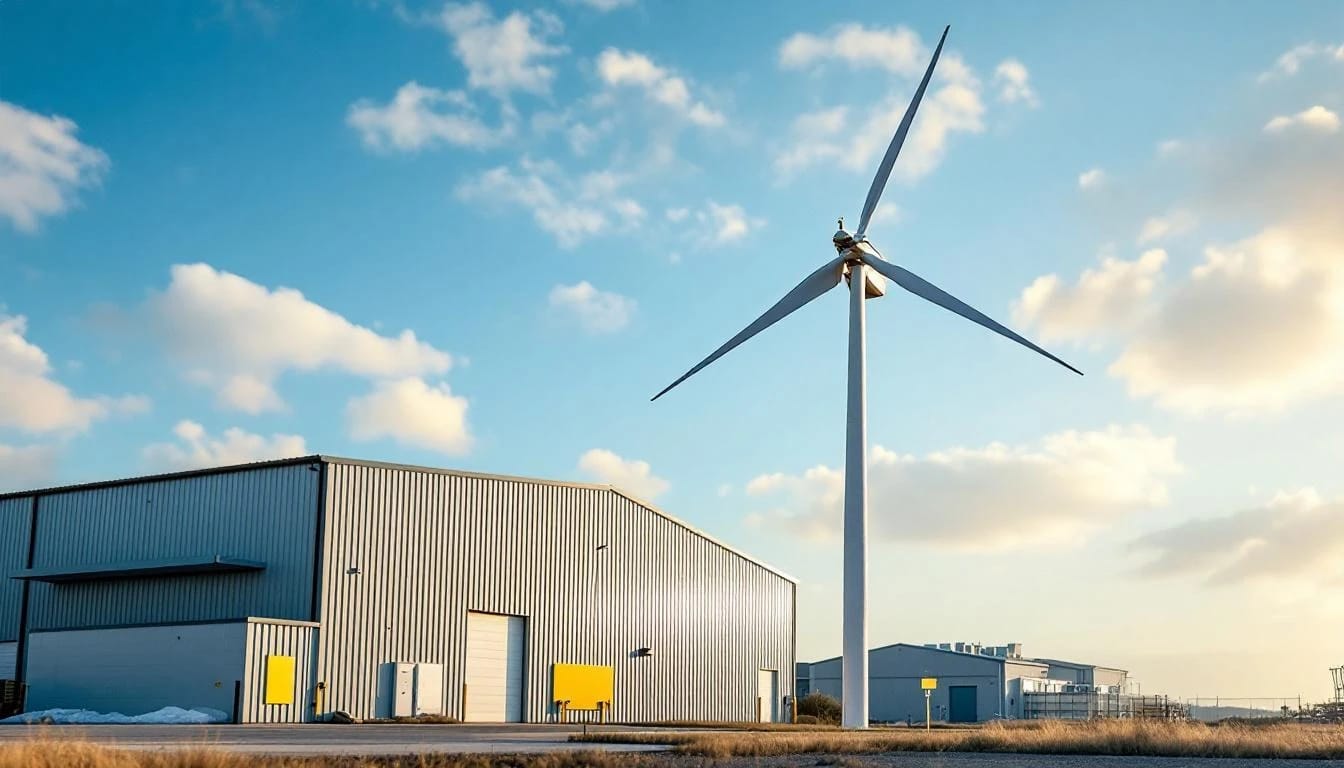
Wind power can offset 15–60% of electricity consumption at warehouses, manufacturing plants, recycling facilities, and distribution centers—transforming steady breeze into predictable operational savings. The National Renewable Energy Laboratory's distributed wind research confirms that small and medium-sized turbines (10 kW to 100 kW) deliver measurable cost reductions for commercial sites with adequate wind resources and clear airspace. Success hinges on three factors: average wind speed above 12 mph at hub height, unobstructed fetch, and local zoning that allows structures exceeding 35 feet.
Why warehouses and light industrial sites suit distributed wind
Large rooftops and open yards provide mounting options that residential parcels cannot match. A single-story warehouse with a flat roof simplifies both structural analysis and turbine access. Distribution centers built on former agricultural land inherit wide setbacks and minimal tree cover, conditions that preserve laminar flow. Manufacturing facilities with 24-hour power demand enjoy higher self-consumption ratios, reducing reliance on net-metering credit schedules.
The National Laboratory of the Rockies (formerly NREL) found that onsite generation avoids transmission losses—typically 5–8%—and demand charges that can represent 30–50% of a commercial electric bill. When a turbine feeds the main service panel during peak production hours, it shaves the 15-minute interval that utilities use to calculate monthly demand fees. Over a 20-year turbine lifespan, that reduction compounds.
Distributed wind also mitigates supply-chain risk. Grid outages halt production lines, spoil refrigerated inventory, and idle workers. A grid-tied turbine with battery storage maintains critical loads during short interruptions. The Defense and Disaster Deployable Turbine Project explored mobile wind systems for emergency power; the same design principles—modular inverters, rapid start capability—translate to stationary industrial installations.
Turbine sizing and technology choices
A 10 kW horizontal-axis turbine suits a 20,000 sq ft warehouse drawing 4,000–6,000 kWh per month. Bergey Excel 10 and Primus AIR 40 occupy this segment; both carry Small Wind Certification Council (SWCC) marks and survive IEC 61400-2 stress testing. Expect rotor diameters near 7 meters and tower heights between 80 and 120 feet—tall enough to escape surface turbulence but low enough to remain below FAA Part 77 notification thresholds in many jurisdictions.
A 50 kW machine—Aeolos-H 50kW or Northern Power NPS100—matches facilities consuming 20,000–30,000 kWh monthly. These turbines demand guyed lattice or monopole towers between 100 and 140 feet, concrete foundations exceeding eight cubic yards, and step-up transformers to match utility voltage. Installation costs climb from $60,000–$80,000 (10 kW) to $200,000–$280,000 (50 kW), but per-kilowatt pricing improves with scale.
Vertical-axis turbines—like the Pikasola 5kW or UGE VisionAIR—offer lower profile and omnidirectional operation, traits that appeal to planners navigating height restrictions. Performance lags comparable horizontal designs by 15–25%, and mechanical complexity (blade-pitch actuators, slip rings) increases maintenance intervals. Industrial buyers prioritize uptime; VAWT adoption remains niche unless aesthetic or zoning factors override efficiency.
Site assessment and wind resource validation
Commercial wind feasibility begins with multi-season data collection. Mount an anemometer and wind vane at proposed hub height—typically 100 feet—and log readings at ten-minute intervals for twelve months. The American Wind Energy Association recommends calibrated NRG 40C anemometers or Thies Clima ultrasonic sensors; consumer-grade weather stations introduce 10–15% error.
The National Laboratory's WindWatts tool provides modeled estimates using modern computational fluid dynamics, but onsite measurement remains the standard of care. Wind shear, thermal inversions, and building-wake effects appear only in empirical data. A site showing 11 mph average at 33 feet may deliver 14 mph at 100 feet—crossing the threshold from marginal to viable.
Obstacle analysis follows anemometer deployment. FAA Part 77 requires notification for any structure exceeding 200 feet above ground level or penetrating imaginary surfaces near airports. Most industrial turbines stay below that ceiling, but verify with the FAA's online notice tool and check for nearby heliports or seaplane bases. Local zoning overlays add setback multiples—often 1.5× to 2.0× tower height from property lines—and noise limits between 45 and 55 dBA at the nearest residence.
Soil borings inform foundation design. A 100-foot tower exerts 15,000–25,000 pound-feet of overturning moment; clay and silt require auger-cast piles or drilled shafts, sand accepts spread footings with reinforcement mats. Geotechnical reports cost $1,500–$3,000 and prevent costly redesigns during permitting.
Grid interconnection and NEC compliance
Distributed generation under 100 kW connects through NEC Article 705, which governs interactive inverters, overcurrent protection, and disconnect means. The turbine's inverter output feeds a dedicated breaker in the warehouse's main service panel, and utility meters run backward during surplus generation (net metering) or forward at reduced rate (net billing). The local Authority Having Jurisdiction (AHJ)—city or county building department—reviews single-line diagrams and requires licensed electricians to pull permits.
Anti-islanding protection shuts the inverter within two seconds of grid failure, preventing backfeed into downed utility lines. IEEE 1547-2018 harmonizes inverter behavior across manufacturers; look for UL 1741 listing on the nameplate. Some utilities mandate external visible-break disconnects and instrument transformers for revenue metering, adding $2,000–$5,000 to interconnection costs.
Voltage rise can limit inverter output on weak rural feeders. If the turbine pushes voltage above ANSI C84.1 Range A limits (114–126 V on a 120 V base), the inverter throttles or trips. Coordinate with the utility engineer early; solutions include service transformer upsizing, dedicated circuit upgrades, or export limiting (capping turbine output to avoid reverse power flow).
Three-phase service simplifies larger installations. A 50 kW turbine paired with a three-phase inverter balances load across all legs, reducing voltage imbalance and harmonic distortion. Single-phase warehouses require phase converters or accept single-phase inverters with higher per-watt costs.
Economics: payback, incentives, and tax treatment
The federal Residential Clean Energy Credit (IRC §25D) offers a 30% tax credit through 2032, stepping down to 26% in 2033 and 22% in 2034. The credit applies to systems serving a dwelling, not commercial facilities—but warehouse owners who operate as sole proprietors and claim mixed-use space may allocate a percentage. Consult a CPA familiar with renewable-energy tax treatment; IRS Form 5695 instructions clarify eligibility.
Commercial entities pursue Section 179D deduction (energy-efficient commercial building) or Modified Accelerated Cost Recovery System (MACRS) depreciation over five years. Combined with state incentives—cash rebates, performance payments, property-tax exemptions—effective first-year cost reduction reaches 40–55%.
The Database of State Incentives for Renewables & Efficiency (DSIRE) catalogs programs by ZIP code. California's Self-Generation Incentive Program (SGIP) pays $0.15–$0.35 per watt-hour for wind-plus-storage. New York's NY-Sun offers declining block incentives. Massachusetts combines SMART solar tariffs with behind-the-meter wind credits. Eligibility rules shift annually; verify current rates before finalizing pro formas.
Simple payback for a well-sited 10 kW turbine averages 10–14 years; 50 kW installations achieve 8–12 years when demand-charge savings are factored. Electricity rate escalation—historically 2.5–3.5% annually—shortens payback by year 15. Operations and maintenance (O&M) consume $0.01–$0.02 per kilowatt-hour: annual gearbox inspection, brake-pad replacement every 60 months, blade leading-edge tape every 36 months.
| Turbine size | Installed cost | Annual production (12 mph site) | O&M (annual) | Simple payback* |
|---|---|---|---|---|
| 10 kW | $70,000 | 18,000 kWh | $200–$400 | 11 years |
| 25 kW | $125,000 | 42,000 kWh | $500–$800 | 10 years |
| 50 kW | $240,000 | 90,000 kWh | $1,000–$1,800 | 9 years |
*Assumes $0.12/kWh blended rate, 30% federal credit, $0 state incentive, zero demand-charge savings.
Zoning, permitting, and neighbor relations
Industrial zones typically allow accessory structures without conditional-use permits, but height variances require public hearings. Submit a visual impact study—photosimulations from four cardinal directions—and a sound report predicting decibel levels at property boundaries. Modern turbines produce 40–48 dBA at 100 meters, comparable to moderate rainfall; older or poorly maintained machines spike to 55 dBA with blade swish.
Shadow flicker—rotating blade shadows cast through low sun angles—affects offices and adjacent properties. Predictive software (WindPRO, RETScreen) maps flicker duration; mitigation includes setback increases or automated shutdown during specified hours. Document preemptive outreach to neighbors; a single complaint can stall permits for months.
Aviation obstruction lighting activates automatically on turbines exceeding certain heights near flight paths. Red beacons comply with FAA Advisory Circular 70/7460-1M; daytime white strobes are optional. Industrial sites near regional airports may face mandatory lighting on 80-foot towers if within approach zones.
Historic district overlays and viewshed protections exist in unexpected locales. The National Historic Preservation Act (Section 106) review applies to federally connected projects—USDA rural energy grants, SBA loans—and can delay approvals six to twelve months.
Integration with solar and battery storage
Hybrid systems pair wind turbines with rooftop solar arrays, smoothing generation across diurnal and seasonal cycles. Winter wind peaks offset summer solar surpluses; overnight turbine output charges batteries drained by afternoon air conditioning. The National Laboratory's Microgrids, Infrastructure Resilience, and Advanced Controls Launchpad research demonstrated 30% capacity-factor improvement in wind-solar hybrids versus standalone deployments.
Battery storage—lithium iron phosphate (LFP) packs in the 50–200 kWh range—enables time-of-use arbitrage. Store turbine energy during off-peak hours (2 a.m.–6 a.m.) and discharge during on-peak demand (2 p.m.–8 p.m.), capturing $0.08–$0.15/kWh rate differentials. Inverter-chargers like OutBack Radian or Schneider Conext manage bidirectional flow and comply with UL 9540 energy-storage-system standards.
Grid-forming inverters—distinct from grid-following types—sustain facility loads during utility outages without diesel generators. Pair a 50 kW turbine, 100 kWh battery, and grid-forming inverter to ride through four-hour interruptions, protecting temperature-sensitive inventory or CNC machines intolerant of restarts.
Operational considerations and maintenance schedules
Manufacturers specify service intervals tied to runtime hours or calendar months. Gearbox oil changes occur every 2,500–5,000 hours; synthetic lubricants (Mobil SHC, Castrol Alphasyn) withstand temperature swings and extend drain intervals. Brake calipers require inspection every six months—worn pads cause rotor scoring and $4,000–$8,000 replacement costs.
Blade leading edges accumulate pitting from sand, insects, and hail. Apply polyurethane tape (3M 8671HS) to the outer 20% span every three years, restoring aerodynamic efficiency lost to roughness. Delamination inspections use tap testing or thermography; repair kits with epoxy and fiberglass cost $300–$600 per blade.
Yaw bearing grease fittings need annual pumping—three to five strokes per fitting—to prevent seizing. A frozen yaw bearing forces the turbine offline until a crane and technician can free it, a $2,500–$5,000 incident. Lightning protection systems (down conductors, grounding grids) require biennial resistance testing per NFPA 780; readings above 25 ohms indicate corrosion or loose connections.
Remote monitoring via SCADA (supervisory control and data acquisition) transmits turbine status—rotor RPM, generator output, error codes—to facility managers' dashboards. Cellular or Ethernet gateways cost $800–$1,500 installed and prevent undetected downtime. Historical production data informs warranty claims and validates manufacturer performance curves.
Case studies from diverse industrial applications
A dairy farm in Wisconsin installed an Aeolos-H 20kW turbine in 2019, offsetting 35% of milking-parlor and refrigeration demand. The farm qualified for USDA Rural Energy for America Program (REAP) grants covering 25% of project cost, stacking with the federal tax credit. Four-year cumulative savings exceeded $18,000 against a net installed cost of $95,000.
A recycling company in Colorado deployed a Bergey Excel 10 beside its sorting facility, pairing the turbine with a 30 kW rooftop solar array. The hybrid system reduced grid draw by 48% and provided backup power for conveyors during two utility outages in 2021. Municipal solid-waste facilities generate Class I renewable-energy certificates (RECs) in states with carve-outs; the operator sold RECs for an additional $1,200 annually.
A vineyard and winery in Oregon chose a Northern Power NPS100 (100 kW) to power crushers, fermentation tanks, and climate-controlled barrel rooms. Wind speeds averaged 15 mph at 120-foot hub height, producing 180,000 kWh in year one—exceeding the manufacturer's estimate by 8%. The winery marketed "wind-powered wine" as a brand differentiator, attracting eco-conscious distributors.
A public school district in Iowa mounted a Primus AIR 40 on campus, integrating turbine data into STEM curriculum. Students tracked production via classroom displays and calculated payback scenarios. The district accessed Iowa Energy Center grants and net-metered excess generation, achieving 13-year payback despite modest 11.5 mph average wind speed.
More project examples appear in the U.S. Department of Energy's Wind Energy Technologies Office case-study library, spanning agriculture, manufacturing, and municipal applications.
Evaluating manufacturers and installer credentials
Prioritize turbines with Small Wind Certification Council (SWCC) or IEC 61400-2 certification. These programs verify power curves, sound emissions, and structural integrity through independent testing. Uncertified machines introduce financing hurdles—banks and insurers demand third-party validation—and jeopardize incentive eligibility.
Installer experience matters more than brand loyalty. Request portfolios showing three or more commercial installations in similar wind regimes. Verify liability insurance ($2 million minimum) and workers' compensation coverage. North American Board of Certified Energy Practitioners (NABCEP) Small Wind Installer credentials signal adherence to best practices; only 120 individuals nationwide hold the certification.
Warranty terms separate reputable manufacturers from importers. Expect five-year coverage on major components (generator, inverter, yaw drive) and two years on wear items (brake pads, blade tape). Extended warranties (ten years) cost 8–12% of turbine price but transfer to buyers if the facility changes hands.
Avoid turnkey contracts bundling turbine, tower, installation, and interconnection without itemized pricing. Transparent bids list equipment model numbers, labor hours, permitting fees, and concrete volumes. Compare at least three proposals; variance exceeding 30% suggests incomplete scopes or underqualified bidders.
Regulatory landscape and future trends
The National Laboratory's Distributed Wind Energy Futures Study projects 30 GW of distributed wind capacity by 2035, with commercial and industrial segments driving two-thirds of growth. Cost reductions—target $2,000 per installed kilowatt by 2030—depend on domestic manufacturing scale and supply-chain rationalization. Current tariffs on imported nacelles (10–25%) push projects toward U.S.-assembled turbines, favoring Bergey and Xzeres over Chinese suppliers.
Revised interconnection standards (IEEE 1547-2018) enable advanced grid services: volt-VAR control, frequency response, ride-through during voltage sags. Turbines capable of grid support command premium pricing but unlock utility incentive payments—$0.01–$0.03/kWh—in markets piloting distribution-resource programs.
State Renewable Portfolio Standards (RPS) increasingly recognize distributed wind. New Jersey, Maryland, and Illinois credit behind-the-meter generation toward compliance, creating REC revenue streams that improve project economics by 10–15%. Federal Investment Tax Credit (ITC) reauthorization debates continue; proposed extensions through 2040 would stabilize financing.
Community wind models—where multiple businesses co-invest in a shared turbine—reduce per-participant capital requirements. A 100 kW turbine serving four warehouses allocates output via power-purchase agreements (PPAs), each buyer contracting for 25 kW. Aggregation simplifies permitting and maintenance while preserving individual incentive eligibility.
Can a warehouse with metal roofing support a roof-mounted turbine?
Metal roofs rarely provide adequate structural capacity for turbines above 5 kW. A ground-mounted tower beside the warehouse eliminates roof penetrations and simplifies foundation design. For roof mounting, hire a structural engineer to analyze joist spacing, truss load paths, and wind-uplift resistance. Most installers recommend ground arrays when available land exists.
Do wind turbines interfere with warehouse WiFi or radio systems?
Modern turbines use non-conductive composite blades that do not scatter radio-frequency signals. Electromagnetic interference from inverters is minimal when proper grounding and shielding are installed per NEC Article 250. If the facility operates sensitive communications equipment—two-way radios, telemetry—position the turbine at least 200 feet from antennas and consult the equipment manufacturer.
How do property-tax assessments change after turbine installation?
Some states exempt renewable-energy equipment from property valuation (Texas, Iowa, Oregon). Others assess turbines as real property, increasing annual taxes by $400–$1,200 for a 50 kW system. Review state statutes and local assessor policies before finalizing budgets; exemptions require application within specified windows, often 30–60 days post-installation.
What happens if wind speeds are lower than projected?
Turbine output scales with the cube of wind speed—a 10% shortfall yields 27% less energy. Performance guarantees in some contracts refund the difference if year-one production misses targets by more than 15%. Third-party production insurance (parametric wind policies) pays claims when measured wind falls below thresholds, transferring resource risk for 1.5–2.5% of project cost.
Can existing diesel generators integrate with wind turbines?
Hybrid wind-diesel systems use the turbine as primary generation, starting the diesel only when wind drops below load demand. Synchronous generators require load-matching controls; modern inverter-based turbines connect via AC coupling, treating the diesel as another grid source. Expect $8,000–$15,000 in additional controls and switchgear for automatic source transfer.
Bottom line
Wind turbines between 10 kW and 100 kW deliver measurable electric-cost reductions for warehouses and light industrial facilities with average wind speeds exceeding 12 mph at 100-foot hub height. Site assessment, NEC-compliant interconnection, and realistic financial modeling separate successful projects from expensive mistakes. Start with a calibrated anemometer, verify local zoning allowances, and request itemized bids from NABCEP-credentialed installers to move from feasibility to ribbon-cutting in 6–12 months.
Share this article
windturbinehome.com/s/a5f9df
Editorial note: This article was researched and written by a member of the Wind Turbine Home editorial team. AI-assisted tools were used for spell-checking and light grammar review only — all research, analysis, and conclusions are our own. Our editorial policy prohibits sponsored content and paid placements. Read our editorial policy →
Related reading
small industrial wind
Farm-Scale Wind Turbines 10kW-50kW: Which Size Fits Your Operation
Choosing between 10kW, 25kW, or 50kW farm wind turbines depends on daily electrical demand, available land, and whether you net-meter or store power.
small industrial wind
Wind Turbine for Water Pumping: Modern Takes on a Century-Old Idea
Modern wind-powered water pumping marries century-old mechanical principles with solar-hybrid systems, battery banks, and smart controllers for off-grid livestock, irrigation, and rural domestic supply.
small industrial wind
Wind Turbine for a Greenhouse: Powering Fans, Vents, and Lights
Wind turbines rated 1-5 kW can power greenhouse ventilation, lighting, and controls. Grid-tie or battery systems store excess energy while direct DC connections minimize conversion losses.
small industrial wind
10 kW Wind Turbine Cost for Home 2026: Complete Price Guide
A 10 kW home wind turbine costs $40,000–$65,000 installed in 2026, with final price driven by tower height, site prep, and permit fees—plus 30% federal tax credit.