Wind Turbine for a Greenhouse: Powering Fans, Vents, and Lights
Wind turbines rated 1-5 kW can power greenhouse ventilation, lighting, and controls. Grid-tie or battery systems store excess energy while direct DC connections minimize conversion losses.
Share this article
windturbinehome.com/s/a1478a
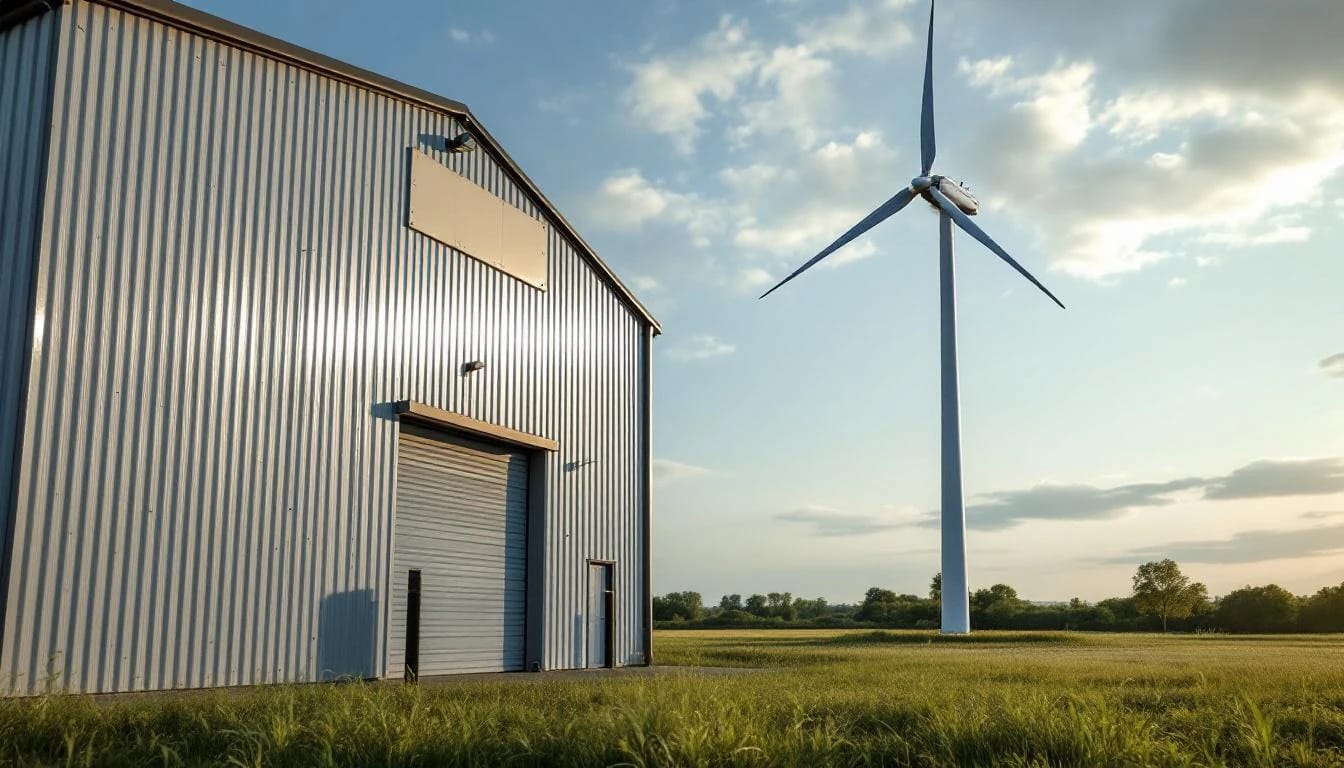
A properly sized wind turbine supplies clean energy for greenhouse climate control, extending production seasons without grid dependence. Most commercial greenhouses consume 4-8 kWh daily for fans, evaporative coolers, LED grow lights, and automated vent motors. A 3 kW turbine at a site averaging 12 mph wind produces 150-200 kWh monthly—enough to offset 60-80% of typical electricity costs in a 30×60 foot structure. The key decision is whether to connect grid-tie for net metering or pair the turbine with batteries for true off-grid autonomy.
Matching turbine output to greenhouse loads
Greenhouses demand two load types: continuous (circulation fans) and intermittent (vent motors, supplemental lighting). A 30×60 foot hoop house typically runs:
- Two 120 W circulation fans (2.9 kWh/day at constant operation)
- Four automated vent motors at 50 W each (0.8 kWh/day in warm months)
- 400 W LED grow lights for four hours (1.6 kWh/day during short daylight periods)
- 150 W controller, sensors, and irrigation pump (1.0 kWh/day intermittent)
Total: 6-7 kWh daily. A turbine must produce 180-210 kWh monthly to cover this. The Bergey Excel 1 (1 kW rated) generates approximately 150 kWh/month at 12 mph average wind speed. The Primus Windpower AIR X (400 W) produces 45-55 kWh/month under the same conditions. For most greenhouse applications, the sweet spot is 2-3 kW rated capacity.
Wind resource matters more than rated capacity. A site with 10 mph average wind and a 5 kW turbine produces less energy than a 3 kW machine at 14 mph average. Power output scales with the cube of wind speed: doubling wind speed yields eight times the power. Use an anemometer or regional wind map data from the National Renewable Energy Laboratory to verify your site averages 10 mph minimum at hub height before purchasing equipment.
Grid-tie versus battery-backup systems
Grid-tie turbines feed excess energy to the utility meter, banking credits for nighttime or calm-day consumption. This requires a grid-tie inverter compliant with NEC Article 705 and IEEE 1547 anti-islanding standards. Most inverters also shut down during grid outages for lineworker safety, meaning the greenhouse loses power during storms even if wind is blowing.
Battery-backup systems store energy for use when wind drops. A 48 V lithium iron phosphate (LiFePO₄) bank rated 10 kWh provides 24-36 hours of greenhouse operation without wind or sun. The turbine charges batteries through a dedicated controller (MPPT or PWM), and an inverter converts stored DC to 120/240 V AC for standard equipment. This approach costs $4,000-7,000 more than grid-tie but ensures climate control continuity during power outages.
Hybrid systems combine both: the turbine charges batteries first, then exports excess to the grid. A backup-capable inverter (SMA Sunny Island, Schneider Electric Conext XW) manages the switching. This setup qualifies for the 30% federal Residential Clean Energy Credit (IRC §25D) on both turbine and battery costs when installed at a home-based commercial greenhouse.
Direct DC connections reduce conversion loss
Running fans and pumps on native DC voltage eliminates inverter losses (8-12% efficiency penalty). Greenhouse-specific 12 V and 24 V circulation fans from manufacturers like Orion and Sofasco move 1,500-2,500 CFM at 4-8 W input. Many automated vent openers accept 12 V DC linear actuators.
Primus Windpower and Pikasola produce turbines with built-in rectifiers outputting 12 V, 24 V, or 48 V DC. Pair a 24 V turbine directly with 24 V fans and a small battery buffer (200 Ah at 24 V), bypassing the inverter entirely for daytime loads. Reserve AC inverter capacity for grow lights and controllers that require standard voltage.
This hybrid DC/AC approach cuts system cost by $1,200-1,800 compared to full AC conversion. It also improves reliability: DC motors handle voltage sag better than AC equipment during gusty wind conditions.
Mounting considerations for greenhouse proximity
Turbines installed within 200 feet of a greenhouse create three concerns: vibration, shadow flicker, and structural clearance. Most jurisdictions require setback equal to tower height plus 10 feet from occupied structures. A 40-foot tilt-up tower must stand at least 50 feet from the greenhouse perimeter.
Horizontal-axis turbines (Bergey, Southwest Windpower) suit proximity better than vertical-axis designs due to predictable downtower wake patterns. Place the turbine upwind of prevailing winds—typically west-northwest or southwest in most U.S. regions—so rotor shadow moves away from the structure.
Tilt-up towers simplify maintenance and satisfy NEC 690.15 requirements for rapid shutdown. A gin pole or manual winch system allows one person to lower a 1-3 kW turbine for inspection without renting a bucket truck. Guyed lattice towers cost less but require 50% more land area for anchor points.
Check FAA Part 77 if your tower exceeds 200 feet AGL or sits within five statute miles of an airport. Most greenhouse turbines on 40-60 foot towers fall below notification thresholds.
Electrical integration per NEC Article 705
Wind turbines qualify as interconnected electric power production sources under NEC Article 705. Key compliance points:
- Disconnect switch: A load-side tap requires a breaker rated 125% of turbine maximum current, located within sight of the service panel (NEC 705.12(B)).
- Rapid shutdown: Systems over 1 kW must include a manual disconnect at the turbine base and the point of grid connection (NEC 690.15 applies by analogy to wind).
- Grounding: Tower and turbine frame require an 8 AWG copper ground rod driven 8 feet deep, bonded to the AC grounding electrode system (NEC 250.50).
- Surge protection: Install Type 1 or Type 2 SPD at the main panel to protect greenhouse electronics from lightning-induced transients (NEC 705.30).
Hire a licensed electrician familiar with distributed generation. Utility interconnection agreements take 30-90 days in most states, and inspectors will red-tag installations lacking proper labeling or overcurrent protection.
Comparing wind versus solar for greenhouse power
| Factor | Wind Turbine (3 kW) | Solar Array (3 kW) |
|---|---|---|
| 30-year energy output (12 mph avg wind / 5 kWh/m²/day sun) | 135,000 kWh | 120,000 kWh |
| Installed cost (2024) | $14,000-19,000 | $9,000-12,000 |
| Winter production | 40% higher than summer | 60% lower than summer |
| Maintenance hours/year | 2-4 (bearing grease, blade inspection) | 0.5-1 (panel cleaning) |
| Footprint | 50-80 sq ft (tower base + guy anchors) | 300-400 sq ft (roof or ground mount) |
| Noise at 100 feet | 38-45 dBA | 0 dBA |
Wind delivers better value where average wind speed exceeds 12 mph and winter heating or lighting loads peak. Solar wins on lower upfront cost and silent operation but requires roof space or unshaded ground area. Many greenhouse operators install both, using wind to charge batteries at night and solar to top them off during calm, sunny days.
Real-world performance: 2 kW turbine on a Colorado flower farm
A cut-flower operation near Fort Collins installed an Aeolos-H 2 kW turbine in 2021 to power two 30×96 foot hoop houses. The site averages 13.5 mph annual wind at 45 feet hub height. Monthly production:
- January-March: 220-260 kWh
- April-June: 180-210 kWh
- July-September: 150-180 kWh
- October-December: 240-280 kWh
Annual total: 2,580 kWh, offsetting 72% of the greenhouses' 3,600 kWh consumption. The farm grid-ties through a Fronius Primo 3.0 inverter and nets $320/year in avoided electricity cost at $0.124/kWh. After the 30% federal tax credit, the system should break even in 11 years. The operator notes bearing replacement at year five ($280 parts + labor) and blade balancing at year three.
State-level incentives and grants
Check the Database of State Incentives for Renewables & Efficiency (DSIRE) for local programs. Examples:
- California SGIP: Self-Generation Incentive Program pays $0.15-0.25/W for wind paired with batteries.
- New York NYSERDA: Small Wind Incentive offers $1.50/W up to 100 kW capacity.
- Vermont Small Scale Renewable Energy Incentive: Covers 25% of installed cost up to $15,000 for farm-based systems.
- USDA REAP: Rural Energy for America Program grants (25%) and loan guarantees for agricultural wind projects over $2,500.
Combine state incentives with the federal tax credit for effective rebates of 45-55% in high-support states.
Vertical-axis turbines for tight spaces
Vertical-axis wind turbines (VAWTs) accept wind from any direction without yaw mechanisms, suiting cramped greenhouse layouts. The Pikasola 600 W VAWT mounts on a single pole 15-20 feet high and occupies a 3×3 foot footprint. It generates 30-50 kWh/month at 12 mph average wind—enough for circulation fans in a small 20×30 foot starter greenhouse.
VAWTs produce less energy per swept area than horizontal-axis machines and cost 20-30% more per watt. They excel where zoning restricts tower height below 30 feet or where roof mounting is the only option. Noise is lower (32-38 dBA at 50 feet) due to slower tip speed.
Avoid VAWTs with unbalanced rotor designs or aluminum blades. Excessive vibration damages roof structures, and aluminum fatigues under cyclic loading within 5-8 years. Fiberglass or composite blades on sealed-bearing hubs last 15-20 years with minimal maintenance.
Monitoring and troubleshooting common issues
Install a digital power meter (Victron BMV-712, Morningstar TriStar) to track daily kWh, battery voltage, and turbine current. Smartphone apps provide real-time alerts for low production or over-voltage events.
Frequent problems:
- Low output despite wind: Check for brake engagement (manual or automatic furling), loose wiring connections, or failed rectifier diodes. Measure open-circuit voltage at the turbine terminals—should read 40-90 V DC spinning freely with no load.
- Excessive vibration: Indicates blade imbalance or loose tower bolts. Lower the turbine, rebalance blades with tape weights, and re-torque all fasteners to spec.
- Inverter fault codes: Typically over-voltage from wind gusts exceeding inverter input range. Add a DC dump load resistor (rated 10% over turbine max output) to burn excess energy.
Annual maintenance: Grease hub bearings, inspect blade leading edges for erosion, verify guy wire tension (3,000-3,500 lbf for 1/4-inch EHS cable), and clean slip-ring contacts if present.
When wind power doesn't make sense
Skip wind if your site averages under 10 mph at 30 feet height, you're within 1,000 feet of neighbors who object to visual or noise impact, or local zoning caps tower height at 35 feet or less. The turbine will produce 40-60% of rated capacity, pushing payback beyond 20 years.
Greenhouses in forested areas or urban settings with significant turbulence should prioritize solar. Wind turbines need laminar flow; chaotic gusts reduce bearing life and cause frequent furling/braking cycles that waste energy.
For operations using supplemental CO₂ or propane heat, the greenhouse itself may block clean wind access from the best direction. Model wake effects with software like WAsP or hire a site assessor before committing to tower construction.
Can a wind turbine power a greenhouse year-round without grid backup?
Yes, if the turbine is oversized to 150-200% of average daily consumption and paired with a 3-5 day battery reserve. A 5 kW turbine with 20 kWh lithium storage covers a 30×60 foot greenhouse through three-day calm periods in most climates. Budget $18,000-28,000 installed.
How close can I mount a turbine to my greenhouse structure?
NEC and most municipal codes require setback equal to tower height plus 10 feet. A 40-foot tower needs at least 50 feet clearance. Closer mounting risks vibration transfer, shadow flicker, and structural damage if the tower fails.
Does the federal tax credit apply to greenhouses used for business?
The 30% Residential Clean Energy Credit (IRC §25D) applies to home-based greenhouses where the structure is on the same property as the taxpayer's primary residence. Commercial-only greenhouses qualify for the Business Energy Investment Tax Credit (IRC §48) at 30% with prevailing wage and apprenticeship requirements. Consult a CPA for classification rules.
Which turbine brand offers the best reliability for agricultural use?
Bergey Windpower leads in proven longevity—many Excel 1 and Excel 6 turbines operate 20+ years with bearing replacement every 7-10 years. Primus Windpower (AIR series) suits smaller greenhouses under 1,500 sq ft. Aeolos and Pikasola provide value pricing but expect more frequent maintenance intervals (3-5 years).
Do I need a building permit for the turbine tower?
Yes. Towers qualify as structures under International Building Code and require engineered foundation drawings, wind load calculations, and inspector sign-off. Permit costs range $150-800 depending on jurisdiction. Unpermitted towers void insurance coverage and complicate property sales.
Bottom line
A 2-3 kW wind turbine cuts greenhouse electricity costs by 60-80% at sites with 12+ mph average wind, paying for itself in 8-14 years after incentives. Grid-tie systems offer the lowest installed cost, while battery-backup configurations provide true energy independence for critical climate control. Work with a licensed electrician to ensure NEC Article 705 compliance and verify your site's wind resource before purchasing equipment. For most growers, a hybrid approach—wind charging batteries, solar topping them off—delivers the most reliable year-round power.
Share this article
windturbinehome.com/s/a1478a
Editorial note: This article was researched and written by a member of the Wind Turbine Home editorial team. AI-assisted tools were used for spell-checking and light grammar review only — all research, analysis, and conclusions are our own. Our editorial policy prohibits sponsored content and paid placements. Read our editorial policy →
Related reading
small industrial wind
Farm-Scale Wind Turbines 10kW-50kW: Which Size Fits Your Operation
Choosing between 10kW, 25kW, or 50kW farm wind turbines depends on daily electrical demand, available land, and whether you net-meter or store power.
small industrial wind
Wind Energy for Warehouses and Light Industrial Sites
Commercial wind turbines for warehouses and light industrial facilities can offset 15-60% of electric costs. Site selection, zoning, and grid-tie economics determine ROI.
small industrial wind
Wind Turbine for Water Pumping: Modern Takes on a Century-Old Idea
Modern wind-powered water pumping marries century-old mechanical principles with solar-hybrid systems, battery banks, and smart controllers for off-grid livestock, irrigation, and rural domestic supply.
small industrial wind
10 kW Wind Turbine Cost for Home 2026: Complete Price Guide
A 10 kW home wind turbine costs $40,000–$65,000 installed in 2026, with final price driven by tower height, site prep, and permit fees—plus 30% federal tax credit.