Wind Turbine Making a Clicking Noise: Causes and Fixes
Wind turbine clicking sounds usually stem from loose blade bolts, worn bearings, brake pad contact, or slip-ring arcing. Identify the rhythm and location, then inspect hardware, lubricate bearings, or replace components before damage spreads.
Share this article
windturbinehome.com/s/850a71
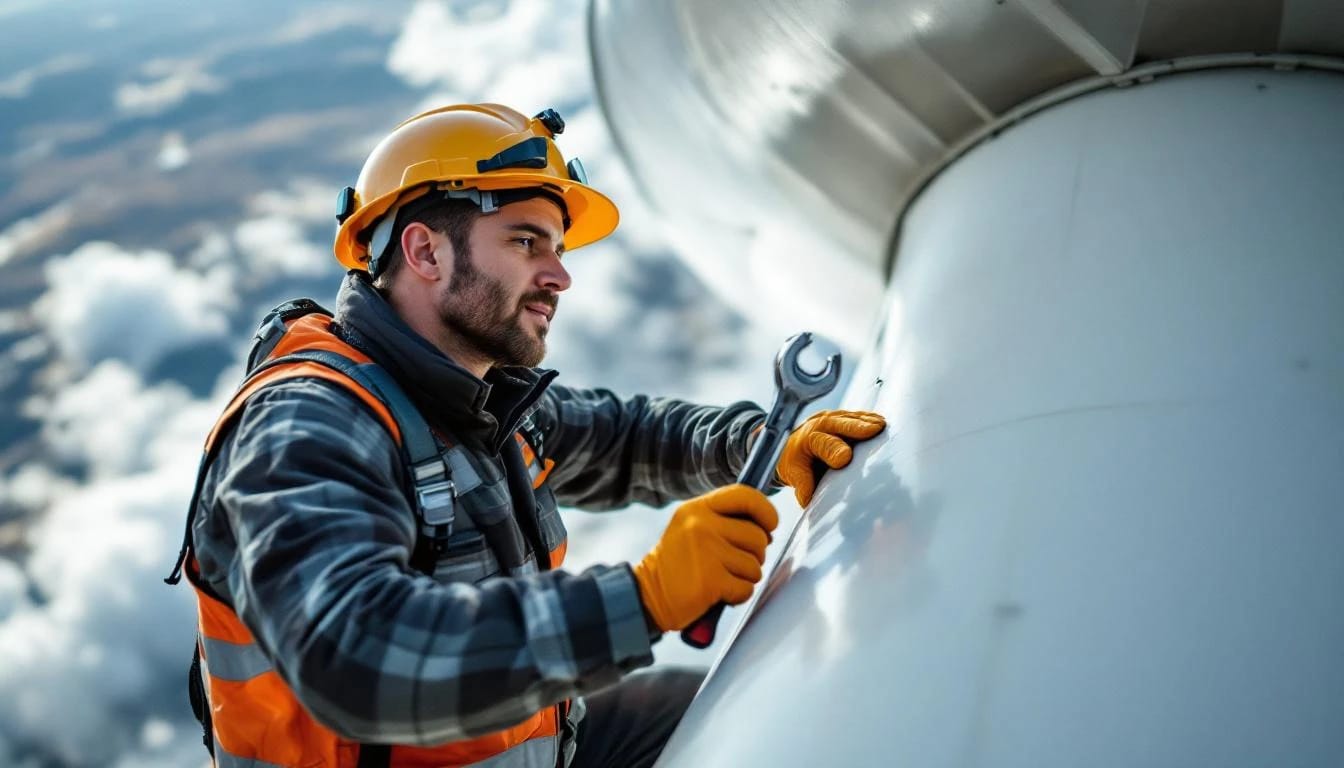
A clicking noise from a residential wind turbine typically signals loose hardware, bearing wear, brake-pad drag, or electrical arcing inside the nacelle. The fix depends on whether the click matches blade rotation, changes with wind speed, or occurs only during startup and shutdown. Most causes are mechanical—loose bolts, worn bushings, or debris in the hub—and can be resolved with basic hand tools and a grounding harness. Ignoring the sound often leads to accelerated wear, vibration damage to the inverter mounting, or catastrophic bearing failure that requires a crane and a four-figure repair bill.
Why clicking sounds matter in small wind turbines
Rotating equipment produces predictable hum from the alternator and a low whoosh from blade tips cutting air. A click introduces a percussive element that indicates metal-on-metal contact or intermittent electrical discharge. In vertical-axis turbines like the Pikasola 600 W or Aeolos-V 3 kW, clicks often trace to the central shaft bearing or guy-wire tensioners. Horizontal-axis machines—Bergey Excel 10, Primus Air 40, Southwest Windpower models—add gearbox meshes and tail-hinge pins to the list of suspects.
The sound's cadence reveals the source. One click per revolution suggests a blade-root issue or a single loose yaw-bearing bolt. Multiple clicks per revolution point to gear teeth, brake pads, or debris wedged in the hub. Random, arrhythmic clicks during gusts hint at electrical arcing between brushes and slip rings or loose terminal connections vibrating against the nacelle wall.
Small turbines operate at tip-speed ratios between four and seven, meaning blade tips move four to seven times faster than the wind. A three-blade rotor spinning at 250 RPM produces 12.5 events per second; a single loose bolt clicking once per revolution is immediately audible above ambient noise. Left unaddressed, that bolt backs out further, the hole wallows, and the blade or hub cracks from dynamic load concentration.
Loose blade-root bolts and fasteners
Blade-root bolts endure alternating tension and compression as the airfoil generates lift. Bergey turbines use grade-8 cap screws torqued to 45 ft-lb on 10 kW models; Primus Air series specify metric M10 × 1.5 bolts at 55 Nm. Factory thread-locker and lock washers resist vibration, but thermal cycling, UV degradation of composite blade flanges, and installation errors cause gradual loosening.
A clicking blade bolt creates a tiny gap—often less than 0.5 mm—that opens and closes with each rotation. The sound is sharp, metallic, and synchronous with blade passage in front of the tower. Inspect by shutting down the turbine using the dump-load brake or furling mechanism, verifying zero rotation, then donning a harness rated to ANSI Z359 and climbing with a calibrated torque wrench. Check all blade bolts in a star pattern, re-torque to specification, and apply fresh medium-strength thread-locker (Loctite 243 equivalent). If a bolt spins without tightening, the blade-flange insert is stripped; that blade must come down and be sent to the manufacturer or a composite-repair shop.
Hub-to-shaft bolts suffer similar wear. On direct-drive machines, six to eight M12 or M16 bolts clamp the rotor hub to the alternator shaft. Loosening here produces one click per revolution, often accompanied by a faint grinding as the hub shifts a fraction of a millimeter. Re-torque to the service manual value—typically 80–120 Nm—and confirm the keyway or spline engagement is clean and undamaged.
Worn main-shaft bearings
The main shaft rotates inside two or more sealed ball or roller bearings pressed into the nacelle frame. Bergey and Primus machines use deep-groove ball bearings with lifetime-grease seals; Southwest Windpower units employed double-row angular-contact bearings in earlier models. Bearing life depends on load, RPM, seal integrity, and environmental contamination. A 10 kW turbine spinning at 300 RPM in a dusty agricultural area may see bearing wear within eight to twelve years; a 1 kW unit in a clean coastal location can exceed twenty.
Clicking from a failing bearing sounds irregular at first—an occasional tick when a ball rolls over a pitted race—then progresses to a rhythmic rattle as spalling spreads. The noise intensifies under load and may disappear in calm winds when shaft speed drops below 50 RPM. Diagnosis requires shutting down, spinning the rotor by hand, and feeling for roughness or lateral play. Acceptable end-play is under 0.1 mm; anything beyond 0.5 mm indicates the bearing has lost preload or the inner race has spun on the shaft.
Bearing replacement demands nacelle disassembly. Disconnect the turbine from the grid per NEC Article 705 (open the AC-disconnect, lock out, verify zero voltage). Lower the turbine or work from a bucket lift with fall protection. Remove the nose cone, tail boom (horizontal-axis), and blade assembly. Press or pull the old bearing using a gear puller or hydraulic arbor press; heating the bearing housing to 100 °C with a heat gun eases removal without distorting aluminum castings. Clean the bore, chill the new bearing in a freezer for thirty minutes, and press it home with a bearing driver that contacts only the outer race. Reassemble with fresh gaskets and high-temperature grease on exposed splines.
| Symptom | Likely cause | Typical repair time | Parts cost (USD) |
|---|---|---|---|
| One click per blade revolution | Loose blade-root bolt | 1–2 hours | $0–15 (thread-locker) |
| Continuous ticking, load-dependent | Worn main-shaft bearing | 6–10 hours | $80–$300 (bearing + seals) |
| Click only during yaw movement | Dry yaw bearing or bolt | 2–3 hours | $10–$50 (grease, hardware) |
| Arrhythmic click in nacelle | Slip-ring arcing or loose terminal | 3–5 hours | $40–$200 (brushes, connectors) |
| Click with brake engagement | Brake-pad contact or spring | 2–4 hours | $60–$180 (pads, springs) |
Brake systems and stall mechanisms
Most residential turbines incorporate an over-speed brake: electromagnetic disc brakes on Bergey models, shorting resistors with contactor relays on Primus machines, mechanical stall tabs on vertical-axis Aeolos units. When a brake pad or tab vibrates against its mounting or drags lightly against a disc, it produces a rhythmic click that worsens as wind speed climbs toward the brake-activation threshold.
Electromagnetic brakes use a spring-loaded pad that clamps the alternator shaft when power to the coil is interrupted. Wear on the friction material or a weakened spring allows the pad to flutter in strong winds before full engagement. Adjustment involves shimming the pad or replacing the spring. Shorting brakes generate no mechanical click unless the relay chatters; listen for a buzzing hum inside the control box rather than a percussive click at the nacelle.
Vertical-axis turbines with guy-wire tensioners sometimes develop clicks from cable clamps vibrating against the tower or from turnbuckle threads binding and releasing under cyclic tension. Inspect all guy hardware, apply anti-seize compound to threads, and re-tension cables to the manufacturer's specification—commonly 10–15 percent of the cable's breaking strength.
Electrical arcing and slip-ring noise
Turbines with yaw capability route power from the spinning nacelle to stationary tower wiring via slip rings and brushes. The brushes—graphite blocks or braided-copper pigtails—ride on concentric metal rings, maintaining electrical contact as the turbine yaws. Arcing occurs when a brush lifts momentarily due to vibration, worn spring tension, or contamination from carbon dust and moisture. The arc produces a sharp click audible through the tower wall and visible as tiny pits on the ring surface.
Inspect slip rings by removing the nacelle cover and rotating the head by hand while observing the brush contact. Healthy contact shows a polished, even track on each ring. Arcing leaves black deposits and rough patches. Clean rings with isopropyl alcohol and 600-grit emery cloth; replace brushes if shorter than the manufacturer's minimum length—typically 8–10 mm. Tighten all ring-to-PCB solder joints and crimp connectors; a loose #10 AWG lug vibrating against a bus bar mimics slip-ring arcing but produces a lower-frequency clunk.
Direct-drive turbines without slip rings use down-tower cables that twist and untwist with yaw. Excessive yaw cycles—common in gusty, shifting winds—can fatigue the cable jacket, allowing conductors to fray and arc internally. This produces intermittent clicking synchronized with gusts. Lowering the turbine and inspecting the cable every five years prevents catastrophic short-circuits.
Debris and foreign objects in the rotor assembly
Birds nest in dormant nacelles during migration season; insects build hives in tail-boom vent holes; wind-blown branches wedge between blade roots. A walnut-sized object trapped in the hub can click against the alternator housing once per revolution or tumble chaotically, producing random percussion. Vertical-axis turbines with open lattice structures are especially vulnerable; a plastic bag wrapped around the central shaft sounds like rapid-fire clicks as it flutters and strikes guy wires.
Shutdown and visual inspection are the only reliable diagnostics. Use a mirror and flashlight to peer into the hub cavity and behind the alternator. Remove any debris, then cover vent openings with stainless-steel mesh to prevent re-entry. UV-resistant mesh with 6 mm openings balances ventilation and bird exclusion.
Tail-hinge and yaw-bearing wear
Horizontal-axis turbines passively yaw into the wind via a tail fin mounted on a hinge or bearing. The hinge pin—often a stainless-steel shoulder bolt—sits in a bronze or nylon bushing. Wear opens clearance, allowing the tail to rattle in turbulent wind. The click is irregular, tied to wind-direction changes rather than rotor speed.
Remove the tail-boom retaining bolt, slide the boom off, and measure pin diameter and bushing ID with calipers. Wear beyond 0.2 mm radial clearance requires a new bushing or oversized pin. Apply marine-grade grease (NLGI Grade 2 with PTFE) to the pin before reassembly. Some Bergey models use a sealed cartridge bearing at the yaw axis; these are lifetime components but can be swapped if contaminated with salt spray or agricultural chemicals.
Temperature and thermal expansion effects
Aluminum nacelle castings, steel shafts, and composite blades expand at different rates. A turbine installed on a sub-zero winter morning may develop clicks on the first hot summer day as thermal expansion tightens fits and shifts bolt preload. The reverse occurs at night when desert-installed turbines cool rapidly. These clicks are transient and non-damaging but indicate hardware approaching tolerance limits.
Record the ambient temperature when clicks occur. If confined to temperature extremes, schedule a re-torque during moderate weather and apply thread-locker rated for –40 °C to +150 °C (Loctite 270 or equivalent). Consider thermal-expansion washers—spring discs that maintain preload through temperature cycles—on critical blade and hub bolts.
Tower and mounting-hardware resonance
A click that doesn't correlate with rotor speed may originate below the turbine. Guy anchors, tower-section bolts, and gin-pole mounts can vibrate at harmonics of the rotor frequency, producing sympathetic clicks. Walk the guy wires while the turbine runs, listening for rattling turnbuckles or loose cable clamps. Inspect the tower base for cracked welds or loose foundation bolts.
Monopole towers with bolted flanges sometimes develop clicks at section joints when bolt tension relaxes. Re-torque flange bolts to 150–200 ft-lb (200–270 Nm) using a cross pattern, and apply vibration-resistant lock nuts (nylon-insert or prevailing-torque).
When to call a professional versus DIY fixes
Blade-bolt re-torquing, slip-ring cleaning, and debris removal are within the scope of an owner comfortable with heights and basic tools. Work above 20 feet demands fall-protection equipment—full-body harness, shock-absorbing lanyard, and rated anchor per ANSI Z359.11—and experience climbing. Local code (NEC Article 705.12) requires a licensed electrician to disconnect and lock out grid-tied systems; violating this risks both safety and interconnection-agreement terms.
Bearing replacement, brake adjustment, and structural repairs warrant professional service. Certified wind-turbine technicians carry liability insurance, manufacturer-specific training, and hydraulic tools for controlled disassembly. Costs range from $150–$300 per hour plus parts; a bearing swap on a 10 kW turbine typically runs $1,200–$2,000 all-in. Many installers offer annual maintenance contracts ($400–$800) that include click diagnosis and preventive re-torquing.
Diagnostic checklist for clicking wind turbines
- Note the rhythm: One click per revolution (blade/hub), multiple clicks (gear/brake), random (electrical/debris).
- Correlate with wind: Load-dependent (bearing/brake), yaw-dependent (tail hinge), constant (loose bolt).
- Shut down safely: Engage dump load, wait for full stop, lock out AC disconnect per NEC Article 705.
- Inspect from bottom up: Tower bolts, guy wires, tower-to-nacelle joint, then climb with fall protection.
- Hand-turn the rotor: Feel for roughness, listen for grinding or ticking, check end-play.
- Photograph before disassembly: Document bolt positions, wire routing, shim stacks for reassembly.
- Torque to specification: Use a calibrated wrench and the service manual; over-torquing cracks castings.
- Test under load: Run the turbine in light wind (5–10 mph) before releasing to full operation.
Can a clicking wind turbine damage itself if I keep running it?
Yes. A loose blade bolt can back out completely, causing catastrophic blade detachment and property damage. Worn bearings shed metal particles that contaminate grease, accelerating wear in adjacent components. Electrical arcing erodes slip-ring surfaces and can carbonize insulation, leading to short-circuits. Shutting down at the first persistent click prevents a $200 repair from escalating to $5,000.
How do I know if the clicking is the turbine or something else on my property?
Shut off the turbine completely—engage the brake and lock the rotor if possible. If the click stops within two seconds, the source is turbine-related. If it continues, investigate nearby HVAC units, loose siding, or tree branches. A directional microphone (under $50 from electronics retailers) helps pinpoint intermittent sounds by amplifying and isolating frequencies.
Will lubricating the bearings stop the clicking noise?
Only if the bearing is designed for periodic re-greasing and the click stems from dry contact rather than wear. Most small-turbine main bearings are sealed-for-life; adding grease requires drilling a tap hole, which voids warranties and risks contamination. Yaw bearings and tail hinges with grease fittings (zerk nipples) benefit from annual shots of marine-grade grease. Check the service manual for lubrication points and intervals—typically every 1,000 operating hours or one year.
Should I climb the tower in high wind to check the noise source?
No. Tower work demands winds below 15 mph and clear skies. Gusts destabilize ladders, compromise harness anchor points, and make it impossible to hear diagnostic sounds over wind roar. Schedule inspections during calm morning hours, and never climb alone. Have a ground assistant with a charged phone and knowledge of your location.
Is it normal for a new turbine to click during the break-in period?
Light, transient clicks during the first 50 operating hours can occur as thread-locker cures, paint flakes settle out of the hub, and machined surfaces polish under load. A click that persists beyond 100 hours or grows louder indicates improper installation. Most manufacturers require a 30-day post-commissioning inspection specifically to catch loose hardware before warranty provisions expire.
Bottom line
A clicking wind turbine signals mechanical looseness, wear, or electrical fault that will worsen without intervention. Identify the rhythm, shut down safely per NEC Article 705, and inspect hardware with fall protection if working above 20 feet. Re-torque bolts, replace worn bearings, and clean slip rings as needed. Addressing clicks early preserves component life and prevents catastrophic failures. If the source isn't obvious after a ground-level inspection, hire a certified technician—most click repairs cost less than $500 when caught promptly, compared to thousands for neglected damage.
Share this article
windturbinehome.com/s/850a71
Editorial note: This article was researched and written by a member of the Wind Turbine Home editorial team. AI-assisted tools were used for spell-checking and light grammar review only — all research, analysis, and conclusions are our own. Our editorial policy prohibits sponsored content and paid placements. Read our editorial policy →
Related reading
maintenance troubleshooting
Winterizing Your Home Wind Turbine: Pre-Winter Checklist
Prepare your residential wind turbine for winter with this comprehensive maintenance checklist covering blade inspection, electrical systems, and tower safety.

maintenance troubleshooting
How to Balance Homemade Wind Turbine Blades Without Lab Equipment
Balance DIY wind turbine blades using household items: paint stirrers, fishing line, and sandpaper. Static and dynamic methods reduce vibration by 70-90%.
maintenance troubleshooting
Charge Controller Fault Codes: What They Actually Mean
Decode your wind turbine charge controller fault codes with this practical guide covering overcurrent, overvoltage, temperature errors, and sensor failures.
maintenance troubleshooting
A Realistic Annual Maintenance Schedule for Small Wind Turbines
Monthly visual checks, quarterly bolt torque, semi-annual blade inspections, and annual electrical testing keep small wind turbines safe and productive for 20+ years.

maintenance troubleshooting
Wind Turbine Ice on Blades: Detection, Mitigation & Shutdown
Ice buildup on wind turbine blades reduces efficiency by 20-80% and increases structural stress. Learn detection methods, heating systems, and safe shutdown protocols.

maintenance troubleshooting
Wind Turbine Slip Ring Replacement: Signs, Steps, Cost
How to tell when a residential wind turbine slip ring needs replacing, plus the tools, safety steps, and typical cost for both HAWT and VAWT setups.

maintenance troubleshooting
How to Lubricate Wind Turbine Bearings: Schedule & Grease Guide
Learn proper bearing lubrication schedules, NLGI grade selection, and access methods for residential wind turbines to prevent costly failures and extend service life.

maintenance troubleshooting
Wind Turbine Yaw Motor Not Working: Diagnosing and Fixing
Yaw motor failures lock turbines facing the wrong direction, costing 30-70% of power. Learn to diagnose controller faults, seized bearings, and wiring issues.

maintenance troubleshooting
How to Brake a Runaway Wind Turbine Safely | Emergency Stop
Learn three proven methods to stop a runaway residential wind turbine: dynamic braking, manual furling, and emergency disconnect. Quick action prevents damage.