Ballasted Flat-Roof Mounts for Vertical-Axis Turbines Guide
Ballasted flat-roof mounts secure vertical-axis wind turbines without roof penetration using concrete blocks or water ballast, ideal for commercial buildings with membrane roofs.
Share this article
windturbinehome.com/s/8f84d8
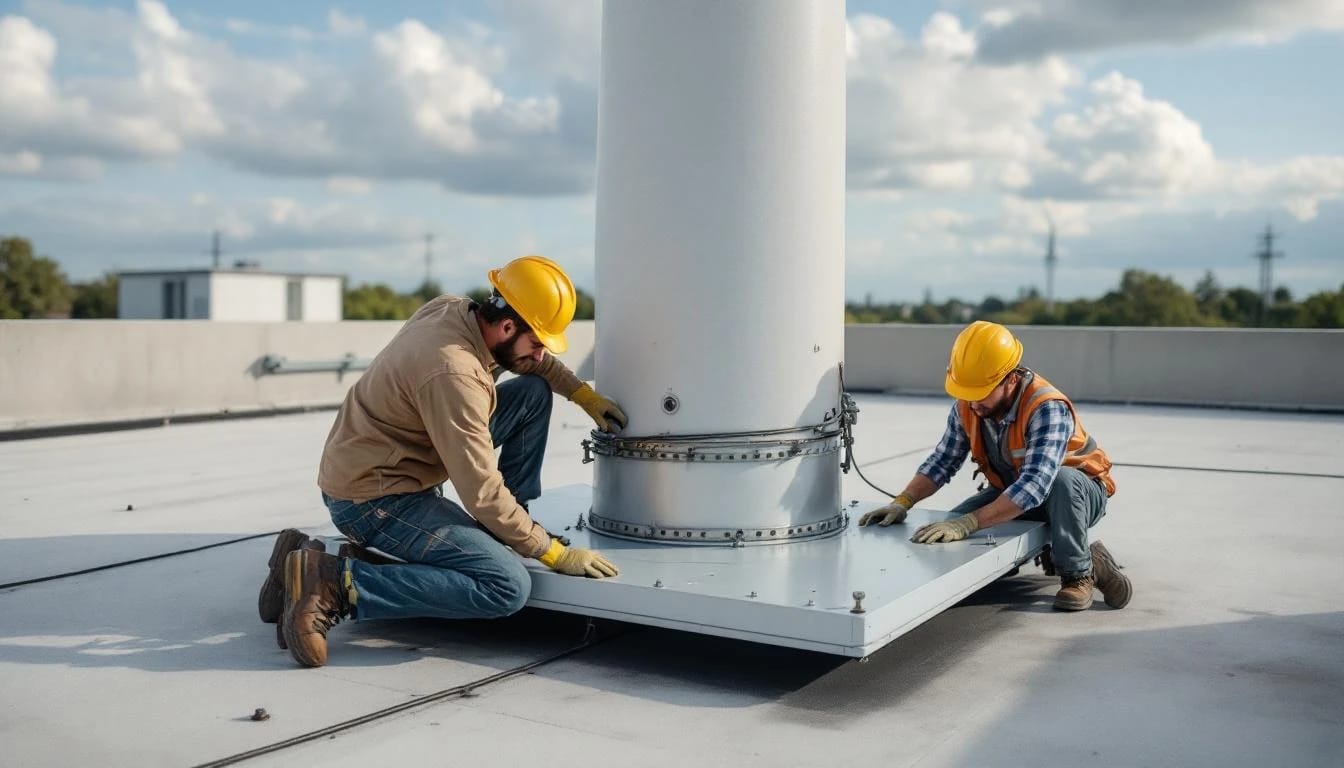
Ballasted flat-roof mounts anchor vertical-axis wind turbines (VAWTs) to flat roofs using weighted bases instead of through-roof bolts, eliminating membrane penetration that voids warranties and creates leak risks. These systems typically use concrete blocks, water-filled containers, or steel plates weighing 300-1,200 pounds per mounting foot, distributed across a base platform measuring 4-8 feet square. Building engineers favor ballasted designs for commercial roofs where drilling through EPDM, TPO, or modified bitumen membranes is prohibited by lease agreements or municipal codes.
Why Vertical-Axis Turbines Suit Flat-Roof Installation
Vertical-axis turbines generate power from wind arriving at any horizontal angle, unlike horizontal-axis machines that must yaw to face the wind. This omnidirectional advantage matters on flat roofs, where building corners, HVAC units, and parapets create chaotic airflow patterns that constantly shift direction.
The Aeolos-V 1kW and similar Savonius or Darrieus designs produce 40-60% of their rated output in urban turbulent conditions, compared to 20-35% for comparable horizontal-axis models. Their lower height profiles—typically 6-10 feet tall versus 12-18 feet for horizontal machines—also reduce structural loading and keep installations below FAA Part 77 notification thresholds in most residential and light-commercial zones.
Vertical-axis machines experience lower peak torque during gusts because their swept area remains constant regardless of wind direction. This predictable loading simplifies ballast calculations and reduces the risk of mount shifting during storm events.
Structural Load Requirements for Ballasted Systems
Flat roofs in commercial buildings typically support 20-30 pounds per square foot (psf) live load, with additional dead load capacity varying by construction type. A ballasted VAWT system exerts point loads through its base platform, requiring structural analysis to verify the roof deck, joists, and load-bearing walls can handle concentrated weight.
A 1kW vertical-axis turbine with a 6-foot rotor diameter and 8-foot tower height creates approximately 800-1,000 pounds of total system weight (turbine + mount + ballast). Distributed across a 6×6-foot platform, this yields roughly 22-28 psf—acceptable for most modern commercial roofs built to IRC 2021 standards. However, older buildings constructed before 1990 may have lower load ratings requiring reinforcement.
Wind uplift forces present the critical design challenge. At 100 mph winds (hurricane Category 2), a 1kW VAWT experiences roughly 600-900 pounds of lateral force and 400-700 pounds of uplift, depending on rotor solidity and drag coefficient. Ballast mass must exceed these forces by a 1.5-2.0 safety factor, typically requiring 1,200-1,800 pounds of dead weight for secure anchoring.
Professional structural engineers calculate these loads using ASCE 7-16 wind load provisions, accounting for building height, exposure category (B, C, or D), and topographic factors. Most jurisdictions require stamped structural drawings before issuing permits for rooftop wind installations.
Ballast Material Options and Configuration
Concrete blocks remain the most common ballast material, offering high density (140-150 pounds per cubic foot), weather resistance, and easy stacking. Standard 8×8×16-inch blocks weigh 35-40 pounds each; a typical 1kW VAWT installation uses 30-45 blocks arranged in a double layer within the mount's base frame.
Water ballast tanks provide adjustable weight and easier rooftop transport when empty. Commercial systems use food-grade polyethylene tanks ranging from 50-300 gallon capacity, achieving 8.34 pounds per gallon (624-2,502 pounds total). The Pikasola ballasted mount system for their VAWT-2000 model employs four 75-gallon tanks positioned at the base corners, allowing installers to carry empty tanks to the roof and fill on-site.
Steel plates (1-2 inches thick) offer the highest density-to-footprint ratio but cost $3-7 per pound versus $0.80-1.50 per pound for concrete blocks. Some commercial installations combine materials: steel plates for the bottom layer (maximizing ground contact area) with concrete blocks stacked above to reach required total weight.
The base platform itself—constructed from welded steel tube, aluminum extrusion, or marine-grade plywood—must resist racking forces and distribute weight evenly. Platforms should extend 12-24 inches beyond the turbine's footprint in all directions, preventing edge loading that could damage roof membranes or create stress concentration points.
Roof Membrane Protection and Interface Details
Direct ballast-to-membrane contact crushes insulation and abrades waterproofing materials, requiring protective barriers. EPDM-compatible installations use 1/2-inch to 3/4-inch rubber pavers (24×24 inches or 48×48 inches) beneath the entire mount footprint, distributing point loads and creating a slip-resistant interface.
TPO and PVC membranes tolerate high-density polyethylene (HDPE) protection boards or expanded polystyrene (EPS) load-distribution pads. These materials resist UV degradation and maintain compression strength across temperature ranges from -40°F to 180°F.
Building engineers often specify geotextile fabric beneath ballast platforms to prevent abrasion during thermal expansion/contraction cycles. Non-woven polypropylene fabric (6-8 oz per square yard) allows water drainage while protecting the membrane from repeated friction.
Some mount manufacturers integrate adjustable feet with large-diameter pads (8-12 inches) that allow leveling on slightly sloped "flat" roofs. True flat roofs maintain 1/4-inch per foot slope for drainage; mount systems must accommodate this pitch while maintaining turbine verticality within ±2 degrees.
Consult a roofing contractor before installation. Many commercial roof warranties include explicit prohibitions against ballasted equipment without prior approval and professional inspection. Membrane manufacturers like Carlisle, Firestone, and GAF offer written approval letters for specific ballast configurations that comply with their warranty terms.
Installation Sequence and Site Preparation
Roof access for heavy ballast materials requires planning. Concrete blocks arrive on pallets weighing 2,000-3,000 pounds; freight elevators, external hoists, or rooftop crane lifts move materials to the installation site. Some contractors hand-carry blocks up stairwells—a labor-intensive process requiring 2-4 workers and adding $400-800 to installation costs for 1,500 pounds of ballast.
Before positioning the mount, mark the installation area and inspect the membrane for damage, ponding water, or soft spots indicating deck deterioration. The chosen location should sit over load-bearing walls or structural columns when possible, verified through building plans or consultation with the property engineer.
| Installation Step | Time Required | Personnel | Key Considerations |
|---|---|---|---|
| Roof access setup | 1-2 hours | 2 | Hoist rental, elevator scheduling |
| Membrane inspection | 0.5 hours | 1 | Document existing damage with photos |
| Protection layer install | 1-2 hours | 2 | Ensure complete coverage, no gaps |
| Base platform assembly | 2-3 hours | 2-3 | Level within ±0.5° before ballasting |
| Ballast placement | 2-4 hours | 2-3 | Symmetrical distribution, safety gear |
| Tower/turbine install | 3-5 hours | 2-3 | Proper torque specs, electrical routing |
| Electrical connection | 2-4 hours | 1 (licensed) | NEC Article 705 compliance required |
Position rubber pavers or protection boards first, then place the mount's base platform. Check level in both axes using a precision bubble level or laser level; shim as needed with marine-grade composite shims that won't compress over time.
Add ballast progressively, maintaining symmetry to prevent platform tilting. Stack concrete blocks in interlocking patterns with mortar or construction adhesive between layers to prevent shifting. For water ballast systems, fill tanks evenly—never fill one corner completely before others, which creates temporary imbalance.
Attach the turbine tower to the ballasted base using manufacturer-specified bolts torqued to rated values (typically 40-65 ft-lbs for 1/2-inch Grade 5 bolts). Route DC or AC output cables through conduit, avoiding sharp bends and securing with UV-resistant zip ties every 18-24 inches.
Electrical Integration and Code Compliance
Rooftop VAWTs typically generate 12V, 24V, or 48V DC power requiring charge controllers and battery banks, or grid-tie inverters for net metering. NEC Article 705 governs interconnected power production sources, mandating rapid shutdown systems, arc-fault protection, and utility-approved disconnect switches.
DC wiring from the turbine enters a weatherproof junction box mounted on or near the ballasted platform, then runs through rigid metal conduit (RMC) or electrical metallic tubing (EMT) to the building's electrical room. Conduit should follow roof penetrations used by existing HVAC or electrical services when possible, minimizing new membrane cuts.
For grid-tied systems, the inverter's AC output connects to the building's service panel through a dedicated breaker sized at 125% of the inverter's continuous output current (NEC 705.12(B)(2)(3)). The utility interconnection agreement, obtained through the local distribution company, specifies metering requirements and anti-islanding protection.
Licensed electricians must perform all wiring and connections—DIY electrical work on grid-connected systems violates most jurisdictions' codes and creates liability. Permit costs range from $150-600 depending on system capacity and local fee structures.
Ground the tower using 6 AWG bare copper wire connected to the building's grounding electrode system or a dedicated ground rod. The turbine's metal frame must bond to this grounding conductor to provide lightning protection and fault current paths.
Wind Performance and Realistic Output Expectations
Flat roofs rarely provide ideal wind resource conditions. Buildings create boundary layers 1.5-3 times their height where turbulence reduces effective wind speed by 30-50%. A 30-foot building generates disturbed airflow extending 45-90 feet above the roofline—exactly where rooftop turbines operate.
Urban wind studies from the National Renewable Energy Laboratory show rooftop-mounted small turbines achieve capacity factors of 5-12%, compared to 20-30% for the same machines on open-ground towers. A 1kW VAWT rated at 28 mph might produce 600-800 kWh annually in a good urban location (average wind speed 10-12 mph at hub height), versus manufacturer claims of 1,500-2,200 kWh based on unobstructed conditions.
Building geometry matters significantly. Corner installations capture accelerated flow around building edges (15-25% higher wind speed), while center-roof locations suffer maximum turbulence and lowest output. Rectangular buildings with length-to-width ratios of 2:1 or greater create stronger corner effects than square footprints.
Expect break-even periods of 15-25 years based on electricity costs of $0.12-0.16 per kWh, before incentives. The federal Residential Clean Energy Credit (IRC §25D) provides a 30% tax credit through 2032 for qualified residential renewable energy property, though commercial buildings may need to use the Investment Tax Credit (ITC) under different provisions.
Maintenance Access and Long-Term Considerations
Ballasted mounts simplify removal for turbine maintenance or building reroofing projects. Unbolt the tower, lift the turbine assembly with a small crane or block-and-tackle, remove ballast, and the platform lifts free without roof patching.
Schedule annual inspections checking:
- Ballast shifting or settling
- Platform levelness (should stay within ±1° of original)
- Membrane condition beneath protection layers
- Bolt torque on tower connections (recheck every 12 months)
- Electrical connection tightness and corrosion
Wind-driven vibration can loosen bolts over time despite initial torque specs. Use thread-locking compound (Loctite 242 or equivalent) on all critical fasteners and check quarterly during the first year.
Protection layers degrade from UV exposure and thermal cycling. EPDM pavers last 15-20 years; HDPE boards 10-15 years. Budget for replacement before membrane-damaging failure occurs.
Roof membrane warranties typically run 10-20 years. If the building requires reroofing during the turbine's operational life (20-25 years for quality VAWTs), the ballasted system's removability prevents complications. Contractors can temporarily relocate the installation, complete roofing work, and reinstall on the new membrane—a process costing $1,200-2,500 versus $4,000-7,000 for removing and reinstalling penetration-mount systems.
Permit Requirements and FAA Notification
Building permits for rooftop wind installations require structural calculations, electrical plans, and wind turbine specifications. Municipalities classify these as "mechanical equipment" or "electrical generation equipment," triggering plan review fees of $300-1,200 and inspection requirements.
FAA Part 77 requires notification for structures exceeding specific heights based on proximity to airports. In most urban and suburban areas, rooftop installations under 50 feet total height (building + tower + turbine) don't require FAA filing, but verify using the FAA's online Notice Criteria Tool before installation.
Homeowners associations, historic districts, and local zoning ordinances may restrict rooftop wind turbines regardless of technical feasibility. Obtain written approvals before purchasing equipment—turbine manufacturers rarely accept returns after shipping.
Some states offer additional incentives through DSIRE (Database of State Incentives for Renewables & Efficiency). California's SGIP, New York's NY-Sun, and Massachusetts' SMART program have provided performance-based incentives for small wind, though programs frequently change or close to new applicants.
Can I install a ballasted VAWT mount on a residential house's flat roof?
Residential flat roofs typically carry lower load ratings (15-20 psf) than commercial buildings, and most single-family homes lack true flat roofs with proper drainage design. The ballast weight required for secure mounting (1,200-1,800 pounds for a 1kW turbine) often exceeds residential structural capacity without reinforcement. Consult a structural engineer—reinforcing costs of $2,000-5,000 often make ground-mounted installations more economical for residential applications.
How much does a complete ballasted mount system cost?
Pre-engineered ballasted mount systems from manufacturers like Pikasola or Aeolos range from $800-2,200 for 1-2kW turbines, not including ballast materials. Concrete blocks add $120-250 (at $0.80-1.50 per pound), water tanks $200-600, and professional installation $1,500-3,500. Total system cost including turbine, mount, ballast, installation, and electrical integration typically runs $7,000-14,000 for a 1-2kW residential-scale VAWT on a commercial flat roof.
Will the ballast damage my roof membrane over time?
Properly installed protection layers (rubber pavers, HDPE boards, or load-distribution pads) prevent membrane damage when the mount remains level and ballast distribution stays symmetrical. Problems occur when platforms shift, creating point loads, or when inadequate protection allows abrasion during thermal expansion cycles. Annual inspections catching early platform movement prevent membrane damage. Most commercial roofing contractors can add ballasted equipment to existing membranes without voiding warranties if the installation follows manufacturer specifications.
What wind speeds can ballasted mounts safely handle?
Engineered ballasted systems designed to ASCE 7-16 standards withstand wind speeds matching the local design wind speed—typically 90-120 mph for most U.S. locations, higher in hurricane zones. The safety factor built into ballast calculations (1.5-2.0× uplift forces) provides margin for extreme weather. However, vertical-axis turbines themselves may require furling or braking above 45-55 mph depending on model. The mount stays secure while the turbine stops generating power during high winds.
Do I need special insurance for a rooftop wind turbine?
Commercial property insurance typically covers rooftop equipment, but insurers may require professional installation certification and engineer-stamped structural approval before extending coverage. Some policies exclude wind generation equipment or charge higher premiums. Obtain written confirmation from your insurance provider before installation. Homeowners with residential applications need liability coverage for potential falling debris or malfunction—discuss with your agent, as some carriers exclude experimental renewable installations.
Bottom Line
Ballasted flat-roof mounts provide practical VAWT installation solutions for commercial buildings where membrane penetration isn't allowed, but realistic output expectations and structural verification are essential before committing to rooftop wind. Most installations break even only with federal tax credits and premium electricity rates, making economic viability site-specific. Work with licensed professionals for structural analysis, permitting, and electrical integration—NEC Article 705 compliance requires expertise that prevents costly code violations.
Share this article
windturbinehome.com/s/8f84d8
Editorial note: This article was researched and written by a member of the Wind Turbine Home editorial team. AI-assisted tools were used for spell-checking and light grammar review only — all research, analysis, and conclusions are our own. Our editorial policy prohibits sponsored content and paid placements. Read our editorial policy →
Related reading
rooftop installation
Pitched-Roof Turbine Mounting: Structural Load & Rafter Sizing
Learn how to calculate wind loads, dead loads, and rafter span requirements for mounting small wind turbines on residential pitched roofs safely and to code.
rooftop installation
Can You Put a Wind Turbine on a Roof? Engineering Reality
Rooftop wind turbines face structural, vibration, and wind-quality challenges that make them impractical for most homes. Tower-mounted systems deliver better performance.
rooftop installation
Roof-Mounted Wind Turbines for Homes: The Honest Verdict (2026)
Roof-mounted wind turbines rarely work for homes. Turbulence, noise, vibration, and structural limits undermine performance. Here's what the data shows.