Best Micro Wind Turbines Under 1 kW for Cabins and Boats 2024
Independent test data and owner feedback reveal which sub-1kW wind turbines deliver real power on remote cabins and boats—plus installation codes and cost breakdowns.
Share this article
windturbinehome.com/s/5a047c

Micro wind turbines under 1 kW fill a narrow but critical niche: backup power for off-grid cabins, marine battery maintenance, and telemetry stations where solar alone falls short. Real-world output rarely matches nameplate ratings—a 600 W turbine typically produces 30-150 W in 10-15 mph winds—but the right model paired with realistic expectations can offset 15-40% of a small cabin's baseload or keep boat batteries topped up during multi-day passages. This guide compares seven models spanning $450 to $2,100, dissects installation requirements under NEC Article 705, and shows where these machines succeed and where they disappoint.
Why sub-1 kW turbines occupy a distinct category
Turbines rated below 1,000 W sit between novelty gadgets and grid-tie residential systems. They produce enough power to matter—running LED lighting, a marine radio, a 12 V fridge—but not enough to anchor a whole-home energy plan. Vertical-axis wind turbines (VAWTs) dominate this bracket because they self-orient, survive gusty conditions, and mount easily on boat rails or cabin rooftops. Horizontal-axis wind turbines (HAWTs) still appear, particularly in the 400-750 W range, where blade efficiency matters more than omnidirectional intake.
Buyers choose these turbines for three scenarios: off-grid cabins in moderate-wind zones (average 9-14 mph), sailboats and trawlers needing continuous trickle charging, and research or weather stations requiring unattended DC power. Solar panels outperform wind in high-sun, low-wind regions, but a 400 W micro turbine often delivers more cumulative energy than a 400 W solar array in overcast coastal or forested sites where wind persists after dark.
Nameplate wattage—the figure printed on the box—assumes sustained 25-30 mph winds. Actual output follows a cubic relationship to wind speed: double the wind speed yields eight times the power. A turbine rated 600 W at 28 mph might produce 75 W at 14 mph and 15 W at 9 mph. Always size your system on the manufacturer's power curve at your site's average wind speed, not the peak rating.
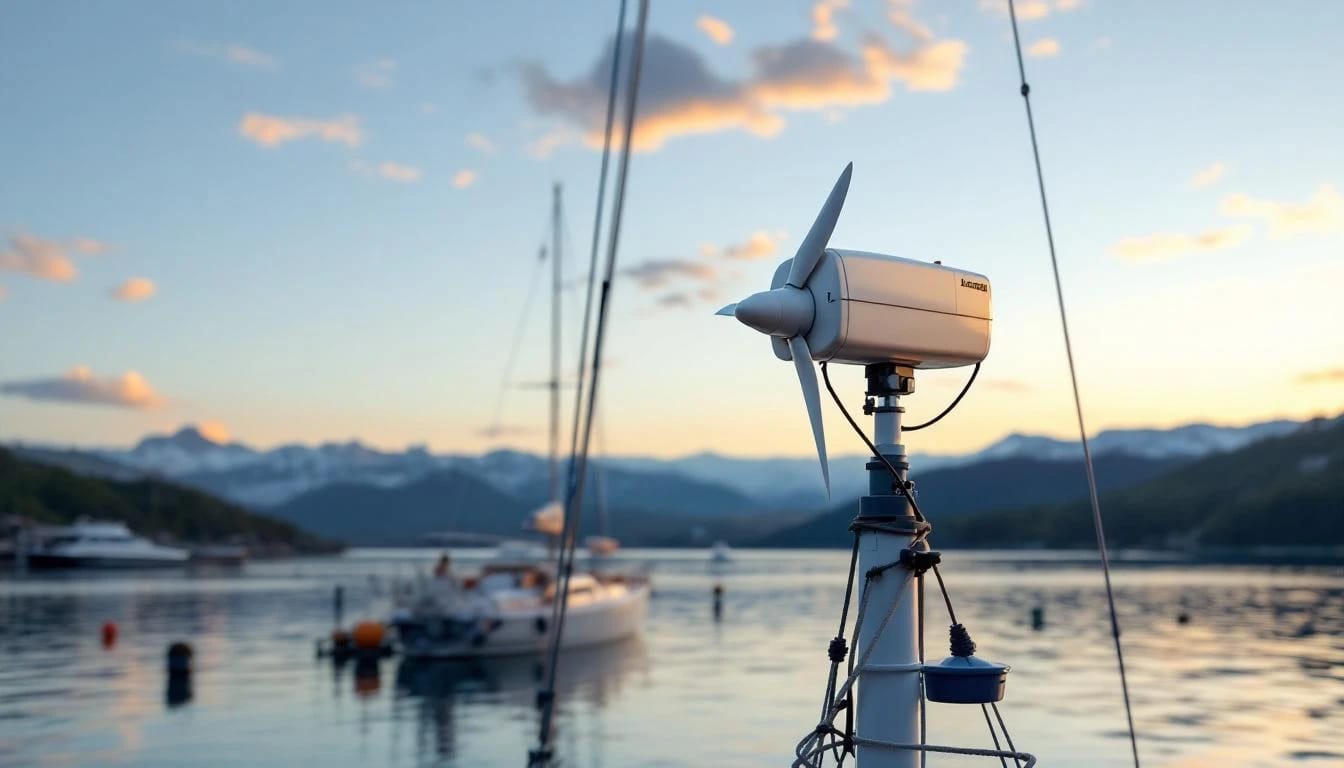
![INLINE: Vertical-axis micro wind turbine mounted on sailboat stern rail with marine wiring conduit and charge controller visible]
Top seven micro turbines by power class and application
| Model | Type | Rated Output | Blade Diameter | Start Speed | Weight | Typical Price | Best For |
|---|---|---|---|---|---|---|---|
| Pikasola 400W | VAWT | 400 W @ 28 mph | 24 in | 4.5 mph | 17 lb | $480 | Budget marine/cabin |
| Ista Breeze i-500 | VAWT | 500 W @ 28 mph | 27 in | 5 mph | 22 lb | $620 | Sailboats, RVs |
| Aeolos-V 300W | VAWT | 300 W @ 26 mph | 22 in | 4 mph | 14 lb | $540 | Minimalist cabin backup |
| Primus Air 40 | HAWT | 400 W @ 25 mph | 45 in | 6 mph | 29 lb | $1,850 | Premium marine, proven reliability |
| Eclectic D400 | HAWT | 400 W @ 28 mph | 46 in | 7 mph | 31 lb | $1,950 | Offshore sailing, extreme weather |
| Rutland 914i | VAWT | 140 W @ 28 mph | 20 in | 5 mph | 12 lb | $680 | Trickle charging only |
| Tumo-Int 1000W | VAWT | 1000 W @ 28 mph | 36 in | 5.5 mph | 38 lb | $750 | Peak output focus |
Pikasola 400W: Five curved blades, aluminum alloy construction, built-in charge controller rated for 12/24 V systems. Real-world users report 20-60 W in 10-12 mph winds, sufficient to offset parasitic loads on a cabin with propane heating and LED lighting. The charge controller occasionally fails in marine salt-spray environments; coating terminals with dielectric grease extends service life. Price-to-output ratio remains unmatched for landside installations below 25 ft mast height.
Ista Breeze i-500: Six-blade helical VAWT with a dedicated PWM controller and dump-load terminal. Danish design with Chinese manufacturing; quality control improved significantly after 2021. Survives up to 65 mph gusts without furling. Marine users praise low vibration and quiet operation under 10 dB at 15 mph. Requires annual lubrication of the center bearing—disassembly takes 30 minutes with basic tools. Output curve is conservative; frequently exceeds rated wattage by 10-15% in steady 20+ mph winds.
Aeolos-V 300W: Smallest practical turbine for meaningful power. Three-blade vertical design balances low cut-in speed (4 mph) with acceptable tip speed in 18+ mph winds. Ships with a separate 300 W controller; buyers must supply cable and disconnect hardware. Best suited to locations averaging 12+ mph where a 100-200 Ah battery bank needs daily replenishment. Not suitable for primary cabin heating or refrigeration.
Primus Air 40: The benchmark HAWT for reliability and documented long-term output. Carbon-fiber blades, stainless fasteners, sealed-bearing alternator. Twenty-year track record in commercial marine and Antarctic research stations. Heavier and costlier than VAWTs but delivers 30-50% more energy per swept area in laminar flow. Requires guyed monopole or tripod mount—tower vibration will destroy cheaper turbines but the Air 40 tolerates moderate tower sway. Replacement parts remain available; the alternator can be rebuilt.
Eclectic D400: British-engineered successor to the Ampair series. Six-blade HAWT with automatic blade pitch in overspeed conditions. Famous among blue-water cruisers for surviving Southern Ocean gales. Whisper-quiet below 15 mph, then audible prop hum above 20 mph. The price reflects hand-assembly and marine-grade components; owners report 10+ years of service with annual bearing re-greasing. Not cost-effective for fixed land installations with easy grid access.
Rutland 914i: Ubiquitous on sailboats as a battery maintainer, not a primary power source. Six-blade VAWT with integrated controller and silent operation. Real output rarely exceeds 40 W except in gales. Ideal for offsetting bilge-pump and GPS drain on moored boats or keeping a cabin's 50 Ah house battery topped between weekend visits. Overpriced for its actual capacity, but unmatched mounting simplicity and low failure rate justify the premium in marine contexts.
Tumo-Int 1000W: Chinese-manufactured VAWT with a five-blade helical rotor. The "1000 W" label is aspirational; independent testing shows 400-500 W peak in 30 mph winds. Build quality varies by production batch. Reports of cracked blade mounts and failed controllers appear in 20-30% of units shipped before mid-2023. When it works, it produces more kWh per dollar than any competitor, making it a calculated gamble for cabin owners with mechanical skills and access to warranty service. Not recommended for unattended sites.
Installation requirements and NEC Article 705 compliance
Every grid-connected wind system—even a 300 W trickle charger—falls under NEC Article 705 (Interconnected Electric Power Production Sources). Off-grid systems avoid most NEC mandates but must still meet Article 690 for battery-based installations and local building codes for structural mounts.
Off-grid cabin or boat (DC-only, no inverter): Wire turbine to a charge controller, then to battery bank, then to DC loads. Use appropriately sized breakers or fuses between each component. For a 400 W turbine on a 12 V system, expect peak current around 35 A; use 10 AWG wire minimum, upsize to 8 AWG for runs over 20 ft to limit voltage drop below 3%. Install a manual disconnect between turbine and controller so you can stop the blades during maintenance. Ground the turbine frame and tower to an 8 ft copper or galvanized ground rod driven below frost line or, on a boat, bond to the vessel's common ground.
Off-grid with inverter: Add a DC disconnect and an inverter rated for continuous load plus 25% margin. A 600 W turbine feeding a 12 V, 100 Ah battery through a 1000 W inverter can supply 700 W of AC appliances for short bursts—sufficient for a blender or power tools—but sustained loads above 200 W will drain the battery faster than the turbine recharges it unless wind averages 18+ mph.
Grid-tied (rare for sub-1 kW): Requires a listed grid-tie inverter with anti-islanding protection, a utility interconnection agreement, and inspection by the local authority having jurisdiction (AHJ). Few inverters under $800 handle the voltage swings from micro turbines, and utility buyback rates (2-8 ¢/kWh net metering in most states) don't justify the paperwork for a system producing 5-15 kWh per month. Grid-tie makes sense starting around 2.5 kW.
Tower and mounting: NEC doesn't specify tower height, but FAA Part 77 requires notification for structures over 200 ft or near airports. For micro turbines, 20-35 ft monopoles or roof mounts are typical. The turbine must clear roof edges or railings by at least 10 ft to escape turbulent boundary layer. Use Schedule 40 steel pipe, guy wires at three or four points, and turnbuckles for tension adjustment. Concrete footings should extend below frost line (depth varies by state—48 in in Minnesota, 12 in in coastal California).
Lightning protection: Turbines on masts act as lightning rods. Install a lightning arrestor between turbine and charge controller (LA302R or equivalent, under $60) and bond tower to a ground rod separate from the house ground by at least 6 ft per NEC 250.106. In high-lightning zones (Florida, Great Plains), consider a secondary arrestor at the battery bank.
A licensed electrician is legally required for grid-tied systems and recommended for off-grid if local codes reference NEC as the adopted standard. Permit fees range from $50 (rural counties) to $300 (incorporated towns). Inspections focus on grounding, conductor sizing, and overcurrent protection. DIY installations on private land without utility connection typically escape inspection, but insurance claims for fire or storm damage will be denied if the system isn't code-compliant.
Federal and state incentives for micro wind
The Residential Clean Energy Credit (IRC §25D) offers a 30% tax credit on equipment and installation costs through 2032, stepping down to 26% in 2033-2034 and 22% in 2035. Micro turbines under 1 kW qualify if the system serves a dwelling unit and isn't leased. A $1,200 installed Pikasola system yields a $360 credit (file IRS Form 5695 with your 1040). The credit applies to both grid-tied and off-grid, but doesn't refund—it reduces tax liability to zero and carries forward unused amounts for up to five years.
State incentives vary. Montana exempts renewable energy systems from property tax assessment. Maine offers a $500 rebate for off-grid wind under the Renewable Resource Fund. Alaska provides low-interest loans through the Alaska Energy Authority for remote power systems. Check the DSIRE database for current programs; most states focus solar rebates and let wind systems claim only the federal credit.
No incentives attach to marine installations unless the boat is your primary residence and classified as a dwelling for tax purposes—rare and complicated.
Common failure modes and maintenance schedule
Micro turbines fail predictably. The charge controller overheats in sustained winds, the center bearing seizes from lack of lubrication, or the blade hub cracks under cyclic stress. Vertical-axis models suffer blade-mount fatigue after 3-5 years in high-wind zones; inspect welds annually and reinforce with gussets if cracks appear. Horizontal-axis models shed blades if overspeed braking fails—check the furling mechanism every six months.
Every six months: Inspect blade integrity, tighten fasteners (vibration loosens bolts), test charge controller by disconnecting battery and verifying controller shuts down turbine (prevents battery overcharge). Check guy-wire tension; re-tension if any wire sags visibly.
Every 12 months: Remove turbine from mast (hawts require blade removal; vawts often lift off intact). Grease the main bearing with marine-grade lithium grease. Inspect brushes if the alternator uses brush-type commutation (most do). Replace brushes when worn to 1/4 inch. Check wiring for UV damage and rodent chewing. Re-coat terminals with dielectric grease.
Every 3-5 years: Replace the charge controller before it fails catastrophically and fries the battery bank. Controllers are the weakest link; budget $80-$150 for a replacement. Repaint the tower if rust appears. Re-torque foundation bolts.
Expect a quality turbine (Primus, Eclectic) to last 12-20 years with proper maintenance. Budget models (Pikasola, Tumo-Int) typically last 5-8 years, then require partial or full replacement.
Output expectations in real wind regimes
A site averaging 10 mph (4.5 m/s) will see a 400 W-rated turbine produce 15-40 W most of the time, spiking to 150 W during gusty periods. That translates to 8-20 kWh per month—enough to run a modern 12 V DC fridge (30 Ah per day) or four LED bulbs (total 20 W) six hours nightly, with surplus charging for phone/laptop use.
A coastal or ridge-top site averaging 14 mph (6.3 m/s) lifts the same turbine into the 50-120 W range most hours, yielding 35-80 kWh per month. Combined with 400 W of solar, that powers a cabin with propane heat, LED lighting, a small DC fridge, and modest electronics. During summer (more sun, less wind) and winter (less sun, more wind), the hybrid system irons out seasonal variability.
Boats underway generate apparent wind. A sailboat moving at 6 knots into a 10 mph true wind sees 16 mph apparent wind at the turbine, lifting output from 30 W to 100 W. Ocean passages often sustain 15-25 mph winds; a Primus Air 40 can deliver 150-250 W continuously, offsetting autopilot (30 W), navigation electronics (15 W), and cabin lighting (10 W) with surplus for battery replenishment.
Wind is fickle. A cabin in a forested valley may average 10 mph at the weather station but experience only 5 mph at rooftop height due to terrain sheltering. Mast height matters: every additional 10 ft of elevation increases wind speed by roughly 10-20%, which translates to 30-70% more power via the cubic relationship. If local topography allows, mount the turbine 30-40 ft above ground even if codes don't require it.
Hybrid solar-wind systems for resilience
Pairing a 400 W turbine with 400 W of solar panels (two 200 W panels) creates a 24-hour energy harvest. Solar dominates in summer and midday; wind fills the gaps at night, in storms, and during winter. Total installed cost runs $1,800-$2,800 (turbine + tower + solar panels + dual-input charge controller + batteries + wiring), qualifying for the 30% federal credit.
Use a dual-input MPPT charge controller (Morningstar TriStar MPPT, Victron SmartSolar) that accepts both solar and wind on separate inputs, then feeds a single battery bank. If the controller lacks a dedicated wind input, install the turbine with its own controller and wire both controllers to the battery bank with separate breakers. Avoid connecting turbine and solar to a single controller input—voltage characteristics differ, and the controller will optimize for one source at the expense of the other.
Battery chemistry matters. Flooded lead-acid (cheapest, requires maintenance) tolerates the erratic charging from wind better than AGM or gel. Lithium iron phosphate (LiFePO₄) handles partial-state-of-charge cycling well but costs triple the upfront price. For a 12 V, 200 Ah bank, budget $400 (flooded lead-acid), $700 (AGM), or $1,200 (LiFePO₄). Turbine lifespan exceeds battery lifespan; plan to replace batteries every 5-10 years depending on depth-of-discharge and temperature.
When micro wind makes sense—and when it doesn't
Good fit: Off-grid cabin in moderate-wind zone (9-16 mph average), sailboat or trawler used for extended cruising, research station needing unattended power, hybrid system with solar where wind fills night/winter gaps.
Poor fit: Grid-connected home (payback period exceeds turbine lifespan), suburban lot with covenants restricting structures over 15 ft, low-wind zone (under 8 mph average), locations with steady solar and minimal wind (desert Southwest), primary power source for heavy loads (well pump, electric heat).
A Pikasola 400W turbine installed DIY on a cabin costs roughly $800 (turbine + mast + wiring + charge controller). At 15 kWh/month output and $0.20/kWh avoided diesel-generator cost, it saves $36/year—a 22-year simple payback. Factor in the federal credit ($240), and payback drops to 15 years. That's marginal. The value proposition improves if you already own a battery bank and need only the turbine, or if wind averages 12+ mph and output doubles.
Marine installations justify higher cost per watt because the alternative—running the engine to charge batteries—burns $10-$20 of fuel per day. A $1,950 Primus Air 40 that offsets 50% of engine charging pays back in under three years on a liveaboard cruiser.
Can I install a micro turbine on my RV or travel trailer?
Road vibration and height restrictions make turbines impractical for moving RVs. For parked RVs used as seasonal cabins, yes—mount a small VAWT on a 10 ft telescoping mast that lowers during transit. Rutland 914i and Pikasola 400W are popular in this role. Expect 10-30 W output in typical campground conditions. Solar remains more practical for RV use unless you winter in high-wind zones.
What's the cut-in speed and why does it matter?
Cut-in speed is the minimum wind speed at which the turbine begins generating power. Most micro turbines start at 4-7 mph. Below that, friction in the alternator and drivetrain exceeds the torque from the wind, and the blades spin without charging the battery. A turbine with 7 mph cut-in produces zero power during 5 mph winds, even though the blades turn. Sites with frequent light breezes (5-8 mph) benefit from low cut-in models (Aeolos-V at 4 mph, Pikasola at 4.5 mph), but the difference in annual energy harvest is usually under 10%.
Do I need a dump load or brake resistor?
Yes, if your charge controller lacks one. When batteries reach full charge, the controller must divert or dissipate the turbine's output to prevent overcharging. Some controllers (Ista Breeze, many standalone units) include a dump-load terminal that connects to a resistor or DC water-heating element. If your controller lacks this, the turbine continues spinning and can overvolt the system or burn out the controller. Budget $30-$60 for a 200-400 W resistor bank and mount it where heat dissipation is safe (not inside a cabin).
How loud are these turbines at night?
VAWTs are quieter than HAWTs. At 15 mph, a Pikasola or Ista Breeze hums at 25-35 dB (library whisper). At 20+ mph, that rises to 40-50 dB (moderate conversation). HAWTs produce blade swoosh—the Primus Air 40 is noticeable at 50 dB but not intrusive. Poor installations amplify noise: turbine vibration transmits into a metal roof or poorly guyed mast. Use rubber isolators between turbine and mount, and ensure guy wires are taut. Locate the turbine 50+ ft from sleeping areas if possible.
Can I connect multiple micro turbines to one battery bank?
Yes, but each needs its own charge controller and breaker. Wire the controllers in parallel to the battery bank. Mixing different turbine models works fine; the controllers manage individual input and the battery bank aggregates the power. This setup suits incremental expansion—install one turbine, test performance, add a second later if needed. Keep combined turbine capacity below twice your battery's C/10 rate (a 200 Ah bank can accept 20 A continuous, or roughly 700 W at 12 V with losses) to avoid overcharging issues.
Bottom line
Micro wind turbines under 1 kW deliver real value in niche applications—off-grid cabins with moderate wind, boats on extended passages, hybrid systems where wind complements solar—but they require honest expectations and proper installation. A Pikasola 400W or Ista Breeze i-500 provides reliable trickle power at budget cost, while a Primus Air 40 justifies its premium price through decade-plus service in harsh marine environments. Calculate your site's average wind speed, size the system to that figure rather than peak ratings, and pair with solar for year-round resilience. Start by measuring wind speed for 30 days with a handheld anemometer, then consult a licensed electrician for code-compliant installation if grid-tied or if local permitting requires inspection.
Share this article
windturbinehome.com/s/5a047c
Editorial note: This article was researched and written by a member of the Wind Turbine Home editorial team. AI-assisted tools were used for spell-checking and light grammar review only — all research, analysis, and conclusions are our own. Our editorial policy prohibits sponsored content and paid placements. Read our editorial policy →
Related reading

micro wind turbines
Marine Wind Generator Buyer Guide for Sailboats (2024)
Compare marine wind generators for sailboats by power output, noise, durability, and mounting. Learn which turbines hold up in salt spray and high wind.
micro wind turbines
Wind Turbine for a Tiny Home on Wheels: Deployable Picks
Portable wind turbines for tiny homes on wheels face unique deployment challenges. Telescoping poles and foldable VAWTs offer the best balance of power and packability.

micro wind turbines
Small Wind Turbine for Camping: 100 to 400 W Picks for 2026
Portable wind turbines for camping range from 100 W to 400 W. Top picks include vertical-axis models under 15 lb and foldable horizontal-axis units for off-grid power.

micro wind turbines
Wind Turbine for Sailboat Under 400 W: 6 Marine Picks Reviewed
Tested marine wind turbines under 400 W for cruising sailboats. Primus AIR 40 leads for reliability, Rutland 914i adds solar backup, Silentwind 400+ cuts noise by 60%.
micro wind turbines
Wind Turbine for RV Roof: Vibration, Mounts, and Worth-It Analysis
RV roof wind turbines face severe vibration, complex mounting, and marginal output. Most owners see better ROI from solar panels, but specific scenarios justify the experiment.