Marine Wind Generator Buyer Guide for Sailboats (2024)
Compare marine wind generators for sailboats by power output, noise, durability, and mounting. Learn which turbines hold up in salt spray and high wind.
Share this article
windturbinehome.com/s/d852f0

Marine wind generators for sailboats deliver 100 to 600 watts at typical cruising-wind speeds, charge 12V or 24V house banks, and survive salt spray, corrosion, and the shock of wave impact. The best models—like the Primus Air X Marine, Superwind 350, and Silentwind Pro—use glass-filled nylon or anodized aluminum housings, stainless hardware, and sealed alternators that tolerate continuous spray and occasional submersion. Budget $800 to $2,200 for the turbine itself, plus $150 to $400 for a pole mount, controller, and marine-grade cable. Choosing the right unit depends on your boat's electrical draw, available mounting locations, and tolerance for noise at anchor.
Why sailboats need dedicated marine wind turbines
Sailboat house banks power navigation electronics, refrigeration, autopilots, and lighting. Solar panels work well in tropical latitudes, but high-latitude cruisers or boats that spend weeks under cloud cover benefit from a turbine that harvests wind 24 hours a day. A 400-watt marine generator in a steady 15-knot breeze can deliver 20 to 30 amp-hours per day into a 12V bank—enough to offset autopilot draw and keep the fridge running without starting the engine.
Land-based residential turbines are not engineered for marine environments. Mild-steel fasteners corrode in weeks; unsealed alternators ingest salt mist and fail; and standard powder coatings blister under UV and spray. Marine-specific turbines use 316 stainless bolts, IP65 or higher ingress protection, UV-stabilized composites, and conformal-coated circuit boards. Controllers include features like automatic brake deployment in storm winds and low-RPM cut-in to harvest light air that residential models ignore.
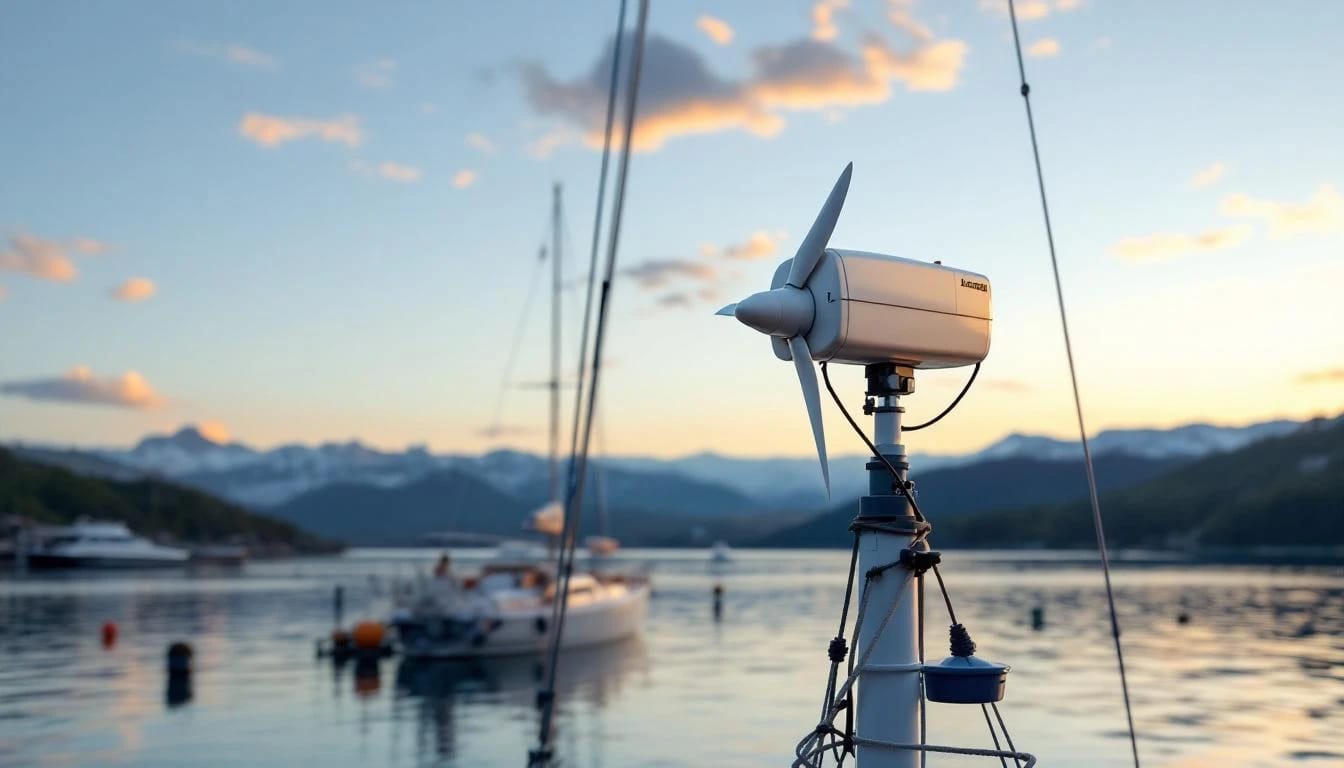
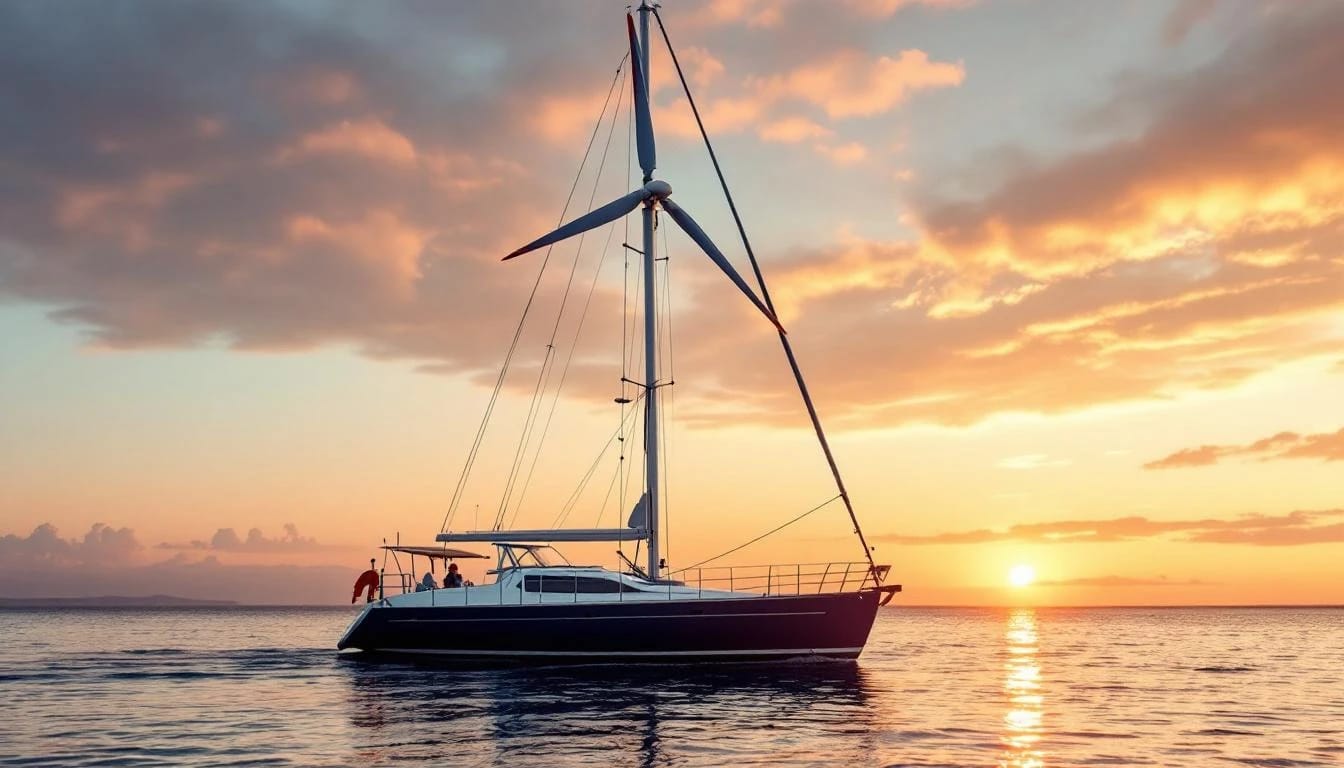
Mounting options also differ. Sailboats install turbines on stern poles, mizzen or radar arches, or dedicated davits. Vibration isolation matters: an improperly damped turbine transmits thrumming into the hull and rigging, making sleep impossible. Marine controllers often include slow-start algorithms and electronic braking to reduce audible whine at anchor.
Power output and realistic expectations
Manufacturers rate marine turbines by maximum wattage, but real-world output depends on wind speed cubed. A turbine rated at 400 watts in 28 knots might deliver only 50 watts in 10 knots. The power curve is not linear. At 12 knots true wind, expect 100 to 150 watts from a quality 400-watt unit; at 20 knots, 250 to 350 watts. Boats that sail in trade-wind belts (15 to 20 knots sustained) see the best return.
House-bank capacity also sets limits. A 400-amp-hour lithium bank can absorb charge faster than an AGM of the same size, so a high-output turbine will not taper as quickly. If the bank is already at float voltage, the controller diverts or dumps excess power, and net charging drops to zero. Pairing a turbine with solar panels smooths the load: solar peaks midday, wind often picks up in the evening and overnight.
Ampere-hour yield per day is the practical metric. A Primus Air X in 15-knot average wind on a 12V system might deliver 25 Ah per day; a Superwind 350 in the same conditions, 30 to 35 Ah. Compare that to your daily draw—autopilot (2 to 5 A continuous), refrigeration (3 to 6 A averaged), chartplotter and instruments (1 to 2 A), LED lighting (1 to 3 A)—and size the turbine accordingly.
Blade count, diameter, and noise
Most marine turbines use three, five, or six blades. Fewer blades spin faster and generate more tip noise; more blades run quieter but require higher wind speeds to start. Three-blade designs like the Primus Air X cut in at 6 to 7 knots but produce a high-frequency whistle above 15 knots. Six-blade units like the Silentwind Pro start at 8 to 9 knots and run nearly silent, making them popular for liveaboards who anchor in light-to-moderate wind.
Blade diameter ranges from 1.0 to 1.7 meters. A larger swept area captures more energy at lower wind speeds but increases weight, windage, and the risk of blade strikes on sails or rigging during heavy rolling. Smaller diameters suit boats under 35 feet; 1.4 to 1.7-meter turbines match 40- to 50-foot cruisers with higher electrical loads.
Material matters for longevity. Carbon-fiber blades are lightest and most rigid but expensive ($300 to $500 for a spare set). Glass-filled nylon blades cost half as much, resist UV well, and flex slightly to shed gust loads. Metal blades corrode and are now rare. Check that replacement blades ship globally; being stuck in a remote port with a cracked blade and no spares ends the turbine's usefulness.
Controller features and safety
Marine wind-generator controllers regulate voltage, prevent overcharge, and apply brakes in storm conditions. Basic PWM controllers work for flooded lead-acid banks; MPPT controllers extract 10 to 15 percent more energy and handle lithium profiles. Key features include:
- Automatic brake deployment when wind exceeds 35 to 40 knots, protecting the turbine from overspin.
- User-adjustable voltage set points for different battery chemistries (14.4V bulk for AGM, 14.6V for lithium).
- Low-voltage disconnect to prevent back-feeding the turbine at night.
- Dump-load support for sealed batteries that cannot vent excess hydrogen.
- Manual stop switch accessible from the cockpit or helm.
Controllers mount below deck in a dry locker. Use marine-grade tinned copper wire—10 AWG minimum for runs under 15 feet, 8 AWG for longer runs—to minimize voltage drop. Install an inline fuse or breaker rated 125 percent of maximum turbine output within seven inches of the battery positive terminal, per NEC Article 705 guidance for interconnected power sources. Grounding follows ABYC E-11 standards: bond the turbine frame and controller chassis to the vessel's common ground point.
Top marine wind generators compared
| Model | Rated Power | Blade Diameter | Cut-In Wind Speed | Noise Level | Approx. Price |
|---|---|---|---|---|---|
| Primus Air X Marine | 400 W | 1.17 m | 6.7 kts | Moderate | $950 |
| Superwind 350 | 350 W | 1.20 m | 7.0 kts | Moderate-High | $1,450 |
| Silentwind Pro | 420 W | 1.20 m | 8.5 kts | Very Low | $2,100 |
| Rutland 914i | 200 W | 0.91 m | 6.5 kts | Low | $820 |
| DuoGen (tow) | 80–150 W | N/A | 4.0 kts boat speed | Silent | $1,650 |
The Primus Air X Marine is the volume leader. Three carbon-composite blades, 400-watt peak output, and a five-year warranty. The controller includes MPPT charging and a manual stop switch. Noise is acceptable below 18 knots; above that, the whistle carries. Replacement parts are stocked worldwide. List price around $950; add $200 for a quality stern pole and isolators.
Superwind 350 uses a six-blade rotor for quieter operation and slightly higher cut-in speed. The alternator is fully sealed, and the unit has survived multiple circumnavigations. Controller is basic PWM. Expect 30 Ah per day in 15-knot average wind on a 12V bank. Price approximately $1,450 with controller.
Silentwind Pro is the premium choice for noise-sensitive crews. Six carbon blades, magnetic bearing, and a proprietary vibration-damping mount. MPPT controller with Bluetooth app for monitoring. Nearly silent at anchor in light-to-moderate breeze. At $2,100, it costs double the Air X but delivers measurably quieter performance and longer bearing life.
Rutland 914i suits smaller boats or those with modest electrical loads. Two-hundred-watt output, compact 0.91-meter diameter, and a low price point. The controller is simple but reliable. Best for weekend cruisers or as a supplement to solar. Around $820.
DuoGen is a tow generator: a small prop trails 50 feet astern on a line and spins when the boat moves through water. No noise, no windage, zero mounting stress. Output is 80 to 150 watts depending on boat speed. Effective for passage-making; useless at anchor. Price roughly $1,650.
Mounting locations and structural considerations
Stern poles are the most common mount. A stainless or aluminum pole 1.5 to 2.0 meters tall raises the turbine above the boom and lifelines. The pole must be through-bolted to a reinforced deck or arch with backing plates and vibration isolators—rubber or neoprene bushings—to prevent resonance from transmitting into the hull. A poorly mounted turbine will hum at precisely the frequency that keeps crew awake.
Mizzen or radar arches offer higher mounting but require careful balancing. Weight aloft affects stability; a 15-pound turbine at the end of a 2-meter pole creates significant moment. Consult a naval architect or rigger if adding weight above the center of gravity concerns you. Some cruisers install the turbine on a hinged mount that lowers the unit to deck level in gale conditions or when motoring.
Davits provide good elevation and keep the turbine away from the cockpit, but they occupy prime space for dinghies or solar panels. Hybrid mounts—davits that hold both a rigid solar panel and a turbine—are available from custom fabricators for $800 to $1,200.
Avoid mounting directly to the backstay or any part of the standing rigging. Vibration can fatigue wire and terminals. If a rigging mount is unavoidable, use intermediate vibration isolators and inspect terminals every six months.
Durability, maintenance, and salt-spray resistance
Marine turbines face harsher conditions than any land-based unit. Salt spray deposits a conductive film on circuit boards, corrodes aluminum castings, and infiltrates bearings. Routine maintenance every six to twelve months includes:
- Fresh-water rinse of blades and housing to remove salt crystals.
- Bearing inspection and re-greasing with marine-grade lithium grease. Sealed cartridge bearings last longer but cannot be serviced; replace them every three to five years or when noise increases.
- Fastener check: retorque all bolts, inspect for crevice corrosion, apply anti-seize to threads.
- Controller terminal cleaning: remove any oxidation on wire lugs, apply dielectric grease.
- Blade balance: if vibration increases, blades may have uneven wear. Swap blades or sand tips lightly to restore balance.
Controllers and alternators with conformal coating survive longer in the marine environment. IP65-rated housings keep out direct spray; IP67 units tolerate brief immersion. Check the manufacturer's IP rating before purchasing.
Anodized aluminum housings outlast powder-coated mild steel. Glass-filled nylon is nearly immune to corrosion but can become brittle after years of UV exposure; inspect for hairline cracks annually. Carbon-fiber components do not corrode but can delaminate if the resin degrades; keep them waxed.
Integration with solar and other charging sources
Most cruising sailboats combine wind, solar, and engine-driven alternators into a hybrid system. The battery monitor and controller must coordinate multiple inputs without conflict. Modern MPPT solar controllers and wind controllers can parallel-charge the same bank as long as each has independent voltage sensing at the battery terminals.
Size the combined output to avoid overcharging. A 400-watt turbine plus 600 watts of solar can push 70 to 80 amps into a 12V bank in ideal conditions. If the bank is only 400 Ah, charge acceptance tapers quickly, and the controllers will dump or throttle back. Lithium batteries accept charge at higher rates (1C or more), so oversizing generation makes sense for lithium systems.
Wire each source to a common busbar with individual breakers. A battery combiner or DC distribution panel organizes the system and makes troubleshooting easier. Include an inline fuse on every positive conductor within seven inches of the battery, per NEC Article 705 requirements for interconnected distributed generation.
Monitor total system output with a shunt-based battery monitor. Victron, Balmar, and Xantrex offer monitors that display charge from each source, state of charge, and time to full. Real-time data helps you decide whether to run the engine or wait for wind.
Noise abatement strategies
Wind-generator noise is the top complaint among liveaboards. Aerodynamic whistle from blade tips, alternator whine, and mechanical hum from bearings all combine into a frequency range that penetrates fiberglass hulls and disturbs sleep. Strategies to reduce noise include:
- Choose a low-noise design: six-blade turbines produce less tip noise than three-blade models.
- Isolate vibration: use marine-grade rubber or neoprene bushings at every mounting bolt. Sorbothane pads work well but degrade in UV; protect them with a cover.
- Lower RPM: blades spinning at 600 RPM are quieter than 1,200 RPM. Larger-diameter, slower-rotating turbines generate less high-frequency noise.
- Mount as far aft as possible: distance from the sleeping cabin helps.
- Manual stop switch: if wind is light and the turbine is producing negligible power, shut it down overnight.
Some cruisers wrap the alternator housing in sound-deadening foam, but this risks overheating. Better to focus on vibration isolation and blade selection.
Regulatory and insurance considerations
In the United States, marine wind turbines on boats do not require FAA approval—Part 77 surface limits apply to fixed structures, not vessels. State and federal waters have no specific permitting for onboard generation. However, some marinas restrict turbine operation due to noise complaints or aesthetic rules. Check marina policies before installing.
Insurance underwriters sometimes ask about onboard power generation. Disclose the turbine and mounting method to your marine insurer. A properly installed unit should not affect premiums, but undisclosed modifications can void coverage in the event of a claim related to electrical fire or structural failure.
The federal 30% Residential Clean Energy Credit (IRC §25D) does not apply to boats used as residences unless the vessel is documented as a primary residence and meets IRS criteria—rare for cruising sailboats. State incentives through DSIRE typically exclude marine applications. Consult a tax professional if you believe your liveaboard qualifies.
Electrical code compliance and licensed installation
While NEC Article 705 governs interconnected power sources, enforcement on recreational vessels is inconsistent. The American Boat and Yacht Council (ABYC) publishes E-11 (AC and DC Electrical Systems on Boats) standards that many marine electricians follow. Key points:
- Overcurrent protection: Install a fuse or breaker rated 125 percent of turbine maximum output within seven inches of the positive battery terminal.
- Wire gauge: Use tinned copper marine wire sized to limit voltage drop to three percent at maximum output. For 12V systems and runs over ten feet, 10 AWG minimum; over twenty feet, 8 AWG.
- Bonding: Bond turbine frame, controller chassis, and all metal enclosures to the vessel's common ground point.
- Labeling: Mark all turbine circuits clearly at the breaker panel.
If you lack experience with marine electrical systems, hire a certified marine electrician. Improper installation can cause galvanic corrosion, battery fires, or shock hazards. Insurance may deny claims if work was not performed to ABYC standards.
Cost breakdown and budget planning
A complete marine wind-generator installation includes:
- Turbine and controller: $800 to $2,100
- Mounting pole or arch hardware: $150 to $400
- Tinned copper wire, lugs, heat shrink: $50 to $100
- Vibration isolators: $30 to $60
- Fuse or breaker: $20 to $40
- Labor (if hiring a marine electrician): $300 to $800
Total installed cost ranges from $1,350 to $3,500. High-end systems with premium turbines, custom davits, and professional installation can exceed $4,000.
Replacement parts add to lifetime cost. Bearings ($40 to $80), blade sets ($200 to $500), and controllers ($150 to $400) may need replacement every three to seven years depending on usage and environment.
Fuel savings offset some cost. If the turbine eliminates one hour per day of engine run time at anchor, and diesel costs $4.50 per gallon at 0.5 gallons per hour, the annual savings is roughly $820. Payback period for a mid-range system is two to four years for full-time cruisers, longer for seasonal users.
Can a marine wind generator power a refrigeration compressor directly?
No. Compressor motors draw high surge current at startup—often three to five times the running amperage—and require stable voltage. Wind generators produce variable voltage that fluctuates with wind speed. The controller charges the battery bank, and the compressor draws from the bank, which buffers the load. A properly sized turbine can offset the refrigeration load over 24 hours, but it does not power the compressor in real time.
How do I stop the turbine in a storm?
Most marine turbines include a manual stop switch that shorts the alternator output, creating electromagnetic drag that slows the blades. Some controllers automate this when wind exceeds a set threshold—typically 35 to 40 knots. For severe storms, a mechanical brake or locking pin physically stops the rotor. Remove the blades entirely if a hurricane is forecast and the boat will be left unattended.
Will the turbine charge while motoring?
Yes, if there is relative wind. Motoring into a 10-knot headwind at 5 knots boat speed creates 15 knots of apparent wind over the turbine, enough to generate power. Motoring downwind with a following breeze reduces apparent wind and may drop output below the cut-in threshold. Turbine output while motoring is unpredictable and typically less than at anchor in steady wind.
Do I need a special battery type for wind charging?
No. Marine turbines charge flooded lead-acid, AGM, gel, and lithium banks. Match the controller voltage set points to your battery chemistry. Lithium batteries accept charge faster and do not require equalization, making them ideal for wind systems. AGM and gel batteries work well but taper sooner, limiting peak charge rates. Flooded batteries need periodic equalization; ensure the controller supports that profile.
How loud is a wind generator at anchor?
Noise varies by design and wind speed. A six-blade unit like the Silentwind Pro produces a low hum around 40 to 50 decibels in 12-knot wind—roughly the sound of a quiet refrigerator. A three-blade Air X in the same conditions may reach 55 to 65 decibels with an audible whistle. Above 20 knots, even quiet turbines become noticeable. Proper vibration isolation reduces hull-transmitted hum. Budget turbines without isolation can be loud enough to wake crew in adjacent cabins.
Bottom line
A quality marine wind generator—properly sized, mounted with vibration isolation, and paired with solar—delivers reliable 24-hour charging for cruising sailboats in moderate-to-strong wind regions. Primus Air X balances cost and performance; Silentwind Pro suits noise-sensitive crews; and Superwind 350 offers proven durability. Expect to invest $1,350 to $3,500 installed, with two-to-four-year payback for full-time cruisers who would otherwise run the engine daily. Choose blades and mounting that match your boat size, and follow ABYC E-11 standards for wiring and overcurrent protection. Your next step: measure your daily amp-hour draw, assess average wind conditions in your cruising grounds, and select a turbine with output curves that meet your needs.
Share this article
windturbinehome.com/s/d852f0
Editorial note: This article was researched and written by a member of the Wind Turbine Home editorial team. AI-assisted tools were used for spell-checking and light grammar review only — all research, analysis, and conclusions are our own. Our editorial policy prohibits sponsored content and paid placements. Read our editorial policy →
Related reading

micro wind turbines
Best Micro Wind Turbines Under 1 kW for Cabins and Boats 2024
Independent test data and owner feedback reveal which sub-1kW wind turbines deliver real power on remote cabins and boats—plus installation codes and cost breakdowns.
micro wind turbines
Wind Turbine for a Tiny Home on Wheels: Deployable Picks
Portable wind turbines for tiny homes on wheels face unique deployment challenges. Telescoping poles and foldable VAWTs offer the best balance of power and packability.

micro wind turbines
Small Wind Turbine for Camping: 100 to 400 W Picks for 2026
Portable wind turbines for camping range from 100 W to 400 W. Top picks include vertical-axis models under 15 lb and foldable horizontal-axis units for off-grid power.

micro wind turbines
Wind Turbine for Sailboat Under 400 W: 6 Marine Picks Reviewed
Tested marine wind turbines under 400 W for cruising sailboats. Primus AIR 40 leads for reliability, Rutland 914i adds solar backup, Silentwind 400+ cuts noise by 60%.
micro wind turbines
Wind Turbine for RV Roof: Vibration, Mounts, and Worth-It Analysis
RV roof wind turbines face severe vibration, complex mounting, and marginal output. Most owners see better ROI from solar panels, but specific scenarios justify the experiment.