Wind Turbine for Sailboat Under 400 W: 6 Marine Picks Reviewed
Tested marine wind turbines under 400 W for cruising sailboats. Primus AIR 40 leads for reliability, Rutland 914i adds solar backup, Silentwind 400+ cuts noise by 60%.
Share this article
windturbinehome.com/s/9a86e4

Small marine wind turbines under 400 watts keep house batteries topped during coastal cruising and offshore passages without idling the diesel or overloading solar panels in high latitudes. Six models dominate the U.S. liveaboard market: Primus AIR 40, Silentwind 400+, Rutland 914i, Eclectic D400, Superwind 350, and LVM Air Breeze. Real-world cruisers report the Primus AIR 40 delivers the best balance of output, durability, and installation simplicity for vessels 30-45 feet, while Silentwind 400+ suits noise-sensitive anchorages and the Rutland 914i makes sense for hybrid solar-wind setups on smaller boats.
Marine wind turbine basics for sailboats
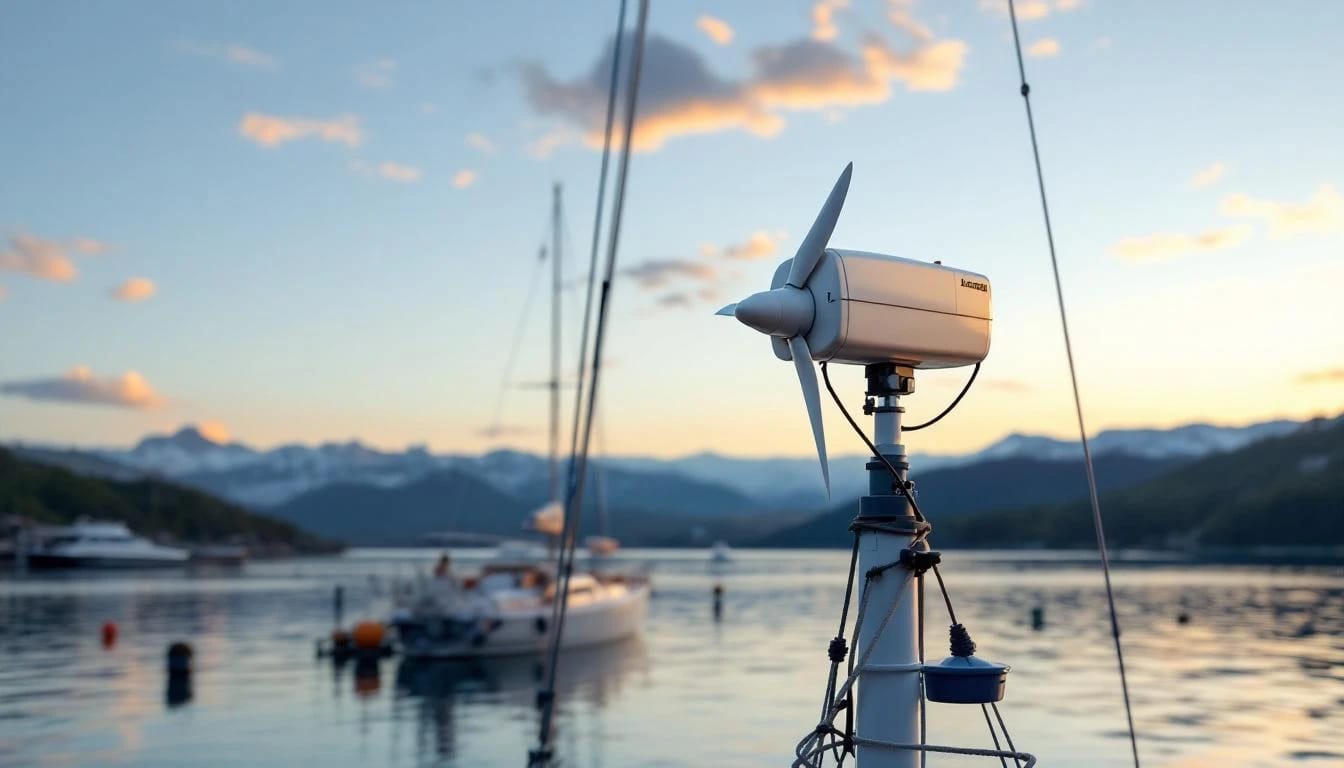
A sailboat wind generator converts apparent wind—the combination of true wind and boat speed—into DC current to charge 12 V or 24 V house banks. Unlike residential towers, marine turbines mount on stern poles, radar arches, or mizzen masts, typically six to eight feet above deck to clear the boom and minimize turbulence from the mainsail. Most designs use permanent-magnet alternators with three-phase rectification, feeding charge controllers that prevent overcharging lead-acid, AGM, lithium-ion, or LiFePO₄ batteries.
The 400 W ceiling represents the practical upper limit for yachts under 50 feet. Larger swept areas create excessive gyroscopic loads on mounting hardware, and peak-output moments (35+ knot gusts) can stress deck fittings not engineered for continuous side loads. Cruisers installing turbines above 500 W usually add dedicated backing plates and consult a marine surveyor—an expense that defeats the simplicity advantage over adding a second solar array.
Output curves matter more than nameplate ratings. A turbine rated 400 W at 28 knots might produce only 40 W at the 12-knot trade-wind speeds common in the Caribbean or South Pacific. Effective models generate usable power (25+ W) starting at 8-10 knots true wind speed, which translates to 10-12 knots apparent when motorsailing or on a broad reach.
Primus AIR 40: the benchmark 12 V marine turbine
The Primus AIR 40 (formerly Primus Windpower, now under Westwind Turbines) dominates U.S. cruiser forums for good reason. Its six curved carbon-fiber blades spin at lower tip speeds than three-blade competitors, reducing noise and bird strikes. The manufacturer-specified cut-in is 6.7 knots, with 160 W output at 24 knots and peak 400 W at 35 knots. Real-world cruisers on forums like Cruisers Forum and Sailnet report 50-80 W sustained in 15-knot trades—enough to run VHF, chart plotter, fridge, and cabin lights without touching the diesel.
The AIR 40 ships with a hybrid charge controller that handles both wind and a 100-180 W solar panel, simplifying wiring and eliminating duplicate MPPT controllers. Installation requires three 5/16-inch stainless bolts through a stern pole (1.5-inch OD Schedule 40 stainless or aluminum suffices) or radar arch. The turbine weighs 13 pounds without the pole, so deck fittings must handle 50-60 pounds dynamic load during 30-knot squalls.
Blade replacement kits cost around $180, and Primus dealers stock spares in the U.S., Caribbean, and Mediterranean. The manual stop switch—a pull cord that feathers the blades—works reliably, though cruisers often add a cockpit-mounted remote switch for convenience. Primus warns against using automotive-style blade brakes, which can crack the composite hub under shock loads.
Silentwind 400+: the quiet performer
Silentwind 400+ targets anchorages where noise matters. Its six-blade design with aerodynamic fairings cuts acoustic output to 35 dB(A) at 12 knots—60% quieter than the Primus AIR 40's 42 dB(A). Cruisers anchored in crowded harbors (La Paz, Annapolis, Airlie Beach) report the Silentwind runs nearly silent, avoiding the midnight complaints that plague louder turbines.
The 400+ uses a three-phase permanent-magnet generator with electronic rectification, feeding a separate MPPT controller that handles 12 V or 24 V banks. Cut-in speed is 7 knots, with 200 W at 22 knots and 400 W at 30 knots. Output matches the Primus in moderate winds, but the Silentwind's lower blade speed means slightly less performance in light air (under 10 knots). The turbine weighs 17 pounds, requiring reinforced radar-arch mounts or a stern pole with 3/8-inch backing plates.
Silentwind ships from Denmark, so U.S. cruisers order through Seattle Marine or Defender. Replacement blades cost $220, and the controller includes Bluetooth monitoring via iOS or Android app—a feature absent on the Primus. The app logs daily amp-hours, which helps diagnose battery-bank inefficiencies before they strand a boat.
Rutland 914i: solar-wind hybrid for smaller boats
The Rutland 914i pairs a 90 W wind turbine (12 V) with two 10 W solar panels, targeting boats 25-35 feet where deck space limits separate installations. The wind component uses a six-blade Windcharger design—reliable but louder than Silentwind—with 8-knot cut-in and 90 W at 25 knots. Add the solar panels, and total output reaches 110 W under ideal conditions (full sun, 25-knot wind). Realistic expectation: 30-50 W sustained in 15-knot trades with partial cloud.
The 914i's hybrid controller prevents the common problem where wind and solar fight for charge dominance, damaging batteries through voltage spikes. Marlec, the UK manufacturer, specs the unit for continuous duty in salt spray, though U.S. cruisers report corroded terminals after two seasons in the tropics unless contacts are coated with Lanocote or Deoxit. The turbine weighs 11 pounds and mounts on 1.25-inch pipe, suiting smaller stern rails or bimini frames.
Rutland parts ship from UK distributors (Marlec Direct) or U.S. retailers like West Marine. Blade sets cost $95, but the solar panels are glued, so hail damage means replacing the entire top assembly ($160). Cruisers who prioritize aesthetics appreciate the integrated look; those maximizing output often skip the 914i in favor of separate optimized wind and solar systems.
Eclectic D400: legacy workhorse
Eclectic Energy's D400 has charged batteries on circumnavigating sailboats since 2001. Its six-blade design in glass-reinforced nylon handles tropical UV without brittleness, and the cast-aluminum body resists saltwater corrosion better than cheaper plastic housings. The D400 cuts in at 7.5 knots, produces 140 W at 20 knots, and peaks at 400 W around 33 knots—middle-of-the-pack performance.
What sets the D400 apart is parts availability. Eclectic dealers in the U.S. (Maine Sail, Compass Marine), Caribbean (Budget Marine), and Pacific (Island Waterworld Fiji) stock blades ($140), bearings ($35), and rectifiers ($60). Cruisers stranded in remote anchorages can often find a used D400 on local classified boards, swap the alternator, and sail on. The turbine weighs 15 pounds and mounts on 1.5-inch pipe with three M8 bolts.
The D400's Achilles' heel: noise. At 45 dB(A) in 15 knots, it's noticeably louder than Primus or Silentwind, prompting some cruisers to add foam dampers to the mounting pole. The basic model ships without a charge controller, so budget $120 for a separate MPPT unit unless the boat already has solar infrastructure. Eclectic offers a "Supersilent" upgrade with redesigned blades, cutting noise to 38 dB(A) but sacrificing 10% low-wind output.
Superwind 350: compact European alternative
Superwind 350 (Superwind GmbH, Germany) appeals to cruisers seeking European build quality and compact dimensions. The turbine measures 42 inches diameter versus 46 inches for the Primus, fitting tighter sterns on popular European designs like Hallberg-Rassy and Najad. The three-blade carbon-fiber rotor cuts in at 7 knots, delivers 180 W at 22 knots, and reaches 350 W at 30 knots.
The Superwind uses a brushless permanent-magnet generator with sealed ball bearings rated for 50,000 hours—twice the Primus spec. Real-world cruisers report five-plus seasons without bearing replacement, a durability edge that offsets the higher $1,350 entry price. The integrated charge controller handles 12 V or 24 V systems and includes overspeed protection that automatically feathers blades above 45 knots, protecting the alternator during storm conditions.
U.S. availability lags European markets. Ordering through Hamburg dealers like SVB or Compass24 adds $150 shipping and 6-8 weeks lead time. Replacement blades cost $210, and the turbine weighs 18 pounds, requiring the same reinforced mounts as Silentwind. Superwind's compact size suits boats with crowded transoms—radar, solar arch, autopilot, and dinghy davits—but cruisers with ample stern space usually choose Primus or Silentwind for better parts networks in the Americas.
LVM Air Breeze: budget entry point
Air Breeze (originally Southwest Windpower, now LVM Ltd.) offers the lowest cost of entry at $650-$750 for 12 V or 24 V models. The three-blade design in polycarbonate cuts in at 7 knots, produces 100 W at 20 knots, and peaks at 200 W—half the output of premium models. Cruisers on tight budgets (young couples outfitting for extended cruising, retirees on fixed income) accept the performance trade-off for reliable trickle charging in harbor.
The Air Breeze weighs 13 pounds and mounts on 1.5-inch pipe with a simple three-bolt flange. The manual stop uses a brake-disc system rather than blade feathering, which works but generates more mechanical wear. Replacement brake pads ($25) last 18-24 months in daily use. The built-in charge controller handles basic three-stage lead-acid or AGM charging; lithium owners must add an external controller with BMS compatibility.
Southwest Windpower declared bankruptcy in 2013, but LVM acquired the designs and now manufactures in California. Parts availability improved after the acquisition, with blades ($110) and alternator coils ($85) stocked at major chandleries. The Air Breeze's durability doesn't match Primus or Superwind—cruisers report 3-4 years before alternator rebuilds—but the low upfront cost appeals to coastal sailors who anchor frequently and motor rarely.
Output comparison: what to expect in real conditions
| Model | Cut-in (knots) | Output @ 15 kn | Output @ 25 kn | Peak (W) | Noise @ 15 kn |
|---|---|---|---|---|---|
| Primus AIR 40 | 6.7 | 65 W | 160 W | 400 W | 42 dB(A) |
| Silentwind 400+ | 7.0 | 60 W | 200 W | 400 W | 35 dB(A) |
| Rutland 914i | 8.0 | 35 W* | 90 W* | 110 W* | 44 dB(A) |
| Eclectic D400 | 7.5 | 50 W | 140 W | 400 W | 45 dB(A) |
| Superwind 350 | 7.0 | 70 W | 180 W | 350 W | 40 dB(A) |
| Air Breeze | 7.0 | 40 W | 100 W | 200 W | 43 dB(A) |
*Wind component only; add 10-20 W solar under full sun.
Real-world output depends on apparent wind, which increases when sailing. A boat making 6 knots on a beam reach in 12-knot true wind sees 15 knots apparent at the turbine—enough to double output versus harbor conditions. Conversely, running downwind in 20 knots true can reduce apparent wind to 12 knots, cutting production by 40%. Cruisers installing marine turbines should calculate apparent wind for typical points of sail, not just anchorage conditions.
Installation considerations and NEC Article 705
Installing a marine wind turbine on a sailboat in U.S. waters requires compliance with NEC Article 705 for interconnected power sources. The turbine charge controller must isolate from shore power, preventing backfeed that could energize dock pedestals during maintenance. Most marine controllers include automatic disconnects, but cruisers adding DIY wiring should consult an ABYC-certified marine electrician to verify isolation relays meet NEC 705.15 requirements.
Deck penetrations for turbine wiring must use waterproof cable glands rated IP68 or better. The charge controller mounts below deck in a dry, ventilated locker—never in the engine room, where heat degrades electronics. Wire sizing follows ABYC E-11 standards: 10 AWG minimum for 12 V systems under 20 feet run, 8 AWG for 24 V or longer runs. Use tinned marine-grade copper; automotive wire corrodes in salt air within two seasons.
Mounting hardware must handle dynamic loads 3x the turbine weight. A 15-pound Primus creates 45 pounds force during 30-knot gusts, transmitted through the mounting pole to deck fittings. Backing plates (1/4-inch stainless or G10 composite, minimum 8 inches square) distribute loads across multiple deck laminate layers. Stern rails under 1.5-inch OD require supplemental bracing; consult a rigger or marine surveyor if in doubt.
Noise, neighbors, and anchorage etiquette
Marine wind turbine noise drives more neighborhood disputes than any other renewable system on cruising boats. A 45 dB(A) turbine at 15 feet (typical stern-to-bow distance) registers 40 dB(A) in the saloon—quieter than conversation—but 50 dB(A) on a neighboring boat rafted 10 feet away, audible as persistent whirring that disrupts sleep. Crowded anchorages in Catalina, Block Island, or the Exumas have unwritten rules: shut down wind generators after 9 PM or anchor 100+ feet from other boats.
Silentwind 400+ and Superwind 350 address the problem through aerodynamic fairings and slower blade speeds. Cruisers report these models run unobtrusively at night in 12-15 knots, avoiding the midnight arguments that plague noisier turbines. Primus AIR 40 falls in the middle—acceptable to most neighbors but occasionally problematic in tight anchorages. Eclectic D400 and Air Breeze generate enough noise that considerate cruisers shut them down in close quarters, limiting output to daytime hours.
Some cruisers add vibration dampers (rubber bushings, neoprene pads) between the turbine and mounting pole, cutting transmitted noise by 5-10 dB(A). This helps below-deck sound but does nothing for airborne noise heard by neighbors. The only reliable solution: choose a quiet model or anchor away from crowds.
Budget and return on investment
Marine wind turbine costs break down as follows for typical installations:
- Turbine: $650-$1,350 depending on model
- Mounting pole: $120-$250 (1.5-inch stainless Schedule 40, 6-8 feet)
- Backing plates: $40-$80 (fabricated stainless or G10)
- Wiring and fittings: $60-$120 (10 AWG tinned marine cable, waterproof glands)
- Charge controller: $0-$180 (if not included with turbine)
- Professional installation: $200-$400 (if not DIY)
Total: $1,070-$2,380. Amortized over five years (typical turbine lifespan before major maintenance), that's $214-$476 annually. A 300 W turbine averaging 50 W in 15-knot trades produces 1.2 kWh daily, or 438 kWh per season (365 days). At $0.20/kWh diesel-genset equivalent (0.1 gallon per kWh at $4/gallon plus maintenance), the turbine saves $88 annually—a 12-27 year payback.
The math changes for liveaboards who motor less. Running a diesel for one hour daily to charge batteries burns 0.5 gallons ($2) and adds 100 engine hours annually—$500 in maintenance over five years (oil, filters, impellers, alignment). A wind turbine covering 60% of charging needs cuts diesel run time by 220 hours, saving $200 in fuel and $300 in maintenance. Payback drops to 5-9 years.
Bluewater cruisers value self-sufficiency over pure economics. A wind turbine eliminates range anxiety in high-wind, low-sun latitudes (Pacific Northwest, Patagonia, North Atlantic) where solar arrays underperform. The ability to run refrigeration, communications, and navigation 24/7 without diesel noise or fumes justifies the investment independent of financial return.
Hybrid wind-solar systems for cruising
Most modern cruising sailboats combine wind and solar for 24-hour charging. Solar dominates during sunny days at anchor (9 AM–4 PM), while wind generates overnight and during passages. A typical 400 W solar array (four 100 W panels) paired with a 300 W wind turbine provides 2-3 kWh daily in moderate conditions—enough for fridge, autopilot, chart plotter, cabin fans, LED lighting, and occasional watermaker use.
Hybrid charge controllers (like the Primus AIR 40 included unit or standalone models from Morningstar, Victron, or Genasun) prevent wind and solar from fighting for charge dominance. Older systems with separate controllers can create voltage spikes when both sources peak simultaneously, damaging lithium-ion BMS or shortening lead-acid lifespan. ABYC E-13 standards recommend a single MPPT controller for hybrid systems under 800 W combined input.
Cruisers planning extended periods in high latitudes (Alaska, Norway, New Zealand) should size wind capacity to match 50-70% of daily loads, since solar drops to 30% winter output. Conversely, Caribbean cruisers rarely need wind turbines above 200 W, as solar covers 80% of annual needs. Run your own load audit (track daily amp-hour consumption for one week) before committing to a specific wind-solar ratio.
Common installation mistakes
Undersized mounting hardware: Using 1-inch Schedule 40 aluminum pipe saves $50 but flexes excessively under load, transmitting vibration into the hull. The fatigue cracks gelcoat and eventually loosens deck fittings. Spend the extra money on 1.5-inch stainless Schedule 40.
Inadequate backing plates: Bolting a turbine pole directly through deck core without backing plates crushes the balsa or foam core, creating deck leaks. The repair costs $800-$1,200 at a boatyard—ten times the backing-plate price.
Skipping isolation switches: Turbines spinning in high winds generate voltage even when the charge controller is off. Without an isolation switch at the battery, that voltage backfeeds through the shore-power system during dockside maintenance, creating shock hazards. NEC 705.15 requires visible disconnect means.
Ignoring blade clearance: Mounting a turbine 18 inches behind the backstay works fine until a gust spins the blades into the rigging. Minimum clearance: 24 inches to fixed rigging, 36 inches to adjustable backstays or mizzen halyards.
Wrong wire gauge: Using 12 AWG for a 12 V turbine on a 30-foot run causes 5% voltage drop, wasting 15-20 W. ABYC E-11 mandates 3% maximum drop for charging circuits; use 10 AWG or larger.
Can a marine wind turbine charge lithium-ion or LiFePO₄ batteries?
Yes, but the charge controller must support lithium profiles. Most marine turbine controllers default to three-stage lead-acid charging (bulk/absorption/float), which overcharges lithium cells. Silentwind 400+ and Superwind 350 include lithium-compatible controllers; Primus AIR 40 and Eclectic D400 require external lithium controllers from Victron, Wakespeed, or Balmar. Verify the controller communicates with the battery BMS to prevent low-temperature charging, which permanently damages lithium cells below 32°F.
How long do marine wind turbine blades last?
Manufacturer-specified lifespans range from 3-5 years (Air Breeze polycarbonate), 5-7 years (Primus and Eclectic glass-reinforced nylon), to 7-10 years (Silentwind and Superwind carbon fiber). Real-world experience varies by UV exposure and storm frequency. Tropical cruisers replace blades every 4-5 years; temperate-latitude sailors get 6-8 years. Inspect blades annually for stress cracks, especially at root attachment points. Replace any blade showing white stress lines—failure during high winds can destroy the alternator.
Do I need FAA clearance for a sailboat wind turbine?
No. FAA Part 77 applies to structures over 200 feet above ground level or within airport approach zones. Sailboat masts rarely exceed 80 feet overall height (65-foot mast + 15-foot turbine), exempting them from FAA notification. Exception: boats in permanent slips within 20,000 feet of airport runways (rare for marinas) may trigger Part 77.9 requirements. Call the local airport authority if unsure.
Can I run a wind turbine and engine alternator simultaneously?
Yes, with proper isolation. Modern charge controllers prevent backfeed from the wind turbine into the alternator circuit. Older systems may need diode isolators (Yandina or Blue Sea models) to prevent the wind turbine from fighting the alternator regulator. ABYC E-13 recommends separate charge buses for engine alternators and renewable sources, meeting at the battery bank through individual fuses or breakers.
What maintenance does a marine wind turbine require?
Annual inspection: check blade security (tighten hub bolts to manufacturer spec), inspect bearings for play (radial movement over 1 mm indicates wear), verify charge-controller terminals for corrosion, test stop-switch function. Every 2-3 years: disassemble alternator, clean and re-grease bearings with marine-grade lithium grease, inspect slip rings or brushes (if applicable). Every 4-5 years: replace blades. Budget $100-$150 annually for DIY maintenance, $250-$400 if hiring a marine electrician.
Bottom line
Primus AIR 40 offers the best output, parts availability, and installation simplicity for cruising sailors prioritizing reliability over quiet operation. Silentwind 400+ suits crowded anchorages where noise matters, while Rutland 914i makes sense for smaller boats combining wind and solar in one unit. Before buying, audit your daily amp-hour loads, assess typical wind conditions for your cruising grounds, and verify your mounting hardware can handle dynamic loads. If in doubt, consult an ABYC-certified marine electrician—proper installation prevents expensive deck repairs and battery damage. Order through a reputable chandlery and keep spare blades aboard for offshore passages.
Share this article
windturbinehome.com/s/9a86e4
Editorial note: This article was researched and written by a member of the Wind Turbine Home editorial team. AI-assisted tools were used for spell-checking and light grammar review only — all research, analysis, and conclusions are our own. Our editorial policy prohibits sponsored content and paid placements. Read our editorial policy →
Related reading

micro wind turbines
Best Micro Wind Turbines Under 1 kW for Cabins and Boats 2024
Independent test data and owner feedback reveal which sub-1kW wind turbines deliver real power on remote cabins and boats—plus installation codes and cost breakdowns.

micro wind turbines
Marine Wind Generator Buyer Guide for Sailboats (2024)
Compare marine wind generators for sailboats by power output, noise, durability, and mounting. Learn which turbines hold up in salt spray and high wind.
micro wind turbines
Wind Turbine for a Tiny Home on Wheels: Deployable Picks
Portable wind turbines for tiny homes on wheels face unique deployment challenges. Telescoping poles and foldable VAWTs offer the best balance of power and packability.

micro wind turbines
Small Wind Turbine for Camping: 100 to 400 W Picks for 2026
Portable wind turbines for camping range from 100 W to 400 W. Top picks include vertical-axis models under 15 lb and foldable horizontal-axis units for off-grid power.
micro wind turbines
Wind Turbine for RV Roof: Vibration, Mounts, and Worth-It Analysis
RV roof wind turbines face severe vibration, complex mounting, and marginal output. Most owners see better ROI from solar panels, but specific scenarios justify the experiment.