Cost per kWh: Wind vs Solar at Residential Scale in 2026
Residential wind costs $0.18–$0.42/kWh versus solar's $0.06–$0.14/kWh when averaged over 20 years. Site wind speed and roof versus tower installation drive the difference.
Share this article
windturbinehome.com/s/9099fb
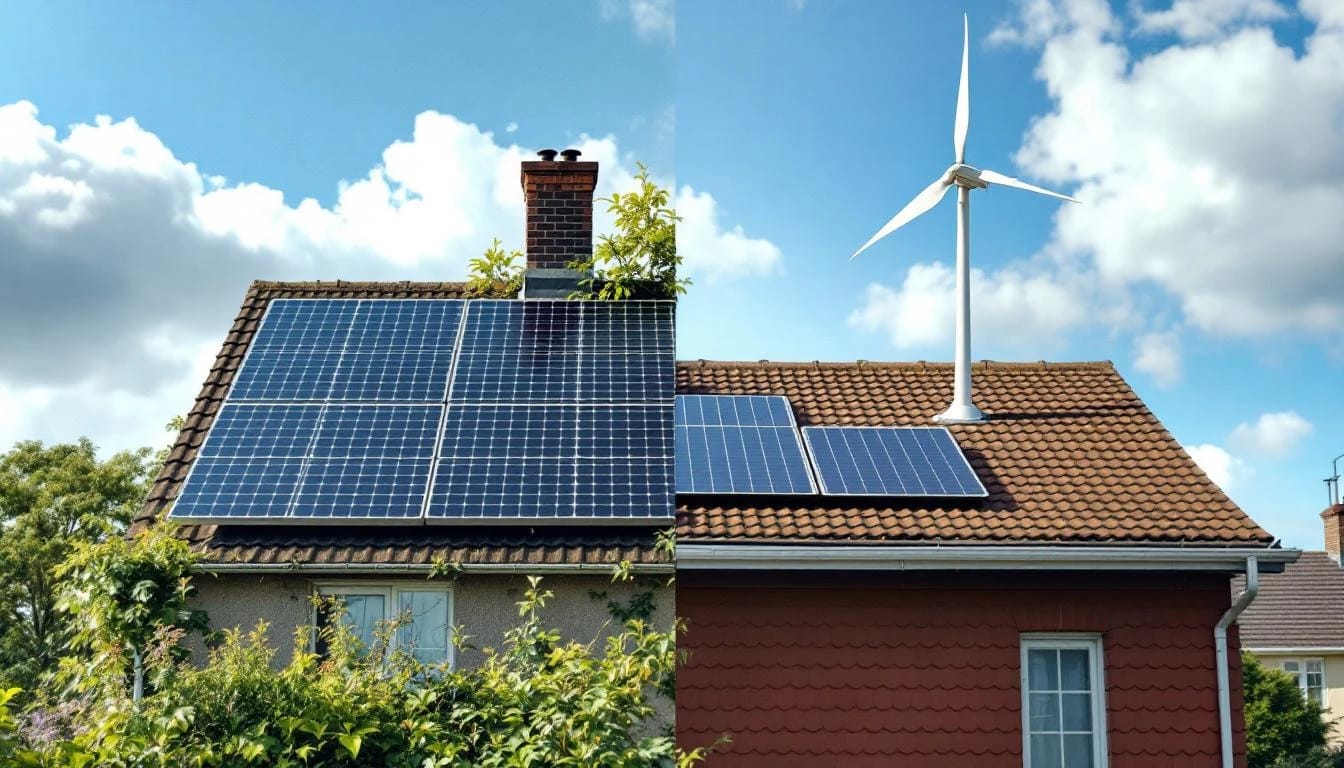
Small residential wind turbines deliver energy at $0.18 to $0.42 per kilowatt-hour over a typical 20-year lifespan, while rooftop solar photovoltaic systems land between $0.06 and $0.14 per kWh under the same accounting. Wind can win on high-wind prairie sites with excellent tower placement, but most suburban and exurban parcels hand solar the economic advantage by a two-to-one margin or better. The National Renewable Energy Laboratory's distributed wind research and WindWatts resource tool make clear that local average wind speed—not national averages—determines whether a turbine pencils out.
Why levelized cost of energy matters more than sticker price
Upfront equipment cost grabs headlines, yet levelized cost of energy (LCOE) shows the true expense per kilowatt-hour produced across the system's working life. A $6,000 1.5 kW Primus AIR 40 perched on a 30-foot tower in a 9 mph average wind site might generate 1,800 kWh per year. Across 20 years that totals 36,000 kWh; adding tower, electrical balance-of-system, and installation pushes all-in cost to roughly $15,000. Dividing $15,000 by 36,000 kWh yields $0.42 per kWh—triple the retail grid rate in many states.
A comparable-output 1.5 kW rooftop solar array costs $4,500 after the 30 percent federal Residential Clean Energy Credit (IRC §25D), produces 2,000 kWh annually in moderate sun, and hits $0.11 per kWh LCOE. NREL's Residential Energy Cost Estimator calculator confirms that solar's capacity factor advantage in most populated latitudes overwhelms wind's occasional high-output days.
Equipment and installation expenses side by side
Base hardware prices for small wind start near $1.50 per rated watt for no-name imports and climb to $4.00 per watt for AWEA 9.1-certified machines like the Bergey Excel 10. A 5 kW Bergey lists at $20,000 for turbine and controller; the monopole tower adds $12,000 to $18,000 depending on height and foundation requirements. Licensed electrical work to tie into the main service panel under NEC Article 705 runs $1,500 to $3,000. Total installed cost lands between $35,000 and $40,000 before incentives.
Solar breaks down differently. Module prices sit around $0.70 per watt wholesale; inverters, racking, wiring, and labor push turnkey residential installs to $2.50–$3.50 per watt pre-incentive. A 5 kW system therefore costs $12,500 to $17,500 before the federal credit, dropping to $8,750 to $12,250 after. State and utility rebates—searchable via the DSIRE database—can shave another ten to twenty percent in high-incentive jurisdictions.
![INLINE: Side-by-side cost breakdown chart showing installed price per watt for 5 kW wind turbine versus 5 kW solar array, including tower, inverter, and electrical balance-of-system components]
Annual energy production and capacity factor reality
Wind turbines achieve rated output only above cut-in speed (typically 7–9 mph) and below cut-out speed (45–55 mph). A Pikasola 5 kW vertical-axis turbine delivers 5 kW at 28 mph sustained wind; at the U.S. residential median of 10 mph average, actual generation hovers around 600–800 watts on average. Multiply by 8,760 hours and apply a realistic 15–25 percent capacity factor: the turbine yields 6,500 to 11,000 kWh per year on a good rural site, closer to 3,000 to 5,000 kWh in tree-sheltered suburbs.
Solar panels produce whenever photons hit silicon. A well-oriented 5 kW array in Denver (5.5 peak sun hours per day) generates 10,000 kWh annually; the same system in Seattle (3.5 hours) makes 6,400 kWh. Capacity factor for solar nationwide ranges 14 to 22 percent, but the predictability—sunrise, noon, sunset—lets homeowners size systems with confidence. Wind's volatility demands either grid connection or substantial battery storage, adding cost and complexity.
| Metric | 5 kW Wind (rural) | 5 kW Wind (suburban) | 5 kW Solar (sunny) | 5 kW Solar (cloudy) |
|---|---|---|---|---|
| Installed cost (post-credit) | $28,000 | $28,000 | $9,500 | $9,500 |
| Annual kWh | 8,500 | 4,000 | 10,000 | 6,400 |
| 20-year kWh | 170,000 | 80,000 | 200,000 | 128,000 |
| LCOE | $0.16 | $0.35 | $0.05 | $0.07 |
Federal and state incentive stacks
Both technologies qualify for the IRC §25D 30 percent Residential Clean Energy Credit through 2032, stepping down to 26 percent in 2033 and 22 percent in 2034. File IRS Form 5695 with your 1040; the credit covers equipment, assembly, installation, and necessary electrical upgrades directly serving the renewable system. Wind-specific rules allow the tower, guy anchors, and foundation concrete to count toward the credit base.
State production incentives tilt toward solar in most markets. California's Net Energy Metering 3.0 pays avoided-cost rates for exports; Massachusetts SMART program offers per-kWh adders that favor solar but include small wind under 60 kW. New York's NY-Sun incentive historically paid $0.40 per watt for solar while offering nothing for turbines. Texas PACE financing districts cover both technologies yet see ten solar applications for every wind inquiry.
Property-tax exemptions exist in twenty-three states for renewable energy systems; check DSIRE for carve-outs that exclude vertical-axis or exclude towers above a certain height. Sales-tax waivers on equipment purchases can save another four to eight percent upfront.
Maintenance, warranty, and lifespan differences
Wind turbines spin at hundreds of RPM in rotor-speed machines, thousands in direct-drive permanent-magnet models. Bearings wear, blades erode, yaw mechanisms seize. Budget $300 to $800 annually for inspections, greasing, and blade refinishing. Major overhauls—gearbox replacement, generator rewind—hit every eight to twelve years at $2,000 to $5,000. Aeolos-H 3 kW and Bergey both offer five-year warranties on electronics, two years on mechanical components; labor and tower work stay owner responsibility.
Solar panels carry 25-year linear performance warranties guaranteeing 80–85 percent output at year twenty-five. Inverters warrant ten to twelve years (central string) or twenty-five (microinverters). Rainfall cleans panels; a hose rinse twice a year suffices in most climates. No moving parts means negligible routine maintenance. A $150 annual reserve for inverter replacement around year twelve covers the only predictable expense.
Over two decades a wind turbine will consume $6,000 to $16,000 in maintenance and parts; solar spends $1,500 to $3,000. Adding those figures into LCOE widens the gap.
When wind makes financial sense
Three conditions tip the balance toward wind: sustained average wind speed above 12 mph at hub height, open land free of turbulence-inducing obstacles within 500 feet, and retail electricity rates above $0.20 per kWh. Ranch properties in the Texas Panhandle, Wyoming high plains, and North Dakota check all boxes. A Bergey Excel 10 on an 80-foot tower in those zones can hit $0.12 LCOE, beating local solar and grid power alike.
FAA Part 77 notification applies to structures exceeding 200 feet above ground level near airports; residential towers stay comfortably below that threshold but verify with the FAA's online tool before permitting. Zoning ordinances cap tower height in many counties—45 feet is a common ceiling—forcing compromised turbine performance. Homeowner associations ban towers outright in subdivisions. Urban and suburban parcels therefore default to solar unless the owner controls acreage beyond HOA reach.
Hybrid systems pair a 2–3 kW wind turbine with 5–8 kW of solar, filling winter's low-sun gaps with wind while summer sun carries the load. NREL's Microgrids, Infrastructure Resilience, and Advanced Controls Launchpad research demonstrated that coordinated inverter controls smooth output and reduce battery cycling. Total cost climbs but reliability improves, a trade-off that appeals to off-grid and backup-power buyers more than grid-tied cost optimizers.
Real-world case studies from NREL data
NREL's WindWatts case studies document performance across diverse settings. A Montana ranch installed a refurbished Bergey Excel 6 on a 60-foot tower in a 13 mph average site; five-year production averaged 9,200 kWh annually against a projection of 10,000 kWh. Total installed cost was $22,000; after federal credit and a $3,000 Montana alternative-energy grant, net outlay hit $12,400. LCOE calculated to $0.13 per kWh, undercutting the rural co-op's $0.15 rate.
A suburban Chicago homeowner erected a Primus AIR 40 on a 30-foot pole in a tree-sheltered 8 mph zone. Three-year average production was 1,400 kWh per year—less than half the manufacturer curve. With $12,000 all-in cost (including the permit fight with the town board), LCOE topped $0.57 per kWh. The owner later added 4 kW of solar for $11,000 post-credit, generating 5,000 kWh annually at $0.11 per kWh, and now regrets the turbine expenditure.
A Colorado dairy farm combined a 10 kW Southwest Windpower Skystream replacement with 15 kW of ground-mount solar and 40 kWh of lithium battery storage. The turbine contributes 12,000 kWh in winter months when snow covers panels; solar delivers 24,000 kWh in summer. Blended LCOE across both systems is $0.14 per kWh, competitive with Xcel Energy's agricultural rate and proof that complementary generation can work when planned intentionally.
Insurance, permitting, and hidden soft costs
Homeowner insurance carriers view towers as attractive nuisance and liability magnets. Expect a twenty to fifty percent premium increase or a requirement to add an umbrella policy. Turbine manufacturers recommend $1 million in liability coverage; $2 million becomes standard near property lines or public roads. Solar adds negligible insurance cost because panels affix to an existing structure.
Building permits for solar run $200 to $600 in most jurisdictions, covering plan review and a single rough-in plus final inspection. Wind turbine permits demand engineered foundation drawings, FAA determination, wildlife impact statements in sensitive habitats, and sometimes a public hearing for variances. Permit and engineering fees range $1,500 to $5,000. Add another $500 to $1,200 for the NEC Article 705 interconnection application and utility approval process.
HOA battles burn time and legal fees. One Illinois homeowner spent $8,000 in attorney costs over eighteen months to overturn a covenant banning "windmills," only to find that the approved 40-foot tower produced disappointing output in the subdivision's wind shadow. Solar rarely triggers covenants because panels lie flush on roofs.
Grid parity and payback period comparison
Simple payback—ignoring time value of money—for solar in moderate-sun states with $0.13 per kWh retail power runs seven to ten years. A $10,000 net-cost system producing 6,500 kWh saves $845 annually, reaching break-even in year twelve. Adding the system's residual value (panels still warrant 85 percent output) and avoided future rate increases pulls effective payback under ten years.
Wind payback stretches twelve to eighteen years in good sites, exceeds twenty in mediocre wind. The $28,000 net-cost 5 kW turbine generating 8,500 kWh at $0.13 per kWh saves $1,105 per year before maintenance. Subtracting $500 annual upkeep leaves $605 net savings and a 46-year simple payback—longer than the turbine's expected service life. Only when retail power tops $0.22 per kWh and average wind exceeds 12 mph does wind payback drop into the low teens.
Financing further separates the two. Solar installers bundle turnkey loans at 2.99–5.99 percent APR; monthly payments often match or undershoot the homeowner's pre-solar electric bill, delivering immediate positive cash flow. Wind projects require construction loans or home-equity lines because few lenders understand turbine collateral, pushing rates to 6–9 percent and delaying cash-flow positivity.
Energy independence versus economic optimization
Payback math matters less to buyers chasing resilience. A grid-tied solar system shuts down during outages unless paired with batteries; NEC 705 anti-islanding rules prevent backfeed into dead utility lines. A turbine with a manual transfer switch can run critical loads during multi-day grid failures, provided wind blows. That autonomy carries subjective value.
Battery integration costs $10,000 to $18,000 for a 13 kWh Tesla Powerwall or equivalent, erasing much of solar's LCOE advantage if the buyer sizes for multi-day backup. Wind plus battery becomes cost-prohibitive except in off-grid scenarios where eliminating a diesel generator justifies the outlay. NREL's Defense and Disaster Deployable Turbine project explored mobile wind for military forward bases; the hardware works but economics hinge on diesel fuel exceeding $6 per gallon delivered.
Philosophical commitment to local generation drives some purchases. Urban community solar subscribers pay $0.10–$0.12 per kWh for clean power without equipment ownership; that beats both backyard wind and rooftop solar on pure cost, yet buyers who want visible hardware choose panels or blades.
Technology trajectory and future cost curves
Solar module efficiency improves two to three percent every five years; residential panels now reach 22 percent conversion, up from 15 percent a decade ago. Manufacturing scale and polysilicon commoditization continue pushing prices down one to two cents per watt annually. NREL forecasts residential solar LCOE dropping below $0.05 per kWh nationwide by 2030.
Small wind sees no equivalent Moore's Law. Bergey's Excel 10 uses the same basic three-blade upwind design the company introduced in 2009. Vertical-axis machines promise lower cut-in speeds and omnidirectional operation but struggle with efficiency—most VAWTs convert only 25–30 percent of wind energy versus 35–42 percent for horizontal-axis designs. NREL's Competitiveness Improvement Project funds incremental improvements—better blade profiles, direct-drive generators, advanced controls—that shave five to ten percent from installed cost over a decade, nowhere near solar's pace.
Certification remains a bottleneck. The AWEA 9.1 Small Wind Turbine standard requires expensive third-party testing; only a handful of models carry the stamp. Uncertified Chinese imports flood Amazon at tempting prices but lack performance data and warranty support, poisoning the market for legitimate manufacturers.
Regulatory and political risks
Net metering policies—critical for grid-tied renewables—face rollback pressure from utilities arguing cost-shift to non-solar ratepayers. California's NEM 3.0 cut export compensation by seventy-five percent in 2023; Arizona, Nevada, and Florida enacted similar changes. Wind exports face identical rate cuts, so the risk is symmetric, but solar's installed base makes it the primary target.
Federal tax credit extension beyond 2034 remains uncertain. The Inflation Reduction Act locked in the 30 percent rate through 2032 for projects that begin construction by year-end 2032, yet political winds shift. A repeal would crater both markets; solar's lower upfront cost leaves buyers less exposed to that tail risk.
Local zoning grows stricter. Noise complaints—real and exaggerated—lead towns to adopt setback rules requiring towers to sit three times their height from property lines. On a quarter-acre suburban lot a 60-foot tower needs 180 feet of clearance, an impossibility. Solar setbacks rarely exceed ten feet from the roof edge.
Is a home wind turbine worth it compared to solar panels?
Wind delivers lower cost per kWh only on properties with sustained 12+ mph average wind, unobstructed tower sites, and electricity rates above $0.18 per kWh. Solar wins on most residential lots due to lower installed cost, minimal maintenance, and predictable output. Run both technologies through NREL's Residential Energy Cost Estimator with your specific address and roof orientation before committing dollars.
How many years does it take for a residential wind turbine to pay for itself?
Payback ranges twelve to eighteen years in excellent wind sites (13+ mph average), twenty-plus years in moderate wind, and never in poor sites (under 10 mph). Solar payback sits seven to twelve years in most U.S. states. Both figures assume current federal tax credits and stable grid electricity rates; remove the 30 percent credit and payback extends by forty to fifty percent.
Can I combine wind and solar on the same property?
Hybrid systems work when wind and solar generation complement each other seasonally—winter wind filling low-sun gaps. Install the wind turbine first to verify actual production against projections before sizing the solar array. Use a single hybrid inverter or two separate grid-tie inverters feeding the same service panel under NEC 705.12(B)(2) sum-of-breakers rule. Combining rarely makes economic sense unless resilience outweighs cost optimization.
What wind speed do I need to make a turbine cheaper than solar?
Sustained average wind of 12 mph at hub height (typically 60–80 feet) allows a quality horizontal-axis turbine to approach solar's LCOE. Below 10 mph average, wind cost per kWh doubles or triples solar's. Use NREL's WindWatts tool or a professional anemometer data logger for ninety days before purchasing equipment; manufacturer power curves assume ideal conditions that real sites rarely match.
Do state incentives favor solar over wind?
Twenty-eight states offer solar-specific rebates, tax credits, or loan programs; only eleven extend equivalent support to small wind. Solar also qualifies for Solar Renewable Energy Certificates (SRECs) in seventeen states; wind earns RECs in just six. Check the DSIRE database for your state's current programs—budget-constrained agencies frequently pause or cap wind incentives while maintaining solar funding.
Bottom line
Residential solar delivers electricity at half to one-third the levelized cost of small wind turbines across most U.S. climates, installation scenarios, and household load profiles. Wind achieves cost parity only on rural acreage with verified 12+ mph average wind and tall towers, conditions that exclude ninety percent of homeowners. For the rare buyer who meets those thresholds, a Bergey or Primus horizontal-axis turbine can generate clean power at $0.12–$0.16 per kWh, competitive with grid rates and solar.
Everyone else should invest in rooftop photovoltaics, capture the 30 percent federal credit, and bank the $15,000 to $20,000 saved versus a comparable-output wind system. Use NREL's Residential Energy Cost Estimator and a local licensed installer's site assessment to model both technologies with your actual wind and sun data—then choose the one that puts the most kilowatt-hours per dollar into your meter.
Share this article
windturbinehome.com/s/9099fb
Editorial note: This article was researched and written by a member of the Wind Turbine Home editorial team. AI-assisted tools were used for spell-checking and light grammar review only — all research, analysis, and conclusions are our own. Our editorial policy prohibits sponsored content and paid placements. Read our editorial policy →
Related reading
wind vs solar
Wind vs Solar for Residential: Which One Wins for Your Site
Wind turbines excel in open, windy sites with consistent 12+ mph winds; solar panels dominate in most suburban settings. Compare costs, energy output, and site requirements.
wind vs solar
Home Wind Turbine vs Propane Generator: Lifetime Cost Compared
A 5kW home wind turbine costs $25,000–$40,000 installed but pays back in 8–15 years. A propane standby generator costs $6,000–$12,000 but burns $1,500–$3,000 in fuel yearly.
wind vs solar
Wind Turbine vs Solar for an RV: Which Actually Wins on the Road
Solar panels dominate stationary RV camping with 400W systems under $800, but wind turbines shine during stormy weather and overnight charging in windy sites.
wind vs solar
Wind Turbine vs Generator for Backup Power: Cost & Runtime
Wind turbines deliver unlimited runtime but need wind and large upfront costs. Generators offer instant power for $500-4,000 but require fuel. Compare costs, reliability, and when each works best.
wind vs solar
Wind Turbine vs Solar for an Off-Grid Cabin: Which Powers Best?
Wind turbines excel in winter and forested sites, while solar panels dominate summer and desert cabins. Most off-grid setups combine both for year-round power.
wind vs solar
Do Wind Turbines Work at Night? Power Generation After Dark
Wind turbines generate electricity 24/7 whenever wind blows, including at night. Unlike solar panels, small wind systems often produce more power after sunset.
wind vs solar
Home Wind Turbine vs Solar Panels: Which Wins for Your Site
Compare wind turbines and solar panels for residential power. Learn which renewable option delivers better ROI based on your property's wind speed, sun hours, and budget.