Wind Turbine vs Generator for Backup Power: Cost & Runtime
Wind turbines deliver unlimited runtime but need wind and large upfront costs. Generators offer instant power for $500-4,000 but require fuel. Compare costs, reliability, and when each works best.
Share this article
windturbinehome.com/s/3044c4
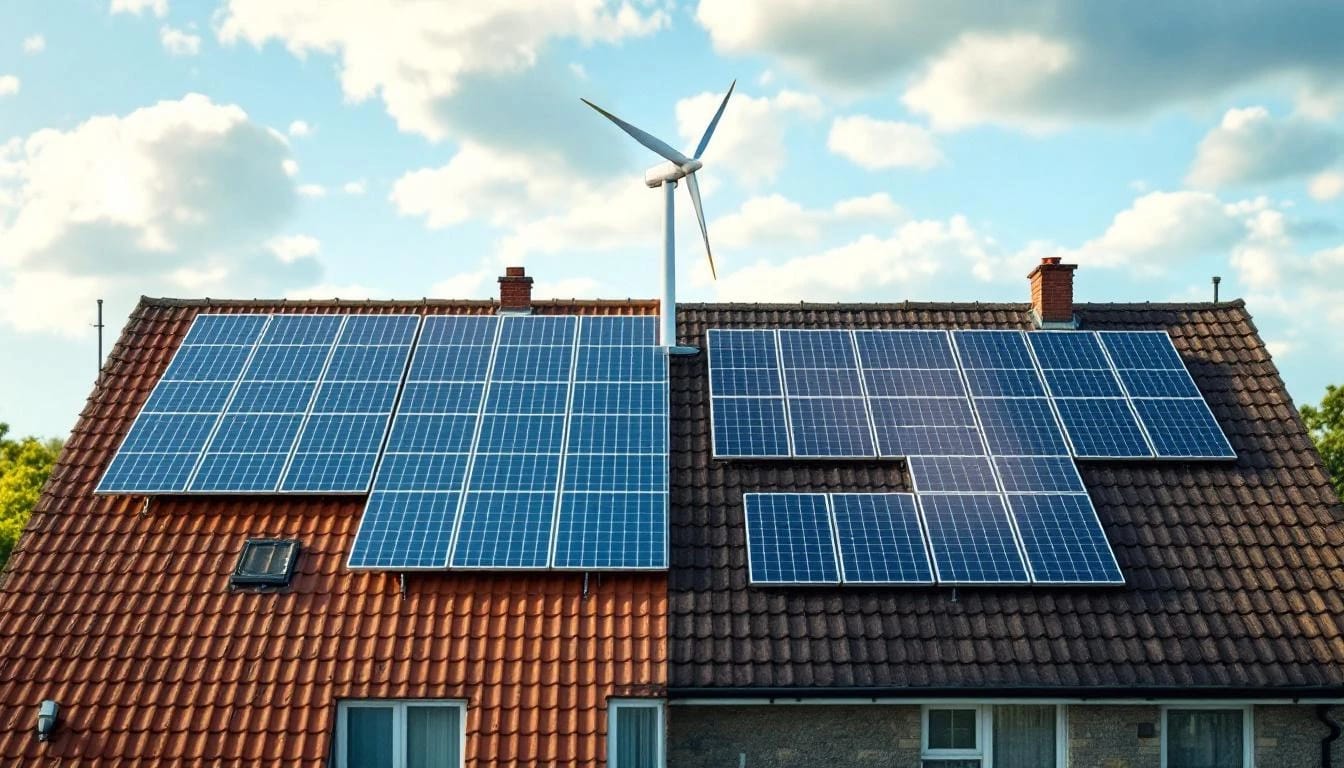
Wind turbines and backup generators solve different power-outage problems. A 1-5 kW small wind turbine costs $4,000-$22,000 installed and generates electricity whenever wind blows above 7-9 mph, delivering free runtime after payback. A standby generator costs $500-$7,000 installed (natural gas/propane models up to $15,000) and provides instant, predictable power for 8-24 hours per tank but requires ongoing fuel purchases. Most homeowners in moderate-wind zones need 12+ years to break even on wind, while generators pay for themselves after 3-5 extended outages in areas with unstable grids.
How wind turbines and generators differ for backup power
A small wind turbine is a renewable energy system that converts kinetic wind energy into electricity through rotating blades connected to a generator. Backup generators are internal-combustion engines that burn gasoline, diesel, propane, or natural gas to produce AC power on demand.
Wind turbines deliver passive, intermittent generation. When wind speed exceeds the cut-in threshold (typically 7-9 mph for residential turbines), the system begins producing power. Output scales with wind speed cubed—doubling wind speed yields eight times the power. A Bergey Excel 10 rated at 10 kW produces that peak only at 31 mph; at typical 12 mph winds, output drops to 1.4 kW. Runtime is theoretically unlimited but depends entirely on local wind patterns.
Generators provide active, dispatchable power. Flip the switch and a standby unit delivers rated capacity within 10-30 seconds. A 7 kW gasoline generator runs 8-10 hours on a five-gallon tank at 50% load. Propane and natural gas models connect to existing fuel lines for extended runtime, but fuel must be purchased or piped in.
Neither system stores energy internally. Wind turbines require a battery bank for off-grid backup or net-metering interconnection to function when the grid fails. Generators produce power only while running and consuming fuel.
Upfront cost comparison: turbines vs generators
Small wind turbines carry significantly higher capital costs than generators. According to the Department of Energy's WINDExchange Small Wind Guidebook, residential wind systems cost approximately $3,000-$8,000 per installed kilowatt. A 5 kW Primus Air 40 turbine costs $6,500-$9,000 for the unit alone, plus $4,000-$8,000 for tower, foundation, wiring, and installation—total $10,500-$17,000. Larger 10 kW systems like the Bergey Excel 10 run $25,000-$35,000 turnkey.
Generators cost a fraction as much:
| Generator Type | Capacity | Installed Cost |
|---|---|---|
| Portable gasoline | 2-7 kW | $500-$1,800 |
| Portable inverter | 2-3 kW | $800-$2,500 |
| Portable diesel | 5-10 kW | $1,200-$3,500 |
| Standby propane/NG | 7-20 kW | $3,000-$7,000 + installation |
| Whole-house standby | 15-22 kW | $5,000-$15,000 installed |
Installation labor differs sharply. A portable generator requires no installation—homeowners run extension cords or a manual transfer switch ($300-$800). Standby generators need a concrete pad, fuel line, automatic transfer switch, and electrical panel integration, adding $1,500-$4,000 in labor. Wind turbines demand engineered foundations, 30-120 foot towers, guy-wire anchors or monopole bases, conduit trenches, grid-tie inverters, and—if off-grid—a battery bank ($4,000-$12,000 for 10-20 kWh lithium). Licensed electrician work for NEC Article 705 grid interconnection typically costs $1,200-$3,000.
The 30% federal Residential Clean Energy Credit (IRC §25D, claimed via IRS Form 5695) applies to small wind systems, reducing net cost by nearly one-third. Generators receive no federal tax incentive. Check DSIRE for state-level rebates—some utilities offer $500-$2,000 for qualified wind installations.
Operating cost and fuel dependency over time
Generators burn fuel with every hour of operation. At mid-2025 prices, a 7 kW gasoline generator consuming 0.5 gallons per hour costs roughly $1.75/hour to run (gasoline at $3.50/gallon). Over a 48-hour outage, fuel cost reaches $168. Propane averages $2.50-$3.50 per gallon; a 20 kW standby unit at 3.2 gallons/hour costs $8-$11/hour or $384-$528 for two days. Natural gas is cheaper—$1.50-$2.50 per therm—but still incurs ongoing expense.
Annual maintenance for generators includes:
- Oil changes every 50-100 hours: $30-$60
- Spark plug replacement: $15-$40
- Air filter: $10-$25
- Carburetor cleaning (gasoline models): $50-$150
- Load-bank testing for standby units: $150-$300
Expect $150-$400/year for maintained standby systems, plus the cost of monthly exercise runs (10-20 minutes) to keep the engine lubricated.
Wind turbines incur near-zero operating costs after installation. No fuel purchases. Maintenance consists of annual visual inspections, bolt re-torquing every 1-3 years ($200-$400 if hiring a technician), and brake-pad or bearing replacement every 5-10 years ($300-$800). Bergey's Excel series uses a direct-drive permanent-magnet alternator with no gearbox, minimizing wear. Inverter replacement may be needed every 10-15 years ($1,200-$2,500). Total lifetime operating cost for a residential turbine averages $3,000-$6,000 over 20-25 years—roughly the fuel cost of running a generator for 200-300 hours.
A homeowner experiencing ten 12-hour outages per year spends $2,100 annually fueling a gasoline generator. The same frequency supplied by a wind turbine (with battery backup) costs only the $200-$300 annual maintenance after the system is paid off.
Runtime and reliability during extended outages
Generator runtime is limited by fuel storage and delivery. A portable unit with a five-gallon tank runs 8-10 hours before refueling. Refueling during operation requires shutdown, cool-down, and restart—risking spoiled food in a refrigerator or interrupting medical equipment. Propane tanks (typically 250-1,000 gallons for home heating) extend runtime to days or weeks, but below 20°F propane vaporization slows and may not sustain full generator load. Natural gas from municipal lines offers near-unlimited runtime until utility pressure drops (which happens during regional disasters).
Standby generators rated for continuous duty (Generac Guardian, Kohler, Cummins Onan) can run 7-10 days non-stop at 70% load before requiring a 24-hour cool-down. Air-cooled consumer models (most under 20 kW) overheat after 10-16 continuous hours and must be shut down for 8-12 hours. This makes them unsuitable for multi-day winter storms or wildfire-season grid shutdowns lasting a week or more.
Wind turbines provide unlimited runtime—if wind blows. A home in a Class 3 wind resource zone (annual average 8.5-9.4 mph at 30 meters) can expect wind above cut-in threshold 40-60% of the time. During a three-day outage with average wind, a 5 kW turbine might generate 60-100 kWh—enough to run essential loads (refrigerator, well pump, lights, internet router, furnace blower) but not whole-house HVAC. During calm periods, a battery bank bridges gaps. Without batteries, a grid-tied wind system is useless during outages unless paired with a hybrid inverter and islanding controller.
Reliability factors include:
- Turbines: Moving parts subject to lightning, icing, bearing wear. Annual downtime typically 2-5% due to maintenance or weather damage. Vertical-axis models like the Aeolos-V 3 kW are less affected by turbulence but produce 20-30% less energy than comparable horizontal-axis designs.
- Generators: Engine failures, carburetor gumming (gasoline models idle 50+ weeks/year), automatic-transfer-switch malfunctions. Standby units fail to start 5-8% of the time if not exercised monthly. Portable models have fewer electronic failure points but require manual setup.
For true backup redundancy, some rural homeowners install both: a wind turbine for daily load reduction and a propane generator for calm-weather emergencies.
Energy output and practical capacity for home backup
Generator capacity is straightforward. A 7 kW unit delivers 7,000 watts continuously (minus 20% derate for altitude and temperature). That powers a refrigerator (600W), freezer (400W), sump pump (800W), well pump (1,200W), furnace blower (600W), LED lighting (200W), and router/TV (150W)—total 4,000W with margin. Whole-house standby units (15-22 kW) support central AC, electric ranges, and laundry simultaneously.
Wind turbine output varies wildly. The power curve for a Bergey Excel 10 shows:
| Wind Speed (mph) | Power Output (kW) |
|---|---|
| 7 (cut-in) | 0.1 |
| 10 | 0.6 |
| 15 | 2.5 |
| 20 | 5.0 |
| 25 | 7.5 |
| 31 (rated) | 10.0 |
At the U.S. average residential wind speed of 9 mph at hub height, this "10 kW" turbine produces only 0.5 kW—enough to run a refrigerator and some lights. To reliably cover 5 kW of critical loads, a homeowner needs a much larger turbine (15-20 kW rated) or must accept intermittent supply with battery buffering.
Annual energy production depends on site wind speed. The DOE Small Wind Guidebook notes that a 10 kW turbine in a Class 3 wind zone (8.5-9.4 mph average) generates approximately 10,000-14,000 kWh/year. The same turbine in a Class 2 zone (7.5-8.5 mph) drops to 6,000-9,000 kWh/year. By comparison, the average U.S. home consumes 10,500 kWh/year. A generator producing 7 kW for 1,500 hours per year (extreme scenario) yields 10,500 kWh but costs $2,600+ in gasoline.
Wind systems excel at reducing grid dependence over months; generators excel at replacing full loads for days. A 5 kW wind turbine offsetting 40% of annual consumption saves $500-$800/year in electricity costs (at $0.14/kWh). A generator sitting idle 360 days/year saves nothing and costs $200-$400 in maintenance.
Permitting, zoning, and installation complexity
Generators face minimal permitting. Portable units require no approval. Standby installations need a local electrical permit (NEC Article 702) and sometimes a mechanical permit for fuel-line work. Municipal inspectors verify the transfer switch prevents backfeeding the grid—a safety requirement to protect line workers. Approval typically takes 1-3 weeks. Homeowner associations may restrict generator placement for noise (most standby units run 60-68 dB at 20 feet—comparable to normal conversation).
Wind turbines face extensive regulation:
- Zoning: Many municipalities restrict turbine height to 35-65 feet, requiring a variance for taller towers. Rural counties often allow structures up to 100 feet by right; suburban zones may prohibit towers entirely.
- Setbacks: Typical requirement is 1.1× total height from property lines. A 100-foot tower needs 110 feet of setback, demanding 1+ acre lots.
- FAA Part 77: Any structure over 200 feet above ground level requires FAA notification. Turbines near airports must file regardless of height; the FAA reviews for interference with flight paths (approval takes 30-60 days).
- NEC Article 705: Grid-tied systems require utility interconnection agreements, anti-islanding protection (IEEE 1547), and AC-disconnect switches accessible to utility workers. Inspections take 4-12 weeks.
- HOA covenants: Many prohibit "windmills" outright. Some states (Colorado, Arizona) have solar/wind access laws that preempt HOA restrictions, but legal battles are common.
Installation timelines differ accordingly. A standby generator goes in over 1-2 days. A wind turbine requires 2-4 weeks of site prep (foundation curing, trenching), tower assembly, and final inspection. Crane rental for large towers adds $800-$2,500.
When wind turbines make sense for backup power
Wind turbines are backup-power candidates when:
High wind resource: Average wind speed ≥9 mph at hub height (30-50 meters). Use the Department of Energy Wind Resource Maps or install an anemometer for 6-12 months of data collection ($300-$800 for logger). Class 3 or better sites recover investment in 10-15 years; Class 2 sites stretch to 18-25 years.
Large property: At least 1 acre, preferably with hilltop or open-prairie exposure. Tree lines, buildings, and terrain block low-altitude wind, necessitating taller (costlier) towers.
Frequent, extended outages: Rural areas on the grid fringe that experience 4+ multi-day outages annually benefit from passive generation. Homeowners paying $2,000/year to refuel generators see faster payback.
Battery-bank investment: Off-grid or islanding systems need 10-20 kWh of lithium storage ($6,000-$14,000 installed) to cover calm periods. Without storage, a grid-tied turbine is worthless when the grid drops.
Grid-offset priority: Homeowners focused on reducing monthly utility bills over 20 years—not just emergency power—get the most value. A 10 kW turbine in a Class 3 zone offsets $1,200-$1,800/year in electricity (at $0.14/kWh), paying for itself in 12-15 years after the 30% federal tax credit.
DIY capability or installer access: Most manufacturers require certified installers (Bergey has a dealer network; Primus and Aeolos offer direct sales but recommend professionals). Remote areas face $2,000-$5,000 travel premiums for specialized crews.
Wind turbines rarely make financial sense purely as backup power. Their true value lies in decades of reduced electric bills with backup as a secondary benefit.
When generators are the better backup-power choice
Generators dominate in these scenarios:
Low wind speed: Class 1 sites (average <7.5 mph) yield poor turbine performance. A 5 kW turbine might generate only 3,000-4,000 kWh/year—15-year payback or worse.
Small lots: Suburban properties under 0.5 acres can't meet setback requirements. Portable generators fit on a patio or in a garage.
Immediate reliability: Power failures during dead-calm weather leave wind systems useless. A generator delivers predictable capacity regardless of weather.
Infrequent outages: Homeowners losing power once or twice a year for 6-8 hours each spend $15-$30 in fuel annually. A $1,200 portable generator pays for itself after the first major storm. A $14,000 wind turbine never does.
Whole-house loads: Running central AC, electric heat, and simultaneous high-draw appliances requires 15-22 kW standby generators. A residential wind turbine would need 30-40 kW rated capacity—unavailable in small-wind models (largest is Bergey Excel 15 at 15 kW rated).
HOA restrictions or rental property: Renters and condo owners can store a portable generator; they can't install a tower. Even owned homes in strict developments have no path to wind-turbine approval.
For most suburban and urban households, a 7-10 kW dual-fuel (gasoline/propane) inverter generator ($1,500-$3,000) plus a 250-gallon propane tank ($400-$800) provides affordable multi-day backup with zero renewable-energy investment or permitting hassles.
Hybrid systems: combining wind and generator backup
Advanced off-grid systems integrate both technologies. A common configuration pairs a 5-10 kW wind turbine with a battery bank (15 kWh lithium) and a diesel or propane generator (5-7 kW). The turbine charges batteries whenever wind blows; the generator runs only when batteries drop below 30% state-of-charge during calm periods.
A charge controller and hybrid inverter manage power flow. Schneider Electric's XW Pro, Outback Radian, and Victron Quattro models support wind input, battery charging from generators, and seamless load transfer. Total system cost: $25,000-$45,000 installed for a 10 kW wind + 5 kW generator + 15 kWh battery setup.
Runtime becomes nearly unlimited. The turbine covers 60-80% of annual energy needs (depending on wind resource), batteries smooth hourly variability, and the generator handles the remaining 20-40% during extended calm spells—reducing fuel consumption from thousands of gallons per year to a few hundred. Maintenance costs rise (both systems need servicing), but fuel savings offset the difference.
These hybrid systems make sense for remote off-grid homes where utility extension costs exceed $30,000 or full-time RVers and rural telecommunications sites needing 24/7 uptime. Suburban grid-tied homes rarely justify the complexity.
Real-world payback and break-even timelines
Break-even for wind turbines depends on three variables: installed cost, annual energy production, and retail electricity rate.
Example 1: Favorable scenario
- Bergey Excel 10 in Montana Class 3 wind zone
- Installed cost: $28,000 (before tax credit)
- Federal tax credit: –$8,400 (30%)
- Net cost: $19,600
- Annual production: 12,000 kWh
- Electricity offset: 12,000 kWh × $0.14/kWh = $1,680/year
- Simple payback: 11.7 years
- 25-year net savings: $22,400 (assuming 2% annual rate escalation)
Example 2: Marginal scenario
- Primus Air 40 (5 kW) in Iowa Class 2 wind zone
- Installed cost: $14,000 (before tax credit)
- Federal tax credit: –$4,200
- Net cost: $9,800
- Annual production: 5,500 kWh
- Electricity offset: 5,500 kWh × $0.12/kWh = $660/year
- Simple payback: 14.8 years
- 25-year net savings: $6,700
For comparison, a 7 kW standby generator ($5,000 installed) pays for itself after 3-5 significant outages if each would otherwise cost $1,000+ in spoiled food, hotel stays, or lost work-from-home income—but provides no ongoing savings.
Most small wind systems achieve 10-18 year payback in Class 3 zones and 18-25 years in Class 2 zones. Generators never pay back in monetary terms (no offset of monthly bills) but deliver immediate return-on-investment through avoided outage costs.
Maintenance requirements and long-term durability
Generators require frequent attention. Gasoline models stored with fuel develop carburetor varnish within 3-6 months; ethanol-blend fuel degrades even faster. Best practice: run the generator monthly for 20-30 minutes under load or use a fuel stabilizer (Sta-Bil, PRI-G) and drain the carburetor when storing over 60 days. Propane and natural gas models avoid fuel-gumming but still need monthly exercise runs to circulate oil and keep the battery charged.
Oil changes every 50-100 hours (annually for standby units) cost $30-$60 DIY or $100-$150 at a service shop. Spark plugs last 100-200 hours. Air filters clog in dusty areas after 50 hours. Standby models need annual load-bank testing ($150-$300) to verify they deliver rated capacity. Consumer-grade generators last 1,000-3,000 hours before needing engine overhauls ($800-$2,000); commercial units (Kohler, Cummins) reach 5,000-10,000 hours.
Wind turbines demand less frequent, more specialized service. Bergey recommends:
- Year 1: Visual inspection, check guy-wire tension (if guyed tower)
- Year 2-5: Re-torque all bolts, inspect blades for cracks, test yaw mechanism
- Year 5-10: Replace brushes (if slip-ring model), check bearing wear, replace brake pads
- Year 10-15: Inverter replacement, blade refurbishment (if damaged by erosion or lightning)
Turbines use either permanent-magnet alternators (Bergey Excel, Primus) or wound-rotor generators (older models). PM designs have fewer wear parts. The main failure modes are bearing seizure from contamination ($500-$1,200 repair) and lightning damage to controllers ($800-$2,500). Proper grounding (NEC Article 250) and surge arresters mitigate lightning risk. Blade erosion in high-wind or abrasive-dust environments may require replacement every 8-12 years ($1,500-$3,500 per set).
Tower maintenance includes inspecting concrete foundations for cracks, re-tightening guy anchors (if applicable), and repainting galvanized steel every 10-15 years. Monopole towers (tilt-up or fixed) simplify maintenance—lower the turbine to the ground for service—but cost $3,000-$8,000 more than guyed towers.
Expected service life: wind turbines last 20-30 years with proper maintenance; generators last 10-20 years (standby models) or 5-10 years (portables).
Can a wind turbine replace a generator for emergency backup?
Only with a battery bank and sufficient wind. Grid-tied wind turbines shut down when the grid fails unless equipped with an islanding inverter and 10-20 kWh of battery storage. Even then, calm weather leaves you without power. For reliable emergency backup, a generator is more dependable. Wind turbines work best for long-term energy offset with backup as a secondary function.
What size wind turbine equals a 7 kW generator for backup power?
A 10-15 kW rated wind turbine produces equivalent average output to a 7 kW generator running at 50% load—but only in Class 3 wind zones (average 8.5-9.4 mph at hub height). Below Class 3, you'd need a 15-20 kW turbine. Most residential properties can't accommodate turbines larger than 10 kW due to zoning and cost constraints ($30,000-$50,000 installed). Generators deliver predictable capacity; turbines deliver variable capacity.
How long does a wind turbine battery bank last during a power outage?
A 10 kWh lithium battery running essential loads (refrigerator, well pump, lights, internet—total 1 kW draw) lasts approximately 8-10 hours at 80% depth of discharge. If the wind turbine recharges the bank during the outage, runtime extends indefinitely. In calm conditions, expect 8-20 hours depending on battery size and load. Most off-grid systems pair 15-20 kWh of storage with wind turbines to cover overnight and calm-day periods.
Do wind turbines work during winter storms when you need backup power most?
Yes, if the turbine remains ice-free. Icing on blades (common below 25°F with freezing rain) disrupts aerodynamics and can stop rotation. Some turbines have blade-heating elements (adds $1,200-$2,500); others rely on vibration to shed ice. Vertical-axis models (Aeolos-V, Windspire) shed ice more easily than horizontal-axis designs. Generators work in any weather as long as fuel doesn't gel (diesel below 15°F, propane below –20°F without additives). For winter reliability, a propane or natural gas generator is more dependable.
What's the noise difference between a wind turbine and a generator?
A residential wind turbine produces 35-45 dB at 100 feet (similar to a refrigerator hum) in moderate wind; at 25+ mph, blade noise rises to 50-55 dB. Generators range from 50-68 dB at 20 feet—louder than turbines and more noticeable because they sit at ground level. Inverter generators (Honda EU2200i, Yamaha EF2000iSv2) run quieter (48-57 dB at 20 feet) than open-frame models (65-75 dB). Neighbors tolerate wind-turbine noise better because it's continuous and white-noise-like; generator rumble is intermittent and intrusive. Check local noise ordinances—many limit nighttime sound to 45-50 dB at property lines.
Bottom line
Wind turbines cost $10,000-$35,000 installed and deliver unlimited runtime if wind blows, but require batteries for outage backup and 10-18 years to recover investment through reduced utility bills. Generators cost $500-$15,000, provide instant predictable power regardless of weather, but incur ongoing fuel costs ($200-$2,000+ per year for frequent use) and limited runtime per tank. Choose a generator for reliable short-term emergency power; choose a wind turbine if you prioritize decades of grid-offset savings in a high-wind area and can afford battery storage for calm-weather gaps. To assess your site's wind potential, request a free consultation from a certified small-wind installer or contact your state energy office through DSIRE for local resource data and incentive programs.
Share this article
windturbinehome.com/s/3044c4
Editorial note: This article was researched and written by a member of the Wind Turbine Home editorial team. AI-assisted tools were used for spell-checking and light grammar review only — all research, analysis, and conclusions are our own. Our editorial policy prohibits sponsored content and paid placements. Read our editorial policy →
Related reading
wind vs solar
Cost per kWh: Wind vs Solar at Residential Scale in 2026
Residential wind costs $0.18–$0.42/kWh versus solar's $0.06–$0.14/kWh when averaged over 20 years. Site wind speed and roof versus tower installation drive the difference.
wind vs solar
Wind vs Solar for Residential: Which One Wins for Your Site
Wind turbines excel in open, windy sites with consistent 12+ mph winds; solar panels dominate in most suburban settings. Compare costs, energy output, and site requirements.
wind vs solar
Home Wind Turbine vs Propane Generator: Lifetime Cost Compared
A 5kW home wind turbine costs $25,000–$40,000 installed but pays back in 8–15 years. A propane standby generator costs $6,000–$12,000 but burns $1,500–$3,000 in fuel yearly.
wind vs solar
Wind Turbine vs Solar for an RV: Which Actually Wins on the Road
Solar panels dominate stationary RV camping with 400W systems under $800, but wind turbines shine during stormy weather and overnight charging in windy sites.
wind vs solar
Wind Turbine vs Solar for an Off-Grid Cabin: Which Powers Best?
Wind turbines excel in winter and forested sites, while solar panels dominate summer and desert cabins. Most off-grid setups combine both for year-round power.
wind vs solar
Do Wind Turbines Work at Night? Power Generation After Dark
Wind turbines generate electricity 24/7 whenever wind blows, including at night. Unlike solar panels, small wind systems often produce more power after sunset.
wind vs solar
Home Wind Turbine vs Solar Panels: Which Wins for Your Site
Compare wind turbines and solar panels for residential power. Learn which renewable option delivers better ROI based on your property's wind speed, sun hours, and budget.