Home Wind Turbine vs Solar Panels: Which Wins for Your Site
Compare wind turbines and solar panels for residential power. Learn which renewable option delivers better ROI based on your property's wind speed, sun hours, and budget.
Share this article
windturbinehome.com/s/8c0079
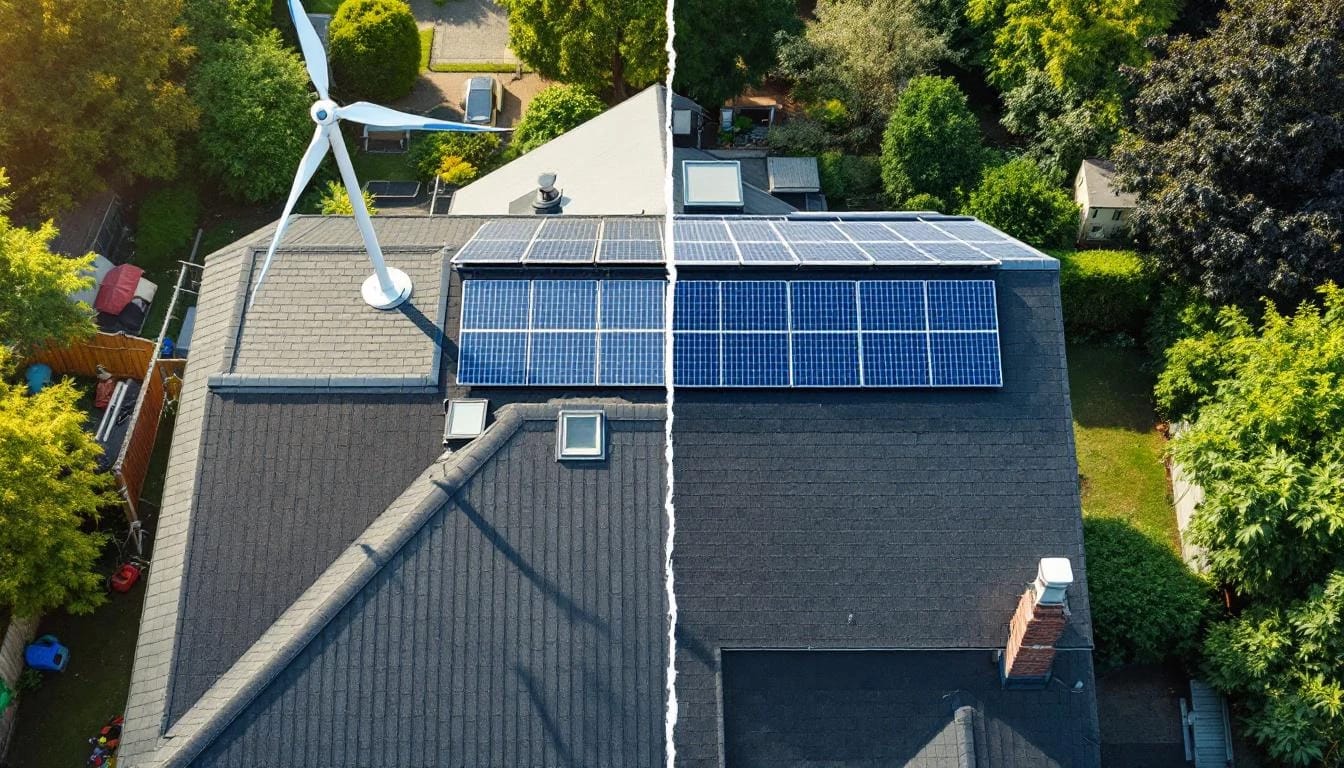
Most homeowners face a binary choice when shopping for renewable energy: mount solar panels on the roof or raise a small wind turbine in the yard. The honest answer is that neither "wins" universally. A site with consistent 12 mph average wind and minimal sun exposure favors turbines. A suburban lot with southern exposure and tree-sheltered calm favors photovoltaics. The decision hinges on local wind resource, available space, zoning tolerance, and your willingness to maintain moving parts. This guide walks through power output, economics, permitting, and site-specific math so you can make the call with confidence.
Why wind speed matters more than you think
Solar irradiance is fairly predictable across the continental United States—most locations see 4–6 peak sun hours per day, and the National Renewable Energy Laboratory publishes county-level maps. Wind, by contrast, is chaotic at the micro scale. A ridge-top property in Wyoming may average 14 mph while a wooded subdivision three miles away scrapes 8 mph. Turbine power output scales with the cube of wind speed, so doubling velocity from 10 mph to 20 mph yields eight times the energy.
Before spending a dollar, measure your site with an anemometer mounted at the proposed hub height for at least three months—ideally a full year. Handheld spot readings are useless; wind varies hour-to-hour and season-to-season. The rule of thumb: annual average below 10 mph makes a residential turbine uneconomical. Between 10–12 mph, you're in the gray zone where a small Bergey Excel or Primus AIR turbine can pencil out if electricity rates exceed eighteen cents per kilowatt-hour. Above 12 mph, wind starts to compete with solar on pure kilowatt-hour cost.
Solar panels, meanwhile, perform predictably once you account for shade, tilt, and azimuth. A south-facing array in Kansas will generate within 5 percent of NREL's PVWatts estimate year after year. Trees, chimneys, and neighbor structures matter, but the output curve is smooth and the technology has no dynamic threshold—panels produce something even on overcast days. Turbines need that minimum cut-in speed (typically 6–8 mph) or the rotor sits idle.
Upfront cost and federal incentives
A grid-tied 5 kW rooftop solar array—enough to offset half of a typical household's annual consumption—runs $12,000–$17,000 after applying the federal 30 percent Residential Clean Energy Credit (IRS Form 5695, IRC §25D). That price includes panels, inverter, racking, wire, and professional installation. Per watt, solar has dropped below $2.40 in most markets as of late 2024.
A comparable 5 kW wind turbine system costs $20,000–$35,000 installed, also eligible for the same 30 percent federal credit. The range is wide because tower height drives labor and materials: a 60-foot tilt-up tower with guy wires is cheaper than a 100-foot freestanding monopole. Shipping a 400-pound nacelle and blades, pouring a concrete foundation, and hiring a crane or gin pole crew pushes wind's effective cost to $4–$7 per watt.
State and utility incentives vary. Check the Database of State Incentives for Renewables & Efficiency (DSIRE) for rebates, sales-tax exemptions, and performance payments. California's Self-Generation Incentive Program historically favored solar over wind. Great Plains states—Nebraska, South Dakota, Kansas—sometimes offer property-tax abatements for small wind. Your local electric co-op may buy surplus generation at wholesale or retail rate under net metering; confirm the meter agreement covers turbine interconnection, not just solar.
Power output under real-world conditions
A 5 kW nameplate solar array in Phoenix averages 7,500–8,000 kWh per year. The same array in Seattle drops to 5,500–6,000 kWh because of fewer sun hours and more cloud cover. Degradation is roughly 0.5 percent annually; after twenty years the system still operates near 90 percent of original capacity.
A 5 kW wind turbine in a 12 mph average site produces 6,000–9,000 kWh per year, depending on tower height and local turbulence. The power curve is non-linear: a Bergey Excel 10 at 13 mph yields about 1,500 kWh per month in winter when demand peaks, but the same machine in an 8 mph urban backyard barely hits 200 kWh per month. Turbines also suffer performance loss over time—bearings wear, blade leading edges erode, yaw mechanisms stiffen. Expect 1–2 percent annual decline without midlife refurbishment.
The seasonal profiles diverge. Solar peaks in summer when air conditioning drives demand; wind often peaks in spring and fall when pressure gradients are steepest. If your utility offers time-of-use rates, winter wind can offset expensive evening draw when solar produces nothing. Combining both technologies—a hybrid microgrid—smooths total generation across the year but doubles capital outlay and complexity.
Maintenance, lifespan, and hidden costs
Solar panels are inert. Rinse them twice a year, check wire connections, replace the inverter once around year twelve. Budget $200–$400 annually for monitoring and minor upkeep. Panel warranties run twenty-five years for output, ten to fifteen for materials. Inverter warranties cover ten to twelve years; a replacement microinverter or string inverter costs $1,500–$3,000.
Wind turbines spin at hundreds of RPM in a corrosive, vibrating environment. Annual maintenance includes greasing the yaw bearing, inspecting blade attachment bolts, checking tower guy-wire tension, and verifying slip-ring or cable-twist continuity. Every five to seven years, lower the tower for bearing replacement and blade leading-edge tape. Parts and labor run $500–$1,200 per year for a diligent owner-operator; hire a technician and the bill climbs to $1,500–$2,500. Manufacturer warranties span five years on average; after that you're self-insuring against gearbox or generator failure, which can cost $3,000–$7,000.
Tower inspection is a hidden line item. NEC Article 705 requires that all distributed generation meet structural and electrical code, but local inspectors often lack wind-turbine expertise. A registered professional engineer may need to stamp tower drawings, adding $800–$2,000. Guy anchors must be tested for pull-out resistance, and concrete piers require soil reports in seismic or frost-heave zones.
Decommissioning is easier with solar—unbolt the racks, recycle the panels at an e-waste facility. Removing a wind tower means cutting guy cables, extracting ground anchors, demolishing the concrete pad, and possibly restoring soil compaction if the site ever changes hands. Factor $2,000–$5,000 for professional teardown.
Zoning, permits, and neighbor relations
Most municipalities allow roof-mounted solar by right or with a simple building permit. Height restrictions apply, but a flush-mount array rarely triggers zoning variance. Homeowner associations can be hostile; check CC&Rs before signing a contract. Some states have solar-access laws that override HOA bans, but litigation is slow and expensive.
Wind turbines run into setback rules, height limits, and noise ordinances. The typical requirement: tower height plus 10 percent must fit within your property line if the structure fails. A 60-foot tower on a half-acre lot is tight; a 100-foot tower demands two acres minimum. Suburban and urban parcels seldom qualify.
Height triggers Federal Aviation Administration review under Part 77 if the tower exceeds 200 feet above ground level or sits near an airport. Residential turbines stay below that threshold, but you still file FAA Form 7460-1 for structures 50–199 feet. The review takes about a month and usually results in a "no hazard" determination, but delayed approval stalls construction.
Noise is subjective and contentious. A well-designed turbine at 300 feet emits 40–45 dBA, comparable to a quiet library. Older machines with metal blades or poor yaw damping produce a rhythmic "whump" that travels farther at night when ambient sound drops. Some neighbors complain about shadow flicker—blade shadows sweeping across windows at sunrise or sunset. Siting the tower 500+ feet from occupied structures minimizes disputes, but few residential lots offer that buffer.
Comparing five-year total cost of ownership
Assume a 5 kW system in a location with 12 mph wind and 5 peak sun hours per day. Electricity rate: $0.20/kWh. Federal credit: 30 percent. No state rebates.
| Line item | Solar (5 kW) | Wind (5 kW) |
|---|---|---|
| Gross installed cost | $15,000 | $28,000 |
| Federal credit (30%) | –$4,500 | –$8,400 |
| Net upfront | $10,500 | $19,600 |
| Annual generation (kWh) | 7,200 | 7,500 |
| Year-1 savings (@$0.20/kWh) | $1,440 | $1,500 |
| Annual maintenance | $300 | $1,000 |
| Net year-1 savings | $1,140 | $500 |
| Five-year O&M | $1,500 | $5,000 |
| Five-year generation value | $7,200 | $7,500 |
| Net five-year position | –$4,800 | –$17,100 |
At this rate and site, solar reaches positive cash flow around year nine; wind around year fourteen. If the wind site improves to 14 mph average, annual generation jumps to 11,000 kWh, shortening payback to eleven years. If electricity climbs to $0.30/kWh—plausible in California or Hawaii—both technologies pay back faster, but solar still leads on maintenance burden.
The table illustrates why small wind remains niche. Only high-wind, high-rate markets justify the capital and hassle. Vertical-axis turbines promise lower cut-in speeds and quieter operation, but field data show they underperform horizontal-axis machines watt-for-watt.
When wind makes sense
Wind pencils out on ridge-top acreage, coastal bluffs, and Great Plains farmsteads where annual average exceeds 13 mph and the nearest structure is a quarter-mile away. If you already own a tractor, a welder, and a comfort with mechanical systems, owner-maintenance keeps costs reasonable. Ranchers and off-grid homesteaders often pair a 10 kW turbine with a battery bank sized for three days of autonomy, accepting the complexity in exchange for energy sovereignty.
Wind also suits seasonal cabins in windy mountain passes where winter access makes solar snow-clearing impractical. The turbine keeps batteries topped while you're absent, and spring gales recharge the bank faster than waiting for the snowpack to melt off panels.
Hybrid systems—3 kW solar + 3 kW wind—diversify risk and smooth generation. The capital outlay doubles, but you're less vulnerable to a single point of failure and you capture energy across more hours of the day. This configuration shines in microgrids where propane backup is expensive or unavailable.
When solar is the obvious choice
Solar dominates in suburbs, planned communities, and anywhere zoning caps structure height at 35 feet. It's silent, invisible from the street, and requires no specialized mechanical skill. Financing options—PACE loans, solar leases, power-purchase agreements—make it accessible even if you lack $10,000 in cash. Panels installed by a licensed contractor meet NEC Article 690 and local fire codes with minimal inspector pushback.
If your roof is less than fifteen years old, south-facing, and shade-free, solar is a thirty-minute decision. Run PVWatts, get three bids, confirm net metering with your utility, apply for the federal credit, and move forward. The technology is mature, the supply chain is robust, and warranty claims follow established channels.
Solar also wins on resale value. Appraisers understand it; buyers see lower electric bills. A wind tower is a coin flip—some buyers see it as an asset, others as a liability they'll pay to remove. Realtors often advise dismantling turbines before listing unless the property markets explicitly as a homestead or farm.
Grid interconnection and net metering
Both technologies require utility approval for grid-tie. Submit an interconnection application—typically a two-page form plus single-line diagram and equipment spec sheets—and wait four to eight weeks. The utility installs a bidirectional meter (or reprograms your existing smart meter) to track export.
Net metering policies vary by state. Full retail credit means every surplus kWh offsets a future kWh one-for-one; you pay only the net difference at month-end. Wholesale or avoided-cost buyback pays you $0.03–$0.06/kWh for exports, so oversizing the system yields poor returns. Some utilities impose monthly fees ($10–$30) for interconnection; factor that into payback math.
NEC Article 705 governs the electrical interface. Solar inverters must have anti-islanding protection and comply with IEEE 1547. Wind inverters (or turbine-integrated controllers) meet the same standard. The installer pulls a permit, the inspector verifies labeling and disconnect placement, and the utility grants permission to operate. Skipping permits is common with small DIY turbines but voids insurance and risks a forced disconnect.
Environmental and carbon considerations
Manufacturing a solar panel emits about 50 grams of CO₂-equivalent per kilowatt-hour over its lifecycle (mining silicon, smelting, shipping). A wind turbine emits roughly 11 g CO₂-eq/kWh (steel tower, fiberglass blades, transportation). Both beat the U.S. grid average of 400 g CO₂-eq/kWh by orders of magnitude.
Panel recycling is improving—First Solar and several EU programs recover 95 percent of materials—but most residential installers still landfill old panels. Turbine blades are thermoset composite; they don't melt and end up in landfills too, though researchers are developing chemical recycling routes. The tower and nacelle are steel and copper, easily scrapped.
Bird and bat mortality is low for small residential turbines (single-digit strikes per year) compared to commercial wind farms. Painting one blade tip black reduces collisions by 70 percent, per Norwegian research. Bats are more vulnerable during migration; shutting down the turbine on calm August nights when bats hunt mitigates risk.
Visual impact is subjective. Some people find a spinning rotor graceful; others see industrial blight. Solar panels are lower-profile but change the roofline. Neither technology is invisible, so weigh aesthetics against carbon reduction in your personal calculus.
Can I install both solar and wind on the same property?
Yes. Hybrid systems capture solar during calm summer days and wind during overcast winter storms. Wire both to a common inverter or use separate grid-tie units with independent net metering. The federal 30 percent credit applies to combined cost. Expect higher design complexity and ensure your electrical panel has capacity for dual feeds per NEC 705.10(D).
Do I need batteries, or can I rely on net metering?
Net metering lets the grid act as your battery, banking surplus daytime solar or windy-night generation for later use. Batteries add $8,000–$15,000 for 10–15 kWh of lithium capacity and make sense if you want backup during outages or live where net metering pays poorly. Off-grid wind systems require batteries; grid-tie systems usually don't.
How loud is a home wind turbine compared to a rooftop AC unit?
A 5 kW turbine at 300 feet measures 40–45 dBA, quieter than a typical central air conditioner (50–60 dBA at ten feet). Blade tip speed and gearbox design matter—direct-drive permanent-magnet machines are quieter than geared turbines. Neighbors rarely complain if the tower sits 500+ feet away, but closer spacing in dense subdivisions invites disputes.
What happens to wind turbines in hurricanes or tornadoes?
Most residential turbines have storm modes: the controller feathers the blades or activates a mechanical brake above 55 mph, stopping the rotor to prevent overspeed. Towers are engineered for 100–120 mph wind loads (ASCE 7 standards). If a tornado strikes, the turbine is likely destroyed, but homeowner's insurance typically covers the loss if you disclosed the installation. Solar panels can blow off in extreme wind if racking is under-spec'd; ensure installers follow local wind-zone ratings.
Can I claim the 30% tax credit if I DIY the installation?
Yes, but only for equipment cost—no labor credit since you're not paying wages. Keep receipts for the turbine, tower, concrete, wire, and disconnect hardware. NEC-compliant work still requires permits and inspection; unpermitted systems risk credit denial on audit. If you lack electrical or rigging experience, hire professionals for the foundation pour, tower erection, and final grid interconnection to avoid injury and code violations.
Bottom line
Solar panels deliver predictable, low-maintenance generation across most U.S. climates and fit suburban lots without zoning drama. Wind turbines reward rural sites with strong, consistent wind and owners who embrace mechanical upkeep. Neither technology "wins" universally—run the numbers for your specific wind resource, electricity rate, and available space. If average wind speed stays below 11 mph or local setbacks box you in, solar is the pragmatic default. Above 13 mph on open land, a well-sited small wind turbine can match or beat solar's economics. For the highest reliability, consider a modest hybrid system and budget for professional installation to satisfy NEC Article 705 and your utility's interconnection rules.
Share this article
windturbinehome.com/s/8c0079
Editorial note: This article was researched and written by a member of the Wind Turbine Home editorial team. AI-assisted tools were used for spell-checking and light grammar review only — all research, analysis, and conclusions are our own. Our editorial policy prohibits sponsored content and paid placements. Read our editorial policy →
Related reading
wind vs solar
Cost per kWh: Wind vs Solar at Residential Scale in 2026
Residential wind costs $0.18–$0.42/kWh versus solar's $0.06–$0.14/kWh when averaged over 20 years. Site wind speed and roof versus tower installation drive the difference.
wind vs solar
Wind vs Solar for Residential: Which One Wins for Your Site
Wind turbines excel in open, windy sites with consistent 12+ mph winds; solar panels dominate in most suburban settings. Compare costs, energy output, and site requirements.
wind vs solar
Home Wind Turbine vs Propane Generator: Lifetime Cost Compared
A 5kW home wind turbine costs $25,000–$40,000 installed but pays back in 8–15 years. A propane standby generator costs $6,000–$12,000 but burns $1,500–$3,000 in fuel yearly.
wind vs solar
Wind Turbine vs Solar for an RV: Which Actually Wins on the Road
Solar panels dominate stationary RV camping with 400W systems under $800, but wind turbines shine during stormy weather and overnight charging in windy sites.
wind vs solar
Wind Turbine vs Generator for Backup Power: Cost & Runtime
Wind turbines deliver unlimited runtime but need wind and large upfront costs. Generators offer instant power for $500-4,000 but require fuel. Compare costs, reliability, and when each works best.
wind vs solar
Wind Turbine vs Solar for an Off-Grid Cabin: Which Powers Best?
Wind turbines excel in winter and forested sites, while solar panels dominate summer and desert cabins. Most off-grid setups combine both for year-round power.
wind vs solar
Do Wind Turbines Work at Night? Power Generation After Dark
Wind turbines generate electricity 24/7 whenever wind blows, including at night. Unlike solar panels, small wind systems often produce more power after sunset.