How to Build a Wind Turbine for Your Home: A Realistic DIY Plan
Building a home wind turbine DIY requires electrical expertise, structural engineering knowledge, and 40-80 hours of work. Most homeowners save money and reduce risk by buying certified turbines like the Primus Air 40 or Bergey Excel 1 instead.
Share this article
windturbinehome.com/s/0faf06
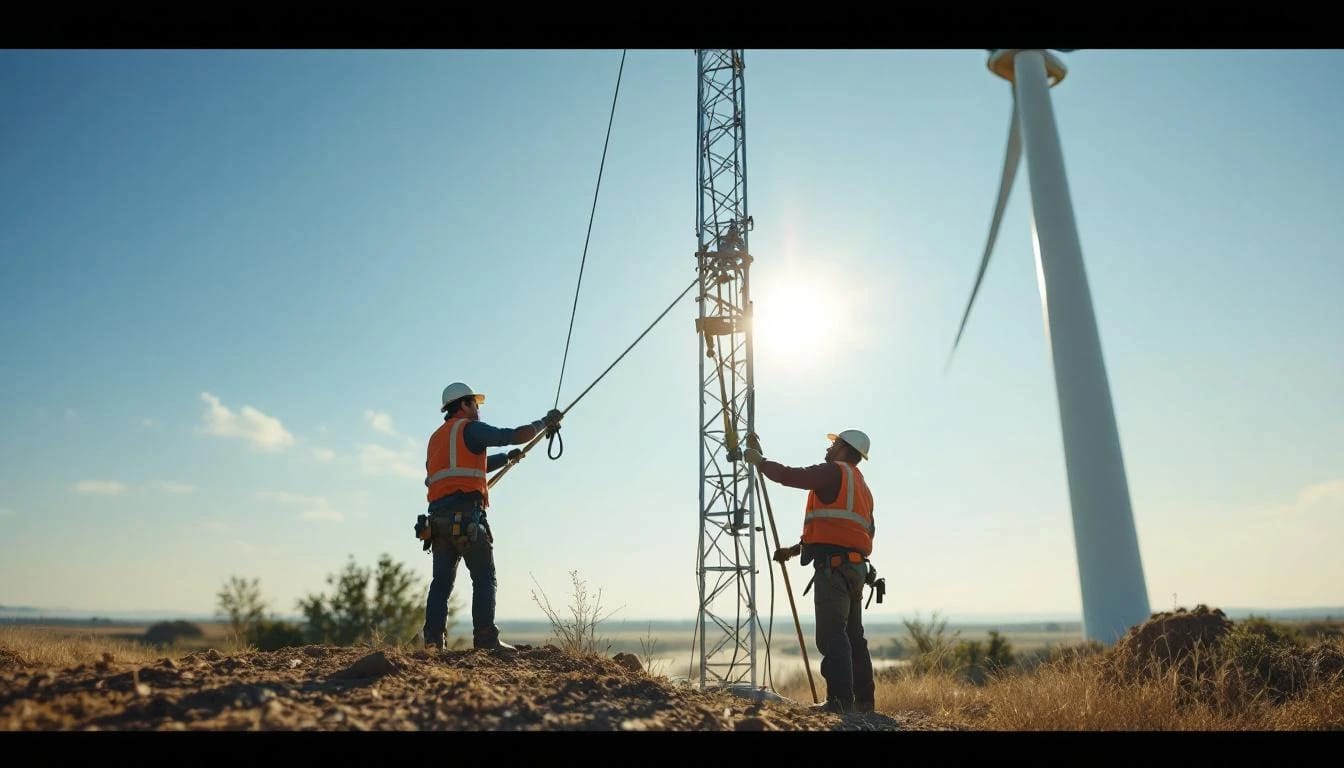
Building a wind turbine from scratch sounds like an exciting weekend project, but the reality involves electrical calculations that could lead to fires, structural loads that could drop a rotor through your roof, and permitting requirements that vary wildly by jurisdiction. A realistic DIY vertical-axis wind turbine using off-the-shelf parts requires 40-80 hours of skilled labor, $800-2,400 in materials, and working knowledge of NEC Article 705 interconnection rules. Most builders discover halfway through that a factory turbine like the Primus Air 40 ($2,800 installed) or Pikasola 400W vertical model ($320 kit) delivers better performance with less legal exposure. That said, motivated individuals with metalworking skills, basic electrical training, and patience can build a functional small turbine—just not the grid-tied powerhouse advertised in viral videos.
Why Most DIY Wind Turbine Projects Fail
Three factors doom amateur wind projects: underestimating blade design complexity, ignoring tower dynamics, and misunderstanding inverter compatibility. PVC pipe blades and ceiling-fan motors appear in dozens of YouTube tutorials, yet these assemblies generate meaningful power only in sustained 25+ mph winds—conditions that occur less than 5% of the year in most suburban areas. The swept area equation (power proportional to blade diameter squared) means a 4-foot diameter rotor captures one-quarter the energy of an 8-foot rotor, which explains why commercial micro-turbines start at 1.2 meters.
Tower vibration kills more DIY turbines than electrical faults. A 30-foot mast experiences cyclical loading from turbulent wind, and any wobble at the base amplifies exponentially at the nacelle. Builders who skip guy-wire tensioning or use hardware-store U-bolts instead of rated shackles often watch their turbines shake apart within the first storm season.
Grid interconnection presents the steepest learning curve. A wind turbine produces wild AC (varying voltage and frequency), which must pass through a rectifier, charge controller, battery bank, and grid-tie inverter before feeding your breaker panel. NEC Article 705.12 requires interconnection equipment to meet UL 1741 standards and disconnect automatically during utility outages—protections absent from most DIY charge controllers marketed online.
Required Skills and Safety Precautions
Attempting a home wind build without these competencies creates serious injury risk:
Electrical proficiency: Understanding three-phase AC, proper wire gauge for ampacity (NEC Table 310.16), overcurrent protection sizing, and grounding electrode systems per NEC Article 250. A 400-watt turbine operating at 48V DC can deliver 8.3 amps—enough to ignite insulation if undersized wire creates resistance heating.
Metalworking capability: Cutting, drilling, and balancing aluminum or steel blades to within 2-gram tolerance. An unbalanced rotor creates harmonic vibration that destroys bearings and cracks welds.
Structural analysis: Calculating wind load per ASCE 7-22 guidelines, selecting appropriate tower diameter and wall thickness, and designing a foundation that resists overturning moment. A 10-foot diameter rotor in 50 mph wind exerts roughly 400 pounds of lateral force at the tower top.
Height safety: Working at elevation requires fall protection harnesses rated to ANSI Z359, proper ladder setup on level ground, and ideally a second person for tool handling and emergency response.
Most municipalities require electrical work to be performed by or inspected by a licensed electrician. Attempting grid interconnection without permit approval risks denied insurance claims after equipment damage and potential fines when utility smart meters flag reverse power flow anomalies.
Materials List for a 400W Vertical-Axis Turbine
This parts list supports a Savonius-style vertical rotor producing 200-400W in 15-25 mph wind—suitable for battery charging but not primary home power. Total materials cost: $850-1,400 excluding tower.
Rotor assembly:
- 6-foot diameter steel drum or 4x 55-gallon polyethylene barrels (cut and shaped)
- 1-inch solid steel shaft, 8 feet long
- Two pillow-block bearings rated for 1,500 RPM
- Four 3/8-inch grade 8 bolts with lock washers per barrel attachment
- Automotive wheel hub and bearing assembly for low-friction rotation
Generator and electrical:
- Permanent magnet alternator (PMA), 12V or 24V output, 400W rated (common brands: Missouri Wind and Sun, Windblue Power)
- Three-phase bridge rectifier rated 50A continuous
- Charge controller suitable for wind (not solar-only), 400W minimum capacity
- 10 AWG THWN-2 copper wire (generator to controller, 15-foot run)
- Weatherproof junction box, NEMA 4X rated
Tower and mounting (15-25 foot range):
- Schedule 40 steel pipe, 3-inch diameter, or telescoping mast sections
- Concrete pier foundation, 3-foot depth below frost line
- 1/4-inch galvanized steel guy wire (three-point anchoring minimum)
- Cable thimbles and wire rope clips (never fewer than three per termination)
Safety and instrumentation:
- Anemometer and data logger (optional but highly recommended for performance validation)
- Emergency brake mechanism—spring-loaded caliper or furling tail
- Grounding rod, 8-foot copper-clad steel, driven to 25 ohms or less resistance
Purchase PMAs from specialty vendors rather than automotive alternators. Car alternators require input shaft speeds of 1,800+ RPM, while wind turbine rotors typically spin 200-600 RPM. Direct-drive PMAs generate usable voltage at low speed without gearbox complexity.
Step-by-Step Build Process
Phase 1: Blade Fabrication and Balancing
Cut barrel sections to create two or three Savonius scoops—curved half-cylinders that catch wind from any direction. Each scoop should span 4-6 feet vertically. Drill mounting holes at precise radial intervals (use a rotary table or indexing jig if available). After bolting scoops to the central shaft, spin the assembly on sawhorses and mark the heavy side with chalk. Grind metal from heavy spots or add set-screw weights to light sides until the rotor stops at random positions when spun—proof of balance.
Poor balance shortens bearing life from years to months. Commercial turbines balance rotors to ISO G6.3 standards (vibration velocity under 6.3 mm/s), a target impossible without specialized equipment but worth approximating.
Phase 2: Generator Mounting and Wiring
Bolt the PMA to a steel plate beneath the rotor shaft, ensuring the generator input shaft aligns within 0.5 degrees of the turbine shaft. Misalignment creates side loads that destroy magnets. Use a flexible coupling (Lovejoy-style jaw coupler) to accommodate minor errors.
Strip 3/4 inch of insulation from each of the three generator leads. Connect them to the rectifier input terminals, then run positive and negative DC output lines to the charge controller. Install an inline fuse rated 125% of maximum expected current—for a 400W turbine at 12V, that's a 50A fuse. Secure all connections with heat-shrink tubing and strain relief clamps; vibration will loosen crimp connectors over time.
Ground the turbine frame and tower with 6 AWG bare copper wire to the grounding electrode, per NEC Article 250.52. This protects against static buildup and provides a low-resistance path for lightning-induced currents (though a direct strike will still destroy electronics).
Phase 3: Tower Erection and Foundation
Dig a hole 3 feet deep and 18 inches diameter, extending below your local frost line. Insert a sonotube form and fill with 3,000 PSI concrete, embedding J-bolts in a square pattern to match your tower base plate. Cure for seven days minimum before loading.
Anchor guy wires at 120-degree intervals, 50-75% of tower height away from the base. Each anchor needs a concrete deadman (buried block) or earth screw rated for 1,000+ pounds tension. Attach guy wires to the tower at two-thirds height for a 20-foot mast, using cable clamps and thimbles—never tie wire around the tower in loops.
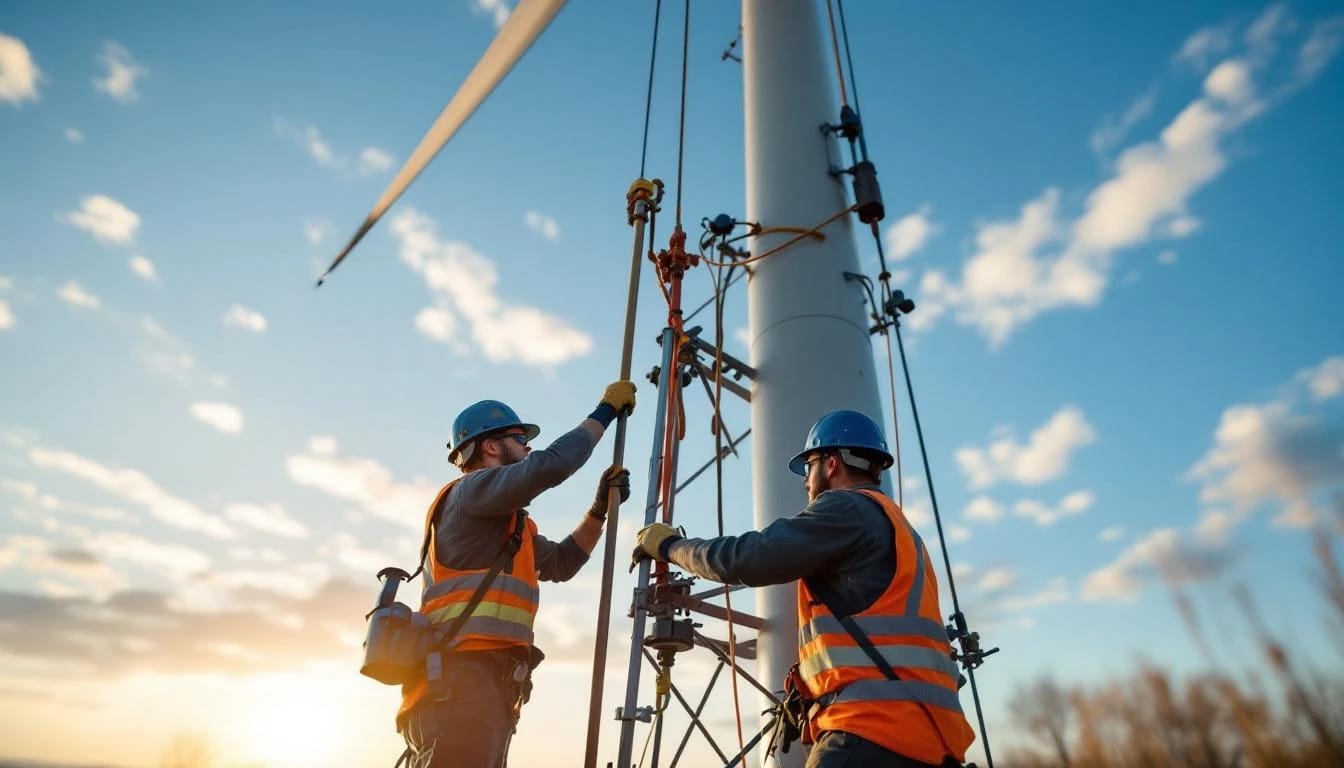
Raise the tower using a gin pole or tilting base method. With the tower horizontal on the ground, attach the turbine assembly, then use a winch or vehicle to pull the tower vertical while two people guide it with tag lines. This step demands coordination and clear communication about hand positions near pinch points.
Tension guy wires to 10-15% of their breaking strength using turnbuckles with locking pins. Check tension with a cable tension gauge if available, or by measuring cable deflection under a known lateral force.
Electrical Integration Options
Three paths exist for using DIY wind power, each with different complexity and return on investment:
Battery-only system: The simplest approach. Turbine charges a 12V or 24V deep-cycle battery bank (lithium iron phosphate preferred for cycle life), which powers DC appliances or feeds an inverter for AC loads. No utility interconnection means no permits in most jurisdictions, but also no ability to sell excess power. Requires battery charge management to prevent overcharging—voltage regulators must dump excess energy to a resistive load when batteries reach 14.4V (12V system) or 28.8V (24V system).
Grid-tie with battery backup: The turbine charges batteries that supply an inverter capable of grid synchronization. Inverters like the Outback Radian or Schneider Electric Conext meet UL 1741 SA standards for anti-islanding protection, automatically disconnecting when the grid fails. This setup requires a licensed electrician to install the interconnection breaker per NEC Article 705.12(D) and utility approval before energizing. Expect 4-12 weeks for utility review in most states.
Direct grid-tie (rare for DIY): Feeding wind power directly to the grid without batteries demands inverters with maximum power point tracking (MPPT) optimized for wind's variable output. Fronius and SMA manufacture grid-tie inverters with wind profiles, but the cost ($1,800-3,500) combined with permitting complexity pushes most builders toward the battery-first approach.
Consult DSIRE (Database of State Incentives for Renewables & Efficiency) to determine whether your state offers production-based incentives or property tax exemptions for residential wind. The federal 30% Residential Clean Energy Credit (IRC §25D, claimed on IRS Form 5695) applies to wind turbine purchases and installation labor through 2032, but DIY material costs may not qualify without professional invoices proving the equipment is part of a complete energy system.
Performance Expectations and Economics
A well-executed 400W DIY vertical-axis turbine will generate 15-30 kWh per month in locations with 10 mph average wind speeds—roughly $2-4 worth of electricity at U.S. residential rates. Annual production rarely exceeds 150 kWh unless sited in consistently windy terrain (coastal bluffs, Great Plains).
Compare this to a Bergey Excel 1 (1 kW rated, $6,200 equipment cost), which produces 150 kWh monthly in the same conditions. The DIY turbine costs 70% less but delivers 20% of the output, making it economically rational only when built for education rather than financial return.
Return on investment calculations must include opportunity cost: 60 hours at $25/hour (a conservative skilled labor rate) equals $1,500 in time value. Adding $1,200 in materials yields a $2,700 total investment for a system generating $3-5 worth of power monthly. Payback stretches beyond 45 years before factoring in maintenance, bearing replacement, and rectifier failures.
The DIY advantage emerges in off-grid scenarios where commercial installation quotes reach $12,000-18,000 due to travel premiums and small-job overhead. A builder in rural Montana or Alaska might justify the project when grid extension costs $30+ per linear foot and the nearest electrician is 90 miles away.
Common Problems and Troubleshooting
Low output despite adequate wind: Check for brake drag (bearing preload too tight), poor blade pitch angle (vertical-axis turbines are less sensitive but still affected by scoop overlap), or rectifier voltage drop. Use a multimeter to measure AC voltage at generator terminals under spin—should see 12-30V AC at 300 RPM for a typical 12V PMA.
Excessive vibration: Rebalance the rotor. If vibration persists, inspect guy wire tension (one loose wire allows pendulum motion) and tower verticality (even 2 degrees off-plumb creates harmonic wobbling). A tower leaning into the prevailing wind sees accelerated fatigue.
Charge controller error codes: Most wind controllers display fault codes when input voltage exceeds safe limits during high winds. This indicates missing dump load resistance or controller undersizing. A 400W turbine can briefly spike to 600W in gusts, requiring a controller rated 50% above nameplate.
Bearing noise: Early bearing failure signals contamination (moisture in grease seals) or side loading from misalignment. Replace bearings annually in coastal environments where salt spray accelerates corrosion.
Permits, Zoning, and FAA Notification
Contact your local building department before purchasing materials. Zoning codes typically limit residential turbine height to 35 feet in suburban areas, 50-60 feet in agricultural zones. Some HOAs prohibit wind turbines entirely under aesthetic covenants.
FAA Part 77 notification applies to any structure exceeding 200 feet AGL (above ground level), irrelevant for residential turbines. However, structures within 20,000 feet of airport runway centerlines may require review regardless of height. File Form 7460-1 at least 45 days before construction if uncertain—processing is free and provides legal clarity.
Electrical permits are mandatory when connecting to the grid or modifying service panel load capacity. Expect inspection fees of $75-200 and a requirement that a licensed electrician stamp the final interconnection. Skipping permits voids homeowner's insurance coverage if a wind-related electrical fire occurs.
Property surveys may be required to prove guy wire anchors remain within lot boundaries. Notify neighbors before installation if anchors approach property lines or if shadow flicker from spinning blades could affect adjacent homes.
When to Buy Instead of Build
Purchase a certified turbine if any of these conditions apply:
- No metalworking tools or electrical testing equipment available
- Local wind speeds below 10 mph annual average (use a temporary anemometer for 3-6 months before committing)
- Grid-tie installation desired with minimal permitting friction (UL-listed equipment expedites approval)
- More than 1 kW capacity needed (DIY turbine performance degrades sharply above 500W due to increased structural demands)
- Warranty protection valued (commercial turbines offer 5-10 year coverage; DIY builds have no recourse)
The Primus Air 40 (1.8 kW, $4,500 equipment) and Bergey Excel 6 (6 kW, $18,000 equipment) represent solid entry points for buyers prioritizing performance over cost. For experimental budgets, Pikasola's 400W vertical turbine kit ($320) includes pre-balanced blades and a matched PMA, reducing build time to 8-12 hours while maintaining DIY involvement.
Related Resources for Wind Energy Builders
Anyone pursuing a DIY wind project should cross-reference these areas of knowledge:
- small wind turbine sizing calculations to match turbine capacity with actual household load profiles
- wind speed measurement and site assessment using proper anemometer placement at hub height
- deep cycle battery banks for renewable energy storage covering lithium versus lead-acid trade-offs
- grid-tie inverter selection for micro wind systems comparing anti-islanding protection features
- residential wind turbine tower options and designs analyzing tilt-up versus fixed guyed masts
- wind turbine blade design and aerodynamics fundamentals explaining lift-to-drag ratios and tip-speed ratios
- NEC Article 705 interconnection requirements for distributed generation detailing code-compliant installation practices
External guidance on structural loading comes from the American Wind Energy Association (now part of the American Clean Power Association) and university extension programs in wind-heavy states. Iowa State University and the National Renewable Energy Laboratory maintain technical resources on small wind system design.
How much does it cost to build a DIY wind turbine?
Materials for a functional 400W vertical-axis turbine run $850-1,400, not including tower and foundation. Adding a 20-foot steel pipe tower with anchors increases total cost to $1,200-2,000. Electrical components (charge controller, batteries, inverter) for useful energy storage add another $600-1,800 depending on capacity. Labor time of 40-80 hours represents $1,000-2,000 in opportunity cost at typical skilled labor rates, bringing realistic all-in cost to $2,800-5,800 for a complete off-grid system.
Can a homemade wind turbine power a house?
A DIY turbine realistically tops out at 400-600W output, enough to charge batteries for lights, electronics, and small appliances totaling 1-2 kWh daily. The average U.S. home uses 30 kWh daily, requiring a 5-10 kW wind turbine or solar array to offset meaningfully. Commercial turbines like the Bergey Excel 10 (10 kW, $35,000 installed) can power a well-insulated home in windy locations, but DIY equivalents face structural and electrical challenges beyond amateur capabilities. Most self-built turbines function as supplemental power or educational projects rather than primary energy sources.
Is building a wind turbine legal?
DIY wind turbine construction is legal nationwide, but installation faces local regulation. Building permits are required in most jurisdictions for structures exceeding 10 feet height. Electrical permits are mandatory when connecting to home circuits or the utility grid. Zoning codes often limit turbine height to 35-50 feet and may impose setback requirements equal to tower height plus 10 feet from property lines. Homeowner association covenants sometimes prohibit turbines entirely. Grid interconnection demands utility approval and compliance with NEC Article 705, typically requiring licensed electrician involvement. Check municipal codes and utility interconnection standards before ordering materials.
What is the best design for a DIY wind turbine?
Vertical-axis Savonius turbines offer the most forgiving DIY design, accepting wind from any direction without yaw mechanisms and using simple curved blades cut from steel drums. They underperform horizontal-axis turbines by 30-40% but eliminate tail vane complexity and blade pitch control. For builders with machining skills, a three-blade horizontal-axis turbine using carved wood or formed aluminum blades achieves better efficiency but demands precise airfoil shaping and dynamic balancing. Turbine diameter matters more than blade style—doubling diameter quadruples power capture, making an 8-foot rotor vastly superior to a 4-foot design regardless of orientation.
How long does a DIY wind turbine last?
Bearings typically fail first, lasting 2-5 years depending on seal quality and exposure to moisture. Generator magnets and windings endure 10-15 years if properly protected from rain infiltration. Blades made from polyethylene or fiberglass degrade under UV exposure, cracking after 5-8 years without coating. Steel components rust in coastal environments unless painted or galvanized, halving lifespan. Guy wires stretch over time and require annual re-tensioning. With proactive maintenance—bearing replacement, blade refinishing, electrical connection inspection—a well-built DIY turbine functions 12-20 years. Commercial turbines like those from Bergey carry 10-year warranties and documented 25+ year operational lives.
Bottom Line
Building a home wind turbine teaches valuable lessons about energy generation, mechanical systems, and electrical safety, but rarely delivers economic payback in grid-connected settings. The $1,200-2,000 material investment plus 60+ hours of skilled labor produces 15-30 kWh monthly—$2-4 of electricity. Builders motivated by hands-on learning and off-grid independence will find the project rewarding. Those seeking financial return should purchase certified turbines with performance warranties or invest equivalent funds in rooftop solar, which generates 3-4 times more energy per dollar in most U.S. locations. If you decide to proceed, start with a temporary anemometer to log three months of wind data, then design your system around measured reality rather than optimistic projections.
Share this article
windturbinehome.com/s/0faf06
Editorial note: This article was researched and written by a member of the Wind Turbine Home editorial team. AI-assisted tools were used for spell-checking and light grammar review only — all research, analysis, and conclusions are our own. Our editorial policy prohibits sponsored content and paid placements. Read our editorial policy →
Related reading

installation guides
Free Wind Turbine Plans: Where to Find Honest Ones (and What to Avoid)
Free wind turbine plans exist, but most are dangerously incomplete or wildly optimistic. We identify legitimate sources and red flags to help you decide if DIY is realistic.
installation guides
Best Motors for a DIY Wind Turbine Generator (2026 Guide)
Permanent magnet DC motors, automotive alternators, and brushless outrunner motors each bring distinct trade-offs for DIY wind turbines—start-up torque, cogging, and voltage regulation determine real-world output.
installation guides
How to Build a 1000W Wind Turbine at Home: Step-by-Step Guide
Learn how to build a 1000-watt wind turbine from scratch with our detailed guide covering materials, tools, alternator selection, blade design, and safe installation.
installation guides
DIY Car Alternator Wind Turbine: 3 Problems to Solve
A car alternator can make power in wind, but only at high rpm, and its variable AC output needs rectifying and regulating to charge a battery safely.

installation guides
Grounding and Bonding a Small Wind Installation Per NEC
Proper grounding and bonding per NEC Article 705 protects your small wind turbine from lightning strikes and electrical faults. Learn equipment, system, and tower grounding requirements.

installation guides
Raising a Tilt-Up Tower Safely: The Procedure Most Installers Follow
Professional installers follow a strict 11-step procedure when raising tilt-up wind turbine towers, using gin poles, winches, and safety gear to prevent injury and equipment damage.

installation guides
Concrete vs Ground Screw Turbine Foundation: Cost & Time Guide
Ground screws install in 4-8 hours for $1,200-$2,800, concrete takes 3-5 days at $2,500-$5,000. Both last 25-30+ years when engineered correctly for soil type.
installation guides
How to Install a Home Wind Turbine: Complete Step-by-Step Guide
Installing a home wind turbine requires site assessment, permitting, foundation work, tower assembly, electrical hookup, and inspection—averaging 3-7 days total labor.

installation guides
Installing a Home Wind Turbine: The Complete Guide (2024)
Step-by-step guide to installing a residential wind turbine—from site assessment and permits to foundation work, electrical hookup, and grid connection.