Rutland 914i Review: 90W Wind Turbine for Boats, Cabins
The Marlec Rutland 914i puts out 90W continuous in 12.5 m/s wind, which suits boat, cabin and off-grid battery charging where reliability beats peak output.
Share this article
windturbinehome.com/s/c4e741
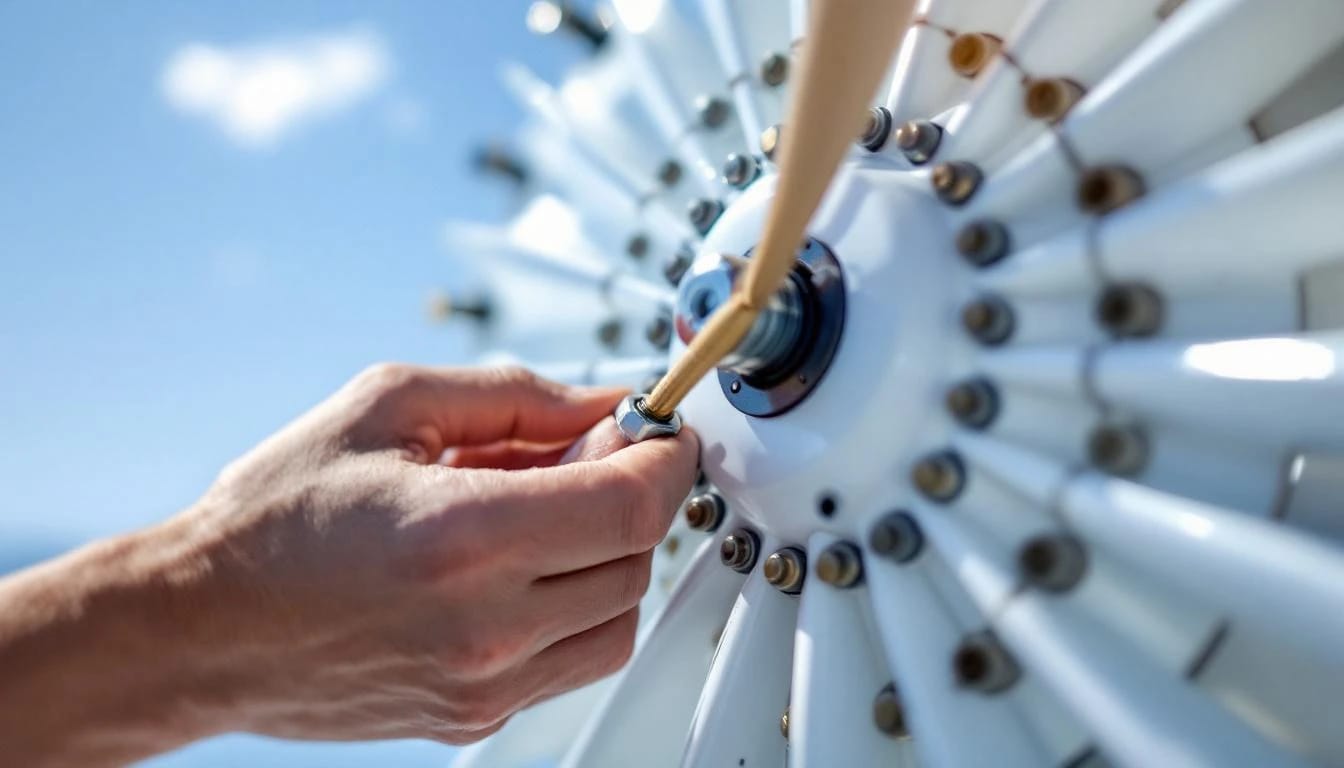
The Marlec Rutland 914i is a six-blade, 0.91-metre horizontal-axis turbine engineered for marine and remote battery-charging applications. It produces up to 90 watts continuous power in 12.5 m/s winds and 280 watts peak in gales, feeding 12 or 24-volt systems through a built-in rectifier and charge controller. First introduced in the 1980s and continually refined, the 914i remains the best-selling small wind generator in the UK marine market, equally at home on canal narrowboats, mountain bothies, and livestock monitoring stations where mains power is absent and solar panels struggle in winter.
What the Rutland 914i is—and what it isn't
Marlec Engineering positions the 914i as a supplementary charging source rather than a primary energy system. The turbine cuts in at 2.5 m/s and reaches rated output at 12.5 m/s—conditions commonly met on exposed coastal moorings and upland sites but less reliably in lowland suburbs. The six-blade rotor spins faster and starts more easily than three-blade designs, trading peak efficiency for consistent low-wind performance.
The 914i ships in two voltages: a 12-volt model (part FM914i-12-BLW) and a 24-volt variant (FM914i-24-BLW). Both use the same injection-moulded glass-filled nylon blades and cast-aluminium nacelle. Weight is 3.8 kg excluding the mast and cabling, light enough for one person to fit or service without a hoist. The turbine yaws freely on a vertical bearing, aligning itself with wind direction without a tail fin—a design choice that reduces turbine weight and parts count at the cost of slightly slower directional response.
![INLINE: Close-up of the Rutland 914i six-blade rotor assembly showing injection-moulded blades and aluminium hub]
Marlec provides a two-year manufacturer's warranty, extendable to three years when installed by an MCS-accredited professional. Blade sets and bearings are sold separately as consumables; expect to replace blades every five to seven years in harsh salt-spray environments or after ten years inland, sooner if debris strikes occur.
Power output: managing expectations
The 914i produces 1 to 3 amp-hours per hour in moderate breezes (5–7 m/s), sufficient to top up a 100 Ah leisure battery over several hours. In a strong 10 m/s wind—Beaufort Force 5, small trees swaying—the turbine delivers roughly 60 watts continuous, or 1,440 watt-hours over a full day if wind persists. That keeps LED lighting, VHF radio, and a 12-volt fridge running on a liveaboard narrowboat without draining the battery bank.
Peak output of 280 watts occurs only in storm conditions above 20 m/s, where most users reef sails or shut down non-essential systems anyway. The internal charge controller limits current to prevent battery overcharge, dumping excess energy as heat through the nacelle casing. For larger loads—an inverter running mains appliances, electric anchor winches, or continuous refrigeration—pair the 914i with a second turbine or a 200–400 watt solar array.
Comparative monthly energy, exposed coastal site (average 6.2 m/s windspeed):
| Month | Rutland 914i (kWh) | 100W solar panel (kWh) |
|---|---|---|
| January | 18.2 | 6.1 |
| April | 16.4 | 14.8 |
| July | 12.8 | 18.3 |
| October | 17.9 | 9.4 |
| Annual | 192 | 136 |
The table assumes a south-facing solar panel at 30° tilt and a 10-metre turbine mast clear of obstructions. Wind energy peaks in winter when solar drops; combining both technologies flattens seasonal variability.
Installation: mast, wiring, and regulation
The 914i requires a 38 mm outer-diameter mast (1½-inch nominal steel pipe in UK builders' merchants) guyed or bracketed to withstand the 180 N side load generated in gale-force winds. On boats, most users mount the turbine on a stern-rail pole 1.5 to 2 metres above deck level, trading some wind access for easier reach during blade inspection. Land-based installations benefit from a 6 to 10-metre freestanding or guyed mast, placing the rotor above roof turbulence and hedge windbreaks.
Cable runs from turbine to battery should use 6 mm² twin-core marine cable (BS 6883) for distances up to 10 metres; longer runs require 10 mm² to limit voltage drop below 3 per cent. The turbine's rectifier outputs direct current with slight ripple; feed this into the battery's positive terminal through a 20-amp inline fuse, never through an MPPT solar controller designed for photovoltaic input. A blocking diode (included in the 914i's charge controller) prevents reverse current drain at night.
British installations on fixed structures—garden offices, farm sheds, off-grid cabins—may require planning permission if the turbine exceeds 11 metres tip height or sits on a listed building. Permitted Development rights under the Town and Country Planning (General Permitted Development) (England) Order 2015 allow turbines up to 11.1 metres tall (measured from ground to blade tip at vertical position) on detached homes more than five metres from the boundary, provided total swept area remains below 3.8 square metres and the site is not within a Conservation Area. The Rutland 914i's 0.91-metre rotor yields 0.65 square metres swept area, comfortably within limits. Scotland, Wales, and Northern Ireland have equivalent Permitted Development rules; consult the local planning authority for current thresholds.
MCS certification is not required for off-grid systems ineligible for Smart Export Guarantee payments, but BS 7671:2018+A2:2022 wiring standards still apply if the turbine connects to any building's electrical installation. Employ a qualified electrician (Part P registered) to terminate cables inside consumer units or distribution boards.
Noise and vibration: living with a small turbine
The 914i emits a soft whooshing sound at rated speed, measured at 45 dB(A) at five metres—quieter than normal conversation. Blade-tip speed is 22 m/s at full output, well below the threshold where trailing-edge noise becomes intrusive. On boats, attaching the mast to the pushpit (stern rail) transmits slight vibration into the hull; rubber vibration isolators (available from Marlec as part FM914-DAMP) reduce structure-borne resonance. Land installations on guyed masts produce negligible vibration if guy anchors are correctly tensioned.
Turbine noise scales with windspeed; in a gale, the 914i is inaudible beneath wind noise against rigging, trees, and buildings. Urban and suburban users should mount the turbine at least 10 metres from bedroom windows to avoid low-frequency hum during night-time winds, though the 914i's small rotor and moderate tip speed rarely disturb sleep even in exposed locations.
Durability and maintenance
The Rutland 914i's mechanical simplicity—no slip rings, no complex pitch mechanisms—underpins its reputation for longevity. The nacelle houses two sealed ball bearings (type 6000-2RS) requiring no lubrication; bearing life exceeds 20,000 hours in clean environments, shorter in salt-laden coastal air. Blade hub and yaw shaft are stainless steel; the nacelle casing is powder-coated marine-grade aluminium alloy that resists corrosion without periodic repainting.
Annual inspection checks blade leading-edge condition (chips and cracks compromise balance), tightness of mounting bolts (vibration loosens fastenings), and electrical connections for corrosion. Blade sets cost £75 to £95 depending on retailer; replacement takes fifteen minutes with a 10 mm spanner and screwdriver. Bearing replacement requires nacelle disassembly and a bearing puller but is rarely needed within the turbine's first decade.
The built-in charge controller has no user-serviceable parts; if it fails—rare but not unknown after a lightning strike—the entire nacelle returns to Marlec's Corby factory for exchange. Extended warranties and annual service contracts are available through marine chandlers and renewable-energy installers for owners uncomfortable performing their own checks.
Real-world applications: where the 914i excels
Liveaboard narrowboats and cruising yachts: The 914i keeps house batteries charged during winter layovers when solar panels produce minimal energy and shore power is unavailable. Pair it with a 100-watt solar panel for year-round autonomy. Turbine output supplements alternator charging underway, reducing engine running hours and fuel consumption.
Off-grid shepherds' huts and mountain bothies: In exposed upland sites with consistent wind, the 914i powers LED lighting, mobile-phone charging, and small 12-volt water pumps without requiring a petrol generator. A 200 Ah battery bank stores several days' energy for periods of calm.
Remote CCTV and telemetry: Livestock farmers use the 914i to charge sealed lead-acid or lithium batteries powering trail cameras, stock water-level sensors, and cellular trail monitors where trenching mains cables is impractical. The turbine's low cut-in speed maintains charge through variable hill-country weather.
Allotment sheds and garden offices: Though grid connection is usually cheaper per kilowatt-hour, the 914i appeals to gardeners seeking lighting and tool-battery charging without digging supply cables across council allotment plots. Pair it with a small inverter for occasional mains appliances.
The turbine is less suited to suburban homes with grid connection, where rooftop solar and mains import deliver better return on investment. The 914i's modest output cannot replace household consumption; its value lies in untethered operation where alternatives are absent or expensive.
Cost breakdown and alternatives
The Rutland 914i retails for £525 to £595 excluding mast and cabling. Budget an additional £100 to £200 for a 6-metre galvanised steel mast kit with ground-anchor guys, mounting brackets, and guy-wire tensioners. Marine installations on existing stern rails need only the turbine and cable; land-based setups require concrete pad foundations (approximately £80 in materials and hired mixer).
Alternative small turbines in the same output class include the Eclectic D400 (rated 400 watts peak, £695), which produces higher output in strong winds but shares the 914i's modest low-wind performance. The Ampair 300 (formerly Ampair 100, now discontinued) occupied similar territory; secondhand units appear on boating forums for £150 to £300 but lack spare-parts support. For higher continuous output, the Leading Edge LE-300 delivers 300 watts rated but weighs 12 kg and requires a stouter mast.
Grid-tied inverter systems complying with G98 (systems up to 3.68 kW per phase) and eligible for Smart Export Guarantee tariffs demand MCS-certified turbines; the Rutland 914i lacks this certification because its low output and DC-only operation target off-grid applications. Homeowners seeking SEG payments should consider 1 to 5 kW pole-mounted turbines from Evance, Gaia-Wind, or Kingspan (though Kingspan exited the small-wind market in 2018 and remaining stock carries no warranty).
Can the Rutland 914i power a household?
No. A typical UK home consumes 8 to 12 kWh per day; the 914i generates 0.5 to 1.4 kWh daily depending on wind conditions. It suits battery charging for 12 or 24-volt systems, not grid-connected household loads.
Does the turbine need planning permission?
Fixed land installations may require permission if tip height exceeds 11 metres or the site lies within a Conservation Area or National Park. Permitted Development applies to many detached homes; check with the local planning authority before purchase. Marine installations on boats and caravans are exempt from planning rules.
How long do the blades last?
Five to seven years in coastal salt-spray environments, ten years inland. Blade replacement costs £75 to £95 and requires no special tools. Ultraviolet degradation and impact damage are the primary failure modes.
Can I connect the Rutland 914i to a solar charge controller?
No. Solar MPPT controllers expect photovoltaic input voltage profiles; wind-turbine rectified DC has different characteristics. Use the 914i's built-in controller directly to the battery, then connect solar panels through their own controller to the same battery bank.
What battery type works best with the 914i?
Sealed lead-acid (AGM or gel), flooded lead-acid, or lithium iron phosphate (LiFePO₄) batteries all work. Match battery voltage (12 V or 24 V) to the turbine model. Lithium batteries require a battery-management system compatible with wind-charging current profiles; consult the battery manufacturer before connection.
Bottom line
The Marlec Rutland 914i delivers predictable, low-maintenance battery charging in the 12 to 24-volt range for boats, cabins, and remote monitoring sites where grid connection is absent and solar panels underperform. Its modest output limits application to supplementary charging rather than primary power, but three decades of proven field service justify confidence in long-term reliability. For off-grid users prioritising durability over peak wattage, the 914i remains the benchmark small wind generator.
Check current pricing and availability through marine chandlers including Mailspeed Marine, Force 4, and renewable specialists Wind and Sun. Compare turbine specifications alongside your site's average windspeed data and battery-bank capacity before committing to purchase.
Share this article
windturbinehome.com/s/c4e741
Editorial note: This article was researched and written by a member of the Wind Turbine Home editorial team. AI-assisted tools were used for spell-checking and light grammar review only — all research, analysis, and conclusions are our own. Our editorial policy prohibits sponsored content and paid placements. Read our editorial policy →
Related reading
wind turbine brands
Aeolos H-Series Wind Turbine Review: Build Quality & Output
Independent review of Aeolos H-series small wind turbines covering construction quality, real-world power output, and installation considerations for homes.
wind turbine brands
Bergey Excel 15 Review: Still the Residential Workhorse?
The Bergey Excel 15 remains a proven choice for serious residential wind power—but is this 7.5-kW turbine still worth its premium in 2025? Our review weighs performance, reliability, and real-world economics.

wind turbine brands
Best Home Wind Turbines in the UK: MCS-Certified Picks for 2026
MCS-certified small wind turbines for UK homes include Bergey Excel 1 (1kW), Evance R9000 (5kW), and SD6 (6kW). Proper site assessment and BS 7671 compliance are critical for safe, legal installation.
wind turbine brands
MCS-Certified Wind Turbines UK: MIS 3003 Standard Explained
MCS certification proves UK wind turbines meet MIS 3003 quality and safety standards. Required for Smart Export Guarantee payments and Permitted Development rights.
wind turbine brands
Cheapest 1 kW Wind Turbine: Where Budget Models Actually Work
Budget 1 kW wind turbines start at $800-1,400, but total installed cost hits $4,000-7,000. Learn which cheap models survive real-world use and where they pencil out.

wind turbine brands
Best Wind Turbines Under $1000 in 2026 | Buyer's Guide
Compare the top budget wind turbines under $1000 for homes in 2026. We tested vertical-axis and small horizontal models for real-world power output and durability.
wind turbine brands
Best Wind Turbines Under $500 in 2026: Budget Models Tested
Budget wind turbines under $500 can generate 50-400W in steady winds. We tested seven models for build quality, real-world output, and warranty support.
wind turbine brands
Eclectic Energy D400 Review: Marine Micro-Wind Generator
The Eclectic Energy D400 delivers 400W peak output in a marine-grade package suited to boats, caravans, and coastal sheds—not grid-tied homes.
wind turbine brands
Is Southwest Windpower Out of Business? What Happened & Alternatives
Southwest Windpower closed in 2013 after manufacturing the popular Air Breeze and Whisper series turbines. Learn what caused the shutdown and which brands now fill the gap.