Sizing a Residential Solar + Wind Hybrid System: Complete Guide
Learn how to properly size a solar-wind hybrid system for your home. Calculate loads, balance generation sources, and optimize battery storage for year-round reliability.
Share this article
windturbinehome.com/s/b21668
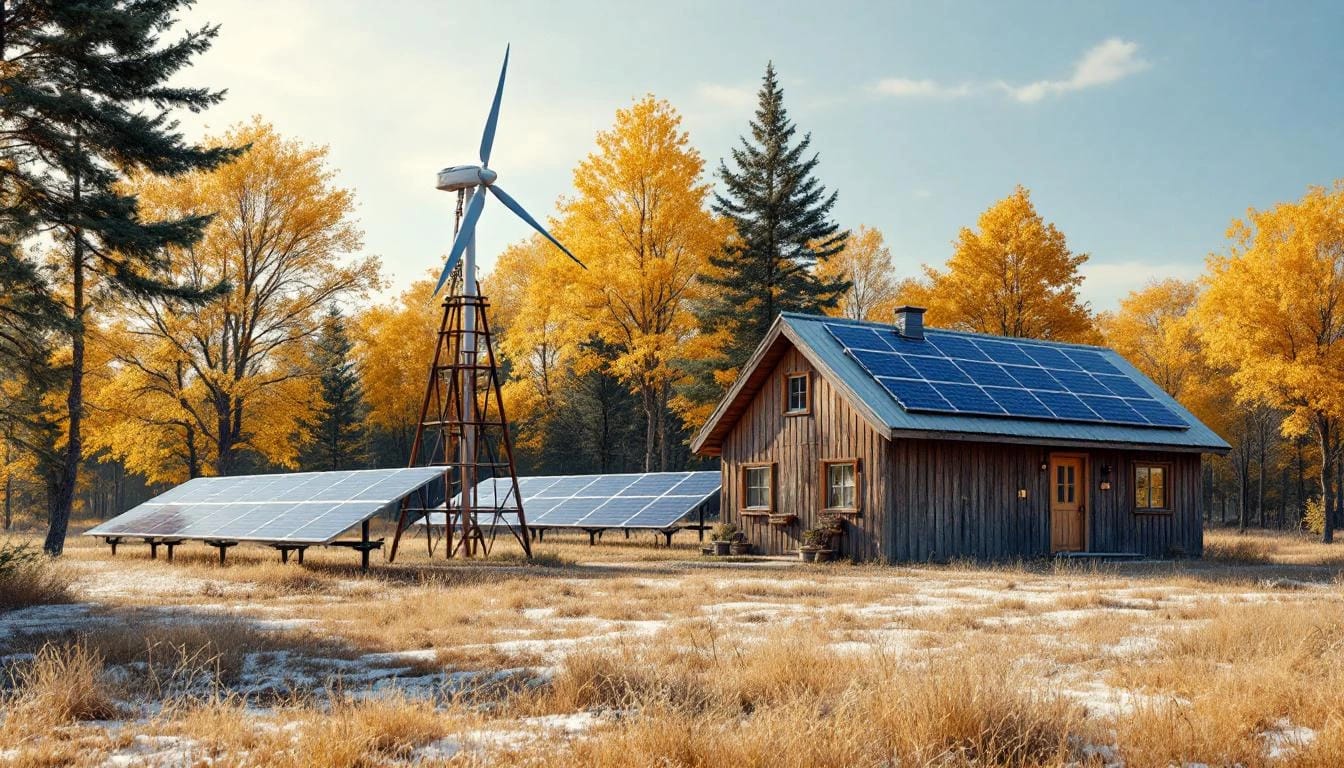
A properly sized solar-wind hybrid system supplies reliable power by leveraging complementary generation patterns—solar peaks midday and summer, wind often delivers more at night and winter. To size your hybrid system, calculate your daily energy consumption in kilowatt-hours, assess both your solar resource (average peak sun hours) and wind resource (annual average wind speed at hub height), then allocate generation capacity between technologies based on seasonal patterns and available space. Most residential hybrids pair 3-8 kW of solar with a 1-5 kW wind turbine, supported by 10-20 kWh of battery storage, though exact sizing depends on your load profile, local climate, and grid-connection status.
Understanding Load Requirements First
Sizing begins with understanding how much electricity your home consumes. Review twelve months of utility bills to identify your average daily consumption in kWh. Homes in the continental United States typically use 28-30 kWh per day (roughly 850-900 kWh monthly), though this varies significantly by climate, square footage, and appliances.
Break consumption into base loads (refrigeration, well pump, always-on devices) and discretionary loads (EV charging, heat pump, laundry). Base loads determine minimum system capacity requirements. For off-grid applications, itemize every device, its wattage, and hours of daily operation. Grid-tied systems have more flexibility since the utility acts as a backup.
Consider future changes. If you plan to add an electric vehicle, heat pump, or expand living space, factor those loads into your sizing calculation now. A Level 2 EV charger delivering 7.2 kW adds 15-40 kWh daily depending on commute distance. Cold-climate heat pumps may consume 30-50 kWh on the coldest days.
Before finalizing your system size, implement energy efficiency measures. LED lighting, insulation upgrades, ENERGY STAR appliances, and smart thermostats can reduce consumption by 20-40%, lowering system cost proportionally. The Department of Energy recommends a whole-building approach to efficiency before investing in generation capacity.
Assessing Solar Resource Availability
![INLINE: Solar resource map showing average daily peak sun hours across different US regions with overlay of seasonal variation patterns]
Solar production potential depends on your location's peak sun hours—the equivalent hours per day of 1,000 W/m² irradiance. The National Renewable Energy Laboratory's PVWatts calculator provides location-specific data. Most of the lower 48 states receive 3.5-6.5 peak sun hours daily on average, with southwestern states at the high end and Pacific Northwest at the low end.
Account for seasonal variation. Northern locations experience 2:1 or 3:1 summer-to-winter ratios in solar production. Phoenix averages 7.2 peak sun hours in June but 5.3 in December. Seattle drops from 6.4 in July to 1.6 in December. This seasonal swing directly impacts how much you'll rely on wind generation during winter months.
Calculate solar array output using this formula: Array Capacity (kW) × Peak Sun Hours × 0.75 (derate factor) = Daily Production (kWh). The 0.75 factor accounts for inverter efficiency losses, temperature effects, wiring resistance, and soiling. A 5 kW array in a 5-peak-sun-hour location produces approximately 18.75 kWh daily under this formula.
Roof orientation and tilt matter. South-facing arrays at latitude-appropriate tilt angles maximize annual production. East-west splits reduce peak output but flatten the daily production curve, which can complement wind generation patterns. Shading from trees, chimneys, or neighboring structures severely impacts output—even 10% shading can reduce production by 40-50% on systems without microinverters or power optimizers.
Evaluating Wind Resource Quality
Wind resource assessment requires more precision than solar. Small wind turbines need minimum average annual wind speeds of 9-10 mph (4-4.5 m/s) at hub height for economic viability, with 12+ mph (5.4+ m/s) considered good to excellent. The Department of Energy's wind resource maps provide initial screening, but on-site measurement at proposed hub height delivers accurate data.
Install an anemometer at the planned tower height for at least three months, ideally twelve, to capture seasonal variations. Wind speed increases with height following the power law: V2 = V1 × (H2/H1)^α, where α is the power law exponent (typically 0.14-0.20 for open terrain, 0.25-0.40 for areas with obstacles). A site measuring 8 mph at 10 feet might deliver 11-12 mph at a 60-foot hub height in open terrain.
Wind power potential increases with the cube of velocity, making small speed differences significant. A site with 12 mph average wind speed has roughly 170% more energy than a 10 mph site. This cubic relationship explains why proper siting—avoiding wind shadows from buildings and trees—dramatically impacts performance.
Turbulence degrades performance and accelerates wear. Position towers at least 30 feet above any obstruction within 500 feet. Trees and buildings create turbulent zones extending downwind 15-20 times their height. FAA Part 77 regulations restrict tower heights near airports; check airspace restrictions before planning installations above 200 feet AGL (above ground level) or closer proximity to airports.
Calculating Generation Capacity Split
Balancing solar and wind capacity depends on their complementary generation patterns at your site. Analyze when each resource peaks. Wind often delivers more during winter months, late afternoon, evening, and night hours—precisely when solar production drops or stops. This inverse correlation improves system reliability and reduces battery storage requirements.
Start with your solar-dominated months. If summer solar production could meet 80-90% of loads, size your solar array to handle those months with modest wind backup. Then examine winter, when solar may drop to 30-40% of summer output. The wind turbine must fill that seasonal gap without oversizing for summer months when output might be wasted.
A common residential split pairs 4-6 kW of solar with a 2.5-3.5 kW wind turbine. For a 30 kWh daily load in a moderate climate (5 peak sun hours summer, 3 winter), a 5 kW solar array generates 18.75 kWh in summer and 11.25 kWh in winter. A Bergey Excel 10 (10 kW rated, 2.5 kW average in 12 mph wind) adds 8-12 kWh daily in good wind, covering the winter shortfall.
Space constraints influence allocation. Solar requires roughly 100 square feet per installed kW. A 6 kW array needs 600 square feet of unshaded roof or ground space. Small wind turbines need property setbacks—typically 1-3 acres minimum depending on tower height and local zoning. If roof space is plentiful but lot size is limited, bias toward solar with minimal wind. Conversely, wooded properties with limited solar access but exposed high ground favor increased wind capacity.
Sizing Battery Storage for Hybrids
Battery storage in hybrid systems serves three purposes: storing excess generation from either source, delivering power during simultaneous solar and wind lulls, and providing surge capacity for motor starts and high-draw appliances. Sizing depends on grid-connection status and your desired autonomy.
Grid-tied hybrids typically use 10-15 kWh of storage—enough to shift midday solar and evening wind generation to morning and late-night consumption peaks, plus 4-8 hours of backup for critical loads during outages. Popular configurations pair two Tesla Powerwall units (27 kWh combined) or LG Chem RESU systems with Schneider Electric or SMA hybrid inverters.
Off-grid systems require 3-5 days of autonomy to weather extended low-wind, cloudy periods. For a 30 kWh daily load, that's 90-150 kWh of usable storage. Given lithium batteries' recommended 80% depth-of-discharge limit, specify 112-187 kWh of rated capacity. This might comprise 12-20 kWh modular lithium batteries (Simpliphi PHI 3.5, Discover AES) or larger integrated systems (Rolls-Surrette lead-carbon).
Account for inverter surge ratings. Well pumps, air conditioners, and power tools demand 2-3× their running wattage during startup. A 1.5 HP (1,100W running) well pump needs 3,300W surge capacity. Inverters should deliver continuous power equal to your maximum simultaneous load plus 25% margin, with surge ratings covering your largest motor start.
Battery charge controllers must match source capacity. Solar charge controllers (MPPT recommended) should handle 125% of solar array short-circuit current. Wind turbines typically include built-in dump load controllers, but verify compatibility with your battery bank voltage (24V, 48V common for residential). Hybrid systems often use a DC bus architecture where both sources charge a common battery bank through separate controllers, feeding a single inverter.
Electrical Integration and Code Compliance
Installing a hybrid solar-wind system requires careful electrical planning and strict adherence to the National Electrical Code (NEC), particularly Article 705 (Interconnected Electric Power Production Sources) for grid-tied systems. This work requires a licensed electrician and permits from your local authority having jurisdiction (AHJ).
The point of interconnection determines system architecture. Grid-tied systems feed excess power to the utility through a bidirectional meter, requiring utility interconnection approval. Most utilities follow IEEE 1547 standards mandating anti-islanding protection (automatic disconnection during outages unless explicitly approved). Apply for interconnection before purchasing equipment—some utilities restrict wind connections or cap total distributed generation.
Load-side connections (supply-side of main breaker) must meet the 120% rule: main breaker rating + backfeed breaker rating ≤ 120% of busbar rating. For a 200A panel, the total cannot exceed 240A. If your main breaker is 200A, the backfeed breaker cannot exceed 40A. Supply-side connections bypass this limitation but require dedicated disconnects accessible to utility personnel.
Wind turbines introduce additional grounding requirements per NEC 250. The tower requires a grounding electrode system—typically a ground rod at the base plus radial ground rods if soil resistivity exceeds 25 ohms. Lightning protection systems are recommended in high-strike-density regions (>5 strikes/km²/year), comprising air terminals, down conductors, and grounding array separate from the tower grounding to prevent ground potential rise from damaging electronics.
Overcurrent protection, disconnects, and conductor sizing follow NEC Article 690 (Solar) and manufacturer specifications for wind turbines. Size conductors for 125% of maximum circuit current with appropriate ampacity derating for temperature and conduit fill. Every source requires a clearly labeled disconnect within sight of the equipment. Critical loads panels for backup power need separate subpanels with transfer switches (automatic or manual) for off-grid operation during utility outages.
Cost Estimation and Financial Incentives
A complete residential hybrid system installed costs $35,000-$75,000 depending on capacity, location, and site conditions. This breaks down approximately: $12,000-$25,000 for solar (before incentives), $15,000-$35,000 for wind turbine and tower, $8,000-$15,000 for batteries, plus engineering, permitting, and installation labor.
Solar costs have declined to $2.50-$3.50 per installed watt nationally. A 6 kW array costs $15,000-$21,000 before incentives. Small wind turbines cost more per watt—$4-$8 per installed watt—because the tower represents substantial expense. A Bergey Excel 10 with 100-foot tower might cost $50,000-$60,000 installed, while a Primus AIR 40 on a 60-foot tower runs $25,000-$35,000.
The federal Residential Clean Energy Credit (IRC §25D) provides a 30% tax credit for both solar and wind components through 2032, declining to 26% in 2033 and 22% in 2034. This applies to equipment costs, installation labor, and directly associated expenses like electrical upgrades. Battery storage qualifies if charged 100% by renewable sources. File IRS Form 5695 with your tax return. The credit is non-refundable but carries forward to future tax years.
State and utility incentives vary significantly. Check the Database of State Incentives for Renewables & Efficiency (DSIRE) for current programs. California, Massachusetts, and New York offer additional rebates or performance-based incentives. Net metering policies affect payback—full retail rate crediting shortens payback versus avoided-cost rates. Some rural electric cooperatives offer zero-interest loans for member-installed renewables.
Payback periods for hybrids typically run 12-20 years before incentives, 8-15 years after. Systems in high-electricity-cost states (California, Hawaii, New England) with good wind and solar resources achieve faster payback. Factor in hedge value against utility rate inflation (averaging 2-3% annually) and increased home resale value—studies suggest solar additions increase home value by $15,000-$20,000 per kW installed.
Detailed Sizing Example for Moderate Climate
Consider a Nebraska homeowner with 35 kWh average daily consumption, 4.8 annual peak sun hours, and 11.5 mph average wind speed at 80-foot hub height. Their goal: offset 80-90% of grid consumption while maintaining battery backup for critical loads.
Load Analysis: 35 kWh daily = 1,458W average load. Peak loads (heat pump startup, oven + dryer simultaneously) reach 12 kW. Critical loads (refrigerator, well pump, furnace blower, lights) total 3 kW continuous, 8 kW surge.
Solar Sizing: 35 kWh × 0.80 (target offset) = 28 kWh needed. Summer production at 6 peak sun hours: 28 ÷ (6 × 0.75) = 6.2 kW array. Winter at 3.2 peak sun hours: 6.2 × 3.2 × 0.75 = 14.9 kWh (43% of daily load). Solar covers summer with 10-15% excess but leaves a winter gap.
Wind Sizing: Winter shortfall: 35 - 14.9 = 20.1 kWh needed from wind. At 11.5 mph average, a Bergey Excel 1 (2.5 kW rated) produces approximately 180 kWh monthly in winter (6 kWh daily). A Bergey Excel 6 (7.5 kW rated) produces roughly 400 kWh monthly (13.3 kWh daily). The Excel 6 covers the winter gap while remaining appropriately sized—the Excel 10 would generate excess wasted production.
Revised Configuration: 6 kW solar array + Bergey Excel 6 on 80-foot tower. This produces 32-34 kWh daily in summer (slight excess) and 28-29 kWh in winter (82-83% offset), meeting the 80-90% annual target with balanced seasonal generation.
Battery Storage: Grid-tied with backup. Critical loads (3 kW × 6 hours) = 18 kWh needed. Add 20% margin: 21.6 kWh usable, requiring 27 kWh rated (80% DoD). Two 13.5 kWh lithium units (SimpliPhi PHI 3.8 series) or similar. Inverter: 8 kW continuous (covers peak critical loads with margin), 12 kW surge (handles well pump startup).
Equipment List:
- Solar: 6.24 kW (16 × 390W panels), Fronius Primo or SolarEdge SE6000H inverter
- Wind: Bergey Excel 6, 80-foot tilt-up tower with concrete foundation
- Storage: 2× SimpliPhi PHI 3.8 (27 kWh total)
- Additional: Schneider XW Pro hybrid inverter/charger, two MPPT charge controllers (solar + Bergey controller), critical loads subpanel with automatic transfer switch
Estimated Installed Cost: Solar $18,700, wind $38,000, batteries $16,000, electrical/labor $12,000 = $84,700 total. After 30% federal credit: $59,290. Nebraska offers net metering at retail rate. Annual generation: 12,000-13,000 kWh, offsetting $1,500-$1,700 at $0.13/kWh. Simple payback: 35 years pre-incentive, 25 years post-incentive—long, but hedge value and backup resilience add non-monetary benefits.
System Monitoring and Performance Optimization
Effective hybrid systems require monitoring both generation sources and battery state. Modern hybrid inverters from Schneider Electric, SMA, or Outback Power include built-in monitoring displaying real-time solar production, wind generation, battery voltage and state-of-charge, grid status, and load consumption via web portals or smartphone apps.
Install separate production monitoring for each source. Solar systems use inverter-integrated monitoring (SolarEdge, Enphase Envoy) or third-party power meters. Wind turbines typically include controller displays showing instantaneous power, monthly kWh, and wind speed. Compare monitored production against predicted output to identify underperformance from shading, turbulence, or equipment faults.
Battery monitoring prevents premature degradation. Track state-of-charge cycles, depth-of-discharge patterns, and cell voltage balance (for lithium banks with BMS). Avoid extended periods at 100% SoC (promotes lithium plating) or below 20% (sulfation risk for lead-acid). Most hybrid inverters include programmable battery management limiting charge/discharge rates and SoC windows to optimize cycle life.
Seasonal optimization adjusts system operation. In winter when solar production drops, increase battery reserve capacity for longer autonomy during multi-day calm, cloudy periods. Summer's excess solar production might trigger dump-load activation for water heating or battery conditioning (periodic full cycles). Some advanced systems use AI-powered forecasting (Sol-Ark, Tesla Gateway) to pre-charge batteries ahead of predicted storms or maximize solar self-consumption ahead of peak utility rate periods.
Annual maintenance includes solar panel washing (5-10% production gain from removing dust/pollen), wind turbine inspection (blade leading-edge erosion, fastener torque, guy wire tension), battery equalization charges (flooded lead-acid only), and inverter filter cleaning. Budget $500-$800 annually for maintenance and periodic component replacements (inverter fans, charge controllers, dump load resistors) over the system's 25-year lifespan.
Common Sizing Mistakes to Avoid
Oversizing the wind component wastes capital. Wind turbines cannot throttle production like solar inverters can curtail output. Excess wind generation in shoulder seasons (spring/fall with moderate loads and decent solar) either overcharges batteries (shortening their lifespan) or requires dump loads that waste energy. Size wind capacity for winter needs, not theoretical maximum production.
Undersizing battery storage forces frequent deep discharge cycles and degrades batteries rapidly. Off-grid systems absolutely require 3-5 days autonomy. Grid-tied backup systems need enough capacity to actually run critical loads through overnight or multi-day outages. Installing 10 kWh of battery storage but trying to back up 8 kWh of daily critical loads provides only 1.25 days autonomy at 80% DoD—insufficient for most outage scenarios.
Ignoring seasonal load variations leads to sizing errors. Homes with air conditioning or electric heating have 50-100% higher consumption in extreme summer or winter months compared to spring/fall. Size for peak-demand seasons, not annual average. A system adequate for April and October may fall short in January and July.
Using generic wind data instead of site-specific measurements risks severe underperformance. Department of Energy wind maps show regional averages, but local terrain, elevation, and obstacles create dramatic variations. A site in a "good wind resource" region might have poor wind at ground level due to surrounding trees. Always measure wind speed at planned hub height or multiply surface measurements by appropriate power-law factors.
Neglecting electrical system upgrades creates bottlenecks and code violations. Adding 8-10 kW of generation to a home with a 100A service panel may require upgrading to 200A service, replacing the meter socket, and trenching for larger service conductors—adding $5,000-$8,000 to project costs. Obtain electrical system evaluation before finalizing equipment purchases.
Can a hybrid system eliminate my electric bill completely?
Complete elimination requires substantial overbuilding to cover the worst-case winter production scenario, making it economically inefficient. Most residential hybrids offset 70-95% of annual consumption, with the utility covering shortfalls during extended unfavorable weather. True zero-grid consumption requires off-grid design with 3-5 days battery autonomy and generation capacity sized 150-200% above average daily loads—substantially more expensive than grid-tied configurations targeting 80-90% offset.
How do I balance solar and wind when one resource is significantly better at my site?
Sites with excellent solar but marginal wind (or vice versa) should bias heavily toward the stronger resource, adding the weaker one only for its complementary generation timing. A Pacific Northwest location with 100+ overcast days but good winter wind might use 70-80% wind capacity, 20-30% solar. Conversely, a Southwest high-desert site with moderate wind could deploy 80-90% solar, 10-20% wind. The goal is year-round reliability, not equal contribution from each source.
What happens when both solar and wind produce more than I need?
Grid-tied systems export excess to the utility for net metering credit at rates determined by your interconnection agreement. Off-grid systems divert excess to dump loads (resistance heaters for domestic hot water or space heating) or curtail production by furling the wind turbine and limiting solar charge controller output. Advanced battery systems may accept temporary overcharge above 100% SoC if the BMS allows brief absorption periods, though this accelerates degradation if frequent.
Do hybrid systems require separate inverters for solar and wind?
Not necessarily. Modern hybrid inverters (Schneider Conext XW+, Outback Radian, SMA Sunny Island) accept multiple DC sources through separate charge controllers feeding a common DC bus and single inverter. This is typically more efficient and less expensive than separate inverters. However, AC-coupled configurations using separate inverters for each source and coupling on the AC side provide redundancy—if one inverter fails, the other source continues operating.
How does extreme weather affect hybrid system performance?
High winds force turbines into shutdown mode above rated cutout speeds (typically 35-45 mph) to prevent damage, eliminating wind production during storms when solar is also absent. Ice accumulation on turbine blades creates imbalance and vibration, triggering shutdown. Heavy snow on solar panels blocks production until melted or cleared. Size battery storage to maintain critical loads through 2-3 day severe weather events. Most outages in the continental United States resolve within 24-48 hours.
Bottom Line
Sizing a residential solar-wind hybrid system requires calculating your actual energy consumption, measuring both resources at your specific site, then allocating generation capacity based on complementary seasonal patterns. The typical residential configuration pairs 4-6 kW of solar with a 2-5 kW wind turbine, supported by 10-20 kWh of battery storage for grid-tied applications or 90-150 kWh for off-grid autonomy. Expect installed costs of $40,000-$75,000 before the 30% federal tax credit. Proper sizing balances year-round reliability against over-capitalization, targeting 80-90% utility offset rather than 100% elimination. Contact a NABCEP-certified solar installer with small wind experience and commission a site-specific wind assessment before purchasing equipment.
Share this article
windturbinehome.com/s/b21668
Editorial note: This article was researched and written by a member of the Wind Turbine Home editorial team. AI-assisted tools were used for spell-checking and light grammar review only — all research, analysis, and conclusions are our own. Our editorial policy prohibits sponsored content and paid placements. Read our editorial policy →
Related reading

hybrid solar wind
Hybrid Charge Controllers for Solar + Wind: What to Look For
Hybrid charge controllers merge solar and wind inputs into one battery bank. Look for MPPT solar tracking, turbine dump-load capability, voltage compatibility, and IP-rated enclosures rated for your climate.

hybrid solar wind
Wind Turbine for a Prepper Home: Long-Haul Off-Grid Resilience
Small wind turbines deliver genuine off-grid power when paired with solar and battery storage. The right setup keeps critical loads running through grid failures.

hybrid solar wind
Wind Turbine for a Hunting Cabin: Low-Maintenance Picks for Seasonal Use
Discover the best low-maintenance wind turbines for seasonal hunting cabins. Compare vertical-axis and small horizontal models built for remote, unattended operation.

hybrid solar wind
Wind Turbine for an Off-Grid Cabin: Full System Design Guide
Design a reliable off-grid wind system for your cabin with the right turbine, battery bank, charge controller, and inverter. Complete wiring, sizing, and NEC compliance guide.
hybrid solar wind
Can You Use Wind and Solar Together? Hybrid System Guide 2026
Yes, wind and solar work together in hybrid systems. Combining turbines with photovoltaic arrays delivers 24/7 renewable generation and smoother grid-tie performance.

hybrid solar wind
Best Off-Grid Wind Turbine Kits With Battery and Inverter
Complete off-grid wind turbine kits pair a HAWT or VAWT with battery storage and sine-wave inverter for standalone power. Top systems from Pikasola, Nature Power, and Missouri Wind supply 400W-3kW continuous output.