Wind Turbine for an Off-Grid Cabin: Full System Design Guide
Design a reliable off-grid wind system for your cabin with the right turbine, battery bank, charge controller, and inverter. Complete wiring, sizing, and NEC compliance guide.
Share this article
windturbinehome.com/s/c96ec2
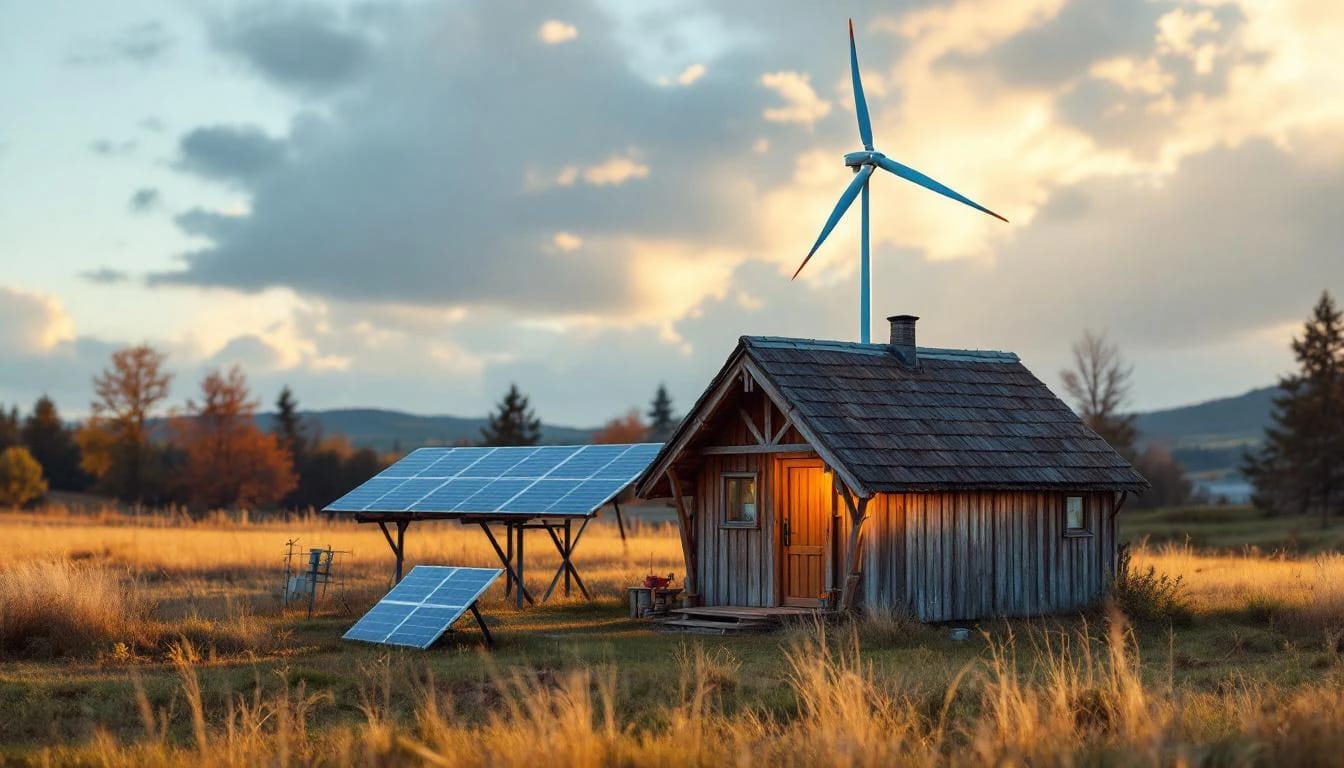
A well-designed off-grid wind system pairs a correctly sized turbine with deep-cycle batteries, a hybrid charge controller, and a pure sine wave inverter to deliver stable power where the grid doesn't reach. For a typical cabin drawing 3–6 kWh per day, expect a 1–3 kW turbine, 400–800 Ah of lithium or AGM battery capacity at 24 or 48 VDC, and an inverter rated 20–40% above your peak load. The Department of Energy's Small Wind Guidebook confirms that off-grid applications demand careful load calculation, proper tower height to clear obstacles, and compliance with NEC Article 705 interconnection rules even when no utility is present, because the code governs all electrical systems regardless of source.
Why off-grid wind makes sense for remote cabins
Grid extension costs run $15,000–$50,000 per mile in the United States, making small wind systems economically attractive when a cabin sits more than a quarter-mile from the nearest transformer. Wind generation complements seasonal usage patterns: many cabins see heaviest occupancy in cooler months when wind speeds peak and solar production falls. A 1.5 kW turbine on a 60 ft tower can generate 150–300 kWh per month in a Class 3 wind resource (annual average 6.7–7.4 m/s at 10 m height), enough to cover lighting, a small refrigerator, a well pump, and modest electronics without relying on a noisy, fuel-hungry generator.
The unequal heating of Earth's surface by the sun creates wind, and turbines capture that kinetic energy through aerodynamically designed blades that spin a shaft connected to a generator. Modern permanent-magnet alternators start producing usable power at cut-in speeds as low as 2.5 m/s, making them practical for sites where trees or topography limit average wind speed but gusts still occur regularly.
Off-grid systems demand energy discipline. Before sizing any turbine, audit your cabin's loads and eliminate phantom draw. LED lighting, a DC refrigerator, and an inverter that sleeps when idle can cut daily consumption by 50% compared to conventional appliances, shrinking both turbine and battery requirements.
System architecture and component roles
A complete off-grid wind installation chains four subsystems: generation, storage, charge control, and inversion. Each must match the others in voltage and capacity, or the weakest link will throttle the entire setup.
Generation: The turbine converts wind into three-phase wild AC, which is immediately rectified to DC inside the nacelle or at the tower base. Manufacturers specify rated output at a reference wind speed—usually 11 or 12 m/s—but real-world annual energy depends on your site's wind distribution curve. A Bergey Excel 1 (1 kW rated) will produce 100 kWh per month at an average 5.4 m/s site but 250 kWh per month at 6.7 m/s, illustrating why accurate wind assessment matters more than nameplate rating.
Storage: Deep-cycle batteries buffer the mismatch between when wind blows and when you need power. Lithium iron phosphate (LiFePO₄) banks tolerate partial state-of-charge cycling and deliver 3,000–5,000 cycles at 80% depth of discharge; sealed AGM lead-acid batteries cost half as much but last only 500–800 cycles under the same duty. System voltage should be 24 VDC minimum for loads above 2 kWh per day, 48 VDC for anything larger, to keep wire gauge and resistive losses reasonable.
Charge control: A hybrid controller accepts input from both the wind turbine and a solar array, applies maximum-power-point tracking (MPPT) or pulse-width modulation (PWM) to the solar side, and shunts or diverts excess wind energy to a dump load when the battery reaches float voltage. Classic Midnite, Morningstar, and Xantrex hybrid units handle 40–100 A at 24–48 VDC. The controller prevents overcharge, which would boil electrolyte out of flooded cells or trigger thermal runaway in lithium packs.
Inversion: A pure sine wave inverter transforms battery DC into 120 VAC at 60 Hz for standard North American appliances. Size the inverter for continuous rating equal to your largest simultaneous load plus 20%, and surge rating at least three times motor starting current. A 3 kW continuous / 9 kW surge inverter covers a well pump, microwave, and power tools without nuisance shutdown. Cheaper modified sine wave inverters cause audible hum in audio equipment, may not start induction motors reliably, and can confuse electronic power supplies.
Turbine selection for cabin loads
Match turbine capacity to daily energy demand, not peak instantaneous load. If the cabin uses 5 kWh per day and your site averages 6 m/s, a 1–1.5 kW turbine running full-time in moderate wind produces 4–8 kWh daily, leaving margin for calm spells when the battery carries the load.
Horizontal-axis machines dominate the off-grid market because they extract more energy per swept area than vertical-axis designs. The Bergey Excel 1 and Excel 6, Primus Air 40 and Air X, and Southwest Windpower Skystream have track records in remote installations. Avoid offshore or novelty brands that lack replacement parts pipelines and North American technical support.
Turbine voltage must match battery bank voltage. A 48 VDC turbine cannot charge a 24 VDC bank without a step-down DC-DC converter, which adds cost and conversion loss. Most manufacturers offer 24, 48, and occasionally 12 VDC versions of the same model; specify voltage at order time because field conversion requires a new stator or rewound windings.
Swept area matters more than blade count. A three-blade 1.2 kW turbine with a 2.5 m rotor diameter sweeps 4.9 m² and will outperform a six-blade 1.5 kW unit with a 2 m rotor sweeping only 3.1 m². Larger rotors start spinning at lower wind speeds and harvest more energy in the 4–8 m/s range where most sites spend the majority of their time.
Battery bank sizing and chemistry trade-offs
Calculate battery capacity by dividing daily watt-hours by system voltage and days of autonomy, then dividing by allowable depth of discharge. For 5 kWh per day, 48 VDC, three days autonomy, and 50% DoD on AGM cells:
(5,000 Wh ÷ 48 V) × 3 days ÷ 0.5 = 625 Ah at 48 VDC
That's eight 6 V 225 Ah golf-cart batteries in series-parallel (four strings of two in series, yielding 450 Ah at 48 V) or twelve 12 V 100 Ah AGM units in series-parallel. Lithium banks allow 80% DoD, cutting the 625 Ah requirement to 390 Ah—often met by a single pre-assembled 48 V rack system.
| Chemistry | Cycle life (80% DoD) | Cost per kWh | Temperature sensitivity | Maintenance |
|---|---|---|---|---|
| Flooded lead-acid | 300–500 | $150–250 | Moderate | Monthly water check |
| AGM lead-acid | 500–800 | $250–400 | Moderate | None |
| Lithium iron phosphate | 3,000–5,000 | $400–700 | Low | None |
Lithium's higher upfront cost amortizes over five to ten times the cycle life of lead-acid, making lifecycle cost comparable. LiFePO₄ banks tolerate cold better than lithium-ion (18650 cells), surviving discharge at -20°C without permanent damage, critical for unheated cabins in northern climates.
Wire the bank for the highest voltage your inverter and charge controller support. A 48 VDC system carries one-quarter the current of a 12 VDC system for the same wattage, allowing thinner wire and smaller breakers. Run 2/0 AWG copper from battery to inverter for a 3 kW continuous load at 48 V over 10 ft, staying within 2% voltage drop.
Tower height and siting for maximum capture
The Department of Energy guidebook emphasizes that turbine performance depends on mounting height relative to obstacles. Trees, buildings, and terrain create turbulence that cuts generation by 20–40% and accelerates bearing wear. Install the rotor at least 30 ft above any obstacle within 300 ft horizontally. In a forest clearing, that means a 70–80 ft tower; on flat prairie, 40–50 ft suffices.
Guyed lattice towers cost $2,000–$4,000 for a 60 ft height and offer climbing access for maintenance. Tilt-up poles simplify installation and service but require a clear lay-down radius equal to tower height plus 10 ft, unsuitable for tight sites. Free-standing monopoles eliminate guy wires but run $6,000–$10,000 for the same height and demand engineered foundations.
FAA Part 77 requires marking and lighting for structures over 200 ft near airports or 499 ft anywhere; cabin-scale towers stay well below these thresholds. Local zoning may cap tower height at 35 or 50 ft, forcing a variance application or eliminating wind as an option. Check county ordinances before buying equipment.
Anchor the turbine 200–300 ft from the cabin to dampen blade swish noise and allow a direct underground trench for the DC run. Bury USE-2 or RHW-2 photovoltaic wire rated for wet locations in 2-inch schedule 40 PVC conduit at 24-inch depth per NEC Article 300.5. Size conductors for 2% voltage drop at maximum turbine output current: 10 AWG copper handles 30 A over 150 ft at 48 VDC with 1.7% drop.
Charge controller configuration and dump-load integration
Hybrid charge controllers juggle two variable sources and one variable sink. The Midnite Classic 150, rated for 150 VDC input and 96 A output, accepts a 1–3 kW wind turbine on one channel and up to 2 kW of solar on a second, applying MPPT to the PV and diversion regulation to the wind. When battery voltage hits the absorption setpoint (typically 57.6 V for a 48 V bank), the controller diverts excess wind power to a resistive dump load—usually a bank of heating elements totaling 1.5–2 times turbine rated wattage.
Mount the dump load outdoors or in a vented enclosure; it dissipates kilowatts as heat. Some installers repurpose diverted energy to preheat a water tank or warm a workshop, recovering the energy rather than wasting it. A 1.5 kW turbine needs a 2–3 kW dump rated for continuous duty, built from ceramic wirewound resistors or nichrome coils.
Program absorption voltage, float voltage, and equalization schedules to match battery chemistry. Flooded lead-acid wants 58.4 V absorption, 54.0 V float, and periodic 60 V equalization; LiFePO₄ prefers 56.8 V absorption and 54.4 V float with no equalization. The controller's temperature sensor on the battery terminal adjusts setpoints for ambient temp, preventing undercharge in winter and overcharge in summer.
The controller displays daily kilowatt-hour harvest from each source. Logging this data over a year reveals whether the turbine meets projections or the site underperforms, guiding decisions to raise the tower, trim trees, or add solar capacity.
Inverter sizing and power-quality considerations
Pure sine wave inverters cost $800–$2,500 for 2–4 kW continuous output and deliver utility-grade 120 VAC waveform. Modified sine wave units ($300–$800) produce a stepped approximation that works for resistive heaters and incandescent lights but causes audible buzz in transformers, erratic speed control in variable-frequency motor drives, and charging problems with some laptop power supplies.
Check the inverter's idle draw: 15–30 W is typical, adding 360–720 Wh per day to base load. Models with a search mode wake from sleep when they detect load, cutting idle loss to under 5 W, but may not respond fast enough for momentary switch closures. For a cabin occupied seasonally, a manual switch or relay that powers the inverter only when needed saves 10–20 kWh per month.
Surge rating must exceed motor starting current. A 3/4 HP well pump draws 1,500 W running but 6,000 W for two seconds at start. A 3 kW continuous / 6 kW surge inverter will start the pump; a 3 kW continuous / 4 kW surge unit will not. Adding a soft-start module to the pump cuts inrush by 60%, allowing a smaller inverter.
Stack two identical inverters for 240 VAC split-phase if the cabin has a dryer, range, or large well pump requiring 240 V. The inverters synchronize via a communication cable, each producing 120 VAC 180° out of phase. This doubles available power but also doubles idle consumption and parts count.
Ground the inverter chassis and the DC negative bus to a driven ground rod per NEC Article 250.166, keeping the grounding electrode conductor 6 AWG copper minimum. Do not ground the positive DC conductor; off-grid systems are ungrounded at the source and rely on the inverter's internal isolation transformer to reference the AC output neutral to ground.
Hybrid solar-wind configurations for year-round reliability
Combining wind and solar smooths seasonal gaps. Solar peaks in summer when wind often lulls; wind peaks in winter and at night when solar goes dark. A 1.5 kW turbine plus 1 kW (five 200 W panels) of solar balances generation across the calendar at mid-latitude sites, delivering 6–10 kWh per day averaged year-round where either source alone would swing from 3 kWh in the lean season to 12 kWh in the abundant season.
Mount the solar array on a ground rack or shed roof near the battery bank to minimize DC wire runs. Face panels true south (azimuth 180°) in the Northern Hemisphere, tilted at latitude plus 15° for winter bias. The charge controller's solar input handles up to 150 VDC, so wire five 200 W 24 V panels in series (120 Voc) rather than parallel (6 A × 5 = 30 A), cutting current and allowing smaller wire.
The turbine connects to the controller's dedicated wind input, which expects wild DC voltage that rises with wind speed. Do not connect the turbine directly to the battery—without regulation, overspeed wind will push voltage above safe limits, venting gas from flooded cells or triggering the lithium battery management system (BMS) to disconnect.
Hybrid systems cost 30–50% more than wind-only setups but cut the risk of multi-day generation gaps that force generator runtime. For a cabin 10 miles down a dirt road, avoiding a mid-winter fuel run justifies the added hardware.
Installation, grounding, and NEC Article 705 compliance
NEC Article 705 governs interconnection of distributed generation sources, even in off-grid systems where no utility is present, because the code treats the inverter output as a separate power source requiring overcurrent protection and disconnection means. Install a 30 A breaker at the inverter AC output, a main disconnect at the cabin's AC load center, and label all equipment with voltage, current, and "Multiple Power Sources" warnings.
Bond the turbine tower to a ground rod driven at the tower base, run a 6 AWG copper grounding electrode conductor down the tower inside the conduit alongside the DC conductors, and bond to the system ground at the battery enclosure. This protects against lightning-induced surges that might otherwise travel along the DC conductors and destroy the charge controller or inverter.
Install fused disconnects rated 125% of maximum current at each subsystem: turbine to controller, controller to battery, battery to inverter. Use Class T fast-acting fuses for the battery connections to interrupt fault current before wire insulation melts. A 48 V 400 Ah lithium bank can source 1,200 A into a dead short for several seconds, enough to vaporize 2 AWG copper.
Hire a licensed electrician for final interconnection and inspection sign-off. Many jurisdictions require a permit even for off-grid systems, and DIY installs void equipment warranties. An electrician familiar with NEC Article 690 (solar) and 694 (wind) will ensure proper wire sizing, overcurrent protection, and labeling.
Cost breakdown and federal tax incentives
A turnkey 1.5 kW off-grid wind system installed in 2025 costs $18,000–$30,000 broken down as follows:
- Turbine and controller: $6,000–$10,000
- Tower and foundation: $3,000–$6,000
- Battery bank (LiFePO₄ 400 Ah 48 V): $4,000–$7,000
- Inverter (3 kW pure sine): $1,200–$2,200
- Balance of system (wire, conduit, disconnects, enclosures): $1,500–$2,500
- Installation labor (if not DIY): $2,300–$5,300
The federal Residential Clean Energy Credit under IRC §25D allows a 30% tax credit on qualified equipment and installation costs through 2032, stepping down to 26% in 2033 and 22% in 2034. The credit applies to the turbine, tower, charge controller, inverter, and battery with at least 3 kWh capacity, cutting the net cost of a $24,000 system to $16,800. Claim the credit on IRS Form 5695 filed with your 1040.
State incentives vary. Check the DSIRE database (dsireusa.org) for rebates, property-tax exemptions, and sales-tax waivers in your state. Alaska, Montana, and Wyoming offer additional grants for off-grid renewable systems in rural areas. Some electric co-ops that serve off-grid members provide technical assistance or equipment discounts.
Payback depends on the avoided cost of grid extension or generator fuel. If grid extension would cost $40,000, the wind system recoups its cost immediately. If the cabin currently relies on a 5 kW gasoline generator burning 0.75 gal/hr at $4.50/gal for 200 hours per year ($675 in fuel plus oil and maintenance), the wind system pays back in 20–25 years on fuel savings alone—economically marginal but justified by quiet, emissions-free operation and resilience against fuel supply disruptions.
Maintenance schedule and parts replacement
Inspect the turbine every six months: check blade leading edges for erosion, tighten tower bolts, verify guy-wire tension (on guyed towers), and listen for bearing noise. Manufacturers specify yaw bearing and main shaft bearing re-greasing intervals—typically 12–24 months. A Bergey Excel 1 uses sealed cartridge bearings that last 10–15 years before replacement; Primus turbines have greasable Zerk fittings accessed from outside the nacelle.
Every 24 months, climb the tower and inspect the slip-ring assembly (if present) or the twisted-pair cable drop for chafe and corrosion. Clean any dirt or insect nests from the alternator cooling vents. Turbines in coastal or high-dust environments need inspection every 12 months.
Battery maintenance depends on chemistry. Flooded lead-acid cells need water top-ups every 4–6 weeks during heavy cycling, equalization charges every 30 days, and terminal cleaning twice a year. AGM and lithium banks are sealed and maintenance-free, but the BMS firmware should be updated if the manufacturer releases patches addressing cell-balancing bugs.
Inverters and charge controllers are solid-state with no wear items beyond cooling fans, which fail after 50,000–100,000 hours and cost $20–$60 to replace. Keep spare fuses, a spare dump-load element, and a gallon of distilled water (for flooded cells) on hand. The nearest parts supplier may be hours away by road.
Budget $200–$500 per year for maintenance labor and consumables. A bearing replacement runs $300–$800 parts and labor; a blade set (after hail damage or fatigue crack) costs $500–$1,200. Battery replacement is the largest long-term expense: a flooded bank every 5–7 years, AGM every 7–10 years, lithium every 12–15 years.
Monitoring and performance troubleshooting
Modern charge controllers and inverters log data to internal memory or transmit via Bluetooth or Wi-Fi to a smartphone app. Track daily kWh from wind and solar, battery state of charge, and inverter AC output to spot underperformance. If the turbine produces 30% less than the manufacturer's estimate for your wind speed, suspect a misaligned yaw bearing, a blade-pitch error, or a faulty rectifier diode dropping one of three phases.
A sudden drop in wind generation with no change in weather suggests electrical issues: a blown fuse in the DC circuit, a corroded connection at the tower base j-box, or a failed dump load causing the controller to brake the turbine. If the controller's dump-load LED stays lit continuously even in light wind, the battery is overcharged or the voltage sense wire is broken, making the controller think voltage is higher than actual.
Low battery voltage despite adequate wind points to excessive parasitic loads (inverter idle draw, a shorted cell, self-discharge) or a controller stuck in float mode when absorption is needed. Use a DC clamp meter at the battery terminal to verify charge current matches controller display; if they disagree, check wire connections and fuse holders for voltage drop.
An inverter that shuts down under load either lacks surge capacity for motor starting or senses low battery voltage from undersized wire or a weak bank. Measure voltage at the inverter DC input terminals under load; if it sags more than 5% below resting voltage, upgrade the battery-to-inverter cable or add parallel cells.
What size turbine do I need for a small off-grid cabin?
Divide your daily watt-hours by 6 to estimate turbine rated capacity in a moderate (Class 3) wind site. A cabin using 3 kWh per day needs a 500 W turbine; 6 kWh per day calls for 1,000 W. Add 20–30% margin for calm periods, or pair with solar. Always base sizing on measured or modeled wind data, not guesswork.
Can I mount a wind turbine on my cabin roof?
Roof mounting amplifies vibration and noise, transmitting blade swish and tower resonance into living space. Building-integrated turbines also sit in turbulent airflow, cutting generation by 30–50%. Ground-mounted towers 150 ft from the structure perform better and allow easier service. Reserve roof mounting for micro-turbines under 400 W where noise and efficiency trade-offs are acceptable.
How long do off-grid wind turbines last?
Quality horizontal-axis turbines from Bergey, Primus, or Southwest Windpower operate 15–25 years with bearing replacements at 10 and 20 years. Blades last 20+ years unless damaged by hail or debris. The charge controller and inverter have 10–15 year service lives, limited by electrolytic capacitor aging. Budget for a full electronics refresh at year 12.
Do I need a backup generator with a wind-solar hybrid system?
A properly sized hybrid system with three days of battery autonomy eliminates generator runtime 90–95% of the year. Keep a 2–3 kW portable generator for the rare week-long calm spell in winter or when equipment fails. Run the generator monthly under load to keep fuel fresh and seals lubricated, even if the batteries stay full.
What permits does an off-grid wind system require?
Building and electrical permits apply in most counties even when no utility interconnection occurs. Submit engineered tower foundation drawings, single-line electrical diagrams, and equipment specification sheets. If the tower exceeds local height limits, apply for a variance or special-use permit before ordering hardware. FAA notification is required only for towers over 200 ft near airports.
Bottom line
Off-grid wind systems deliver reliable cabin power when the turbine, battery bank, charge controller, and inverter are correctly matched to load and wind resource. Expect to invest $18,000–$30,000 for a turnkey installation before the federal 30% tax credit, with the bulk of expense in the tower and batteries. Pair wind with solar for year-round balance, size the battery bank for three days autonomy, and hire a licensed electrician to ensure NEC Article 705 compliance. Start by measuring wind speed at hub height for 12 months, then calculate payback against grid extension or generator fuel costs. If the numbers pencil and local zoning permits tall towers, a well-designed wind system can power your cabin for two decades with minimal maintenance and zero fuel deliveries.
Share this article
windturbinehome.com/s/c96ec2
Editorial note: This article was researched and written by a member of the Wind Turbine Home editorial team. AI-assisted tools were used for spell-checking and light grammar review only — all research, analysis, and conclusions are our own. Our editorial policy prohibits sponsored content and paid placements. Read our editorial policy →
Related reading
hybrid solar wind
Hybrid Charge Controllers for Solar + Wind: What to Look For
Hybrid charge controllers merge solar and wind inputs into one battery bank. Look for MPPT solar tracking, turbine dump-load capability, voltage compatibility, and IP-rated enclosures rated for your climate.
hybrid solar wind
Sizing a Residential Solar + Wind Hybrid System: Complete Guide
Learn how to properly size a solar-wind hybrid system for your home. Calculate loads, balance generation sources, and optimize battery storage for year-round reliability.

hybrid solar wind
Wind Turbine for a Prepper Home: Long-Haul Off-Grid Resilience
Small wind turbines deliver genuine off-grid power when paired with solar and battery storage. The right setup keeps critical loads running through grid failures.
hybrid solar wind
Wind Turbine for a Hunting Cabin: Low-Maintenance Picks for Seasonal Use
Discover the best low-maintenance wind turbines for seasonal hunting cabins. Compare vertical-axis and small horizontal models built for remote, unattended operation.
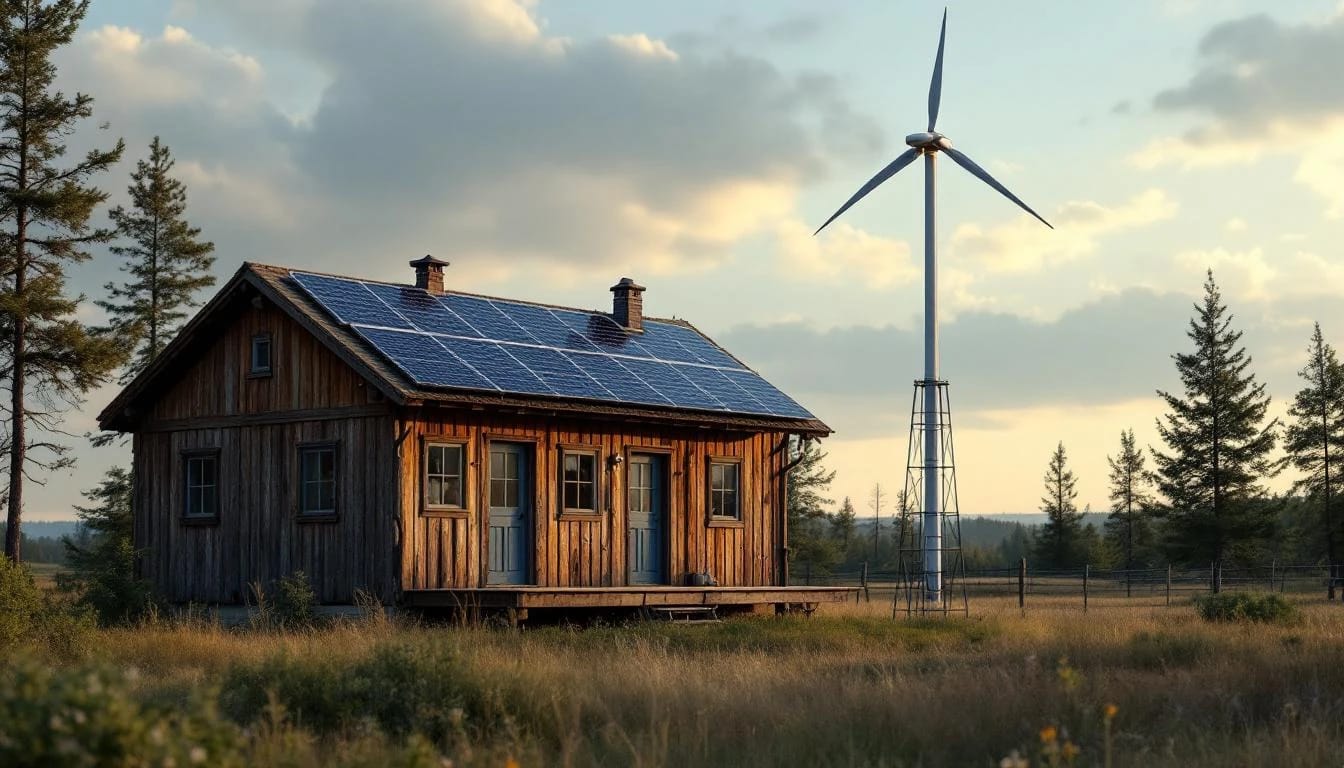
hybrid solar wind
Can You Use Wind and Solar Together? Hybrid System Guide 2026
Yes, wind and solar work together in hybrid systems. Combining turbines with photovoltaic arrays delivers 24/7 renewable generation and smoother grid-tie performance.
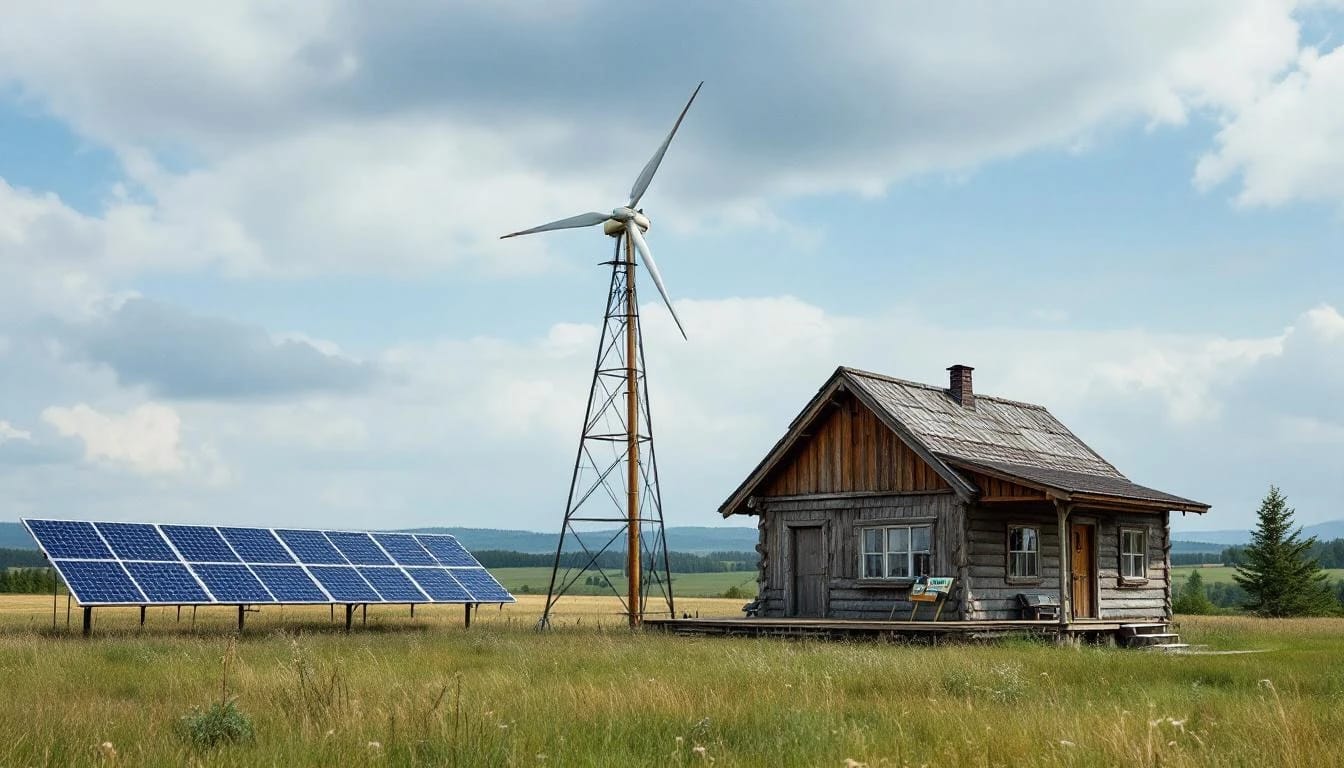
hybrid solar wind
Best Off-Grid Wind Turbine Kits With Battery and Inverter
Complete off-grid wind turbine kits pair a HAWT or VAWT with battery storage and sine-wave inverter for standalone power. Top systems from Pikasola, Nature Power, and Missouri Wind supply 400W-3kW continuous output.