How Vertical-Axis Turbines Actually Perform in Low Wind
Vertical-axis wind turbines start generating power at lower wind speeds than horizontal models but deliver 15-40% less annual energy in typical residential sites.
Share this article
windturbinehome.com/s/7d453b
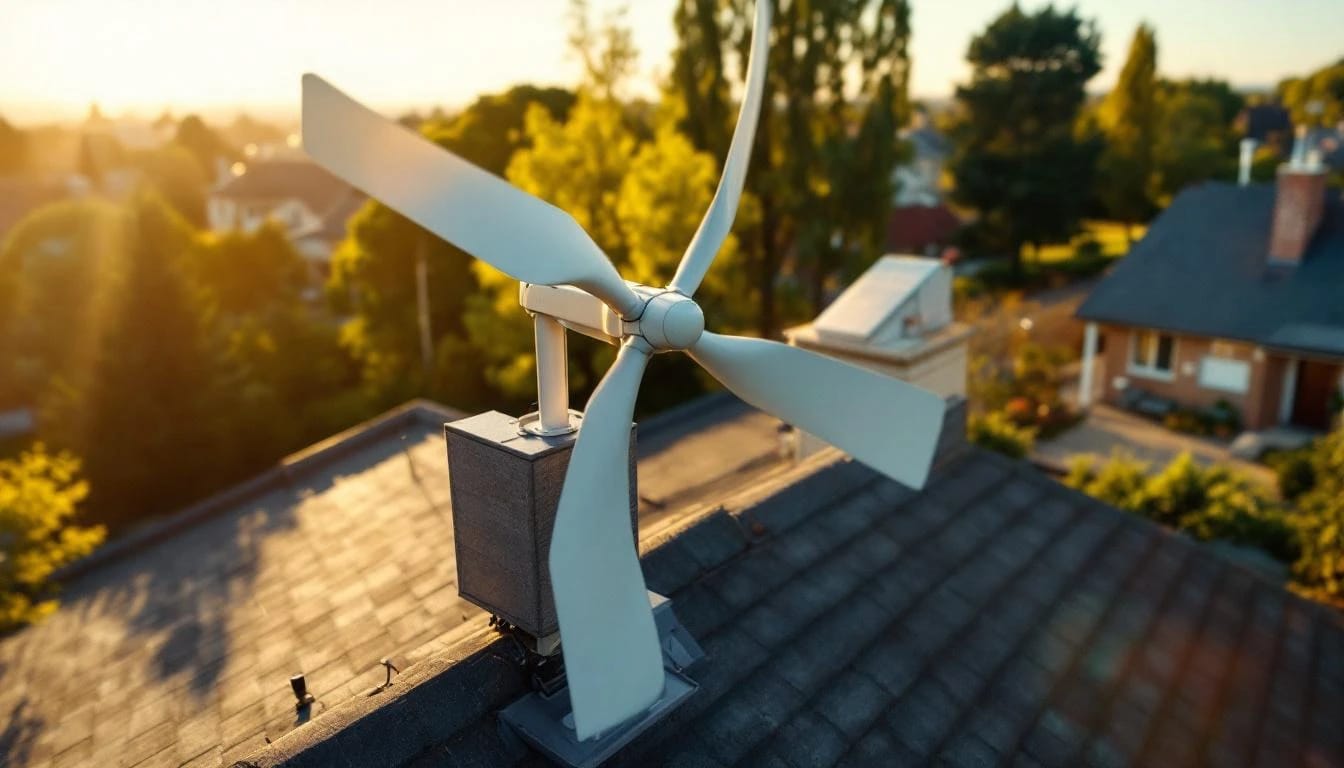
Vertical-axis wind turbines (VAWTs) offer a tempting promise: they spin in light breezes when horizontal-axis turbines (HAWTs) sit idle, making them seem perfect for suburban yards and rooftops where wind speeds rarely exceed 12 mph. The reality is more complex. VAWTs do start generating at lower cut-in speeds—often 6-8 mph versus 8-10 mph for small HAWTs—but their power curves flatten quickly, and most residential models deliver 15-40% less annual energy than comparably rated horizontal turbines in the same location. For property owners in genuinely low-wind sites (average annual speeds below 10 mph), the question isn't whether VAWTs work but whether any small turbine justifies the investment.
How vertical-axis turbines capture low-speed wind
Vertical-axis turbines mount their rotor shaft perpendicular to the ground. The blades—typically two to five curved airfoils or straight Giromill-style panels—orbit the central shaft. Because they accept wind from any direction, VAWTs eliminate the tail vane and yaw mechanism, reducing moving parts. This omnidirectional design also means half the rotor always fights incoming wind while the other half extracts energy, creating inherent drag that limits efficiency.
Most residential VAWTs use either Savonius (drag-based, scoop-shaped) or Darrieus (lift-based, curved-blade) architectures. Savonius rotors start turning in winds as low as 5 mph but plateau around 20-25% efficiency. Darrieus models—including the newer helical "eggbeater" designs from manufacturers like Aeolos and Pikasola—reach 30-35% efficiency at optimal tip-speed ratios but require higher wind speeds to self-start. Hybrid designs attempt to combine Savonius starting torque with Darrieus efficiency, though real-world performance rarely matches laboratory claims.
The National Renewable Energy Laboratory's distributed wind research emphasizes performance assessment tools for small turbines. Their testing protocols reveal that manufacturers often rate VAWTs using instantaneous peak output rather than sustained power across the operating range. A turbine labeled "1 kW" may only sustain 400-600 watts in steady 12 mph wind—the difference between rated capacity and actual output matters enormously for payback calculations.
Comparing cut-in speeds and power curves
Cut-in speed is the minimum wind velocity at which a turbine begins generating measurable power. Most residential VAWTs cut in between 6-8 mph; small HAWTs typically require 8-10 mph. That 2 mph advantage sounds significant until you examine the power curve—the relationship between wind speed and electrical output.
| Wind Speed (mph) | Typical VAWT Output (400W rated) | Typical HAWT Output (400W rated) |
|---|---|---|
| 6 | 5-10 W | 0 W |
| 8 | 20-35 W | 10-20 W |
| 10 | 60-90 W | 80-120 W |
| 12 | 140-180 W | 200-260 W |
| 15 | 260-320 W | 380-450 W |
| 20 | 380-420 W | 550-650 W |
| 25 | 400 W (rated) | 650-750 W (limited by controller) |
The VAWT's early start provides minimal energy because wind power scales with the cube of velocity—doubling wind speed delivers eight times the power. The handful of watts generated at 6-7 mph contributes negligibly to monthly production. By 10-12 mph, the HAWT has caught up and begins pulling ahead as its higher tip-speed ratio and cleaner airflow extract more energy from the same wind resource.
Wind-speed frequency distribution matters more than cut-in thresholds. Most residential sites experience a Weibull distribution: many hours at low speeds, fewer at moderate speeds, rare periods at high speeds. If your site averages 9 mph annually, you'll spend 60-70% of operating hours below 10 mph where VAWTs theoretically excel. But energy production happens disproportionately during the 20-30% of time when winds exceed 12 mph—precisely where HAWTs dominate.
Real-world efficiency losses in turbulent residential environments
Vertical-axis turbines market themselves as rooftop-friendly because they handle turbulence better than HAWTs. This claim contains truth wrapped in misleading context. VAWTs do tolerate rapidly changing wind direction—common in suburban neighborhoods with buildings, trees, and fences—without yaw misalignment losses. However, turbulence itself destroys efficiency for both architectures, and rooftop installation introduces structural complications that often outweigh aerodynamic advantages.
Turbulent wind—characterized by swirling eddies and rapid velocity changes—reduces effective power capture by 20-50% compared to smooth laminar flow. The NREL's WindWatts tool demonstrates this through computational modeling. A VAWT rated for 1,200 kWh annual production in smooth 11 mph wind might deliver only 500-700 kWh when mounted 8 feet above a suburban garage roofline. The building itself creates a wake zone; wind accelerates over the peak then separates chaotically. Trees upwind add more disturbance. The VAWT spins, but it's harvesting degraded, low-energy wind.
Rooftop mounting also transfers vibration directly into living space. VAWTs produce less aerodynamic noise than HAWTs but generate significant structural transmission—a low-frequency hum that penetrates walls. Most residential installations require vibration dampers, adding $200-400 to system cost. Tower-mounted VAWTs 15-25 feet above ground avoid building interaction but sacrifice the low-profile aesthetic that drives many buyers toward vertical designs.
The U.S. Department of Energy's Competitiveness Improvement Project funds testing of small turbines under realistic distributed-generation conditions. Participating manufacturers submit units for independent verification. Results consistently show field performance 25-45% below laboratory ratings. Vertical-axis models suffer disproportionately because their drag-dominated physics amplify turbulence penalties.
The low-wind economics problem
Small wind economics hinge on annual energy production, not nameplate capacity. A $4,500 VAWT producing 800 kWh/year in a low-wind site (9 mph average) displaces roughly $96 worth of grid electricity annually at $0.12/kWh. Before federal incentives, simple payback exceeds 45 years—well beyond turbine lifespan. The 30% federal Residential Clean Energy Credit (IRC §25D, claimed on IRS Form 5695) drops net cost to $3,150, improving payback to 33 years. Still uneconomical.
Compare that to a $6,500 HAWT producing 1,400 kWh/year in the same location. Grid offset: $168/year. Post-credit cost: $4,550. Payback: 27 years. Better, but hardly compelling. The fundamental issue isn't VAWT versus HAWT—it's whether any turbine makes financial sense below 12 mph average wind speed. Most don't.
State-level incentives through the Database of State Incentives for Renewables & Efficiency (DSIRE) occasionally improve math. California's SGIP program historically offered $1.80-2.50/watt for wind systems; Texas property tax exemptions reduce ongoing costs; Massachusetts SMART program provides per-kWh payments. However, many states exclude or cap small wind, focusing instead on solar PV. Check DSIRE for your jurisdiction before committing capital.
Equipment costs tell only part of the story. Installation for a 15-foot guyed tower runs $800-1,500 if you're experienced with concrete foundations and basic electrical work. Most homeowners hire out, adding $2,000-4,000. NEC Article 705 governs interconnection; you'll need a grid-tie inverter ($400-800), disconnect switches, and a bidirectional meter. Many utilities impose standby charges ($10-30/month) that further erode savings. Plan on $7,000-12,000 all-in for a professionally installed 400-1,000W system.
Maintenance is minimal but not zero. Bearings wear; controllers fail; blades degrade. Budget $100-200 annually for upkeep. Blade replacement every 10-15 years costs $600-1,200. Factor these into lifecycle calculations. The VAWT's mechanical simplicity—no yaw mechanism, no pitch control—does reduce service frequency compared to HAWTs, but savings amount to perhaps $50-100 per year.
When vertical-axis designs make practical sense
Vertical-axis turbines occupy specific niches where their characteristics align with operational constraints. Off-grid cabins at 8,000+ feet elevation see steady orographic winds; a Bergey Excel or Primus AIR turbine performs better, but if you lack a clear horizontal fetch and need to mount near the structure, a helical VAWT provides some charging current for battery banks. Pair it with solar—never rely on a single low-wind turbine.
Marine applications favor VAWTs. Sailboats and offshore platforms pitch and roll; a vertical rotor stays balanced. Wind over water is less turbulent than over land, partially compensating for efficiency losses. Several liveaboard cruisers run 200-400W VAWTs to maintain house batteries during passages, though most sailors prefer larger HAWTs (Superwind 350, Primus Air 40) once the mast height justifies installation complexity.
Educational settings value VAWTs for visibility and hands-on demonstration. A school that mounts a 300W vertical turbine on a courtyard pole isn't optimizing energy production—it's teaching wind-speed measurement, power electronics, and renewable-energy principles. The NREL's Distributed Generation Market Demand model includes a "non-economic adoption" category recognizing that some installations prioritize education or signaling over financial return.
Urban "wind art" installations blend sculpture with function. City plazas and commercial building facades sometimes integrate decorative VAWTs as architectural features. These generate token power—often feeding LED accent lighting—while serving primarily aesthetic purposes. If you're drawn to the visual appeal and accept negligible economic payback, a VAWT becomes yard art that occasionally offsets a few kilowatt-hours.
Strict zoning or HOA restrictions may force vertical designs by default. Some municipalities cap turbine height at 15 feet or ban structures visible from the street. A compact 8-foot helical VAWT tucked beside a garage might gain approval where a 30-foot tower would not. Understand this as a compromise: you're accepting lower performance to satisfy regulatory constraints, not because VAWTs excel in the conditions you face.
What the data says about annual energy production
Independent testing separates marketing claims from delivered performance. The NREL's distributed wind research program conducts field assessments of small turbines, measuring output over 12-month periods at instrumented test sites. Their performance assessment tools track energy production, wind resource, turbulence intensity, and availability (uptime).
Results for vertical-axis models consistently show capacity factors—annual energy divided by rated capacity times 8,760 hours—between 4-8% at sites averaging 9-11 mph. A 1,000W VAWT in 10 mph average wind produces 350-700 kWh/year. Horizontal-axis turbines at the same sites achieve 10-15% capacity factors: 880-1,300 kWh/year for a 1,000W rated unit. The gap narrows slightly at very low wind speeds (below 8 mph average) where neither architecture performs well.
Manufacturers rarely publish honest capacity factors. Instead, they list annual energy estimates using optimistic wind-speed assumptions. An Aeolos-V 1kW turbine might claim "1,200 kWh/year in 5 m/s (11 mph) average wind." That figure assumes Rayleigh distribution (unrealistic in complex terrain), 95% availability (no maintenance downtime), and smooth flow (no turbulence penalty). Real production: 600-800 kWh. Always reduce manufacturer estimates by 35-50% for residential installations.
The U.S. Department of Energy's Wind Energy Technologies Office publishes case studies from distributed-generation installations. A dairy farm in Vermont installed a 5kW VAWT expecting 8,000 kWh/year; three-year average was 4,100 kWh. A rural cooperative in Idaho tested a 2.5kW helical model; first-year production reached only 1,850 kWh versus a 4,500 kWh projection. These aren't defective units—they're standard VAWTs operating in typical low-wind environments where physics limits what any turbine can extract.
Third-party certification through the Small Wind Certification Council (SWCC) provides the most reliable performance data. SWCC testing measures power curves, noise, safety, and duration following IEC 61400-2 standards. Certified turbines include validated annual energy estimates for various wind speeds. Unfortunately, SWCC certification costs $50,000-150,000, and most small VAWT manufacturers skip the process. The Bergey Excel and Primus AIR hold certification; nearly all budget VAWTs under $5,000 do not. That absence should inform your expectations.
Alternatives that work better in genuinely low wind
If your site averages below 10 mph and you're determined to generate electricity onsite, solar photovoltaic arrays deliver superior returns. A 2kW solar system costs $4,000-6,000 after federal credits, produces 2,400-3,200 kWh/year in most U.S. locations, requires near-zero maintenance, and benefits from net metering in 38 states. Low wind speed doesn't limit solar production.
Hybrid wind-solar systems make sense in specific scenarios: winter-peaking wind resource combined with summer-dominant solar, off-grid sites needing year-round generation, or locations with excellent wind resource (13+ mph average) where adding solar smooths variability. For typical suburban low-wind sites, dedicating the entire budget to solar maximizes energy and minimizes complexity. You avoid the tower, the wiring, the utility interconnection hassles—and you produce more power.
Ground-mounted solar tracking systems improve winter performance when sun angles are low and wind speeds peak. Single-axis trackers add 20-30% annual production compared to fixed arrays, narrowing the gap during months when wind might otherwise contribute. Cost premium runs $0.50-0.80/watt; evaluate whether that investment beats a small turbine for your specific wind resource.
Battery storage paired with grid-tied solar provides backup power during outages—the key reason some homeowners consider wind. A 10kWh lithium battery system costs $8,000-12,000 installed. It delivers actual resilience (lights and refrigerator during blackouts) rather than the marginal trickle-charge a VAWT provides. If backup capability drives your interest in wind, batteries solve the problem more reliably.
Community solar programs let you subscribe to a shared off-site array, receiving credits on your utility bill proportional to your share. No equipment, no installation, no maintenance—just predictable per-kWh savings. Not available everywhere, but where offered (check DSIRE), community solar provides renewable energy access without requiring a windy property or suitable roof.
Installation and grid-connection requirements under NEC
Any grid-connected wind system must comply with NEC Article 705, which governs distributed generation interconnection. Key requirements include a clearly marked dedicated circuit breaker in your main panel, a lockable AC disconnect switch visible from the turbine, and proper grounding. VAWTs connect through a grid-tie inverter that synchronizes output to utility voltage and frequency; the inverter must be UL 1741-listed and include anti-islanding protection (automatic shutdown if grid power fails).
FAA Part 77 notification applies to structures exceeding 200 feet AGL or within certain distances of airports. Most residential tower heights (15-35 feet) stay below thresholds, but verify using the FAA's online Notice Criteria Tool if you're near an airport or helipad. Some states require a licensed electrician to make final connections; others permit homeowner work with inspection. California, Massachusetts, New Jersey, and Oregon restrict electrical DIY; Montana, Wyoming, and Idaho allow it. Check local jurisdiction.
Utility interconnection agreements vary wildly. Some municipal utilities streamline small wind with a single-page form and no fees. Investor-owned utilities often impose application fees ($100-500), engineering review charges (another $200-800), and insurance requirements (liability coverage minimums of $300,000-1,000,000). Nevada Energy, Duke Energy, and several Florida utilities have historically made interconnection expensive and slow for small wind. Your local utility's "net metering" or "distributed generation" webpage outlines the process—read it before buying hardware.
Inverter sizing matters. VAWTs produce highly variable output; the inverter must handle peak power without clipping but shouldn't be so oversized that efficiency suffers at typical loads. For a 1,000W-rated VAWT, use a 1,000-1,500W grid-tie inverter. Smaller than 1:1 ratio risks losing production during gusts; larger than 1.5:1 means the inverter operates in its low-efficiency range most of the time. Manufacturers like Schneider Electric and SMA offer inverters specifically designed for small wind, with MPPT algorithms tuned for variable-speed turbines.
Grounding and lightning protection follow NEC Article 250. Drive a copper grounding rod at the tower base, bond it to the turbine frame, and run a continuous conductor to your service panel ground bus. Install a surge protector rated for wind applications ($150-300) on the DC side of the inverter. Lightning strikes near small turbines are uncommon but catastrophic—budget $200-400 for proper protection.
Navigating federal incentives and state programs
The federal Residential Clean Energy Credit provides a 30% tax credit for qualified small wind installations through 2032, stepping down to 26% in 2033 and 22% in 2034. Qualified expenses include equipment, installation labor, permitting fees, and necessary electrical components. You claim the credit on IRS Form 5695, filing it with your 1040. The credit is non-refundable but carries forward if it exceeds your tax liability in a given year.
Crucially, the system must be installed at your primary or secondary residence and used primarily for residential purposes. A turbine on a rental property you don't occupy doesn't qualify. There's no maximum credit amount for wind (unlike the $500 cap on some efficiency upgrades), but the property must be located in the United States. Keep all receipts and contractor invoices—the IRS may request substantiation.
State and utility incentives vary enormously. DSIRE catalogs every program; filter by your state and "wind" technology. Alaska, Montana, and Wyoming offer property tax exemptions that reduce ongoing costs. California's SGIP program historically paid upfront capacity-based rebates but has largely pivoted to energy storage. New York's NY-Sun program focuses on solar but occasionally includes wind for agricultural operations. Texas provides no direct incentives beyond the federal credit—wind is common for commercial scale but rare residentially.
Renewable Energy Certificates (RECs) let you sell the "renewable" attribute of your generation separately from the electricity itself. In practice, small wind produces too few RECs to bother. One REC equals 1 MWh (1,000 kWh). A residential VAWT generating 700 kWh/year creates 0.7 RECs annually, worth perhaps $15-30 in markets where small wind is even eligible. Transaction costs exceed revenue. Ignore RECs unless your system produces 5,000+ kWh/year and you're in a state with an active compliance market (Massachusetts, New Jersey, Pennsylvania, Connecticut).
Grants and zero-interest financing occasionally appear through rural electric cooperatives, community foundations, and green banks. The USDA's Rural Energy for America Program (REAP) funds agricultural wind projects but excludes residential properties unless they're part of a working farm. Contact your state energy office (usually housed in the environmental or commerce department) to ask about any current programs. Expect limited options; small wind fell out of favor after 2015 when solar costs dropped and wind incentives expired.
Do vertical-axis turbines really work in low wind speeds?
Yes, but with significant caveats. VAWTs begin spinning at 6-8 mph—lower than most HAWTs—but generate minimal power until wind exceeds 10-12 mph. A 1kW VAWT might produce only 20-30 watts at 8 mph, contributing negligibly to household consumption. Annual energy production in genuinely low-wind sites (9-10 mph average) typically ranges 400-800 kWh for residential models, displacing $50-100 worth of grid electricity per year. They work, but rarely justify their cost unless site restrictions preclude solar or you're off-grid with no alternative.
How much electricity does a 1kW vertical-axis turbine produce annually?
In a 10 mph average wind site, expect 400-700 kWh/year from a residential VAWT rated at 1,000 watts, representing 4-8% capacity factor. Manufacturer estimates often claim 1,200-1,500 kWh, but those assume ideal conditions: smooth wind flow, Rayleigh distribution, zero downtime, and no turbulence. Real-world installations face turbulence from buildings and trees, maintenance outages, and controller inefficiencies. Independent testing by NREL consistently measures performance 30-50% below sales literature. A comparable 1kW HAWT produces 900-1,400 kWh/year in the same conditions.
Can I install a vertical-axis turbine on my roof?
Technically yes, but it's rarely advisable. VAWTs handle turbulent, omnidirectional wind better than HAWTs, making them superficially suitable for rooftop mounting. However, rooftop installations face severe performance penalties: buildings create turbulent wake zones, effective wind speed drops 20-40% compared to open terrain, and vibration transmits directly into living space. Most residential roofs also lack structural capacity to support turbine loads without reinforcement. Tower-mounting 15-25 feet above ground delivers 2-3x more energy than rooftop placement, though you lose the compact aesthetic. If zoning permits a tower, always choose it over rooftop.
Are vertical-axis turbines quieter than horizontal-axis turbines?
VAWTs produce less aerodynamic "whoosh" noise than HAWTs—typically 35-45 dBA at 50 feet versus 45-55 dBA for comparable HAWTs. The vertical blade path creates steadier pressure changes, reducing audible swish. However, VAWTs generate more mechanical noise from bearings and transmit vibration into mounting structures. Rooftop installations often create low-frequency hum that penetrates walls even when outdoor sound levels are acceptable. Tower-mounted VAWTs 30+ feet from dwellings avoid structural transmission. Overall, properly installed VAWTs are quieter, but "quiet" doesn't mean silent—expect persistent background noise similar to a bathroom exhaust fan.
What wind speed do I need for a vertical-axis turbine to be worthwhile?
Annual average of 12+ mph at hub height makes small wind economically viable; below 10 mph, even VAWTs struggle to offset their cost. Use NREL's WindWatts tool or your state wind resource map to check site-specific speeds—most residential locations fall short. If your site averages 8-10 mph, solar PV delivers better financial returns and more total energy. Between 10-12 mph, wind is marginal; hybrid wind-solar systems spread risk but add complexity. Above 12 mph, a quality HAWT outperforms most VAWTs. Measure wind at your actual installation height for 3-6 months using a recording anemometer ($200-400) before committing to any turbine purchase.
Bottom line
Vertical-axis turbines start generating at lower wind speeds than horizontal models, but that advantage translates to minimal additional annual energy in typical residential sites averaging below 11 mph. Most homeowners considering VAWTs for low-wind locations will capture more electricity, save more money, and avoid more maintenance by investing the same budget in solar panels. VAWTs occupy narrow niches—off-grid charging, marine applications, height-restricted lots—where their compact form and omnidirectional operation outweigh efficiency limitations. If your site lacks sufficient wind resource for a turbine to pay back within its lifespan, no axis orientation fixes the fundamental problem. Measure your wind, run honest production estimates, and compare alternatives before buying.
For low-wind sites, start with solar PV system sizing to establish baseline economics, then evaluate whether adding a turbine improves resilience or winter production. If wind remains appealing, investigate certified small wind turbines with verified performance data. Understand net metering policies in your state and review off-grid battery systems if backup power motivates your interest. Calculate small wind payback periods using your actual utility rate and wind resource. Consider hybrid renewable energy systems that combine solar, wind, and storage for off-grid reliability. Always comply with NEC Article 705 requirements and secure necessary permits before installation. Factor in small wind maintenance costs over the turbine's 15-20 year lifespan.
Check DSIRE for current state incentives, confirm your eligibility for the federal 30% Residential Clean Energy Credit, and verify utility interconnection procedures. For electrical connections and structural installations, hire a licensed professional familiar with NEC Article 705 and local building codes. Wind energy works where the resource justifies the investment—measure first, buy later.
Share this article
windturbinehome.com/s/7d453b
Editorial note: This article was researched and written by a member of the Wind Turbine Home editorial team. AI-assisted tools were used for spell-checking and light grammar review only — all research, analysis, and conclusions are our own. Our editorial policy prohibits sponsored content and paid placements. Read our editorial policy →
Related reading
vertical axis turbines
DIY Savonius Wind Turbine From PVC: Weekend Build Guide
Build a functional Savonius vertical-axis wind turbine from PVC pipe in two days. Step-by-step instructions, materials list, and performance expectations included.

vertical axis turbines
Vertical-Axis Wind Turbines: Honest Pros and Cons for Homes
Vertical-axis wind turbines look sleek but face real performance trade-offs. We examine VAWT efficiency, noise, durability, and cost versus horizontal designs.

vertical axis turbines
Budget Vertical-Axis Wind Turbines: Entry-Level VAWT Tradeoffs
Budget vertical-axis wind turbines ($200–$1,200) sacrifice efficiency and durability for lower upfront cost. Expect 15–25% capacity factors and frequent maintenance.
vertical axis turbines
Savonius vs Darrieus Wind Turbine: The 9 mph Rule
Savonius rotors self-start in light, turbulent breezes, while Darrieus rotors get more efficient once steady wind tops 9 mph. Match the rotor to your site.

vertical axis turbines
Residential Vertical Wind Turbines in 2026: Category Overview
Vertical-axis wind turbines (VAWTs) offer quieter operation and omnidirectional wind capture for residential sites. This 2026 overview covers proven models, costs, and performance trade-offs.

vertical axis turbines
Best Vertical-Axis Wind Turbines for Homes in 2026
Compare proven vertical-axis wind turbines for residential power. Real-world performance, installation costs, and maintenance data for seven VAWT models tested in US homes.