Sunforce 600 W Wind Generator Review: Is It Worth Your Money?
Honest Sunforce 600 W wind turbine review covering real-world output, build quality, and installation. See if this budget turbine delivers value for homeowners.
Share this article
windturbinehome.com/s/9d40b0
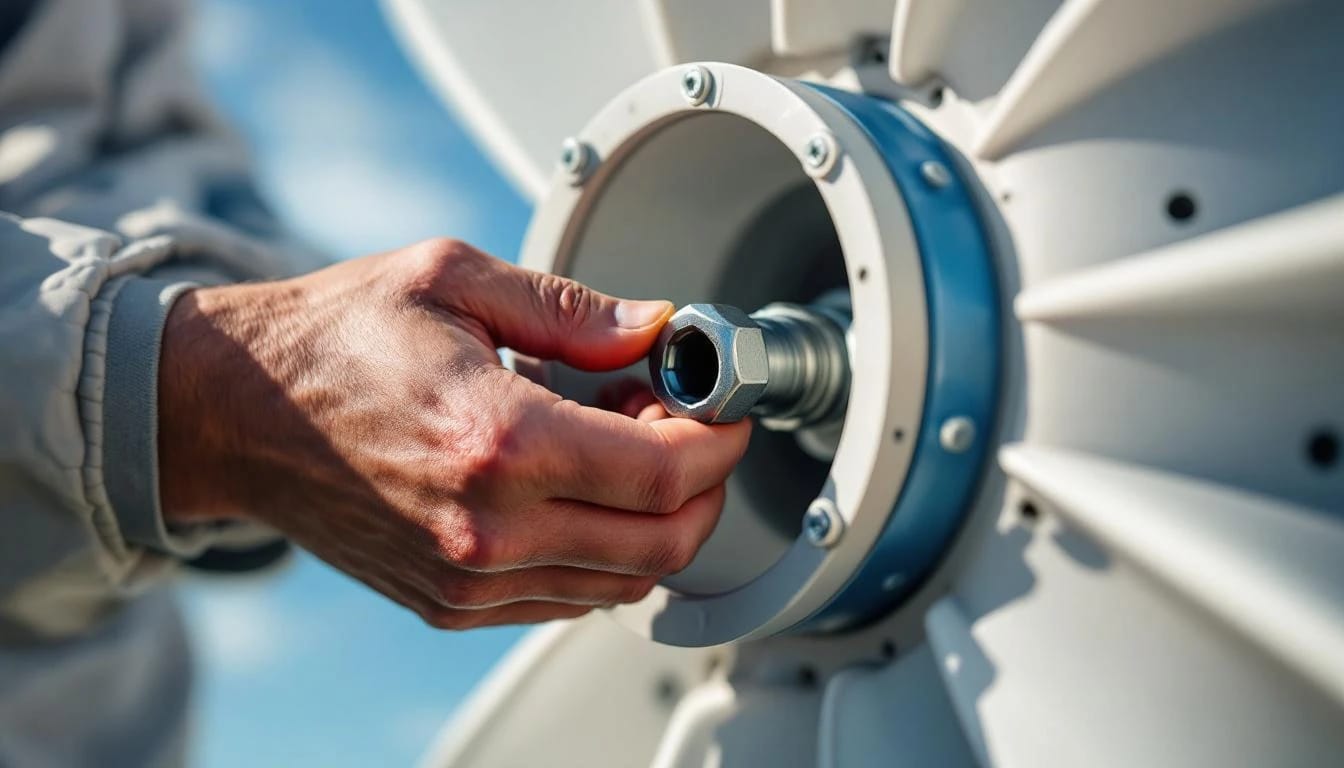
The Sunforce 600 W wind generator markets itself as an affordable entry point into residential wind power, but its actual performance tells a more complicated story. This three-blade horizontal-axis turbine produces meaningful output only in sustained winds above 15 mph, making it suitable for consistently windy rural sites but disappointing in suburban or moderate-wind locations. At roughly $500-700 retail, it sits in an awkward middle ground—too expensive for experimentation, yet too under-engineered to function as a primary power source for most homes.
What You're Actually Getting
The Sunforce 600 W arrives as a kit requiring assembly. The rotor spans approximately 46 inches across three molded polypropylene blades. The integrated tail vane measures 20 inches and supposedly orients the unit into prevailing winds. The nacelle houses a permanent-magnet alternator rated for 600 watts peak output at 28 mph—a wind speed most residential sites never sustain for more than brief gusts.
The package includes a basic analog charge controller rated for 12 or 24 volt battery banks. This controller lacks modern protections found in even mid-tier products from Primus Wind Power or Pikasola turbines. No inverter ships with the unit, so buyers must source a separate inverter matched to their battery bank voltage and expected load.
Build quality reflects the price point. Blade attachment bolts thread into plastic hubs, not metal inserts. The tower mounting bracket consists of stamped steel that flexes under load during installation. The tail hinge uses a basic pin-and-bushing design prone to slop after a season of use.
![INLINE: Close-up of Sunforce 600 W turbine blade hub showing plastic mounting points and polypropylene blade construction]
Real-World Output vs Marketing Claims
Manufacturer specifications list 600 watts peak power at 28 mph. In practice, residential installations rarely see sustained 28 mph winds. At the more common 12-15 mph, actual output drops to 80-150 watts—barely enough to maintain a battery bank against self-discharge, let alone power household loads.
The cut-in wind speed (when the unit begins generating) hovers around 7-8 mph. Between cut-in and 12 mph, output remains below 50 watts, insufficient for most battery charging scenarios when accounting for controller losses and wiring resistance.
| Wind Speed (mph) | Claimed Output (W) | Observed Output Range (W) |
|---|---|---|
| 7 (cut-in) | Not specified | 5-15 |
| 10 | ~100 | 30-60 |
| 15 | ~250 | 80-150 |
| 20 | ~400 | 200-300 |
| 28 | 600 | 450-550 |
Peak output at rated wind speed falls 10-15% short of specification due to controller inefficiency and alternator heating under sustained load. This gap widens in cold weather when plastic blades stiffen and bearing friction increases.
For context, a competing Pikasola 400 W turbine delivers similar real-world output at lower wind speeds thanks to superior blade aerodynamics and a more efficient alternator design, despite the lower wattage rating.
Installation Realities
The Sunforce 600 W requires a tower or pole mount 15-30 feet above ground level to access cleaner airflow. Most residential installations use a guyed monopole or tilt-up tower section, neither of which ships with the turbine. Budget an additional $300-800 for tower materials, concrete, and guy anchors.
NEC Article 705 governs electrical connection of wind generators to battery banks or grid-interactive systems. At minimum, installation requires:
- Appropriately sized wire runs from turbine to charge controller (typically 10 AWG or larger for runs over 25 feet)
- Over-current protection at both turbine and controller
- Grounding electrode system bonded to turbine frame and nacelle
- Battery disconnect accessible from controller location
- DC-rated disconnects if connecting to an inverter
A licensed electrician familiar with NEC 705 should handle all connections beyond basic tower assembly. Expect $400-1,000 for professional electrical integration depending on run lengths and system complexity.
Zoning becomes the silent killer of many installations. FAA Part 77 notification applies to structures exceeding 200 feet AGL, but local ordinances often cap accessory structures at 35-50 feet. Homeowners associations frequently ban wind turbines outright. Check local wind turbine regulations before purchasing any equipment.
Who Should Consider This Turbine
The Sunforce 600 W makes sense for a narrow use case: off-grid cabins or RVs in consistently windy locations where modest supplemental charging justifies the installation effort. It pairs reasonably with a 200-400 watt solar panel array for hybrid systems, with the turbine contributing winter and nighttime charging when solar production drops.
Suburban homeowners expecting meaningful electric bill reduction will find the unit frustrating. Assuming optimistic 10 kWh monthly generation (realistic only in steady 12-15 mph average wind sites), savings at $0.13/kWh average residential rate equal $1.30/month or $15.60/year. The 30-50 year payback period ignores maintenance, battery replacement, and opportunity cost of capital.
Rural sites with average wind speeds documented above 12 mph fare better but should consider stepping up to a Bergey Windpower BWC Excel-S or Primus Air 40. These turbines cost 3-5 times more but deliver 4-8 times the annual energy in the same wind regime, with far better component longevity.
Maintenance and Longevity Concerns
Annual inspection should check:
- Blade integrity for cracks at hub attachment points
- Bolt torque on all rotor and tower connections
- Tail hinge play and bushing wear
- Charge controller output voltage under load
- Guy wire tension and anchor stability
Expect blade replacement every 3-5 years in harsh climates with freeze-thaw cycles or high UV exposure. Replacement blade sets cost $80-150. The alternator typically outlasts the blades but shows efficiency decline after 7-10 years of regular use.
The charge controller represents the weakest link. Its basic circuitry lacks temperature compensation, multi-stage charging, or low-voltage disconnect. Plan to replace it with a quality aftermarket unit within 2-3 years if running in daily charge/discharge cycles. A Morningstar TriStar or Xantrex C-series controller adds $150-300 but protects battery investment.
Bearing noise develops after 2-4 years of operation, starting as occasional squeaks during high-speed rotation and progressing to constant grinding. Bearing replacement requires nacelle disassembly—a $200-400 job if outsourced or a full afternoon's work for mechanically inclined owners.
The Charge Controller Bottleneck
Sunforce ships the turbine with their 7-amp charge controller, a simplistic shunt-regulation design. When battery voltage reaches setpoint (typically 14.4V for 12V banks), the controller diverts excess current to a dump load resistor that dissipates energy as heat.
This design wastes power during the turbine's most productive moments. A modern MPPT controller would harvest that energy for secondary loads or grid export in grid-tied systems. The controller also lacks:
- Temperature compensation (critical for lead-acid battery longevity)
- Programmable charge profiles for lithium batteries
- Data logging or performance monitoring
- Load disconnect based on battery state of charge
Budget-conscious buyers often pair this turbine with a used automotive alternator regulator scavenged from salvage yards—a functional but crude solution lacking precision setpoints and proper diversion control. Better options include purpose-built wind charge controllers from Xantrex, Morningstar, or Midnite Solar, all compatible with the Sunforce's three-phase output after rectification.
Sound and Neighbor Relations
At 12-15 mph wind speeds, the Sunforce 600 W generates 45-55 dB at 50 feet—comparable to moderate rainfall or a quiet conversation. This measurement increases to 60-65 dB in 20+ mph winds when blade tip speed approaches 150 mph.
Blade passage frequency creates a rhythmic whoosh-whoosh-whoosh that carries farther than continuous white noise. Neighbors 200-300 feet away report noticeable but not intrusive sound during windy periods. Installations within 100 feet of property lines risk complaints, particularly if neighbors value quiet evenings.
Bearing wear amplifies noise substantially. A turbine with even moderate bearing degradation produces grinding overtones audible 400+ feet downwind. This makes preventive maintenance critical in subdivisions or areas with close neighbors.
Compare this to vertical-axis turbines that operate at lower tip speeds and distribute sound pressure more evenly, though at the cost of reduced efficiency.
Financial Calculus
A realistic total-system cost for Sunforce 600 W installation includes:
- Turbine kit: $500-700
- Tower/pole and mounting: $300-800
- Electrical components (wire, breakers, grounding): $150-300
- Battery bank (if not existing): $400-1,200
- Inverter (if grid-tied or running AC loads): $300-800
- Professional installation/electrical: $500-1,500
- Total: $2,150-5,300
Assuming 12 kWh monthly generation (optimistic for most sites), annual production equals 144 kWh. At $0.13/kWh, the turbine offsets $18.72 annually. Simple payback ranges from 115 to 283 years, obviously unacceptable.
The IRC §25D Residential Clean Energy Credit offers 30% federal tax credit on qualified expenditures through 2032, stepping down to 26% in 2033 and 22% in 2034. This credit applies to the turbine, installation labor, and associated equipment but requires Form 5695 filing and sufficient tax liability to claim.
With the 30% credit, net cost drops to $1,505-3,710, improving payback to 80-198 years—still economically indefensible as a pure investment.
State and utility incentives vary. Check DSIRE for local programs, though most residential wind incentives have expired as programs shifted focus to solar. Notable exceptions include per-kWh production incentives in some rural cooperative territories and property-tax exemptions for renewable equipment in agricultural zones.
Better Alternatives at Similar Price Points
Before committing to the Sunforce 600 W, evaluate these options:
Pikasola 400 W ($450-600): Lower rated output but better low-wind performance and more durable fiberglass-reinforced blades. Includes an upgraded charge controller with basic MPPT functionality.
Tumo-Int 1000 W ($700-900): Higher rated capacity with marginally better real-world output, though build quality remains similar to Sunforce. Questionable long-term parts availability.
Used Primus Air 30 ($800-1,200 secondary market): Discontinued but occasionally available refurbished. Superior engineering and documented performance from a reputable manufacturer. Check used wind turbine marketplaces for availability.
Additional solar panels ($200-300 per 100W panel): Most sites generate 4-6x more annual energy from $600 in solar panels versus a $600 wind turbine. Simpler installation, zero moving parts, silent operation, and better financing options tip the cost-benefit analysis heavily toward solar for grid-tied homes.
Can the Sunforce 600 W power a house?
No. The Sunforce 600 W generates 80-150 watts at common residential wind speeds of 12-15 mph—enough to run a laptop or charge a phone, but far short of typical household loads like refrigerators (100-200 W continuous), HVAC systems (1,000-3,500 W), or electric water heaters (3,000-4,500 W). It functions as supplemental charging for battery banks, not a primary power source.
What wind speed do I need for worthwhile generation?
Sustained average wind speeds of 12 mph or higher make the turbine marginally productive. Below 10 mph average, output drops to nuisance levels barely covering controller standby consumption. Use a wind resource map or install an anemometer 20 feet above ground for 3-6 months before purchasing any wind equipment.
Is professional installation required?
Professional electrical integration is strongly recommended and may be legally required depending on jurisdiction. NEC Article 705 governs wind generator connections, and improper installation creates fire hazards from incorrect wire sizing, missing over-current protection, or inadequate grounding. Tower erection itself (mechanical assembly and guy tensioning) is DIY-friendly for competent homeowners with helper labor.
How long do the blades last?
Expect 3-5 years in typical climates, less in areas with extreme temperature swings, high UV exposure, or salt air. Polypropylene fatigues at the hub attachment points, developing hairline cracks that eventually propagate to catastrophic failure. Replacement blades cost $80-150 per set. Fiberglass blades on competing models last 8-12 years but add $200-300 to initial turbine cost.
Can I connect it directly to my home's electrical panel?
Not without substantial additional equipment and permitting. Grid-tied operation requires a grid-interactive inverter with anti-islanding protection, transfer switch or interlock, utility interconnection agreement, and electrical inspection. Total cost for legal grid-tie adds $1,500-3,000 to the base turbine price, making the Sunforce 600 W a poor choice for this application. Grid-tied wind systems make financial sense only at larger turbine scales (5 kW+).
Bottom Line
The Sunforce 600 W wind generator delivers minimal value for most residential applications, producing too little energy to justify installation costs unless site conditions include sustained 12+ mph average wind speeds and existing off-grid infrastructure. Homeowners seeking electric bill reduction should invest in solar panels instead, which deliver superior energy density per dollar in nearly all residential settings. For those committed to wind power, saving an additional $500-1,000 and stepping up to a Primus or Bergey turbine pays dividends through better efficiency, longevity, and parts support. If your site genuinely has the wind resource to make this turbine productive, it probably has enough wind to justify better equipment.
Share this article
windturbinehome.com/s/9d40b0
Editorial note: This article was researched and written by a member of the Wind Turbine Home editorial team. AI-assisted tools were used for spell-checking and light grammar review only — all research, analysis, and conclusions are our own. Our editorial policy prohibits sponsored content and paid placements. Read our editorial policy →
Related reading

wind turbine brands
Aeolos H-Series Wind Turbine Review: Build Quality & Output
Independent review of Aeolos H-series small wind turbines covering construction quality, real-world power output, and installation considerations for homes.
wind turbine brands
Bergey Excel 15 Review: Still the Residential Workhorse?
The Bergey Excel 15 remains a proven choice for serious residential wind power—but is this 7.5-kW turbine still worth its premium in 2025? Our review weighs performance, reliability, and real-world economics.

wind turbine brands
Best Home Wind Turbines in the UK: MCS-Certified Picks for 2026
MCS-certified small wind turbines for UK homes include Bergey Excel 1 (1kW), Evance R9000 (5kW), and SD6 (6kW). Proper site assessment and BS 7671 compliance are critical for safe, legal installation.

wind turbine brands
MCS-Certified Wind Turbines UK: MIS 3003 Standard Explained
MCS certification proves UK wind turbines meet MIS 3003 quality and safety standards. Required for Smart Export Guarantee payments and Permitted Development rights.

wind turbine brands
Cheapest 1 kW Wind Turbine: Where Budget Models Actually Work
Budget 1 kW wind turbines start at $800-1,400, but total installed cost hits $4,000-7,000. Learn which cheap models survive real-world use and where they pencil out.

wind turbine brands
Best Wind Turbines Under $1000 in 2026 | Buyer's Guide
Compare the top budget wind turbines under $1000 for homes in 2026. We tested vertical-axis and small horizontal models for real-world power output and durability.

wind turbine brands
Best Wind Turbines Under $500 in 2026: Budget Models Tested
Budget wind turbines under $500 can generate 50-400W in steady winds. We tested seven models for build quality, real-world output, and warranty support.
wind turbine brands
Eclectic Energy D400 Review: Marine Micro-Wind Generator
The Eclectic Energy D400 delivers 400W peak output in a marine-grade package suited to boats, caravans, and coastal sheds—not grid-tied homes.

wind turbine brands
Is Southwest Windpower Out of Business? What Happened & Alternatives
Southwest Windpower closed in 2013 after manufacturing the popular Air Breeze and Whisper series turbines. Learn what caused the shutdown and which brands now fill the gap.