Wind Turbine Swept Area: Calculate Rotor Size & Power Output
Swept area determines how much wind energy a turbine can capture. Learn the formula, why rotor diameter matters more than blade count, and how to size a system.
Share this article
windturbinehome.com/s/406c34
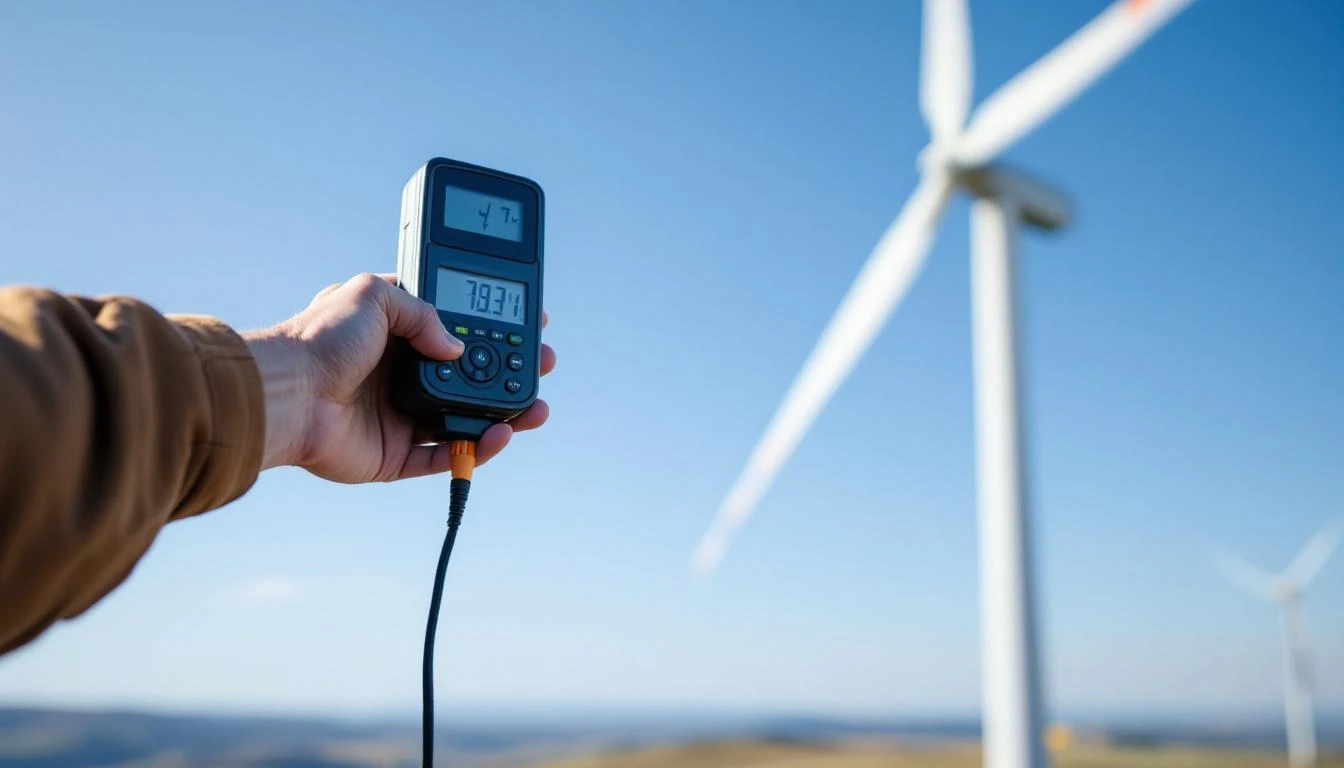
Swept area is the circular area covered by a wind turbine's rotating blades—and it's the single most important factor in predicting how much electricity a small wind system will generate. A turbine with a 10-foot rotor diameter sweeps 78.5 square feet, while doubling that diameter to 20 feet increases swept area to 314 square feet—a fourfold jump in energy-capturing surface. Understanding this calculation helps homeowners compare models accurately, avoid undersized installations, and verify manufacturer claims before spending $8,000 to $60,000 on a residential wind system.
What Swept Area Means for Power Production
Swept area (A) equals π × radius², or 0.7854 × diameter². For a Bergey Excel 10 with its 7-meter (23-foot) rotor, the swept area reaches 38.5 square meters (415 square feet). Power output scales with swept area, not blade length alone, because the area dictates how many cubic meters of moving air pass through the rotor each second.
The Betz limit—a physics constraint—caps real-world turbine efficiency at 59.3% of the kinetic energy in the wind. Manufacturers achieve 35–45% efficiency in practice, so a turbine with twice the swept area captures roughly twice the energy at the same wind speed. That's why a 400-watt Primus Air 40 (1.4 m rotor, 1.5 m² swept area) generates a tenth the annual output of a Bergey Excel 10 (38.5 m² swept area) when both operate at sites averaging 12 mph winds.
| Turbine Model | Rotor Diameter | Swept Area | Rated Output | Typical Annual kWh (12 mph site) |
|---|---|---|---|---|
| Pikasola 400W | 1.17 m (3.8 ft) | 1.07 m² | 400 W | 200–350 |
| Primus Air 40 | 1.4 m (4.6 ft) | 1.54 m² | 400 W | 300–500 |
| Aeolos-V 1kW | 1.6 m (5.2 ft) | 2.01 m² | 1 kW | 600–900 |
| Skystream 3.7 | 3.72 m (12.2 ft) | 10.87 m² | 2.4 kW | 3,500–5,000 |
| Bergey Excel 10 | 7 m (23 ft) | 38.48 m² | 10 kW | 14,000–18,000 |
Wind speed matters exponentially—available power increases with the cube of velocity—but swept area determines the baseline capacity to harvest that power.
![INLINE: Diagram showing two wind turbines side by side with overlaid swept area circles and measurements, illustrating how doubling rotor diameter quadruples swept area]
The Swept Area Formula and How to Apply It
Calculate swept area using A = π × r² or the shortcut A = 0.7854 × D², where D is rotor diameter. For a turbine with a 15-foot diameter:
- Radius = 7.5 feet
- A = 3.1416 × (7.5)² = 176.7 square feet
In metric: a 2-meter rotor has a 1-meter radius, so A = 3.1416 × 1² = 3.14 square meters.
Wind resource assessments from the Department of Energy's WINDExchange provide average wind speeds. Pair that data with swept area to estimate generation using the formula:
Annual kWh = 0.01328 × A × V³ × 8760 × efficiency
Where A is in square feet, V is average wind speed in mph, 8760 is hours per year, and efficiency is 0.35–0.45 for small turbines. A 200-square-foot swept area in a 10 mph average wind with 40% efficiency yields:
0.01328 × 200 × 10³ × 8760 × 0.4 = 9,311 kWh/year
This rough estimate confirms whether a site can support a given turbine size. For precise projections, manufacturers provide power curves showing output at specific wind speeds.
Why Rotor Diameter Drives Turbine Cost and Performance
Doubling rotor diameter quadruples swept area but increases material costs and structural loads. A Bergey Excel 10 with its 23-foot rotor carries a manufacturer-specified price near $34,000 (turbine only), while a Skystream 3.7 with a 12-foot rotor costs roughly $12,000. Installation adds $3,000–$15,000 depending on tower height and site complexity; NEC Article 705 and local building codes mandate licensed electricians for grid interconnection.
Larger rotors also demand taller towers. The Department of Energy's Small Wind Guidebook recommends mounting the rotor at least 30 feet above any obstruction within 500 feet. A 10 kW system often requires an 80- to 120-foot tower, triggering FAA Part 77 notification for structures exceeding 200 feet or within airport glide paths. Zoning setbacks—often 1.5× tower height from property lines—can eliminate sites with less than 1 acre.
Blade count is secondary to swept area. Three-blade horizontal-axis turbines (HAWTs) dominate the residential market because they balance rotational speed, torque, and vibration. Five-blade designs offer smoother operation but add weight and cost without increasing swept area. Vertical-axis turbines (VAWTs) like the Aeolos-V series claim omnidirectional wind capture, but swept area still governs output—the advertised "rotor diameter" for a VAWT refers to its width, and effective swept area equals height × diameter for Darrieus models.
Matching Swept Area to Household Energy Demand
The average U.S. home consumes 877 kWh per month (10,500 kWh/year), according to the Energy Information Administration. A turbine must deliver that total after accounting for capacity factor—the ratio of actual output to rated capacity over a year. Residential turbines typically achieve 15–30% capacity factor, meaning a 10 kW system in a good wind site (12–14 mph average) produces 13,000–26,000 kWh annually.
To offset 75% of a 10,500 kWh annual load, target 7,875 kWh from the turbine. In a 12 mph average wind zone (IEC Class III), swept area needs to reach:
- 7,875 kWh ÷ (0.01328 × V³ × 8760 × 0.4) = 7,875 ÷ 680 ≈ 11.6 square meters (125 square feet)
- Diameter = √(A ÷ 0.7854) = √(125 ÷ 0.7854) ≈ 12.6 feet
A Skystream 3.7 (12.2-foot rotor) fits this scenario. Drop to a 10 mph site, and required swept area climbs to 280 square feet (19-foot diameter), pushing into Bergey Excel 6 territory.
Grid-tied systems benefit from net metering where available. As of 2025, 38 states plus Washington D.C. offer net metering programs through the Database of State Incentives for Renewables & Efficiency (DSIRE). Excess generation earns credits at retail or wholesale rates, smoothing seasonal mismatches between wind production and household demand.
Swept Area in Hybrid and Off-Grid Configurations
Off-grid systems pair wind turbines with solar panels and battery banks because wind speeds peak in winter and nighttime hours when solar is dormant. Swept area determines the wind system's contribution to the hybrid capacity. A cabin using 500 kWh/month (6,000 kWh/year) in a 9 mph average wind site needs:
- 6,000 kWh ÷ (0.01328 × 9³ × 8760 × 0.35) = 6,000 ÷ 285 ≈ 21 square meters (226 square feet)
- Diameter ≈ 17 feet
Battery capacity must handle multi-day lulls. A 48V system supporting 500 kWh/month requires 30–50 kWh usable storage (roughly 60–100 kWh nominal lithium capacity), costing $15,000–$30,000. Charge controllers for wind differ from solar MPPT units; turbines need dump loads or dynamic braking to prevent overspeed damage during battery-full conditions. Swept area sizing should account for 20% parasitic loss in charge/discharge cycles.
Verifying Manufacturer Swept Area and Performance Claims
Turbine datasheets list rotor diameter; calculate swept area independently to confirm advertised figures. The Bergey Excel 10 specifies 7 meters—manual calculation yields 38.48 m², matching the datasheet. If a manufacturer claims 5 kW rated output from a 2-meter rotor (3.14 m² swept area), cross-check against the power density formula. At the IEC standard 11 m/s (24.6 mph) rating point, power density is:
P = 0.5 × ρ × A × V³ × efficiency
Where ρ (air density) = 1.225 kg/m³. Plugging in:
0.5 × 1.225 × 3.14 × 11³ × 0.4 = 1,047 watts
A 5 kW claim on a 3.14 m² rotor requires either fabricated wind speed (testing at 20+ m/s) or impossible efficiency. Legitimate manufacturers provide IEC 61400-2 certification and independent power curves.
Third-party testing by the Small Wind Certification Council (SWCC) verifies swept area and performance. As of 2024, fewer than 15 models hold active certification due to program funding constraints, but certified turbines—Bergey Excel series, Endurance E-3120, Southwest Windpower Skystream—demonstrate measurable swept area and output alignment.
Regulatory and Incentive Considerations Tied to System Size
Swept area influences permitting and financial incentives. The federal Residential Clean Energy Credit (IRS Form 5695, IRC §25D) offers 30% tax credit on installed cost through 2032, stepping down to 26% in 2033 and 22% in 2034. There's no maximum credit, so a $60,000 installed system (turbine, tower, wiring, labor) yields an $18,000 credit. Larger swept area drives higher installed cost but proportionally larger credit—though only if the system serves a primary or secondary residence.
State and utility rebates often cap incentives by rated capacity (kW) rather than swept area. California's Self-Generation Incentive Program historically excluded wind, while New York's NY-Sun focuses on solar. DSIRE lists current programs; rural electric cooperatives sometimes offer $1,000–$3,000 flat rebates for members installing small wind regardless of swept area.
Zoning boards scrutinize tower height and noise, both of which scale with swept area. Larger rotors require taller towers (to clear turbulence) and generate more audible swish—typically 35–55 dBA at 300 feet for residential turbines. A 400-square-foot rotor on a 100-foot tower produces higher sound levels than a 100-square-foot rotor on a 50-foot tower. Obtain a zoning variance before purchasing; some jurisdictions ban turbines outright or impose blade-tip height limits that preclude systems above 1 kW.
Common Sizing Mistakes Related to Swept Area
Confusing rated power with swept area. A turbine rated at 5 kW doesn't produce 5 kW continuously. It hits that output only at a specific high wind speed (often 11–13 m/s). Swept area determines average output across the wind speed distribution at your site. A 5 kW turbine with 10 m² swept area will generate less annual energy than a 3 kW turbine with 20 m² swept area if both operate in moderate winds.
Underestimating swept area needs in low-wind sites. Wind power scales with V³. Dropping from 12 mph to 9 mph cuts power density by 58%, requiring 2.4× the swept area to maintain the same output. Homeowners in 8–9 mph zones often need 30+ square meters (18+ foot diameter) for meaningful generation, pushing budgets past $40,000 installed.
Ignoring vertical-axis swept area geometry. A Darrieus VAWT with 2-meter width and 3-meter height has swept area of 6 m² (width × height), not π × 1². Savonius VAWTs have lower efficiency and often achieve 15–25% capacity factor even with stated swept area, making them better suited for battery charging than grid offset.
Overlooking site-specific capacity factor. Swept area calculations assume the manufacturer's efficiency curve. Real-world turbulence, icing, maintenance downtime, and curtailment reduce output by 10–30%. A turbine with 15 m² swept area might deliver 3,500 kWh/year instead of the formula's 4,500 kWh prediction.
Installation and Maintenance Access Requirements
Larger swept areas complicate installation. A Bergey Excel 10's 23-foot blades require a crane and 2–3 days for tower erection and turbine mounting. Installation crews charge $50–$150/hour, and remote sites add mobilization fees. Budget $8,000–$15,000 for labor on systems above 5 kW.
Maintenance scales with swept area. Annual inspections check blade integrity, fastener torque, and vibration. Blades accumulate leading-edge erosion; Bergey recommends re-taping or replacement every 5–10 years at $1,000–$3,000. Gearboxes (if present) need oil changes every 3–5 years. Larger rotors increase gyroscopic loads, accelerating yaw-bearing wear. Direct-drive generators—common in Skystream and Primus models—eliminate gearbox maintenance but concentrate stress on the alternator, which can fail after 10–15 years (replacement: $2,000–$5,000).
Tower climbing or gin-pole lowering systems enable turbine access. Tilt-up towers (common for systems below 3 kW) simplify maintenance but cost $2–$3 per foot more than guyed towers. Fixed towers serving 10 kW turbines require professional climbers or crane rental ($500–$1,200/day).
How much swept area do I need to power my home?
For a typical 10,500 kWh/year household in a 12 mph average wind site, target 10–15 square meters (110–160 square feet) of swept area to offset 60–80% of consumption. That translates to a rotor diameter of 11–14 feet. Lower wind speeds require proportionally larger swept area—up to 25 square meters (18-foot diameter) in 9 mph zones.
Does blade count affect swept area?
No. Swept area depends only on rotor diameter. A two-blade turbine and a three-blade turbine with identical 10-foot diameters both sweep 78.5 square feet. Three-blade designs run quieter and smoother but don't capture more wind per rotation.
Can I add swept area by installing multiple small turbines?
Yes, but with diminishing returns. Two 5-foot turbines (39 square feet each, 78 total) theoretically equal one 10-foot turbine (78 square feet), but spacing requirements—minimum 10× rotor diameter apart to avoid wake interference—limit placement. Two towers, two inverters, and double maintenance often cost more than a single larger turbine. Hybrid wind-solar systems make better economic sense than multiple turbines.
How accurate are online swept area calculators?
Most calculators correctly apply πr² but fail to account for site-specific factors. They provide a starting point for comparing turbines but can't replace a professional wind resource assessment. The Department of Energy's WINDExchange offers validated tools that incorporate local wind data, though final generation estimates need on-site anemometer readings over 12+ months for accuracy.
Does swept area matter for vertical-axis turbines?
Yes. VAWTs calculate swept area as height × diameter (the frontal area facing the wind from any direction). A Darrieus VAWT that's 3 meters tall and 2 meters wide has 6 m² swept area. Savonius VAWTs have 30–50% lower efficiency than HAWTs at the same swept area, making them less cost-effective for grid-connected residential use.
Bottom Line
Swept area—calculated as 0.7854 × diameter²—predicts a wind turbine's energy output more reliably than rated power or blade count. Homeowners should match swept area to their annual kWh consumption and site's average wind speed, recognizing that doubling diameter quadruples both swept area and material cost. For most U.S. residential applications, a 10–20 square meter swept area (12–16 foot diameter) balances generation and investment when paired with net metering or battery storage. Verify manufacturer claims with independent calculations, consult DSIRE for state incentives, and engage a licensed electrician familiar with NEC Article 705 before committing to a system. For site-specific sizing guidance, request a wind resource assessment from a NABCEP-certified installer or use the Department of Energy's Small Wind Guidebook planning tools.
Share this article
windturbinehome.com/s/406c34
Editorial note: This article was researched and written by a member of the Wind Turbine Home editorial team. AI-assisted tools were used for spell-checking and light grammar review only — all research, analysis, and conclusions are our own. Our editorial policy prohibits sponsored content and paid placements. Read our editorial policy →
Related reading
wind resource assessment
Weibull Distribution for Wind Energy: What k and c Actually Mean
Learn how Weibull k (shape) and c (scale) parameters define your site's wind profile and predict small turbine output. Real examples from 5-10 kW installations included.
wind resource assessment
Wind Shear Formula for Hub Height: Extrapolating Ground Data
Learn the power law wind shear formula to extrapolate 10m ground measurements to your turbine hub height. Includes coefficients, worked examples, and error ranges.
wind resource assessment
How To Read the DOE WindExchange Map for Your Address (2026)
The DOE WindExchange map shows wind speed at your home—but only if you decode hub height, filter layers, and match your turbine class. Here's the exact process.
wind resource assessment
How to Measure Wind Speed at Your Property Before You Buy
Learn proven methods to assess wind resources on your property using anemometers, data loggers, and free tools—so you know if a turbine investment makes sense.
wind resource assessment
Do Wind Turbines Work in Low Wind Areas? Performance Analysis
Small wind turbines need minimum 9-10 mph average wind to generate meaningful power. Low-wind sites under 8 mph often produce 30-40% of rated output, making payback periods exceed 25 years.
wind resource assessment
How Much Wind Do You Need for a Home Wind Turbine?
Home wind turbines need average wind speeds of 10+ mph (Class 2) to generate meaningful power. Most residential sites require 9-12 mph sustained winds to justify investment.