12V vs 24V vs 48V Wind Turbine Systems: Which Voltage Is Right?
Choosing between 12V, 24V, and 48V wind turbine systems depends on power needs, wire costs, and battery architecture. Most residential setups favor 24V or 48V.
Share this article
windturbinehome.com/s/4dd6ff
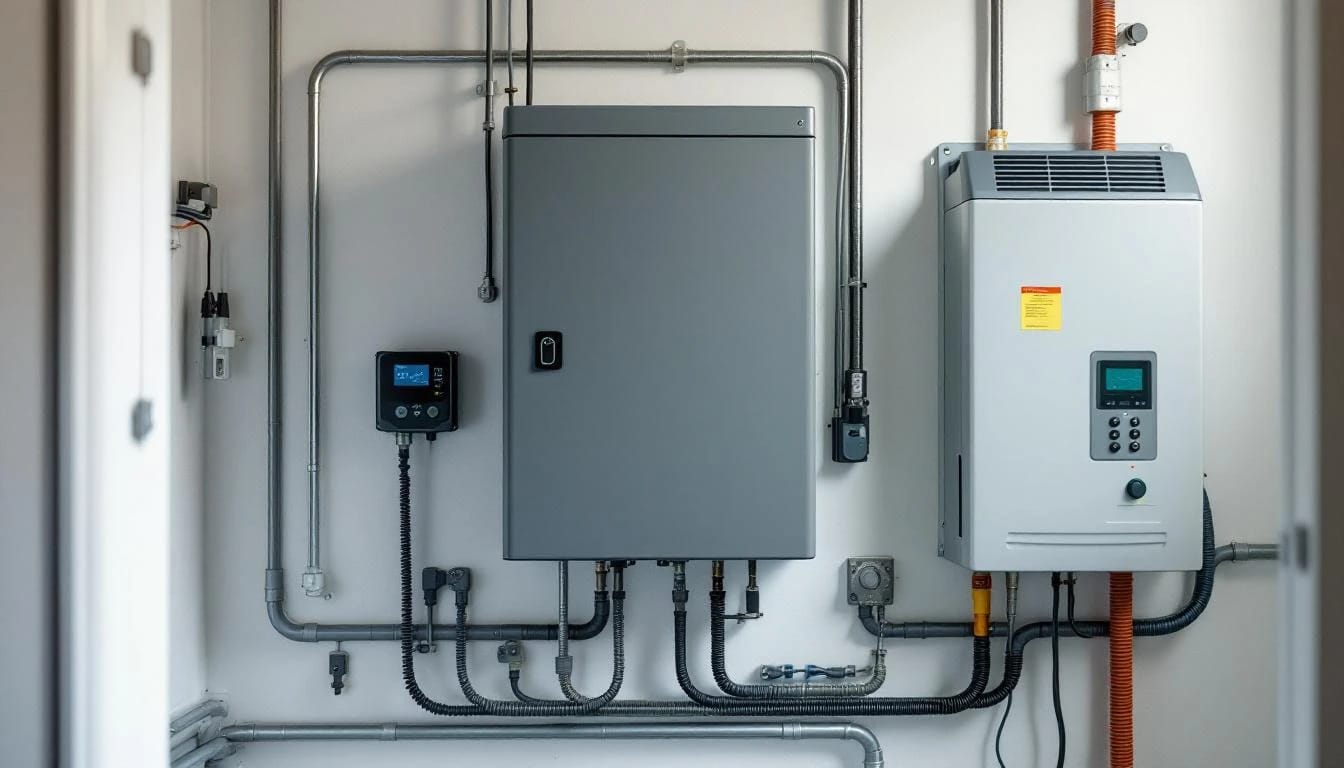
Voltage selection is the single most consequential decision in a small wind turbine system—dictating wire gauge, battery count, inverter compatibility, and expansion headroom. A 12 V system suits minimal off-grid loads under 500 W; 24 V covers typical cabins and RVs from 500 to 2,000 W; 48 V dominates residential grid-tie and serious off-grid installations above 2,000 W. Mismatched voltage compounds losses, inflates copper costs, and locks the owner into an undersized architecture that resists future upgrades.
Why system voltage matters more than turbine nameplate voltage
Many turbine manufacturers stamp "12 V / 24 V" on the same unit, relying on internal wiring changes or an external charge controller to match the battery bank. The turbine itself produces three-phase AC that a rectifier converts to DC; the rectifier output must land within the battery bank's charging window—typically 13.8-14.6 V for a nominal 12 V bank, 27.6-29.2 V for 24 V, 55.2-58.4 V for 48 V.
Wire gauge drives the real cost difference. Current equals power divided by voltage; doubling voltage halves current for the same wattage. A 1,000 W load at 12 V draws 83 A; at 48 V it draws 21 A. National Electrical Code Article 310 mandates #4 AWG copper for 83 A over any distance; 21 A permits #10 AWG. Over a 100-foot run, #4 copper costs roughly $280; #10 costs $65. The copper savings alone can pay for the voltage step-up hardware in systems above 1 kW.
Battery architecture adds another layer. Flooded lead-acid, AGM, and lithium iron phosphate (LiFePO₄) cells come in 2 V, 6 V, or 12 V units. A 12 V bank requires one 12 V battery in parallel groups; 24 V needs two in series; 48 V needs four in series. Series strings magnify the weakest cell's limitations—one sulfated 12 V battery in a 48 V string drags down the entire bank. Lithium packs often ship as pre-balanced 48 V modules, sidestepping the issue.
12 V systems: the off-grid minimum and marine standard
Twelve-volt systems persist in three niches: sailboats, travel trailers, and remote monitoring stations where DC appliances dominate and total load stays below 500 W. Most 12 V wind turbines generate 50-400 W; the Primus Air 40 and Rutland 914i are long-standing marine models. A 200 Ah 12 V AGM bank (2.4 kWh nominal) paired with a 300 W turbine and 200 W solar panel can power LED lights, a 12 V refrigerator, VHF radio, and laptop charger—classic cruising loads.
Advantages narrow to simplicity and parts availability. Automotive jump-starters, RV converters, and truck-stop battery isolators all speak 12 V. No series wiring means a single failed cell doesn't cascade. Charge controllers for small turbines—like the Morningstar TS-45 or Missouri Freedom II—regulate 12 V natively.
Disadvantages multiply with scale. A 1,000 W inverter at 12 V draws 90+ A under full load; the wire from battery to inverter alone demands #2 AWG or larger, and voltage drop over any distance becomes punishing. Expanding beyond 400 Ah of battery capacity requires tedious parallel strings, each needing matched impedance to avoid circulating currents. Most modern hybrid inverters (Schneider, Victron, Sol-Ark) treat 12 V as legacy; their catalogs start at 24 V.
Practical ceiling: 500 W continuous load, 800 Ah max battery bank, turbine tower under 30 feet to minimize wire run.
24 V systems: the off-grid workhorse for cabins and workshops
Twenty-four-volt systems balance parts count against efficiency for installations between 500 and 2,000 W. A 400 Ah 24 V bank (9.6 kWh nominal) costs less than doubling a 12 V bank to 800 Ah, because two 12 V batteries in series beat four in parallel for cycle life and physical footprint. Wind turbines in this class—Bergey Excel 1, Aeolos-V 1 kW, Missouri Freedom II—commonly ship with 24 V charge controllers or offer easy field reconfiguration.
The Bergey Excel 1, a 1 kW rated horizontal-axis turbine, runs 24 V or 48 V via internal winding taps. Bergey's documentation shows that 24 V suits tower heights of 30-50 feet with battery banks under 800 Ah; above that, 48 V reduces rectifier losses. The Aeolos-V 1 kW vertical-axis model ships 24 V by default, targeting suburban backyards where zoning caps tower height at 35 feet. Both pair cleanly with Morningstar TriStar MPPT charge controllers, which handle 24 V battery banks and offer data logging.
Wire gauge relief begins here. A 1,500 W inverter at 24 V draws 68 A peak; #6 AWG copper suffices for runs under 25 feet. Compare to 125 A at 12 V, demanding #2 AWG. A 200-foot run from turbine to battery room—common in rural layouts—uses #8 AWG at 24 V for 1 kW continuous; the same run at 12 V would need #4 AWG, tripling copper cost.
Inverter selection improves. Schneider Conext SW 2524, Victron MultiPlus 24/3000, and Outback Radian GS4024 all offer grid-tie capability under NEC Article 705, automatic transfer switching, and battery charge profiles for lithium or lead-acid. The 30% federal Residential Clean Energy Credit (IRC §25D) covers the hardware if the system offsets home consumption; DSIRE databases list additional state rebates in California, New York, and Massachusetts.
Practical ceiling: 2,000 W continuous load, 1,200 Ah battery bank, turbine up to 3 kW nameplate, tower 60 feet.
48 V systems: residential grid-tie and serious autonomy
Forty-eight-volt systems dominate residential wind installations above 2 kW and any grid-tie configuration. Utility-interactive inverters—Sol-Ark 12K, Schneider XW Pro, SMA Sunny Island—standardize on 48 V DC input because it minimizes the DC-to-AC inversion stages and keeps battery cabling manageable. A 5 kW inverter at 48 V draws 108 A at full tilt; the same unit at 24 V would pull 216 A, exceeding the busbar ratings of most residential breaker panels.
The Bergey Excel 10 (10 kW rated) and Evance R9000 (5 kW) ship 48 V exclusively. Both integrate with hybrid inverters that blend wind, solar, and grid inputs. The Excel 10 requires a 60-100 foot tower and generates enough surplus in average wind (Class 3, 12 mph annual mean) to backfeed the utility under net metering, provided local interconnection agreements permit it. NEC 705.12 limits backfed breaker size to 120% of the panel busbar rating; a 200 A panel can accept a 40 A backfed breaker, capping inverter output at 9.6 kW continuous.
Battery options favor lithium at this scale. Simpliphi PHI 3.5 kWh and Fortress Power eVault 18.5 kWh modules arrive as 48 V plug-and-play units with integrated battery management systems. A 20 kWh bank—sufficient for two days of backup at 400 W average load—fits four Simpliphi modules or one Fortress unit. Lead-acid at 48 V demands eight 6 V golf-cart batteries in series or four 12 V units; series strings amplify voltage imbalance and sulfation failures.
Wire savings peak here. A 100-foot run carrying 3 kW at 48 V needs #10 AWG (62 A); the same power at 12 V would require #2 AWG (250 A). Over long tower runs—120 feet is common for 80-foot guyed towers—copper cost differences exceed $600. Conduit size drops from 1.5-inch to 0.75-inch, easing permits and trenching.
Grid-tie under NEC Article 705 mandates a rapid shutdown system (RSS) per 690.12, separate AC disconnect, and utility-approved anti-islanding. Most 48 V inverters include UL 1741-SA certification for California Rule 21, required for interconnection. The federal 30% tax credit covers turbine, tower, inverter, and balance-of-system; the homeowner files IRS Form 5695 with the tax return. FAA Part 77 applies if the turbine exceeds 200 feet AGL or sits within airport approach zones; amateur radio towers under Part 97 and residential structures are typically exempt.
Practical ceiling: 10 kW continuous load, unlimited battery expansion, turbines up to 10 kW nameplate, towers 120 feet.
Conversion and mixed-voltage traps
Voltage conversion—stepping 24 V to 12 V for legacy appliances or 12 V to 48 V for inverter compatibility—incurs efficiency loss and failure points. DC-DC converters like Victron Orion or Morningstar SureSine add 8-12% loss; a 24 V to 12 V converter passing 30 A wastes 100 W as heat. Off-grid systems with mixed voltage often run dual battery banks, doubling charge-controller cost and complicating wiring.
A common misstep: buying a 12 V wind turbine for a future 48 V solar array. The turbine's charge controller regulates 12 V, while the solar MPPT targets 48 V. Combining them requires a DC combiner box and matched setpoints—complexity that invites ground faults. Better practice: select system voltage first, then spec all generation and storage to match. The Midnite Solar Classic series and Morningstar TriStar MPPT controllers auto-detect 12/24/48 V, offering flexibility during testing, but final deployment should lock one voltage.
Another pitfall: undersized inverter DC input. A 3,000 W inverter rated for 24 V cannot run on a 12 V bank—voltage sag under load trips the low-voltage cutout before the inverter reaches half power. Conversely, connecting a 12 V turbine to a 48 V bank without a charge controller risks overcharging the first battery in the series string, venting hydrogen and destroying the cell. Charge controllers bridge this gap, but each added device is another potential failure and efficiency loss.
Cost comparison: wire, batteries, and balance of system
| Component | 12 V System | 24 V System | 48 V System |
|---|---|---|---|
| Wire (#6 to inverter) | #2 AWG, $180/100 ft | #6 AWG, $75/100 ft | #10 AWG, $45/100 ft |
| 400 Ah battery bank | 4× 12V 200Ah = $1,600 | 2× 12V 400Ah = $1,400 | 4× 12V 200Ah = $1,600 |
| Charge controller | $180 (Morningstar) | $220 (Morningstar) | $280 (Midnite Classic) |
| 3 kW inverter | Not feasible | $1,100 (Victron 24V) | $1,200 (Sol-Ark 48V) |
| Total BoS | — | $2,795 | $3,125 |
The table assumes identical turbine cost (e.g., Bergey Excel 1 at $3,200) and 100-foot wire runs. The 12 V system cannot support a 3 kW inverter without absurd wire gauge; the 24 V system needs moderate wire; the 48 V system minimizes wire but adds $85 to the charge controller. Over 200 feet of run, the 48 V system's wire savings ($210 vs. 24 V, $540 vs. theoretical 12 V) recoup the controller premium.
Battery longevity tilts toward higher voltage in series-configured lead-acid, because the charge controller equalizes the entire string simultaneously. Parallel 12 V banks require per-string monitoring or accept uneven charging. Lithium packs bypass the issue—each cell has BMS—but cost $400-600/kWh vs. $150-250/kWh for AGM.
Expansion headroom and future-proofing
A 48 V architecture accommodates growth without teardown. Adding a second turbine or solar array requires only parallel DC wiring and a second charge controller—no battery reconfiguration. Grid-tie inverters like the Sol-Ark 15K accept dual DC inputs (PV + wind) on the same 48 V bus. A homeowner who installs a 2 kW 24 V wind system today and wants to add 6 kW of solar in three years must either run a separate 24 V solar charge controller and accept split batteries, or replace the entire wind charge controller and rewire the turbine—both expensive.
The federal 30% tax credit applies per installation, not per technology; a combined wind-solar project files one Form 5695. State incentives vary: California's SGIP (Self-Generation Incentive Program) offers $200/kWh for battery storage paired with renewables; New York's NY-Sun stacks with federal credits but excludes wind unless part of a microgrid. DSIRE lists 37 states with net metering, but wind-specific carve-outs are rare—most utilities treat all behind-the-meter generation identically under NEC 705 interconnection rules.
Forty-eight-volt inverters also support AC coupling of additional inverters—stacking a 5 kW wind inverter with a 10 kW solar inverter on the same breaker panel, controlled by a single battery bank. This requires careful compliance with NEC 705.12(D)(2) busbar limits and often a line-side tap ahead of the main breaker. A 24 V system can theoretically do the same, but fewer inverters support it, and the wire ampacity becomes prohibitive.
Real-world voltage mismatches and their fixes
A Minnesota off-gridder installed a 400 W 12 V Primus Air 40 turbine in 2018, then added 800 W of solar in 2021. The solar charge controller auto-detected 12 V and worked—but wire runs from the turbine (80 feet) and solar array (60 feet) each needed #6 AWG to limit voltage drop under 3%. Expanding to a 2 kW inverter required parallel 12 V batteries up to 800 Ah (ten 12 V 80 Ah AGMs), and the inverter itself—Aims Power 2000 W—drew 180 A at full load, necessitating a 4/0 AWG cable to avoid voltage sag. Total copper and battery cost: $3,400 beyond the generation hardware.
Had the owner chosen 24 V from the start, the Primus could have been field-rewired (Primus offers 24 V stators), solar would use the same 24 V controller, and wire gauge would drop to #10 AWG for the same runs—saving roughly $800 in copper and $600 in batteries. The lesson: upfront voltage choice locks in wire and battery architecture for the system's 15-20 year lifespan.
Another case: a Colorado rancher installed a 1 kW 24 V Aeolos-H turbine for a well pump. The pump ran on 240 V AC, so the system used a 24 V to 120/240 V split-phase inverter (Magnum MS4024PAE). Later, the rancher added a 6 kW solar array—but the Magnum's charge controller maxed out at 3 kW input. Rather than replace the $2,800 inverter, the rancher added a second 24 V MPPT controller and ran both charge controllers into the same battery bank. It worked, but monitoring two controllers and balancing charge rates added complexity. A 48 V system with a 10 kW all-in-one inverter (Sol-Ark 12K) would have handled wind and solar on one DC bus.
Which voltage for which scale: decision matrix
Choose 12 V if:
- Total load stays under 500 W continuous.
- The system is mobile (RV, boat, trailer).
- DC appliances dominate and inverter use is minimal.
- Battery bank remains under 400 Ah.
- Wire runs under 20 feet.
Choose 24 V if:
- Load ranges 500-2,000 W continuous.
- System is stationary (cabin, workshop, shed).
- Inverter provides AC for standard appliances.
- Battery bank targets 400-1,200 Ah.
- Wire runs 20-100 feet.
- Grid-tie is not planned.
Choose 48 V if:
- Load exceeds 2,000 W continuous.
- Grid-tie or net metering is intended.
- Battery bank will exceed 1,200 Ah or use lithium modules.
- Wire runs exceed 100 feet or involve underground conduit.
- Future expansion (more wind, solar, backup generators) is likely.
- The site qualifies for federal or state incentives requiring utility interconnection.
Every increase in voltage adds one series connection in the battery bank and slightly raises charge-controller cost, but it slashes wire expense and expands inverter options. For residential wind—where a 3-10 kW turbine and 5+ kW inverter are common—48 V is the default unless legacy 24 V hardware dictates otherwise.
Safety and code compliance across voltages
NEC Article 690 (solar) and 705 (interconnection) apply regardless of voltage; DC systems above 50 V fall under stricter arc-fault and rapid-shutdown rules. A 48 V battery bank at full charge (58.4 V) exceeds the 50 V threshold in NEC 690.12, mandating rapid shutdown if the array or turbine is roof-mounted. Turbines on ground-mounted towers may be exempt, but local AHJs (authorities having jurisdiction) interpret 690.12 variably—always confirm before the inspection.
Ground-fault protection differs by voltage. Systems under 50 V (12 V, 24 V) can use simple fusing; 48 V systems require listed ground-fault detection interrupters (GFDI) per NEC 690.41. Midnite Solar and Schneider inverters include GFDI as standard; standalone charge controllers may not. A missed ground fault at 48 V can arc-weld metal enclosures or ignite insulation; the added cost of GFDI ($150-300) is non-negotiable.
Battery enclosures at any voltage must ventilate hydrogen (flooded lead-acid) per NEC 480.9(A) or suppress off-gassing (sealed AGM, lithium). A 48 V lithium bank generates no hydrogen but must include thermal runaway containment—metal cabinets with blow-out panels and Class C fire suppression nearby. Local fire marshals increasingly require lithium installations to follow NFPA 855, which specifies clearances and suppression even in residential settings.
Permitting rigor scales with system size, not voltage. A 1 kW 24 V wind turbine may pass as a shed accessory in rural counties; a 5 kW 48 V grid-tie system triggers structural, electrical, and utility interconnection permits. FAA Part 77 notification applies when the tower exceeds 200 feet AGL or sits within 20,000 feet of an airport; most residential turbines stay under 120 feet and avoid FAA scrutiny.
Can I change system voltage later without replacing the turbine?
Many turbines ship with switchable voltage taps or separate rectifier models. The Bergey Excel 1 offers 24 V or 48 V winding configurations via internal jumper; the Primus Air series requires ordering a 12 V or 24 V stator at purchase. Changing voltage post-install means opening the turbine nacelle—difficult 40 feet in the air—or lowering the tower. Budget for professional service ($400-800) if field reconfiguration is needed. Battery banks and inverters must also match; a 24 V bank cannot run a 48 V inverter without a costly DC-DC converter.
Does higher voltage reduce turbine efficiency or cut-in speed?
No. Turbine aerodynamics set cut-in speed (typically 6-8 mph); the rectifier and charge controller convert three-phase AC to DC at whatever voltage the battery demands. A 24 V and 48 V version of the same turbine have identical blade pitch, rotor diameter, and cut-in speed. The difference lies in rectifier diode count and winding turns—electrical, not mechanical. Some manufacturers claim 48 V systems achieve 2-3% better end-to-end efficiency due to lower resistive losses in wiring, but real-world gains depend on wire run length.
How do I protect a 48 V lithium battery from turbine voltage spikes?
Wind turbines generate voltage spikes during gusty conditions or braking. A quality MPPT charge controller with overvoltage clamp protects the battery; models like Midnite Classic 250 and Morningstar TriStar MPPT clamp at 80 V and shunt excess to a dump load (resistor bank). Lithium batteries have narrower charge windows than lead-acid—typically 55.2-56.8 V for LiFePO₄—so the controller must support user-defined absorption and float voltages. Most lithium packs include internal BMS that disconnect at 60 V, but relying on BMS alone risks nuisance shutdowns in high wind.
Are there hybrid charge controllers that auto-detect 12/24/48 V?
Yes. The Morningstar TriStar MPPT and Midnite Solar Classic series auto-detect battery voltage during commissioning. Connect the battery, power the controller, and it samples terminal voltage to determine 12, 24, or 48 V. However, once set, the controller locks that voltage—switching banks later requires a reset and recalibration. Auto-detection helps during testing but does not allow mixed-voltage operation. Victron controllers often require manual dip-switch settings, trading automation for reliability.
Will my homeowner's insurance cover a 48 V battery bank or higher voltage wind system?
Standard homeowner's policies cover attached renewable energy systems up to $10,000 in equipment value, but many exclude lithium batteries over 10 kWh or wind turbines above 5 kW without a rider. Contact the insurer before installation and request a renewable energy endorsement; expect $50-150/year in added premium for a 48 V system with 20 kWh lithium. The insurer will ask for NEC-compliant installation and a certificate of occupancy or electrical inspection sign-off. Some carriers deny coverage for DIY wind installs—hire a licensed electrician for final connection even if the owner does tower work.
Bottom line
System voltage—12 V, 24 V, or 48 V—dictates wire cost, inverter selection, and expansion potential more than any single equipment choice. A 12 V system locks the owner into sub-500 W loads and short wire runs; 24 V suits 500-2,000 W off-grid cabins; 48 V dominates residential grid-tie and battery banks above 10 kWh. Choosing 48 V from day one costs an extra $100-200 in charge controllers but saves $400-900 in wire and preserves room to add solar, generators, or additional turbines without rewiring batteries. Match voltage to the five-year load forecast, not today's minimum—upgrading voltage later means replacing batteries, inverters, and charge controllers all at once. For anyone planning grid interconnection or battery backup beyond a long weekend, 48 V is the only voltage that makes economic and electrical sense.
Next step: Map the property's average wind speed using anemometer data loggers, calculate five-year load growth, then specify turbine and battery voltage together—battery bank sizing guide and inverter selection matrix walk through the process. Consult a NABCEP-certified installer for final wire routing and NEC 705 interconnection paperwork; the 30% federal tax credit reimburses design fees when claimed on Form 5695.
Share this article
windturbinehome.com/s/4dd6ff
Editorial note: This article was researched and written by a member of the Wind Turbine Home editorial team. AI-assisted tools were used for spell-checking and light grammar review only — all research, analysis, and conclusions are our own. Our editorial policy prohibits sponsored content and paid placements. Read our editorial policy →
Related reading
battery storage inverters
DIY Wind Turbine Charge Controller: When to Build vs Buy
Building a wind turbine charge controller saves $150-400 but risks battery damage and code violations. Compare DIY circuit boards against commercial MPPT units.
battery storage inverters
Hybrid Inverter Selection for Small Wind + Battery Systems
Choose the right hybrid inverter for your wind turbine battery setup—DC-coupled models work best for systems under 5 kW, while AC-coupled units offer easier solar retrofits.
battery storage inverters
Best Batteries for Small Wind Systems in 2026 | Expert Guide
Lithium iron phosphate batteries dominate 2026 wind storage. Compare cycle life, depth-of-discharge, and cold-weather performance for systems 400W-10kW.
battery storage inverters
Lithium vs AGM Batteries for Wind Systems in Cold Weather
Cold weather cuts AGM capacity by 20-40% and lithium by 10-15%. Learn which chemistry survives winter turbine charging, how battery management systems respond, and what installers must change below 32°F.
battery storage inverters
MPPT vs PWM Controller for Small Wind: Which to Buy and Why
MPPT controllers harvest 15-30% more energy than PWM in variable-wind conditions but cost 2-4× more. Choose MPPT for systems above 1 kW or battery banks over 400 Ah.
battery storage inverters
Best Battery Banks for Home Wind Turbines (LiFePO4, 2026)
Home wind turbines charge in irregular bursts, so battery chemistry matters as much as capacity. Here is why lithium iron phosphate leads on reliability.
battery storage inverters
Off-Grid Wind Turbine Battery Setup: Complete System Guide
Complete guide to off-grid wind turbine battery systems covering charge controllers, battery banks, inverters, and load management for residential installations.
battery storage inverters
Home Wind Turbine Kits With Battery and Inverter (2026)
See how all-in-one home wind turbine kits bundle the turbine, battery bank and inverter, how to size each part, and what the installation actually involves.