Best Battery Banks for Home Wind Turbines (LiFePO4, 2026)
Home wind turbines charge in irregular bursts, so battery chemistry matters as much as capacity. Here is why lithium iron phosphate leads on reliability.
Share this article
windturbinehome.com/s/4f3224
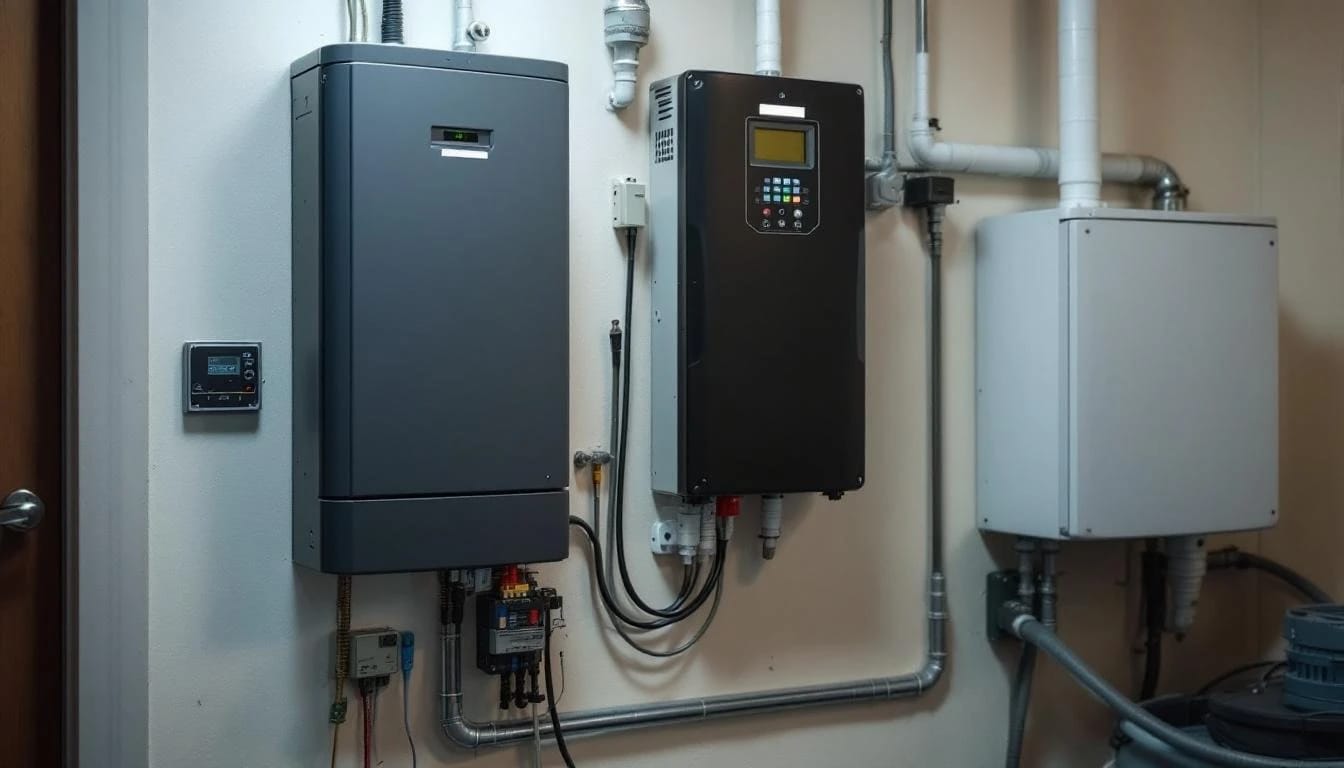
Residential wind turbine systems require battery banks that tolerate irregular charge cycles and voltage swings absent in solar arrays. The best batteries for home wind applications combine high cycle life, charge acceptance at partial state-of-charge, and stable performance through winter lulls and summer storms. Lithium iron phosphate (LiFePO₄) leads for most installations due to 4,000–6,000 cycle ratings and immunity to partial-state-of-charge damage, while flooded lead-acid remains viable for budget-conscious retrofits on existing 48V systems with manual maintenance capability.
Why wind turbine battery requirements differ from solar
Wind turbines generate power in bursts. A Bergey Excel 10 can deliver 10 kW during a gust, then drop to 400 W minutes later as wind speed falls from 30 mph to 12 mph. Solar panels ramp predictably with sunrise and clouds. This difference stresses batteries in three ways.
First, wind systems rarely achieve full state-of-charge during multi-day calm periods. Batteries sit partially charged for weeks in summer, inviting sulfation in lead-acid chemistry and capacity fade in poorly managed lithium. Second, wind turbine voltage varies with rotor speed. A direct-drive permanent magnet alternator may produce 42 VDC at cut-in and 62 VDC at rated wind speed on a nominal 48V system. The battery management system must clamp voltage without wasting energy. Third, cold overnight winds deliver charging current when temperatures drop below 20°F, forcing lithium cells into low-temperature cutoff unless self-heating circuitry activates.
Solar battery banks optimize for predictable daily cycles. Wind battery banks optimize for endurance under unpredictable partial cycling.
Lithium iron phosphate: the standard for new installations
LiFePO₄ packs dominate new residential wind installs for six reasons. They tolerate 80% depth-of-discharge daily for 4,000+ cycles—double the usable lifetime energy of flooded lead-acid at half the weight. Prismatic cells in rack-mount enclosures fit indoors without venting requirements. Built-in battery management systems balance cells and communicate with hybrid inverters via CAN bus. Self-heating elements allow charging down to -4°F when AC power or surplus wind energy warms the pack. Round-trip efficiency hits 95%, capturing more gusts than lead-acid's 80%.
Brand selection matters. SimpliPhi PHI 3.5 batteries (3.5 kWh, 48V nominal) ship with pre-installed BMS, UL 1973 listing, and IP67-rated enclosures for unheated outbuildings. Expect $1,050–$1,200 per kWh installed. Fortress Power eFlex 5.4 units (5.4 kWh) offer modular stacking to 21.6 kWh on a single inverter port, priced around $950/kWh in four-pack orders. Both integrate with Sol-Ark and Schneider Electric hybrid inverters common in wind-solar hybrid systems.
Budget LiFePO₄ cells sold as "grade B" or bare prismatic modules require assembly into custom packs. DIY builders save 40% but assume liability for UL compliance under NEC 706.30, which mandates listed interconnection systems for energy storage above 1 kWh. The cost advantage evaporates if the authority having jurisdiction rejects the system during final inspection.
Lead-acid: when budget and existing infrastructure align
Flooded lead-acid batteries cost $180–$280 per kWh—one-quarter the lithium price—and remain the economical choice for three scenarios. Existing 48V wind systems with Outback or Magnum inverters already configured for lead-acid profiles avoid the $1,200–$1,800 reprogramming and cable replacement required for lithium voltage curves. Off-grid homes in temperate climates with year-round wind can cycle flooded cells through the 50% depth-of-discharge sweet spot and achieve 1,200–1,800 cycles at $0.12–$0.19 per kWh delivered. Owners willing to check specific gravity monthly and equalize quarterly extract maximum value.
Trojan L16RE-2V cells (370 Ah at 20-hour rate, 2V nominal) remain the benchmark. Twelve cells in series create a 24V bank with 7.4 kWh nominal (3.7 kWh usable at 50% DoD). Four parallel strings yield 14.8 kWh usable for $4,800–$5,600 including interconnect and enclosure. Crown CR-430 6V golf-cart batteries offer a lower entry point—eight batteries for 25.9 kWh nominal (12.9 kWh usable) at $2,800–$3,200—but require more frequent watering in high-ventilation battery rooms.
Sealed AGM and gel batteries eliminate maintenance but cost $350–$480 per kWh and suffer shorter lifespans (600–900 cycles to 50% DoD) when subjected to wind's partial-state-of-charge cycling. Lifeline GPL-4CT AGM batteries tolerate 80% DoD better than wet cells but still fall short of lithium longevity at double the lead-acid price point.
Lead-acid installations require vented enclosures per NEC 480.9(A) to exhaust hydrogen during charging. Battery rooms need 1 CFM per 20 Ah of charging current. A 400 Ah bank charging at 10% C-rate (40 A) requires a 2 CFM exhaust fan interlocked with the charge controller.
Sizing battery capacity for wind turbine output patterns
Battery banks should store 2–5 days of household consumption at 50% depth-of-discharge for lead-acid and 80% for lithium. A home using 30 kWh daily needs 60 kWh nominal lead-acid capacity (30 kWh usable) or 38 kWh nominal lithium capacity (30 kWh usable). This three-day buffer prevents deep discharge during calm spells while avoiding oversizing that leaves batteries chronically undercharged.
Wind turbine nameplate ratings mislead. A Primus Air 40 (2.5 kW rated) delivers 2.5 kW only at 26 mph wind speed—an event lasting minutes, not hours. Real-world monthly production in Class 3 wind (8.5–9.8 mph average at hub height) equals 250–350 kWh. Size the battery to the consumption pattern, not the turbine rating. Add 15–20% capacity buffer for winter heating loads if electric resistance or heat pump backup activates during grid outages.
Hybrid solar-wind systems benefit from smaller battery banks because generation sources complement each other. Solar peaks midday in summer; wind peaks overnight in spring and fall. A 5 kW solar array and Bergey Excel 6 (7.5 kW rated wind) can share a 20 kWh lithium bank serving 25 kWh daily consumption in a temperate climate. The battery buffers the 10 PM to 6 AM gap when neither source generates.
Voltage selection: 24V vs. 48V systems
Residential wind turbines ship in 24V, 48V, and occasionally 120V DC configurations. Battery bank voltage must match turbine output or insert a DC-DC converter with 6–10% efficiency loss.
Choose 48V for systems above 4 kW turbine rating. Lower current at higher voltage reduces resistive losses in cables and allows longer runs from turbine to battery bank. A 5 kW load at 48V draws 104 A; the same load at 24V draws 208 A and requires 2/0 AWG copper versus 2 AWG for 48V at a 50-foot run per NEC 310.15(B)(16) ampacity tables.
Stick with 24V only for sub-1 kW vertical-axis turbines and micro installations where equipment costs dominate. The 24V inverter and charge controller market is shrinking as manufacturers standardize on 48V for residential systems.
Grid-interactive hybrid inverters (Sol-Ark 15K, Schneider Conext XW Pro) specify 175–250 VDC battery input for maximum efficiency. These systems use high-voltage lithium packs incompatible with traditional 24V/48V turbines. A Midnite Solar Classic 250-SL MPPT controller steps wind turbine output to match the inverter's HV battery bus, but adds $1,800–$2,200 to system cost. This configuration suits premium installs pairing 10+ kW wind turbines with 30+ kWh battery banks.
Charge controllers and battery compatibility
Wind turbines require diversion-load charge controllers or MPPT controllers designed for three-phase permanent magnet alternators. Standard solar MPPT controllers fail because wind generators cannot tolerate open-circuit voltage spikes when the controller disconnects—the rotor accelerates and destroys rectifiers.
Xantrex C-Series (C35, C40, C60) controllers dump excess energy into resistive heating elements when batteries reach absorption voltage. They handle 12–48V battery banks and 600–4,000W turbines. Program the absorption voltage to match battery chemistry: 57.6 VDC for LiFePO₄, 58.8 VDC for flooded lead-acid on 48V banks. The diversion load must dissipate the turbine's maximum output; a Windtura 750 needs a 1,000W element (safety margin), a Bergey Excel 10 needs 12 kW of heating coils.
Midnite Solar Classic MPPT controllers optimize for wind by tracking power curves and soft-starting turbines. The Classic 250-SL handles 12–300 VDC input (wind rectifier output) and charges 12–250 VDC battery banks at 63 A continuous. Programmable logic integrates with battery BMS via Modbus to pause charging when LiFePO₄ cells hit low-temperature or high-voltage faults. These controllers cost $700–$950 but extract 8–15% more energy from gusty sites than dump-load regulators.
Hybrid inverters with built-in wind charge inputs (Schneider XW-MPPT, Outback FlexMax) eliminate separate charge controllers and simplify system design. Verify the inverter supports the turbine's three-phase rectified output and accepts the voltage range before purchase. Some "wind-ready" inverters assume 120 VDC nominal input incompatible with 48V turbines.
Comparing leading battery systems for residential wind
| Battery System | Usable Capacity | Cycle Life (80% DoD) | Operating Temp | Installed Cost | Cost/Cycle |
|---|---|---|---|---|---|
| SimpliPhi PHI 3.5 | 3.5 kWh | 5,000 | -4°F to 140°F | $4,200 | $0.84 |
| Fortress eFlex 5.4 | 5.4 kWh | 4,000 | 5°F to 131°F | $5,100 | $1.28 |
| Trojan L16RE-2V (24 cells) | 14.8 kWh | 1,500 | -4°F to 113°F | $5,200 | $3.47 |
| Crown CR-430 (16 batteries) | 12.9 kWh | 1,200 | 5°F to 113°F | $3,000 | $2.50 |
| DIY LiFePO₄ (280 Ah cells) | 13.4 kWh | 4,000 | 5°F to 131°F | $7,800 | $1.95 |
Cost-per-cycle divides installed cost by cycle life at 80% depth-of-discharge. Lower numbers indicate better long-term value. This table assumes professional installation adding 20–30% to component costs and excludes charge controller and inverter.
Installation requirements and code compliance
NEC Article 705 governs interconnected power sources. Wind turbines qualify as "other electric power production sources" under 705.2. Battery energy storage falls under Article 706, which requires listed equipment (UL 1973, UL 9540) for systems over 1 kWh.
Install batteries in spaces meeting NEC 110.26 working clearance—36 inches in front of enclosures, 30 inches width. Flooded lead-acid needs ventilation per 480.9(A): hydrogen exhaust to outdoors and makeup air from conditioned space. Lithium batteries require temperature monitoring; install in heated spaces or use self-heating models if ambient temperature drops below 32°F.
Overcurrent protection sizing: NEC 706.31 mandates fusing or circuit breakers within 10 feet of the battery terminals. Size to 125% of the inverter's maximum continuous input current. A 48V inverter rated for 6 kW (125 A continuous input) needs a 150 A fuse or breaker. Use Class T fuses for DC systems above 100 A to achieve the 20,000 A interrupting rating required by 706.31(B).
Ground the battery system per 706.30(C). Bond the negative terminal to the grounding electrode system. Do not ground both terminals; this creates ground loops and stray currents that accelerate corrosion in flooded cells.
Tax incentives and total cost of ownership
The federal Residential Clean Energy Credit (IRC §25D) offers 30% tax credit through 2032 for qualified energy storage installed with a wind turbine. The battery system must have 3 kWh minimum capacity and charge exclusively from the turbine (or solar array). Standalone batteries added to existing systems do not qualify; they must be commissioned with the renewable generator. File IRS Form 5695 with your tax return. The credit applies to equipment and installation labor.
State incentives vary. New York's NYSERDA program rebates $250–$350/kWh for behind-the-meter storage. California's SGIP offers $200–$850/kWh depending on equity category. Massachusetts SMART program provides performance-based incentives when storage shifts wind generation to peak hours. Check DSIRE.org for updated state and utility programs.
Total cost of ownership over 15 years for a 15 kWh usable battery bank:
- LiFePO₄ (SimpliPhi): $15,750 installed, zero replacement, $15,750 total → $1,050/year
- Flooded lead-acid (Trojan): $5,200 installed, $5,200 replacement (year 8), $10,400 total → $693/year
- AGM (Lifeline): $9,400 installed, $9,400 replacement (year 6), $18,800 total → $1,253/year
The 30% federal credit reduces net cost by $4,725 (lithium) or $1,560 (flooded), improving lithium's relative position. In year 16, lithium cells retain 80% capacity while lead-acid requires a third replacement.
Thermal management in extreme climates
Cold winters stress lithium batteries. Below 32°F, internal resistance rises and charging damages cells by lithium plating. SimpliPhi and Fortress batteries self-heat using 25–50 W drawn from the pack itself when temperature sensors detect <41°F. This works during charging (turbine runs) but depletes capacity during calm periods. In sub-zero climates, mount lithium batteries in heated utility rooms or insulated enclosures with 150–300 W thermostatically controlled heaters drawing from grid or generator backup.
Flooded lead-acid tolerates cold charging better but loses capacity—a cell rated 400 Ah at 77°F delivers 320 Ah at 32°F and 240 Ah at 0°F. Compensate by oversizing lead-acid banks 20–30% in northern states or heating the battery room to 50°F minimum.
Hot climates above 95°F accelerate degradation in all chemistries. Lead-acid loses 50% cycle life for every 18°F above 77°F; lithium loses 20% capacity over 15 years when cycled at 95°F versus 77°F. Install batteries in shaded, ventilated spaces. Avoid attics and metal sheds. A 10 kWh lithium pack dissipates 200–300 W during fast charging, raising enclosure temperature 5–8°F above ambient without ventilation.
Monitoring and maintenance protocols
Battery management systems report state-of-charge, voltage, current, and cell temperatures to the inverter display or web portal. SimpliPhi PHI batteries stream data via Modbus to Schneider Conext ComBox or Sol-Ark monitoring platforms. Check weekly during the first year to verify charge cycles match expectations. Monthly thereafter.
Flooded lead-acid requires hands-on maintenance:
- Monthly: Check electrolyte level, refill to 1/4 inch above plates with distilled water
- Monthly: Measure specific gravity with hydrometer; cells should read 1.265 ±0.015 when fully charged
- Quarterly: Equalization charge at 10% of 20-hour rating for 2–4 hours when specific gravity spreads exceed 0.030 between cells
- Annually: Load test at 50% of 20-hour rating for 15 seconds; voltage should stay above 1.75 VPC (volts per cell)
Lithium systems need no watering or equalization. Verify firmware updates annually; manufacturers issue BMS patches improving low-temperature performance and communication protocols. Inspect terminals and cables for corrosion every six months.
Can I connect wind and solar to the same battery bank?
Yes, using separate charge controllers for each source. Wind requires a diversion-load or wind-specific MPPT controller. Solar uses standard MPPT controllers. Both feed the same battery bank through fused combiner boxes. This hybrid approach increases utilization—solar generates during calm summer days, wind generates during cloudy winter nights. Ensure total charging current does not exceed the battery's maximum charge rate (typically 0.5C for LiFePO₄, 0.2C for flooded lead-acid).
How long do wind turbine batteries last?
Lithium iron phosphate batteries endure 4,000–6,000 full depth-of-discharge cycles, translating to 12–18 years in residential wind systems cycling daily. Flooded lead-acid lasts 5–8 years (1,200–1,800 cycles at 50% DoD). AGM batteries fall between at 7–10 years. Actual lifespan depends on depth-of-discharge, temperature, and maintenance. Oversized batteries cycled shallower last longer—a 20 kWh bank serving 10 kWh daily loads (50% DoD) outlives a 12 kWh bank at 83% DoD.
What size battery bank does a 5 kW wind turbine need?
Battery capacity should match consumption, not turbine size. A 5 kW nameplate turbine produces 300–600 kWh monthly in Class 3 winds. For a home using 30 kWh daily, install 15–20 kWh usable lithium (18–24 kWh nominal) or 30–40 kWh usable lead-acid (60–80 kWh nominal) to buffer 2–3 days without wind. Larger banks enable load-shifting—storing surplus wind overnight for use during expensive peak rate hours.
Do I need a licensed electrician to install wind turbine batteries?
NEC Article 706 installations above 1 kWh require permit and inspection. Most jurisdictions mandate a licensed electrician perform final connections to the main service panel and inverter. DIY owners can mount batteries, run conduit, and install disconnects under permit, but a licensed professional must verify code compliance before the authority having jurisdiction approves the system. Attempting unpermitted DC systems over 50V risks insurance claim denial and homeowner liability in fire or electrical accidents.
Can wind turbine batteries power my whole house during outages?
Yes, when paired with a hybrid inverter. Grid-interactive inverters (Schneider Conext XW+, Outback Radian) switch to off-grid mode during utility outages and run the house from batteries and turbine. Size the battery bank to carry critical loads through a 24–48 hour calm period. A 20 kWh lithium bank powers a refrigerator, lights, furnace blower, well pump, and electronics for 24–36 hours at typical usage. Add a propane generator for extended outages exceeding battery and wind capacity.
Bottom line
Lithium iron phosphate batteries deliver the lowest cost-per-cycle and best reliability for residential wind turbine systems, justifying the initial premium through 15+ year service life and minimal maintenance. Flooded lead-acid remains economical for budget-conscious installations in temperate climates with hands-on owners. Consult a NABCEP-certified installer to size capacity to your consumption patterns and confirm compliance with NEC Article 705 and 706 before purchasing components.
Share this article
windturbinehome.com/s/4f3224
Editorial note: This article was researched and written by a member of the Wind Turbine Home editorial team. AI-assisted tools were used for spell-checking and light grammar review only — all research, analysis, and conclusions are our own. Our editorial policy prohibits sponsored content and paid placements. Read our editorial policy →
Related reading
battery storage inverters
DIY Wind Turbine Charge Controller: When to Build vs Buy
Building a wind turbine charge controller saves $150-400 but risks battery damage and code violations. Compare DIY circuit boards against commercial MPPT units.
battery storage inverters
Hybrid Inverter Selection for Small Wind + Battery Systems
Choose the right hybrid inverter for your wind turbine battery setup—DC-coupled models work best for systems under 5 kW, while AC-coupled units offer easier solar retrofits.
battery storage inverters
Best Batteries for Small Wind Systems in 2026 | Expert Guide
Lithium iron phosphate batteries dominate 2026 wind storage. Compare cycle life, depth-of-discharge, and cold-weather performance for systems 400W-10kW.
battery storage inverters
Lithium vs AGM Batteries for Wind Systems in Cold Weather
Cold weather cuts AGM capacity by 20-40% and lithium by 10-15%. Learn which chemistry survives winter turbine charging, how battery management systems respond, and what installers must change below 32°F.
battery storage inverters
12V vs 24V vs 48V Wind Turbine Systems: Which Voltage Is Right?
Choosing between 12V, 24V, and 48V wind turbine systems depends on power needs, wire costs, and battery architecture. Most residential setups favor 24V or 48V.
battery storage inverters
MPPT vs PWM Controller for Small Wind: Which to Buy and Why
MPPT controllers harvest 15-30% more energy than PWM in variable-wind conditions but cost 2-4× more. Choose MPPT for systems above 1 kW or battery banks over 400 Ah.
battery storage inverters
Off-Grid Wind Turbine Battery Setup: Complete System Guide
Complete guide to off-grid wind turbine battery systems covering charge controllers, battery banks, inverters, and load management for residential installations.
battery storage inverters
Home Wind Turbine Kits With Battery and Inverter (2026)
See how all-in-one home wind turbine kits bundle the turbine, battery bank and inverter, how to size each part, and what the installation actually involves.