MPPT vs PWM Controller for Small Wind: Which to Buy and Why
MPPT controllers harvest 15-30% more energy than PWM in variable-wind conditions but cost 2-4× more. Choose MPPT for systems above 1 kW or battery banks over 400 Ah.
Share this article
windturbinehome.com/s/1953ad
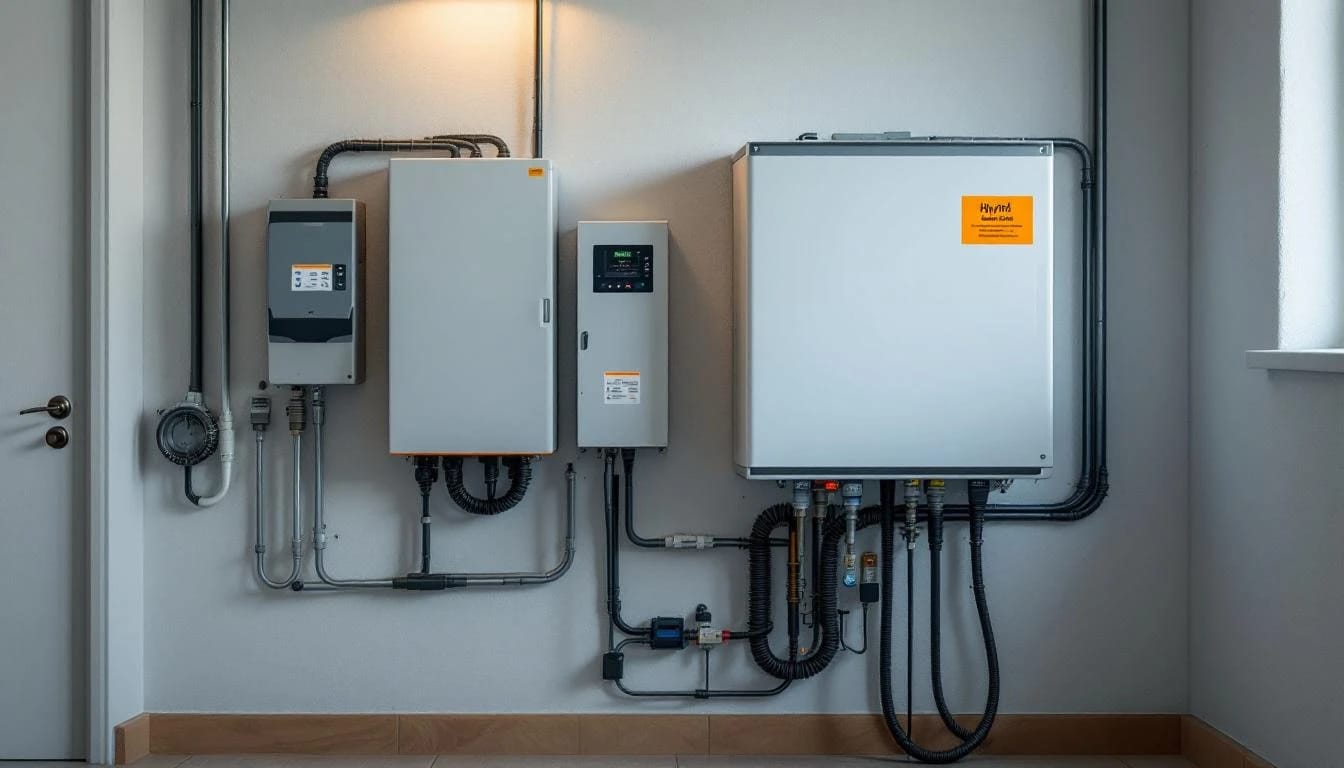
Maximum Power Point Tracking (MPPT) controllers extract 15-30% more energy from small wind turbines in real-world variable conditions compared to Pulse Width Modulation (PWM) controllers, but they cost two to four times as much. For residential systems below 600 watts with small battery banks, PWM offers adequate performance at a lower price. Systems above 1 kW with deep-cycle battery banks exceeding 400 Ah recoup the MPPT premium within 18-36 months through increased harvest, making MPPT the better long-term investment.
The choice hinges on turbine rated power, battery bank capacity, wind regime variability, and whether the installation is off-grid or grid-tied with battery backup. Both controller types perform the same core function—regulate voltage between turbine and batteries—but the method and efficiency differ dramatically. This guide explains how each technology works, compares real-world performance across common residential configurations, and provides decision criteria based on system size and site conditions.
How PWM controllers work with wind turbines
Pulse Width Modulation controllers act as fast-switching gates between the turbine and battery. When battery voltage drops below the float setpoint, the PWM opens fully and connects turbine output directly to the batteries. As battery voltage rises, the controller rapidly switches on and off—hundreds of times per second—reducing the average current flow while maintaining voltage match.
The switching duty cycle adjusts to battery state-of-charge. A battery at 50% charge might see an 80% duty cycle (switch closed 80% of the time), while a battery at 90% charge receives a 20% duty cycle. This approach works well when turbine voltage closely matches battery voltage, which occurs at specific wind speeds but rarely across the full operating range.
PWM controllers perform no voltage transformation. A 12-volt PWM controller requires the turbine to output near 12 volts to charge effectively. When wind speeds push turbine voltage to 18 volts, the controller clamps excess power as heat or engages dump-load circuits. When wind slows and turbine voltage drops to 10 volts, charging stops entirely even though the turbine still produces power. This voltage-matching limitation wastes potential energy at both high and low wind speeds.
Most PWM controllers designed for solar panels work adequately with permanent-magnet alternator wind turbines, but wind-specific models add features like adjustable cut-in voltage (allowing charging from slower winds), three-stage battery charging profiles, and dump-load terminals for brake resistors. Morningstar TriStar PWM and Xantrex C-Series controllers are commonly adapted for small wind despite being solar-optimized.
How MPPT controllers extract maximum power
Maximum Power Point Tracking controllers use DC-to-DC conversion to transform voltage while maintaining power flow. Unlike PWM's simple switching, MPPT employs a buck-boost converter topology that can step voltage up or down. A turbine producing 200 watts at 30 volts gets transformed to 200 watts at 14 volts (minus 5-8% conversion loss) to match battery requirements.
The "maximum power point" refers to the voltage-current combination at which a turbine produces peak wattage at any given wind speed. For a permanent-magnet alternator, this power curve shifts constantly. At 15 mph wind, peak power might occur at 18 volts; at 25 mph, peak power shifts to 32 volts. MPPT controllers sample turbine voltage and current 50-100 times per second, calculate instantaneous power, and adjust the load impedance to keep the turbine operating at the mathematically optimal point.
The algorithm typically uses perturb-and-observe logic: slightly increase voltage, measure power; if power rises, continue in that direction; if power falls, reverse direction. This hill-climbing approach finds the peak within 1-3 seconds and tracks it as wind speed changes. Sophisticated controllers use sweep algorithms that map the entire power curve every few minutes to avoid getting stuck at local maxima.
MPPT efficiency—the percentage of extracted power successfully delivered to batteries—ranges from 92-97% in quality controllers. Victron SmartSolar MPPT, Morningstar TriStar MPPT 600V, and Midnite Classic series are proven in small wind applications, though most manufacturers position them for solar. Purpose-built wind controllers from Aerogen, Superwind, and Primus Wind Turbines incorporate turbine-specific protections like rotor-brake control and storm-mode disconnect.
Performance comparison across turbine sizes
A 400-watt turbine (Primus Air 40, Southwest Windpower Air X) generates peak power at 12-15 volts on a 12-volt battery system. PWM controllers waste minimal energy here because turbine voltage naturally matches battery voltage through most of the power curve. At cut-in speeds (7 mph), the turbine produces 50 watts at 11 volts; PWM charging begins immediately. At rated speed (28 mph), the turbine produces 400 watts at 15 volts; PWM charging continues efficiently. The MPPT advantage shrinks to 8-12% in this configuration, insufficient to justify a $300 MPPT controller over a $75 PWM unit.
A 1,000-watt turbine (Bergey Excel 1, Pika T701) operates across a wider voltage range. At 10 mph, it produces 100 watts at 25 volts. A PWM controller on a 24-volt battery system (nominal 28.8V when charging) cannot harvest this power—voltage too low. At 20 mph, the turbine generates 600 watts at 45 volts. PWM clamps voltage to 28.8V and diverts excess power to dump loads. Only at 14-16 mph does turbine voltage align with battery voltage for efficient PWM charging.
An MPPT controller captures energy across the entire range. The 25-volt, 100-watt output at low wind gets boosted to 28.8 volts at 3.5 amps for battery charging. The 45-volt, 600-watt output at high wind gets bucked down to 28.8 volts at 20.8 amps (assuming 5% loss). Over a month with typical variable wind, MPPT harvests 22-28% more energy than PWM on this 1 kW system.
Systems above 2 kW see even larger gains. A 2.5 kW turbine (Bergey Excel 6, Jacobs 31-20) may have an operating envelope from 20 to 120 volts. PWM becomes impractical; MPPT is essential. Many manufacturers specify MPPT controllers as mandatory for their larger turbines to achieve rated performance.
| System Size | Turbine Voltage Range | PWM Harvest Efficiency | MPPT Harvest Efficiency | MPPT Gain | Break-Even Period |
|---|---|---|---|---|---|
| 400W (12V) | 10-18V | 82-88% | 90-94% | 8-12% | 48-60 months |
| 1,000W (24V) | 20-50V | 58-68% | 85-92% | 22-28% | 18-24 months |
| 2,500W (48V) | 30-120V | 35-48% | 88-94% | 48-62% | 12-18 months |
Wind variability and charging efficiency
Wind rarely blows at steady rated speed. Real residential sites experience frequent shifts between 5 mph and 30 mph, with occasional gusts to 40+ mph. This variability amplifies MPPT advantages because the controller continuously optimizes across changing conditions rather than waiting for the narrow voltage window where PWM charges efficiently.
A study using wind data from Des Moines, Iowa (Class 2 wind resource, annual average 10.2 mph at 33 feet) modeled a 1 kW turbine on a 24V battery system over one year. The PWM controller harvested 1,240 kWh. The MPPT controller harvested 1,580 kWh—a 27% gain. Breaking down by wind speed bins: at 8-12 mph (41% of the year), MPPT gained 34%; at 13-18 mph (28% of the year), MPPT gained 18%; at 19-25 mph (15% of the year), MPPT and PWM performed nearly equally; above 26 mph (8% of the year), both controllers diverted excess power to dump loads.
Sites with smoother, more consistent wind see smaller MPPT gains. Coastal locations or ridge-top installations with steady 12-18 mph winds reduce the voltage-mismatch problem that PWM suffers. Sites with gusty, turbulent wind—suburban installations near buildings, or heavily treed rural properties—maximize MPPT benefits.
Battery state-of-charge also influences the gap. PWM charges efficiently when battery voltage sits at absorption setpoint (14.4V for 12V flooded lead-acid). When batteries reach float (13.5V), turbine voltage must drop proportionally for PWM to deliver power. MPPT maintains harvest because it transforms voltage independently of battery voltage. Off-grid systems with frequent deep discharge cycles favor MPPT; grid-tied systems with batteries kept near full charge reduce the MPPT advantage.
Installation and electrical requirements
Both controller types mount indoors near the battery bank. NEC Article 705 governs interconnected electric power production sources and requires overcurrent protection, disconnect means, and ground-fault protection. For turbine-to-controller wiring, voltage drop must stay below 3% at rated current. A 1,000-watt turbine on a 24V system produces 41.7 amps at full output; 30 feet of run requires 4 AWG copper minimum (40-amp ampacity after temperature correction).
PWM controllers need minimal configuration—set battery type (flooded, AGM, gel) and voltage (12V, 24V, 48V). Most models use simple DIP switches or single-button menus. MPPT controllers require turbine power-curve parameters: open-circuit voltage, short-circuit current, voltage at maximum power, and current at maximum power. Generic solar MPPT controllers use approximations that work adequately; turbine-specific controllers load custom profiles.
Dump loads are critical for small wind. When batteries reach full charge, the controller must divert power to prevent turbine overspeed. PWM controllers typically include 30-60 amp dump-load terminals that switch resistive heaters or water-heating elements. MPPT controllers from solar backgrounds often lack dump-load outputs, requiring external diversion-load controllers like Xantrex C35 or Midnite Classic's built-in diversion. Undersizing dump loads causes voltage spikes that damage rectifiers and controllers.
Grounding follows NEC 250.160-250.166. The turbine tower requires a grounding electrode system separate from the building ground, then bonded with 6 AWG copper minimum. Wind turbines present lightning-strike risk higher than rooftop solar, making surge protection essential. Install Type 1 SPD at the turbine base, Type 2 SPD at the controller input, and AC-side surge protection if grid-tied.
Licensed electricians must perform all work. Most jurisdictions require permits for systems above 200 watts. NEC 705.12(D)(2) limits interconnected power sources to 20% of the busbar rating, affecting grid-tied battery systems with inverter backup.
Cost analysis and return on investment
PWM controllers for small wind cost $65-$180 depending on amperage rating and features. A 30-amp PWM controller ($75) handles up to 420 watts on a 12V system or 840 watts on a 24V system. MPPT controllers start at $220 for 10-amp models and reach $800+ for 60-amp models with advanced features. Quality wind-optimized MPPT controllers like the Midnite Classic 150 (150V input, 96A output) run $600-$700.
The price difference means MPPT must harvest enough additional energy to offset its premium. Using national average electricity rates (16.7¢/kWh, EIA 2024), a system that generates an extra 340 kWh per year from MPPT saves $56.78 annually. A $450 MPPT premium takes eight years to recoup through energy savings alone.
Off-grid systems change the math. Generated energy replaces diesel-generator runtime or prevents capacity expansion. If avoided diesel costs run 45¢/kWh (30¢ fuel + 15¢ maintenance), that same 340 kWh saves $153 annually, recovering the MPPT premium in three years. Battery longevity also improves when MPPT maintains float voltage more consistently, potentially adding 1-2 years to a $1,500 battery bank.
Grid-tied systems with battery backup see modest MPPT benefits. When batteries stay near full charge and excess power exports to the grid at wholesale rates (3-8¢/kWh in most states), the harvest improvement translates to only $15-$35 annually. Grid-tie installations prioritize reliability over harvest optimization, making PWM acceptable if it meets minimum performance.
State incentives can shift economics. The federal Residential Clean Energy Credit (IRC §25D) provides a 30% tax credit through 2032 for qualified wind systems including charge controllers. This reduces MPPT net cost by 30%, shortening payback. DSIRE database lists additional state incentives—Massachusetts offers a state tax credit up to $1,000; New York's NY-Sun program provides per-watt rebates; California's SGIP includes wind-plus-storage incentives. Run calculations with post-incentive costs to determine true break-even periods.
Decision criteria by system configuration
Choose PWM if:
- Turbine rated power under 600 watts
- 12V battery system with single turbine
- Battery bank under 400 Ah
- Budget under $150 for controller
- Site has consistent 12-18 mph wind regime
- Grid-tied with batteries kept near full charge
Choose MPPT if:
- Turbine rated power 1,000 watts or higher
- 24V or 48V battery system
- Battery bank 400 Ah or larger
- Off-grid or frequent deep discharge cycles
- Site has highly variable or gusty wind
- Expansion planned (adding turbines or increasing capacity)
- Turbine operates 40+ volts above battery voltage at rated speed
For borderline cases—800-watt turbines or 24V systems with moderate wind—calculate energy gain using manufacturer power curves and local wind data. The NREL PVWatts calculator estimates solar generation; for wind, use the Betz limit (59.3% theoretical maximum efficiency) and turbine-specific power curves. Multiply wind-resource hours by turbine output at various speeds, then apply PWM efficiency (60-70% average) versus MPPT efficiency (88-92%). If the annual energy difference exceeds 300 kWh, MPPT justifies the cost for most residential installations.
Battery chemistry matters. Lithium iron phosphate (LiFePO4) batteries have tighter voltage windows than flooded lead-acid. MPPT's precise voltage control prevents overcharging and undercharging, critical for lithium longevity. Lead-acid tolerates PWM's looser regulation but benefits less from MPPT's optimization unless deeply cycled daily.
Common mistakes and misconceptions
Installing a solar-optimized MPPT without dump-load protection causes turbine overspeed when batteries reach full charge. The turbine spins unloaded, voltage spikes to 120+ volts, and rectifier diodes or controller MOSFETs fail. Always verify MPPT controllers have built-in diversion or pair with external diversion-load controllers.
Undersizing PWM controllers for surge current is another frequent error. A 1,000-watt turbine at 24V nominal produces 41.7 amps average but peaks at 60+ amps during gusts. A 40-amp PWM controller repeatedly trips or engages current limiting, reducing harvest. Oversize PWM controllers by 50% to handle surge; MPPT controllers have larger current margins built in.
Connecting multiple turbines to a single controller without proper isolation causes cross-feeding. When one turbine generates higher voltage than another, current flows backward through the lower-voltage turbine, creating drag and heat. Install blocking diodes or separate controllers for each turbine.
Some installers assume MPPT always outperforms PWM by the full 30-40% advertised. Marketing materials show best-case gains under idealized conditions. Real-world improvements average 15-25% for most residential systems due to controller losses, wiring losses, and time spent at optimal wind speeds where both controller types perform similarly.
Ignoring turbine-controller compatibility leads to poor performance. Controllers designed for high-voltage solar arrays (150V+ input) may not track correctly on 24V wind turbines. Match controller input voltage range to turbine output voltage range, ensuring the turbine's maximum open-circuit voltage stays 10% below controller max input voltage.
Hybrid system considerations
Hybrid solar-wind systems use the same battery bank for both sources. A single MPPT controller cannot optimize both simultaneously—solar panels and wind turbines have different power curves and operate at different voltages. Install separate controllers for each source with independent dump loads.
Some all-in-one hybrid controllers claim to manage both inputs, but real-world performance suffers. The Systellar HAWC-300 and similar units compromise MPPT efficiency on both sources to avoid conflicts. Better practice: dedicated wind MPPT, dedicated solar MPPT, shared battery bank.
For grid-tied hybrid systems, consider battery-based inverters with multiple charge-controller inputs. Schneider XW+ series, Outback Radian, and Sol-Ark inverters have built-in MPPT solar charge controllers plus generator inputs that adapt for wind. These integrate smoothly but cost $3,500-$7,000, making sense only for larger systems (3+ kW combined).
AC-coupling offers another approach. Use separate grid-tie inverters for wind and solar, feeding AC power to critical loads through a battery-based inverter. This allows optimized controllers for each source without complex DC integration, but adds cost and complexity suitable only for systems above 5 kW total capacity.
Monitoring and performance validation
MPPT controllers provide detailed data unavailable from PWM: daily kWh production, voltage-current curves, maximum power point voltage, and charge efficiency. Many include Bluetooth or Wi-Fi for smartphone monitoring. Victron VRM portal graphs historical data; Midnite Classic logs to MicroSD cards; Morningstar TriStar communicates via Modbus.
PWM controllers offer basic LED indicators or simple LCD displays showing battery voltage and charge mode. Advanced PWM models add amp-hour counting and rudimentary data logging, but lack the granularity to diagnose performance issues.
For system validation, measure actual harvest against theoretical output. Use manufacturer power curves and local anemometer data (at hub height) to calculate expected annual kWh. If actual production falls below 75% of calculated, investigate controller settings, wiring losses, or turbine condition. MPPT controllers reveal under-harvest through logged max-power voltage; if this voltage never reaches manufacturer specifications, suspect turbine bearing wear, blade damage, or incorrect load settings.
Annual maintenance includes inspecting dump-load resistors for thermal damage, checking all DC connections for corrosion, and verifying voltage setpoints match battery manufacturer specifications. Re-calibrate MPPT algorithms if battery capacity changes or chemistry shifts—replacing 12V flooded with 12V lithium requires different absorption and float voltages.
Can I use a solar MPPT controller for wind turbines?
Yes, but with caveats. Solar MPPT controllers lack dump-load circuits essential for wind turbine overspeed protection. Pair solar MPPT controllers with external diversion-load controllers or ensure the turbine has built-in braking. Verify the controller's input voltage range covers the turbine's full operating envelope. Most solar controllers work well up to 150V input, adequate for turbines under 2 kW on 24V/48V systems.
How much power does a controller consume?
PWM controllers draw 0.5-1.5 watts idle, 2-4 watts under full load. MPPT controllers consume 3-8 watts idle, 8-15 watts at rated output due to DC-DC conversion losses. For a 1,000-watt system generating 4 kWh daily, MPPT overhead averages 150-200 Wh, reducing net harvest by 3.8-5%. This loss is included in the 92-97% efficiency ratings.
Do MPPT controllers work with three-phase wind turbines?
Most residential MPPT controllers expect DC input and require a rectifier between the turbine alternator and controller. Three-phase turbines use bridge rectifiers (six-diode or 12-diode configurations) to convert AC to DC, then feed MPPT controllers normally. Some industrial-scale active rectifier systems integrate MPPT algorithms into the rectifier stage, but these exceed residential budgets ($5,000+).
Will temperature affect controller performance?
Yes. Both PWM and MPPT controllers derate at elevated temperatures. Operating at 140°F ambient reduces rated current by 20-30%. Mount controllers indoors or in shaded ventilated enclosures. MPPT controllers generate more heat due to switching losses; ensure clearance for convection cooling. Temperature compensation adjusts charge voltage for battery temperature, preventing overcharge in hot climates and undercharge in freezing conditions—essential for both controller types.
Can I retrofit MPPT to an existing PWM system?
Yes, with minimal changes. Replace the PWM controller with an MPPT model matching the system voltage and add an external diversion-load controller if the MPPT lacks dump-load terminals. Ensure DC wiring meets voltage drop requirements for the MPPT's higher current output at the battery side. Reprogram inverter or charge setpoints if the MPPT uses different voltage profiles. Cost: $300-$700 for controller, 2-4 hours installation labor.
Bottom line
MPPT controllers justify their higher cost for systems above 1 kW, battery banks over 400 Ah, or sites with variable gusty wind. The 15-30% energy gain pays for the $300-$500 premium within 18-36 months, then continues delivering value through the 10-15 year controller lifespan. PWM controllers remain viable for small 400-600 watt turbines on 12V systems where simplicity and low cost outweigh the modest harvest improvement MPPT would provide. Calculate break-even using your site's wind data and local electricity costs—then choose the controller that reaches net positive soonest while meeting long-term expansion plans.
Share this article
windturbinehome.com/s/1953ad
Editorial note: This article was researched and written by a member of the Wind Turbine Home editorial team. AI-assisted tools were used for spell-checking and light grammar review only — all research, analysis, and conclusions are our own. Our editorial policy prohibits sponsored content and paid placements. Read our editorial policy →
Related reading

battery storage inverters
DIY Wind Turbine Charge Controller: When to Build vs Buy
Building a wind turbine charge controller saves $150-400 but risks battery damage and code violations. Compare DIY circuit boards against commercial MPPT units.
battery storage inverters
Hybrid Inverter Selection for Small Wind + Battery Systems
Choose the right hybrid inverter for your wind turbine battery setup—DC-coupled models work best for systems under 5 kW, while AC-coupled units offer easier solar retrofits.
battery storage inverters
Best Batteries for Small Wind Systems in 2026 | Expert Guide
Lithium iron phosphate batteries dominate 2026 wind storage. Compare cycle life, depth-of-discharge, and cold-weather performance for systems 400W-10kW.
battery storage inverters
Lithium vs AGM Batteries for Wind Systems in Cold Weather
Cold weather cuts AGM capacity by 20-40% and lithium by 10-15%. Learn which chemistry survives winter turbine charging, how battery management systems respond, and what installers must change below 32°F.
battery storage inverters
12V vs 24V vs 48V Wind Turbine Systems: Which Voltage Is Right?
Choosing between 12V, 24V, and 48V wind turbine systems depends on power needs, wire costs, and battery architecture. Most residential setups favor 24V or 48V.
battery storage inverters
Best Battery Banks for Home Wind Turbines (LiFePO4, 2026)
Home wind turbines charge in irregular bursts, so battery chemistry matters as much as capacity. Here is why lithium iron phosphate leads on reliability.
battery storage inverters
Off-Grid Wind Turbine Battery Setup: Complete System Guide
Complete guide to off-grid wind turbine battery systems covering charge controllers, battery banks, inverters, and load management for residential installations.

battery storage inverters
Home Wind Turbine Kits With Battery and Inverter (2026)
See how all-in-one home wind turbine kits bundle the turbine, battery bank and inverter, how to size each part, and what the installation actually involves.