Lithium vs AGM Batteries for Wind Systems in Cold Weather
Cold weather cuts AGM capacity by 20-40% and lithium by 10-15%. Learn which chemistry survives winter turbine charging, how battery management systems respond, and what installers must change below 32°F.
Share this article
windturbinehome.com/s/9ae3f5
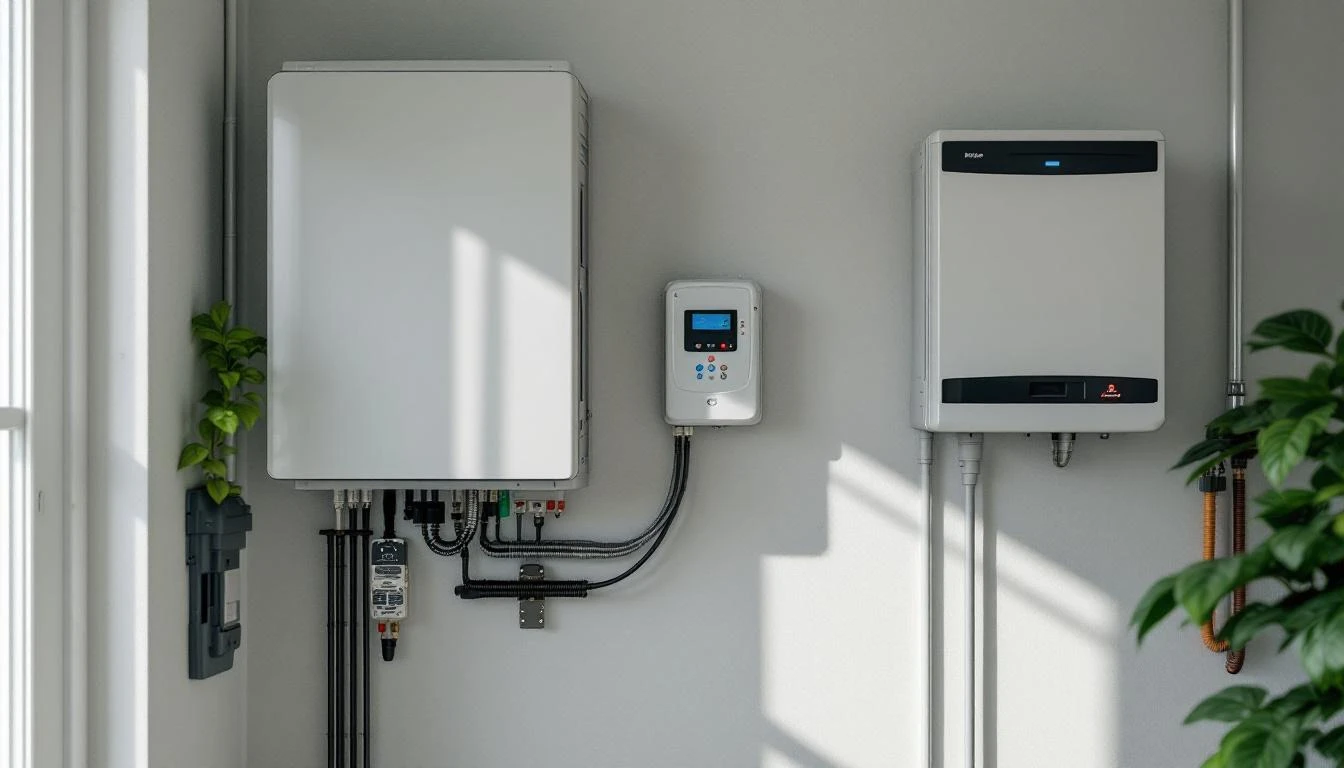
Cold weather shifts the electrochemistry inside every battery your wind turbine feeds. AGM (absorbent glass mat) lead-acid batteries lose 20-40% of rated capacity at 0°F, while lithium iron phosphate (LiFePO₄) cells drop 10-15% and often refuse charge below 32°F unless warmed. Winter forces system designers to oversize capacity, relocate enclosures, and add thermal management hardware that summer-only calculations never reveal. The choice between lithium and AGM determines whether your off-grid site survives February or goes dark.
How temperature alters battery chemistry
All batteries rely on ion movement through an electrolyte. Lower temperature thickens the electrolyte and slows ion migration, raising internal resistance and dropping voltage under load. AGM batteries use sulfuric acid suspended in glass-fiber mats; as the acid chills, reaction rates fall exponentially. A fully charged 12 V AGM may read 12.7 V at 77°F but sag to 12.0 V under the same discharge current at 0°F, triggering low-voltage disconnects prematurely.
Lithium cells move lithium ions between graphite and iron-phosphate lattices. Cold slows diffusion into the graphite anode, raising the risk of lithium plating—a failure mode that creates internal shorts. Most lithium battery management systems (BMS) block charging below 32°F to prevent plating, leaving the battery accepting zero turbine power until temperature rises. Discharge remains possible, though at reduced voltage and capacity.
Lead-acid self-discharge accelerates above 77°F but slows below freezing, an advantage for seasonal storage. Lithium self-discharge stays under 3% per month across the full temperature range, making either chemistry stable when turbines idle during calm winter weeks.
Capacity retention curves at subzero temperatures
AGM manufacturers publish capacity multipliers by temperature. A Trojan T-105 AGM rated 225 Ah at 77°F delivers roughly 180 Ah at 32°F (80%), 135 Ah at 0°F (60%), and 90 Ah at -20°F (40%). These are not permanent losses; warm the battery and full capacity returns. Real-world loss depends on discharge rate; high turbine charging currents (C/5 or faster) magnify the voltage sag.
Lithium iron phosphate cells retain 85-90% of capacity at 0°F when discharging at 0.2 C. Battle Born 100 Ah lithium batteries specify 80% capacity at -4°F, better than AGM at the same temperature. The BMS thermal cutoff, however, means the turbine cannot recharge the bank during cold snaps unless the pack includes internal heating elements. Brands such as Renogy and Victron offer "cold weather" lithium batteries with self-heating BMS that draw 50-100 W from the pack itself to warm cells above 32°F before accepting charge.
Neither chemistry tolerates freezing while discharged. A fully discharged AGM freezes near 20°F because the electrolyte is mostly water; ice expansion cracks the plates. Lithium electrolyte freezes below -40°F, well outside residential use cases, but a depleted lithium pack left outdoors in January will not recharge until ambient temperature rises or a heater intervenes.
Charging acceptance and turbine output mismatch
Small wind turbines produce the highest output during winter storms when cold fronts drive sustained winds. A Bergey Excel 10 can push 40 A at 48 V during a 25 mph gust, but if the lithium BMS locks out charging at 28°F, that energy dumps into a diversion resistor instead of storage. AGM batteries accept charge at any temperature, though the cold raises their internal resistance and forces the charge controller to increase voltage to maintain current flow.
AGM requires temperature-compensated charging. The bulk voltage for a 12 V AGM bank is typically 14.4 V at 77°F, but cold batteries need 14.8-15.0 V to overcome resistance and achieve full state of charge. Wind charge controllers with remote temperature sensors (Midnite Classic, Morningstar TriStar) adjust voltage automatically. Without compensation, a cold AGM bank stops accepting current before reaching 100% state of charge, reducing cycle life.
Lithium batteries demand constant-voltage, constant-current (CC-CV) charging with narrow tolerances: 14.2-14.6 V for 12 V systems. The BMS regulates cell balance and will disconnect if any cell exceeds 3.65 V, preventing overcharge. Turbine controllers must be programmed for lithium profiles; using an AGM voltage set point will trigger BMS shutdowns or, worse, bypass BMS protections on cheaper packs.
Self-heating lithium packs draw power from the turbine or from the battery itself to warm cells. A 400 Ah lithium bank may consume 200 W for thirty minutes to reach 35°F, delaying useful charge acceptance. For off-grid wind systems, this delay matters during short winter daylight when wind peaks at dawn and dusk. AGM banks start charging immediately, even if less efficiently.
Cycle life and depth-of-discharge limits in cold climates
AGM batteries tolerate 300-500 cycles to 50% depth of discharge (DoD) at room temperature. Cold accelerates sulfation—the buildup of lead sulfate crystals that block active material—because the slower chemical reactions leave sulfate in crystalline rather than amorphous form. Winter cycling to 50% DoD can cut AGM life to 200-300 cycles. Best practice is to limit DoD to 30% during sustained cold, requiring a larger bank or supplemental charging from solar panels.
Lithium iron phosphate batteries offer 3,000-5,000 cycles to 80% DoD at room temperature. Cold reduces cycle life by 10-20% when operating near voltage cutoffs, but the absolute number remains far above AGM. The trade-off is upfront cost: a lithium bank with equivalent usable capacity (accounting for safe DoD) costs 2-3× an AGM bank. Total cost of ownership favors lithium over ten years if the site cycles daily; AGM wins for weekend cabins with infrequent discharge.
Cold-weather cycling introduces mechanical stress. AGM plates expand and contract slightly with temperature, loosening active material over time. Lithium cells show minimal dimensional change, but the BMS may limit charge/discharge current at temperature extremes to protect cycle count. Victron SmartLithium batteries reduce maximum discharge to 50 A per 100 Ah module below 14°F, halving available power for high-draw appliances.
Enclosure and thermal management requirements
Batteries in unheated outbuildings face temperature swings from -10°F to 90°F across the year. Insulated enclosures with passive thermal mass (water jugs, sand-filled containers) moderate daily swings but do not prevent multi-day cold soaks. A 200 Ah AGM bank in an insulated box may hold 40°F when outdoor temperature drops to 10°F, buying a few degrees of performance.
Active heating using low-wattage silicone heating pads (20-40 W per 100 Ah) controlled by a thermostat keeps AGM banks above 32°F. The heating load comes from the turbine or battery, a parasitic draw that reduces net storage but maintains capacity. For lithium, self-heating BMS packs automate this process, eliminating external hardware.
Locating batteries indoors in a basement or utility room is the simplest thermal solution. Basements rarely drop below 45°F even when the house is unheated, preserving 90% capacity in both chemistries. NEC Article 705 (interconnected power systems) and Article 690 (solar, adapted for wind) require battery enclosures to meet fire and ventilation codes. AGM emits hydrogen during charging, requiring vented enclosures or sealed battery boxes with flame arrestors. Lithium produces no gas but must be protected from physical damage; a Class I, Division 2 rating is not required, simplifying indoor placement.
Inverter low-voltage cutoff and winter usability
Inverters disconnect when battery voltage falls below a set threshold to prevent over-discharge. A typical 12 V inverter cuts off at 10.5-11.0 V for AGM, 10.0 V for lithium. Cold batteries sag harder under load, so a bank at 50% state of charge and 0°F may hit cutoff voltage under a 1,500 W inverter draw, even though capacity remains. The inverter sees a dead battery; the user sees an outage.
AGM voltage sag is load-dependent. A 400 Ah AGM bank at 12.0 V resting voltage (roughly 50% SoC) may drop to 10.8 V under a 2,000 W load at 0°F, barely above cutoff. The same bank at 50°F holds 11.4 V, providing minutes of additional runtime. Lithium voltage stays flatter; a 400 Ah LiFePO₄ bank at 50% SoC reads 13.1 V and holds 12.8 V under 2,000 W at 0°F, far from the 10.0 V cutoff.
The solution for AGM systems is oversizing the bank to keep DoD shallow during peak loads, or accepting shorter winter runtime. Lithium systems can run deeper without hitting cutoff, but only if the BMS allows discharge at low temperature. Entry-level lithium packs from Pikasola or Ampere Time may disable discharge below 20°F, rendering the bank useless even with charge remaining.
Real-world system examples and trade-offs
A northern Minnesota off-grid home uses a Primus Air 40 turbine (2.5 kW) with 800 Ah of Trojan T-105 AGM at 24 V. Winter capacity drops to 480 Ah usable (60% of rated at 0°F, limited to 50% DoD). The homeowner added four 100 W solar panels and a 500 W propane generator as backup, accepting that January wind alone cannot sustain the load. AGM cost: $2,400; expected replacement at year six.
A Montana ranch installed an Aeolos-H 3 kW turbine with 400 Ah of Battle Born heated lithium at 48 V. The self-heating BMS draws 150 W for fifteen minutes each morning when temperature drops below 30°F, ensuring turbine power flows into storage by mid-morning. Usable capacity at 0°F is 340 Ah (85% of rated, to 80% DoD). Lithium cost: $5,200; expected replacement after year twelve. The rancher values the deeper discharge and faster recharge during multi-day blizzards.
A Vermont workshop runs a Bergey Excel 1 turbine (1 kW) into 600 Ah AGM at 12 V, located in a basement equipment room that stays above 45°F. The mild thermal environment preserves 90% capacity year-round, and the low cost ($1,800) fits a hobby budget. The workshop cycles 30% DoD daily, targeting 400-500 total cycles—adequate for five years of weekend use.
Comparison table: lithium vs AGM in cold climates
| Feature | AGM | Lithium (LiFePO₄) |
|---|---|---|
| Capacity at 0°F | 60% of rated | 85-90% of rated |
| Charge acceptance <32°F | Yes, voltage-compensated | No, unless self-heating BMS |
| Safe depth of discharge | 50% (30% in cold) | 80% |
| Cycle life (cold climate) | 200-400 cycles | 2,500-4,000 cycles |
| Self-discharge | 3-5% per month (slower when cold) | 2-3% per month |
| Thermal management | External heater + insulation | Self-heating BMS or enclosure heater |
| Cost per kWh usable | $200-250 | $400-600 |
| NEC ventilation | Required (hydrogen gas) | Not required |
| Weight per kWh | 70-90 lb | 25-35 lb |
| Voltage sag under load | High at low temp | Low |
| Lifespan (years) | 4-6 | 10-15 |
Federal incentives and installed cost
The IRS Form 5695 Residential Clean Energy Credit (IRC §25D) offers a 30% tax credit on qualified energy storage installed with a wind turbine, effective through 2032. The credit applies to battery hardware, charge controllers, and installation labor, but not routine maintenance or replacements. A $6,000 lithium system paired with a new turbine qualifies for $1,800 credit, reducing net cost to $4,200.
AGM and lithium both qualify if installed as part of an original wind system or a retrofit that adds storage to an existing turbine. The credit does not apply to batteries for backup-only use; the turbine must charge the battery to meet the "energy storage" definition. Consult IRS Notice 2023-17 for specific documentation requirements.
State incentives vary. DSIRE tracks programs by state; Alaska, Vermont, and Oregon offer additional rebates for battery-coupled wind systems in rural areas. These programs often cap reimbursement at $1,000-2,000, favoring modestly sized AGM banks for cost-conscious installations.
For off-grid sites, total installed cost includes the battery bank, charge controller, inverter, enclosure, wiring, and labor. AGM systems typically run $3,000-5,000 turnkey for a 400-600 Ah bank at 24-48 V. Lithium systems cost $6,000-10,000 for equivalent usable capacity, with self-heating BMS adding $800-1,200. The payback window depends on cycle count; lithium pulls ahead after year eight if the site cycles daily.
Internal system integration considerations
Wind charge controllers must match battery chemistry. The Midnite Classic supports user-defined voltage profiles for AGM, flooded lead-acid, and lithium, with temperature compensation via a remote sensor. The Morningstar TriStar offers similar flexibility and a 600 V input, suitable for high-voltage small turbines. Cheaper PWM controllers lock voltage to AGM profiles and will damage lithium packs.
Inverter-chargers such as the Victron MultiPlus or Outback Radian combine inversion, grid-tie (where available), and generator charging. Programming separate charge profiles for lithium and AGM prevents BMS shutdowns and extends cycle life. The inverter must also respect the BMS disconnect signal; a lithium BMS that opens the contactor during overcharge or overtemperature will shut down the entire AC bus unless the inverter has a bypass or timeout setting.
Battery monitors (Victron SmartShunt, Bogart TriMetric) track state of charge by integrating current over time. Cold weather skews voltage-based SoC estimates, so current integration (coulomb counting) proves more accurate. A monitor alerts the user when DoD reaches the safe limit, preventing over-discharge that shortens AGM life or triggers lithium BMS lockout.
Wind turbine charge controller setup and off-grid inverter sizing cover these topics in depth, including NEC Article 705.12(D) requirements for rapid shutdown and 705.20 for disconnect means.
Installation and code compliance
NEC Article 705 governs interconnected power systems, including wind-to-battery installations. Key requirements:
- 705.12(D): Rapid shutdown for systems over 50 V, achievable with a manual disconnect at the battery or a remote-controlled contactor.
- 705.20: Disconnect means must be lockable in the open position and rated for DC voltage and current.
- 705.65: Batteries must have overcurrent protection (fuses or breakers) sized for maximum charge current.
Battery enclosures must meet NEC 110.26 working clearance: 36 inches in front of the battery terminals for 48 V systems. AGM batteries require ventilation per 110.26(F)(1)(c) to disperse hydrogen; lithium does not. Fire-rated enclosures (Type 1 or 3R) protect against physical damage and water ingress in outdoor installations.
All work must be performed or inspected by a licensed electrician. Local authorities having jurisdiction (AHJ) may require site-specific wind permits under FAA Part 77 for turbine height and setback, even for battery-only retrofits if the turbine mount changes.
Maintenance schedules and winter monitoring
AGM batteries benefit from equalization charges every 30-60 days: a controlled overcharge (15.0-15.5 V for 12 V banks) that breaks up sulfate crystals. Equalization is not possible with lithium; the BMS will disconnect. Modern wind charge controllers automate AGM equalization when voltage and temperature conditions permit.
Winter monitoring focuses on voltage under load, temperature at the battery, and state of charge trends. A sudden capacity drop (e.g., 400 Ah bank behaving like 250 Ah) signals sulfation in AGM or cell imbalance in lithium. AGM can often recover with equalization; lithium requires BMS cell balancing, a slow process taking days.
Lithium BMS logs (via Bluetooth or RS-485) reveal cell voltage spread. A 0.1 V difference between highest and lowest cells indicates imbalance; the BMS will throttle charge current until cells converge. Cold slows balancing, so bringing a lithium bank indoors for a weekend accelerates the process.
AGM electrolyte level checks do not apply to sealed AGM, but terminal corrosion does. White sulfate deposits on terminals raise resistance; clean with a baking soda solution and apply terminal grease. Lithium terminals see less corrosion but still require annual inspection for tightness—loose connections create heat under high current.
Battery bank maintenance for wind turbines details seasonal checklists and troubleshooting for both chemistries.
Can I mix AGM and lithium batteries in the same bank?
No. AGM and lithium require different charge voltages and discharge profiles. Connecting them in parallel creates imbalanced currents, overcharging the lithium or undercharging the AGM. Each chemistry needs a dedicated charge controller and bus.
Do lithium batteries really stop charging below freezing?
Most do. The BMS blocks charge to prevent lithium plating on the anode, a defect that shorts cells. Self-heating lithium packs warm themselves above 32°F before accepting charge, adding 10-30 minutes of delay. AGM charges at any temperature with voltage compensation.
How much extra capacity should I add for winter?
Size AGM banks for 40% winter capacity loss (60% of rated at 0°F) and 30% max DoD, meaning a 400 Ah rated bank provides 240 Ah × 0.30 = 72 Ah usable. Multiply your daily kWh load by 1.5-2.0 for winter margin. Lithium needs 15% capacity loss and 80% DoD, providing more usable energy per rated amp-hour.
Will my turbine still charge the battery during a January storm?
Yes, if the battery is above freezing. AGM charges immediately; lithium requires 32°F or a self-heating BMS. If your battery is outdoors and drops to 20°F, a lithium BMS locks out charging until temperature rises. AGM accepts charge but at reduced efficiency. Insulated enclosures or indoor placement solve this.
Does cold damage the battery permanently?
Cold alone does not. AGM loses capacity temporarily; warming restores it. Freezing a discharged AGM (below 20% SoC) cracks plates irreversibly. Lithium tolerates cold discharge and storage but degrades faster if cycled cold repeatedly. Keeping batteries above 32°F during charge and above 0°F during discharge preserves lifespan.
Bottom line
AGM wins for intermittent-use sites and tight budgets, accepting charge at any temperature but losing capacity below freezing and cycling fewer times. Lithium delivers 3-5× the cycle life and deeper discharge, paying back the premium over a decade if the site cycles daily, but requires thermal management to charge in winter. Install either chemistry indoors when possible; if outdoors, insulate AGM and choose self-heating lithium. Both chemistries work in cold climates with proper planning and temperature-aware charge controllers. Compare lead-acid versus lithium battery banks for deeper system-design trade-offs, then find a qualified installer who understands cold-weather battery integration and NEC Article 705.
Share this article
windturbinehome.com/s/9ae3f5
Editorial note: This article was researched and written by a member of the Wind Turbine Home editorial team. AI-assisted tools were used for spell-checking and light grammar review only — all research, analysis, and conclusions are our own. Our editorial policy prohibits sponsored content and paid placements. Read our editorial policy →
Related reading
battery storage inverters
DIY Wind Turbine Charge Controller: When to Build vs Buy
Building a wind turbine charge controller saves $150-400 but risks battery damage and code violations. Compare DIY circuit boards against commercial MPPT units.
battery storage inverters
Hybrid Inverter Selection for Small Wind + Battery Systems
Choose the right hybrid inverter for your wind turbine battery setup—DC-coupled models work best for systems under 5 kW, while AC-coupled units offer easier solar retrofits.
battery storage inverters
Best Batteries for Small Wind Systems in 2026 | Expert Guide
Lithium iron phosphate batteries dominate 2026 wind storage. Compare cycle life, depth-of-discharge, and cold-weather performance for systems 400W-10kW.
battery storage inverters
12V vs 24V vs 48V Wind Turbine Systems: Which Voltage Is Right?
Choosing between 12V, 24V, and 48V wind turbine systems depends on power needs, wire costs, and battery architecture. Most residential setups favor 24V or 48V.
battery storage inverters
MPPT vs PWM Controller for Small Wind: Which to Buy and Why
MPPT controllers harvest 15-30% more energy than PWM in variable-wind conditions but cost 2-4× more. Choose MPPT for systems above 1 kW or battery banks over 400 Ah.
battery storage inverters
Best Battery Banks for Home Wind Turbines (LiFePO4, 2026)
Home wind turbines charge in irregular bursts, so battery chemistry matters as much as capacity. Here is why lithium iron phosphate leads on reliability.
battery storage inverters
Off-Grid Wind Turbine Battery Setup: Complete System Guide
Complete guide to off-grid wind turbine battery systems covering charge controllers, battery banks, inverters, and load management for residential installations.
battery storage inverters
Home Wind Turbine Kits With Battery and Inverter (2026)
See how all-in-one home wind turbine kits bundle the turbine, battery bank and inverter, how to size each part, and what the installation actually involves.