Hybrid Inverter Selection for Small Wind + Battery Systems
Choose the right hybrid inverter for your wind turbine battery setup—DC-coupled models work best for systems under 5 kW, while AC-coupled units offer easier solar retrofits.
Share this article
windturbinehome.com/s/ac4590
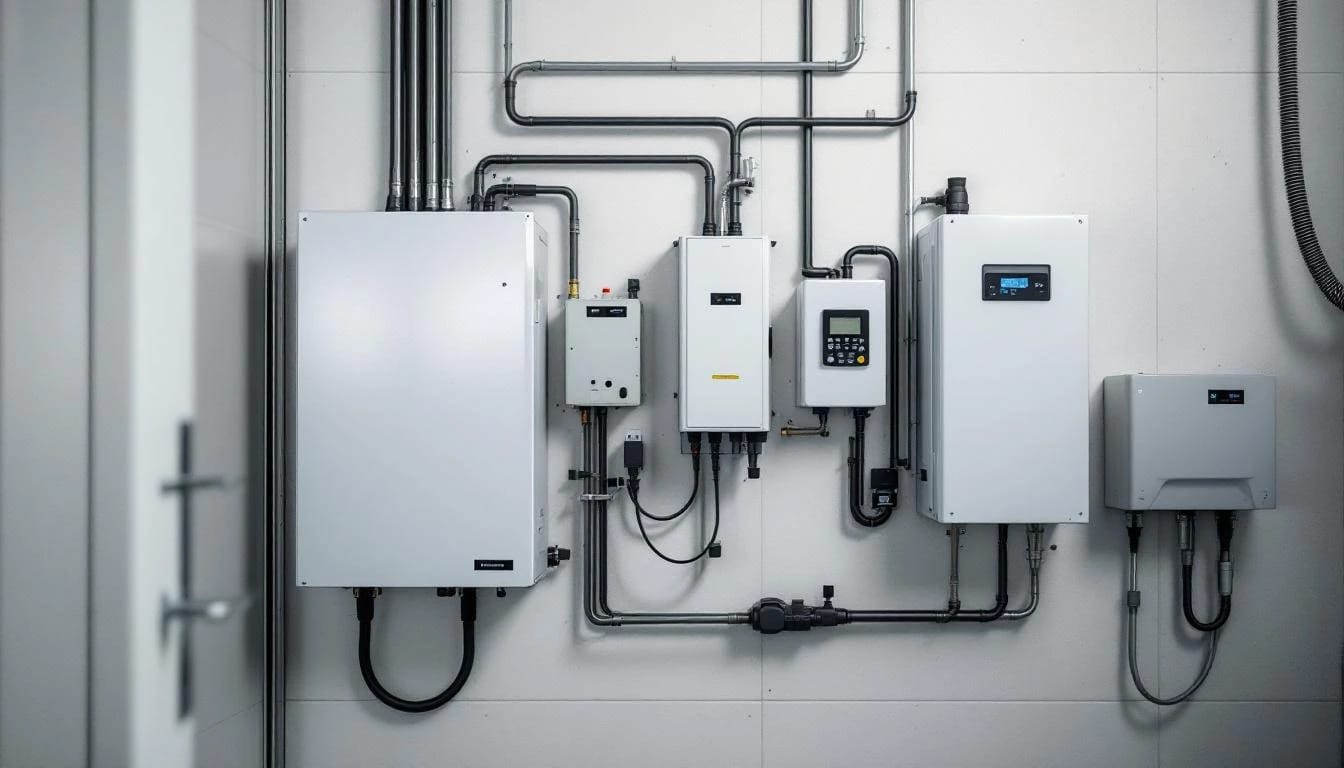
A hybrid inverter converts DC power from your small wind turbine and battery bank into AC power your home can use, while managing charge and discharge cycles. For systems pairing a vertical-axis or small horizontal-axis turbine (1–10 kW) with batteries, DC-coupled hybrid inverters typically deliver better round-trip efficiency—often 94–96%—and simpler wiring than AC-coupled alternatives. Before purchasing, confirm the unit supports the voltage range of both your turbine's rectifier output and your battery chemistry, and verify it complies with NEC Article 705 interconnection rules and carries UL 1741 SA certification for grid-tie operation.
Why hybrid inverters matter for wind-battery setups
Standard grid-tie inverters cannot store energy; they push every watt directly to the utility. A hybrid inverter adds a battery interface and charge controller, so surplus wind power charges the battery first, discharges stored energy during calm periods, and exports leftover generation to the grid. This buffering is especially valuable with wind, which gusts unpredictably and often peaks at night when household demand is low.
DC-coupled hybrids connect the turbine's rectified output and the battery to a common DC bus, then invert to AC once. AC-coupled models use separate inverters for the turbine and battery, synchronizing their outputs on the AC side. DC coupling wastes fewer electrons—one fewer conversion step—but AC coupling makes it trivial to add solar panels or a second turbine without re-engineering the DC bus.
Most residential wind turbines produce three-phase AC, which a built-in or external rectifier converts to DC. Match the rectifier's voltage window (often 200–450 V DC for a 48 V nominal battery, or 400–800 V DC for high-voltage lithium packs) to the inverter's maximum power-point tracking range. Mismatch here throttles output or trips over-voltage faults.
![INLINE: Diagram showing DC-coupled hybrid inverter connecting wind turbine rectifier, battery bank, and home load center with single AC output]
DC-coupled versus AC-coupled architectures
DC-coupled hybrids route turbine DC and battery DC into a single inverter. The charge controller inside regulates battery voltage and state of charge. Advantages: higher efficiency (one inversion), simpler balance-of-system, lower component count. Drawbacks: the inverter must handle the combined peak power of turbine plus battery discharge, so size it generously. Popular DC-coupled units rated 5–8 kW continuous can momentarily pass 10–12 kW surge, which accommodates a 3 kW turbine plus 5 kW battery inverter power.
AC-coupled systems use a grid-tie inverter for the turbine and a separate battery inverter that charges from and discharges to the AC bus. They talk via frequency or voltage droop signals. Advantages: modular upgrades, easier to add solar or a second turbine, each inverter optimizes for its source. Drawbacks: two conversion losses (battery charges from AC, then inverts back to AC), higher installed cost, more panel space.
For a first-time wind-plus-battery project under 5 kW turbine capacity, DC-coupled simplifies commissioning and meets NEC 705.12(B)(2) rules for point-of-connection labeling with fewer interconnection points. Above 5 kW or when planning future solar, AC-coupled flexibility often outweighs the 2–3% efficiency penalty.
Voltage compatibility: turbine, battery, inverter
Small wind turbines output widely varying voltages. A Bergey Excel 10 produces roughly 240–380 V DC after rectification; a Primus Air 40 tops out around 120 V DC. Your battery nominal voltage—12, 24, 48 V lead-acid or 51.2 V lithium iron phosphate (LiFePO₄)—must fall within the inverter's charge-controller input range.
Low-voltage systems (12–48 V nominal) suit turbines under 3 kW. They use heavier copper cable because current is higher (Power ÷ Voltage = Current), but batteries and charge controllers are abundant and affordable. High-voltage systems (200–500 V) reduce cable gauge and resistive losses, ideal for 5–10 kW turbines, but require specialized lithium modules and pricier inverters.
Check three numbers on the inverter datasheet:
- Battery voltage window – typically 40–60 V for a 48 V system, or 180–500 V for high-voltage.
- Maximum PV (or wind) input voltage – the MPPT absolute ceiling.
- Operating MPPT range – where the inverter actively seeks maximum power.
Wire the turbine rectifier output into the "PV" or "DC input" terminals if the hybrid inverter labels them that way; functionally they behave like a charge controller. If the inverter requires a separate wind-charge controller, ensure the controller's output voltage matches the battery bus before paralleling.
Power rating and surge capacity
Hybrid inverters carry two key ratings: continuous output and peak surge. Continuous is steady-state watts the inverter can deliver indefinitely (often 3, 5, 6, 8, 10, or 12 kW). Peak surge—typically 1.5× to 2× continuous for five seconds—covers motor-start inramps like well pumps or table saws.
Size the inverter so its continuous rating exceeds your average household load plus the turbine's rated output. A 3 kW Aeolos-V turbine with a 4 kW average home load calls for at least a 7 kW continuous inverter, leaving headroom for simultaneous turbine generation and battery discharge. Under-sizing throttles the turbine or prevents full battery discharge, wasting capacity.
Check the inverter's pass-through rating if you plan grid backup. Some hybrids can pass 50 A utility power straight to loads when the battery is full and the turbine is idle, bypassing internal electronics. Others force all power through the inverter, limiting pass-through to the inverter's continuous rating.
Battery chemistry and charge profiles
Hybrid inverters support multiple battery chemistries via selectable charge profiles: flooded lead-acid, sealed AGM, gel, lithium iron phosphate, lithium nickel manganese cobalt (NMC). Each chemistry has distinct bulk, absorption, float, and equalization voltages. Mismatched settings under-charge or over-charge, killing the bank in months.
Flooded lead-acid is cheapest (about $150/kWh installed) but requires monthly watering, vented enclosures per NEC 480.9, and equalization cycles every 30–90 days. Hybrid inverters with built-in equalizers simplify this. Depth of discharge should stay above 50% for reasonable cycle life (500–800 cycles).
AGM and gel are sealed, tolerating 60–70% DoD and living 800–1,200 cycles. They cost roughly $250/kWh and work in indoor enclosures without hydrogen ventilation. Charge voltage tolerance is tight—gel especially—so verify the inverter offers a dedicated gel profile.
Lithium iron phosphate (LiFePO₄) dominates new installs. At $400–600/kWh installed, it delivers 3,000–5,000 cycles at 80% DoD, weighs half as much as lead-acid, and charges faster. Most hybrids list a "lithium" or "Li-ion" profile, but confirm it matches the battery manufacturer's recommended bulk voltage (typically 55.2–58.4 V for a 48 V nominal pack) and includes low-temperature charge lockout below 32°F (0°C) since lithium cannot safely charge when frozen.
High-voltage lithium modules (200–500 V nominal) pair with commercial-grade hybrids from manufacturers like Sol-Ark, Schneider Conext, and Victron Quattro-II. These packs use a battery management system (BMS) that communicates over CAN bus or RS485, telling the inverter real-time state of charge, cell voltages, and temperature. The inverter must support that protocol—check compatibility lists.
Grid-tie compliance and anti-islanding
If your system connects to the utility, NEC Article 705.12 mandates that the hybrid inverter carry UL 1741 SA certification, which includes IEEE 1547-2018 anti-islanding and voltage/frequency ride-through. Anti-islanding detects grid outages within two seconds and disconnects the inverter, preventing backfeed to utility workers. UL 1741 SA also enables some California Rule 21 advanced functions like volt-watt and frequency-watt droop, though these are optional in most U.S. jurisdictions.
Submit an interconnection application to your utility before energizing. They will inspect the inverter nameplate, AC disconnect, and external manual disconnect (NEC 705.22). Expect approval timelines of 15–45 days for systems under 25 kW.
Off-grid systems skip UL 1741 and interconnection paperwork but still must follow NEC wiring rules for battery enclosures, conduit fill, overcurrent protection, and grounding per Article 690 (solar and wind share these sections).
Communication and monitoring
Modern hybrid inverters include Wi-Fi or Ethernet for cloud monitoring. The interface displays turbine generation, battery state of charge, load consumption, and grid import/export in real time. Some platforms—Schneider Conext ComBox, Victron VRM, Sol-Ark monitoring—offer smartphone apps and email alerts for fault codes.
Advanced models integrate with home energy-management systems (HEMS) or third-party controllers via Modbus TCP or SunSpec protocols. This lets you automate load shifting: charge batteries when wind is strong, discharge during peak utility rates, or curtail the turbine if the battery nears full and the grid is offline.
Data logging proves invaluable for claiming the federal 30% Residential Clean Energy Credit (IRC §25D, filed on IRS Form 5695). The IRS may ask for commissioning records and annual generation logs to substantiate the credit on a combined wind-solar-battery system.
Top hybrid inverter models for small wind
| Model | Type | Continuous | Surge | Battery Voltage | UL 1741 SA | Approx. Price |
|---|---|---|---|---|---|---|
| Sol-Ark 12K | DC-coupled | 12 kW | 18 kW | 48 V (40–60 V) | Yes | $6,500 |
| Schneider Conext XW Pro 6.8 | DC-coupled | 6.8 kW | 10.2 kW | 48 V or HV | Yes | $4,200 |
| Victron Quattro-II 48/5000 | DC-coupled | 5 kW | 10 kW | 48 V (38–66 V) | No (off-grid) | $2,800 |
| OutBack Radian GS8048A | DC-coupled | 8 kW | 12 kW | 48 V | Yes | $5,000 |
| SMA Sunny Island 6.0H | AC-coupled | 6 kW | 13 kW | HV (220–500 V) | Optional module | $3,600 |
Sol-Ark 12K handles dual MPPT inputs, so you can connect a wind turbine to one string and solar panels to another, all feeding a 48 V lithium battery. Its 12 kW continuous output covers larger homes, and built-in generator-start logic automates backup propane or diesel gensets during multi-day wind lulls.
Schneider Conext XW Pro 6.8 suits mid-size systems with a single turbine (2–5 kW) and offers a second AC input for a backup generator. The Conext ComBox adds cellular monitoring in remote sites where Wi-Fi is unavailable.
Victron Quattro-II 48/5000 lacks UL 1741 SA, limiting it to off-grid or specific jurisdictions, but its VRM portal and VE.Bus expandability (parallel up to six units for 30 kW) make it popular for off-grid cabins. Pair it with a Victron MPPT charge controller for wind.
OutBack Radian GS8048A balances grid-tie and off-grid capability. Its FLEXmax charge controllers integrate tightly, and the OPTICS RE web interface simplifies remote troubleshooting. Certified to UL 1741 SA, it's widely accepted by U.S. utilities.
SMA Sunny Island 6.0H is AC-coupled, designed to retrofit existing grid-tie wind or solar systems by adding battery backup. Frequency-shift control curtails the upstream inverters when the battery is full, preventing overcharge without DC rewiring.
Installation and code considerations
NEC Article 705 requires a site plan showing the inverter location, battery enclosure, AC and DC disconnects, overcurrent devices, and point of interconnection with the utility service panel. The installer must calculate available fault current and select appropriately rated breakers and fuses.
Battery enclosures must meet NEC 480.9 (vented if flooded lead-acid) and maintain temperature per manufacturer specs—lithium typically 32–95°F. Place the inverter within 10 feet of the battery to minimize DC cable voltage drop; for 48 V systems, keep drop below 2% (about 1 V) by using 2/0 or 4/0 AWG copper.
Ground the system per NEC 250.166, bonding the turbine tower, inverter chassis, battery rack, and AC service panel to a common grounding electrode system—typically ground rods or Ufer concrete grounding. A licensed electrician familiar with renewable-energy systems should handle final connections and the utility interconnection inspection.
Check your state's DSIRE database for installation rebates or performance incentives. Some states offer upfront cash per kilowatt for wind-plus-storage, and the federal 30% tax credit applies to the combined cost of turbine, inverter, batteries, and labor if the system was placed in service after January 1, 2022 (under the Inflation Reduction Act extension).
Warranty and support
Hybrid inverters typically carry 5–10 year manufacturer warranties. Sol-Ark and OutBack offer 10 years standard; Victron and SMA provide 5 years with optional extensions to 10 or 15 years. Read the warranty exclusions—lightning damage, saltwater corrosion, and improper battery chemistry settings often void coverage.
Support quality varies. Schneider and SMA maintain toll-free technical lines staffed by engineers. Victron relies on a network of certified installers and a busy community forum. Sol-Ark offers direct phone support and publishes detailed troubleshooting videos.
Plan for firmware updates every 12–24 months. Some manufacturers push updates over the internet; others require a USB stick and manual upload. Updates add new battery profiles, fix grid-compliance bugs, and improve MPPT algorithms—skipping them can leave performance or revenue on the table.
Can I use a solar-only hybrid inverter for wind?
Yes, if the inverter's MPPT input voltage range matches the turbine rectifier's output and the charge controller can handle the fluctuating input typical of wind. Some manufacturers explicitly list "wind" support; others label the input "PV/Wind" or just "DC." Confirm with technical support that the MPPT algorithm does not rely on the slow ramp rates characteristic of solar irradiance changes—wind ramps quickly and can confuse solar-tuned algorithms, reducing harvest.
Do I need a separate charge controller for wind?
Most DC-coupled hybrid inverters include a built-in MPPT charge controller on the DC input terminals, eliminating the need for a separate box. If the inverter datasheet specifies "external charge controller required," purchase a wind-rated MPPT or PWM controller that outputs to the battery bus at the correct voltage. AC-coupled setups always require a separate grid-tie or battery-charging inverter for the turbine.
How much battery capacity do I need?
A common rule of thumb: one day of average household consumption at 80% depth of discharge. A home using 30 kWh per day would need 30 kWh ÷ 0.8 = 37.5 kWh usable, or about 48 kWh of lithium (which allows 80% DoD) or 75 kWh of lead-acid (50% DoD). Smaller banks save money but require the turbine or grid to recharge daily, which may not happen in calm weather. Larger banks add resiliency but raise upfront cost and lengthen payback.
Will my existing grid-tie wind inverter work with a battery retrofit?
Only if you choose an AC-coupled battery inverter that synchronizes with the existing unit via frequency shifting or zero-export control. Fronius, SMA Sunny Boy Storage, and Tesla Powerwall 2/3 support AC coupling with third-party grid-tie inverters. Check compatibility lists, because voltage and frequency droop settings must align, or both inverters will fault and shut down repeatedly.
How do I claim the federal tax credit for a hybrid inverter?
File IRS Form 5695 in the tax year the system was placed in service. Include the cost of the inverter, battery, turbine, installation labor, electrical permits, and interconnection fees. Keep invoices and the signed final inspection certificate. The 30% credit applies to combined wind-solar-battery systems; you cannot double-claim if the turbine and inverter were installed in separate years—only the year the system became operational counts. Consult a tax professional if the credit exceeds your tax liability, as it can carry forward to future years but is nonrefundable (you won't receive a check for the excess).
Bottom line
Selecting a hybrid inverter for a small wind-battery system boils down to matching voltage ranges, right-sizing continuous and surge capacity, and ensuring NEC compliance with UL 1741 SA certification for grid-tie installations. DC-coupled models deliver higher efficiency and simpler wiring for single-turbine setups, while AC-coupled architectures offer modular flexibility if you plan to add solar or a second turbine later. Confirm the inverter supports your battery chemistry's charge profile, budget for professional installation to meet code, and retain all documentation for the 30% federal tax credit. Compare top small wind turbines for residential use to pair with your inverter, review battery-storage-inverters fundamentals for deeper technical dives, explore off-grid wind system design if you're skipping the utility connection, check wind turbine tower grounding requirements for NEC 250.166 details, and bookmark state wind incentive programs to stack local rebates on top of the federal credit.
Share this article
windturbinehome.com/s/ac4590
Editorial note: This article was researched and written by a member of the Wind Turbine Home editorial team. AI-assisted tools were used for spell-checking and light grammar review only — all research, analysis, and conclusions are our own. Our editorial policy prohibits sponsored content and paid placements. Read our editorial policy →
Related reading
battery storage inverters
DIY Wind Turbine Charge Controller: When to Build vs Buy
Building a wind turbine charge controller saves $150-400 but risks battery damage and code violations. Compare DIY circuit boards against commercial MPPT units.
battery storage inverters
Best Batteries for Small Wind Systems in 2026 | Expert Guide
Lithium iron phosphate batteries dominate 2026 wind storage. Compare cycle life, depth-of-discharge, and cold-weather performance for systems 400W-10kW.
battery storage inverters
Lithium vs AGM Batteries for Wind Systems in Cold Weather
Cold weather cuts AGM capacity by 20-40% and lithium by 10-15%. Learn which chemistry survives winter turbine charging, how battery management systems respond, and what installers must change below 32°F.
battery storage inverters
12V vs 24V vs 48V Wind Turbine Systems: Which Voltage Is Right?
Choosing between 12V, 24V, and 48V wind turbine systems depends on power needs, wire costs, and battery architecture. Most residential setups favor 24V or 48V.
battery storage inverters
MPPT vs PWM Controller for Small Wind: Which to Buy and Why
MPPT controllers harvest 15-30% more energy than PWM in variable-wind conditions but cost 2-4× more. Choose MPPT for systems above 1 kW or battery banks over 400 Ah.
battery storage inverters
Best Battery Banks for Home Wind Turbines (LiFePO4, 2026)
Home wind turbines charge in irregular bursts, so battery chemistry matters as much as capacity. Here is why lithium iron phosphate leads on reliability.
battery storage inverters
Off-Grid Wind Turbine Battery Setup: Complete System Guide
Complete guide to off-grid wind turbine battery systems covering charge controllers, battery banks, inverters, and load management for residential installations.
battery storage inverters
Home Wind Turbine Kits With Battery and Inverter (2026)
See how all-in-one home wind turbine kits bundle the turbine, battery bank and inverter, how to size each part, and what the installation actually involves.