Off-Grid Wind Turbine Battery Setup: Complete System Guide
Complete guide to off-grid wind turbine battery systems covering charge controllers, battery banks, inverters, and load management for residential installations.
Share this article
windturbinehome.com/s/76a2f1
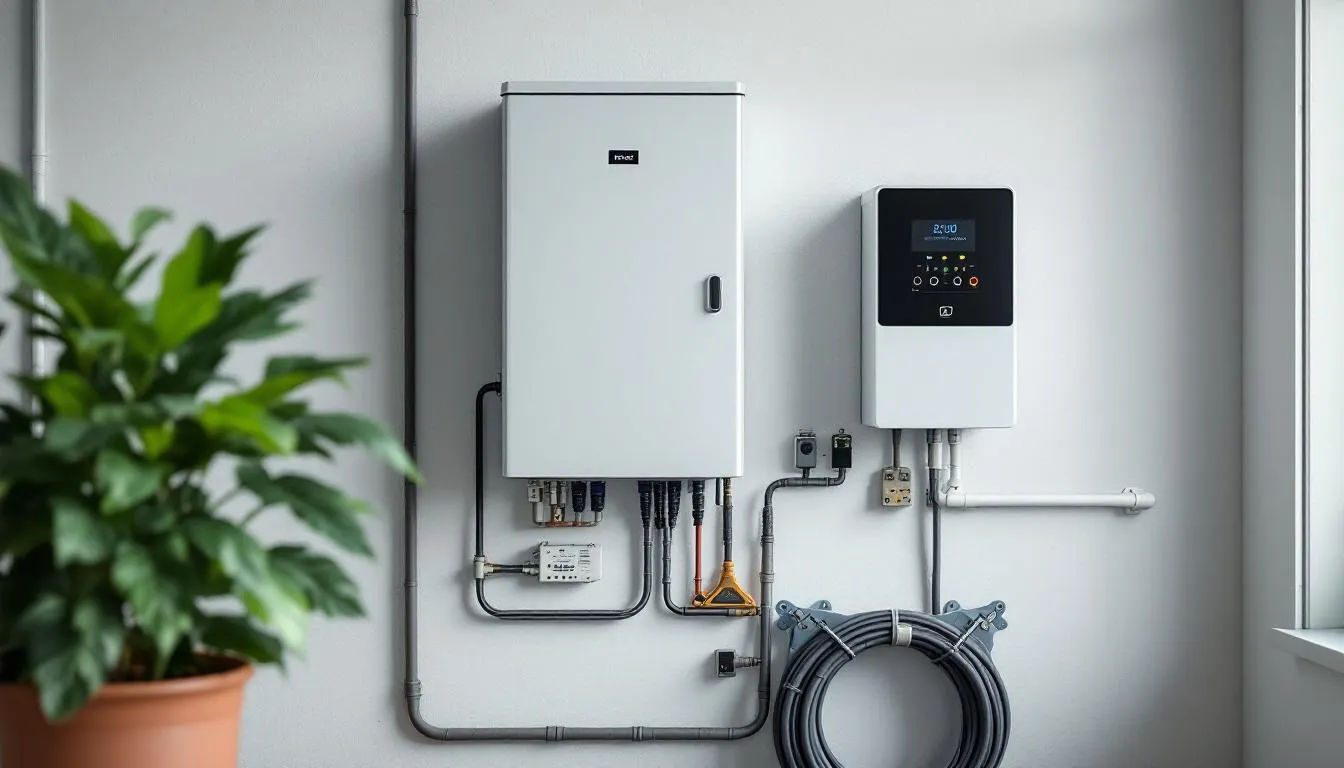
An off-grid wind turbine battery system consists of five critical components working in sequence: the turbine rotor, a charge controller, a battery bank, an inverter, and the load panel. The rotor captures kinetic wind energy and converts it to three-phase AC power (most turbines) or DC power (some vertical-axis models). The charge controller regulates voltage and current entering the battery bank, which stores energy for periods of low wind. The inverter transforms stored DC power into grid-quality AC electricity, and the load panel distributes power to appliances and circuits. System sizing depends on daily kilowatt-hour consumption, worst-case wind lulls (typically 3–7 days), battery depth-of-discharge limits (50% for flooded lead-acid, 80% for lithium), and inverter surge capacity for motor loads.
Why Off-Grid Architecture Differs From Grid-Tied Systems
Grid-tied wind systems push excess energy onto the utility network and draw power when the turbine sits idle. Off-grid systems carry the entire electrical load without utility backup, which imposes strict design requirements. Every watt consumed must either come from the rotor at that instant or from batteries charged during earlier wind events. This zero-tolerance margin demands oversized battery capacity, conservative depth-of-discharge cycling, and load management strategies that grid-tied owners never consider.
The U.S. Department of Energy Small Wind Guidebook emphasizes that off-grid applications require careful matching of turbine output to load profile and storage capacity. A Bergey Excel 10 rated at 10 kW in 24.6 mph wind might deliver only 1.2 kW average output in a 10 mph average wind site, forcing owners to either accept severe battery cycling or add solar photovoltaic capacity to fill generation gaps.
NEC Article 705 governs interconnected power systems but applies selectively to off-grid setups. Section 705.12 covers point-of-connection requirements for interactive systems; standalone systems fall under Article 690 (Solar Photovoltaic Systems) by analogy and general electrical code principles for DC wiring, overcurrent protection, and grounding. Local Authority Having Jurisdiction (AHJ) interpretations vary—always secure a licensed electrician familiar with wind-specific code compliance before breaking ground.
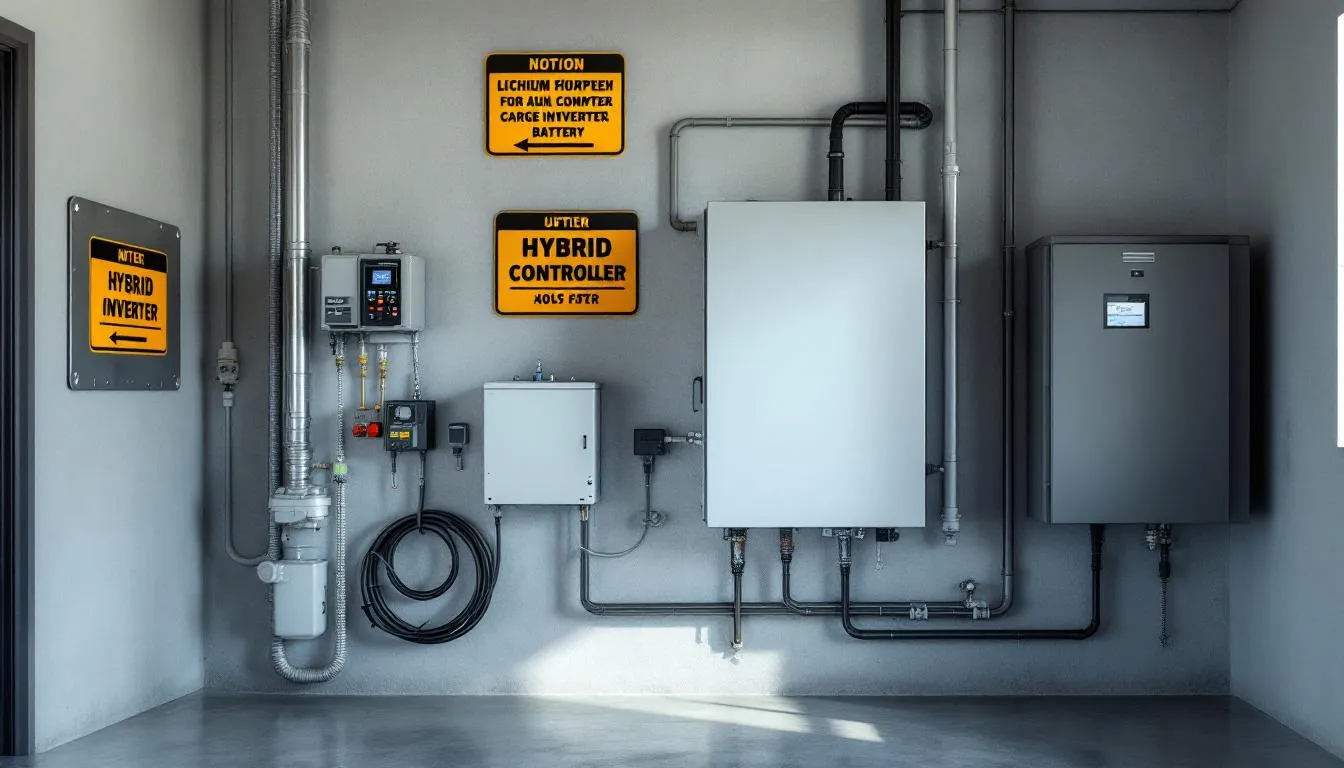
![INLINE: Charge controller mounted in weatherproof enclosure with battery bank and disconnect switches]
Charge Controller Selection and Placement
The charge controller sits between the turbine's rectifier output (or native DC output on some vertical-axis models) and the battery terminals. It performs three jobs: prevents battery overcharge by diverting or dissipating excess power, blocks reverse current drain from the battery to the turbine at night, and provides load-disconnect logic when battery voltage drops below safe thresholds.
Maximum Power Point Tracking vs. Diversion Control
Two controller topologies dominate residential wind installations. Maximum power point tracking (MPPT) controllers, common in solar arrays, adjust input impedance to extract peak wattage across varying wind speeds. Diversion controllers take a simpler approach: once batteries reach absorption voltage (typically 14.4 V for 12 V lead-acid banks, 28.8 V for 24 V banks, 57.6 V for 48 V banks), the controller routes excess current into a dump load—usually air-heating elements or water-heating elements that dissipate kilowatts as heat.
Primus Air 40 and Aeolos-H 5 kW turbines ship with manufacturer-specified diversion controllers calibrated to the alternator's voltage curve. MPPT controllers work better when combining wind and solar inputs on a shared battery bus, but they cost $800–$2,200 compared to $300–$700 for diversion units. The MPPT efficiency gain (4%–8% more energy harvested) rarely justifies the price premium in wind-only systems because wind turbines lack the sharply defined voltage-current knee that MPPT algorithms exploit in photovoltaic panels.
Voltage Rating and Current Headroom
Match controller voltage to battery bank nominal voltage: 12 V, 24 V, or 48 V. Most turbines above 1 kW specify 24 V or 48 V to reduce conductor gauge and resistive losses. A 5 kW turbine feeding a 48 V battery bank at peak output pushes 104 amps DC (5,000 W ÷ 48 V); the charge controller must handle continuous current of at least 130 amps (125% safety margin per NEC 690.8). Undersized controllers overheat, trip thermal protection, and waste wind events.
Controller placement matters. Mount the unit as close to the battery bank as practical—within 10 feet if possible—to minimize voltage drop in the high-current DC circuit between controller and batteries. Outdoor-rated enclosures (NEMA 3R minimum) protect electronics from moisture; ventilated designs prevent heat buildup during sustained charging. Grounding and bonding follow NEC 250 requirements: bond the controller chassis to the system grounding conductor, and bond the DC negative bus to earth ground at one point only to avoid ground loops.
| Controller Type | Typical Efficiency | Cost Range | Best Application |
|---|---|---|---|
| Diversion (resistive dump) | 96%–98% | $300–$700 | Wind-only systems, simple installs |
| MPPT (wind-optimized) | 97%–99% | $800–$2,200 | Hybrid wind-solar, variable wind regimes |
| PWM (pulse-width modulation) | 92%–95% | $200–$500 | Small turbines <1 kW, DIY hobbyist builds |
Battery Bank Sizing and Chemistry Trade-Offs
Battery capacity dictates how many windless days a home can endure before load-shedding or generator startup. The industry standard calculation multiplies daily consumption (kWh) by autonomy days, then divides by allowable depth of discharge and DC system voltage.
Example: A household consumes 15 kWh daily. Target autonomy is 5 days. Battery chemistry is flooded lead-acid with 50% maximum DoD. System voltage is 48 V.
Energy storage required = (15 kWh × 5 days) ÷ 0.50 = 150 kWh
Amp-hour capacity at 48 V = 150,000 Wh ÷ 48 V = 3,125 Ah
That's twenty-six Rolls S-550 6 V batteries (each 428 Ah) wired in series-parallel strings, costing approximately $18,000–$22,000 before installation.
Lead-Acid vs. Lithium Iron Phosphate
Flooded lead-acid batteries dominate off-grid wind because of lower upfront cost ($180–$280 per kWh installed) and field-repairable design. They require monthly water top-ups, equalization charges every 30–90 days, and temperature-compensated charging to prevent sulfation. Cycle life ranges from 1,200 to 2,000 cycles at 50% DoD, translating to 8–12 years in well-managed systems.
Lithium iron phosphate (LiFePO₄) batteries accept charge and discharge at higher rates, tolerate 80% DoD without lifespan penalties, and weigh 40% less than equivalent lead-acid capacity. Cost runs $450–$650 per kWh installed. A 150 kWh LiFePO₄ bank sized to 80% DoD drops to 2,344 Ah at 48 V, saving space and cycle stress. SimpliPhi PHI 3.5 and Discover AES modules integrate battery management systems (BMS) that balance cell voltages and shut down on over-temperature faults. Lithium installations require NEC-compliant fire-rated enclosures and thermal runaway mitigation per UL 9540A testing.
Inverter Specifications for Motor Loads and Surge Demand
The inverter bridges DC battery voltage and 120/240 V split-phase AC household circuits. Off-grid inverters differ from grid-tied models in two critical ways: they create voltage and frequency from scratch (no utility reference waveform), and they must handle surge currents when motors, pumps, and compressors start.
Pure Sine Wave and Surge Rating
Cheap modified sine wave inverters ($200–$600) produce stepped approximations of AC waveforms that damage variable-frequency drives, create audible hum in audio equipment, and reduce motor efficiency. Pure sine wave inverters ($1,200–$4,500 for 4–8 kW continuous) deliver total harmonic distortion below 3%, meeting IEEE 519 power-quality standards.
Surge capacity determines whether the inverter can start a well pump drawing 18 amps running current but 54 amps locked-rotor current for two seconds during startup. Manufacturers specify continuous watts and surge watts (or peak watts). A Schneider Conext XW Pro 6848 inverter delivers 6,800 W continuous and 13,000 W surge for 30 seconds. Select inverter continuous rating at 125% of maximum simultaneous load, then verify surge rating covers the largest motor's locked-rotor demand.
Stacking and Load Center Integration
Inverters above 8 kW often require stacking (paralleling two units) or operating in split-phase mode with two inverters on L1 and L2 legs. The Outback Radian GS8048A can parallel up to four units for 32 kW continuous output, sharing load via a dedicated communication bus. NEC 705.12(D)(2) limits the sum of inverter and utility breaker ratings to 120% of the busbar rating, although off-grid systems have no utility breaker.
Wire the inverter AC output to a critical-loads subpanel, not the main service panel. This segregates essential circuits (refrigerator, furnace blower, lights, well pump) from discretionary loads (electric dryer, window AC units, resistance water heater). During extended wind lulls, the homeowner shuts off non-critical circuits to extend battery autonomy.
Grounding follows NEC 250.30 for separately derived systems: bond neutral to ground at the inverter output, install a grounding electrode conductor to a ground rod or Ufer ground, and leave the neutral floating (unbonded) in the main panel to avoid parallel ground paths. Licensing requirements and permit inspections vary by county—engage a licensed electrician to ensure code compliance.
Turbine-to-Controller Cable Runs and Voltage Drop
High-current DC conductors between the tower base and the charge controller introduce resistive losses that steal watts from the battery bank. A 5 kW turbine at peak output on a 48 V system pushes 104 amps. A 50-foot run of 2/0 AWG copper (resistance 0.0778 Ω per 1,000 feet) drops 0.8 V (104 A × 0.0778 Ω × 100 ft ÷ 1,000), wasting 83 watts—1.7% of turbine output.
NEC 690.8(B)(1) recommends limiting voltage drop to 3% for DC circuits. For a 48 V system, 3% equals 1.44 V. Calculate minimum wire gauge using the formula:
Area (cmil) = (2 × L × I × ρ) ÷ V_drop
where L is one-way length in feet, I is current in amps, ρ is resistivity (12.9 for copper), and V_drop is allowable drop in volts.
Aluminum conductors save money ($1.80–$2.40 per foot for 2/0 versus $3.20–$4.10 for copper 2/0) but require upsizing by two AWG steps to match copper's conductivity. Transition to copper within junction boxes using compression lugs and anti-oxidant compound to prevent galvanic corrosion. Conduit must meet NEC 300.5 burial depth (18 inches minimum in rigid PVC) or use direct-burial rated cable (Type USE-2).
For more on matching turbine nameplate capacity to actual site output, see small wind turbine power curves.
Integrating Backup Generators and Solar Hybrid Systems
Few off-grid sites rely on wind alone. A 5 kW diesel or propane generator provides insurance during week-long calm periods or when the turbine goes offline for maintenance. Automatic transfer switches (ATS) monitor battery voltage and start the generator when state-of-charge drops below 30%–40%, then stop it once batteries reach 80%–90% charge.
Hybrid wind-solar systems smooth out seasonal generation gaps. Summer doldrums with low wind speeds often coincide with high solar irradiance; winter storms deliver strong winds but short daylight hours. Combining a Pikasola 3 kW vertical-axis turbine with 3 kW of rooftop solar panels yields more consistent year-round output than either source alone. Both sources feed the same charge controller (or separate controllers on a common battery bus), and the inverter sees only DC voltage—it doesn't care whether electrons originated from photons or kinetic wind energy.
Load Management Strategies to Extend Battery Life
Battery cycle life correlates inversely with depth of discharge. Cycling a flooded lead-acid bank to 50% DoD daily yields 1,200–1,500 cycles (3.3–4.1 years). Limiting DoD to 30% extends cycle count to 3,000–4,000 (8.2–11 years). Off-grid wind operators use four load-management tactics to preserve capacity:
- Time-shifting loads: Run washing machines, dishwashers, and water-heating elements during daytime wind events when the turbine generates surplus power.
- Load-shedding circuits: Install smart relays that disconnect garage heaters, workshop tools, and EV chargers when battery voltage drops below 48 V (for a 48 V bank).
- DC-direct appliances: Eliminate inverter losses for lights, fans, and electronics by running 12 V or 24 V DC circuits from a buck converter.
- Propane or wood for thermal loads: Avoid electric resistance heating and cooking, which consume 40%–60% of household kWh in all-electric homes.
A SunWize SCP-200 system controller automates these strategies, reading battery voltage, wind speed, and load current to prioritize circuits and start the backup generator.
For more on optimizing turbine placement to maximize generation, see wind turbine tower height calculations.
Safety Equipment and Disconnect Requirements
NEC 690.13 (for solar, applied by analogy to wind) mandates rapid shutdown capabilities within 10 feet of an array or turbine. A turbine-mounted brake switch on the tower base allows emergency shutdown—either a mechanical disk brake or electrical dynamic braking that shorts the alternator stator phases. This arrests rotor rotation within 15–30 seconds, preventing runaway overspeed during controller failures.
Install DC-rated disconnects at four points:
- Tower base: Fused disconnect between turbine rectifier and underground cable.
- Controller input: Non-fused disconnect to isolate turbine during maintenance.
- Battery terminals: Fused disconnect sized to battery short-circuit current (often 2,000–5,000 amps for large banks).
- Inverter DC input: Fused disconnect matching inverter DC current rating.
Fuses must be DC-rated (UL 248-14 for photovoltaic fuses, applied to wind). AC-rated fuses cannot extinguish DC arcs reliably. Typical sizes: 125 A for turbines up to 5 kW on 48 V systems, 250 A for battery banks above 1,000 Ah.
Class T fuses in combiner boxes meet NEC 690.16 arc-fault protection requirements when DC circuits exceed 80 V to ground (typical in 150 V lithium systems). Consult the National Electrical Code Article 705 for full compliance details.
Financial Incentives and Payback Calculations
The federal Investment Tax Credit (ITC) under IRC §25D offers a 30% tax credit for qualified small wind installations placed in service through December 31, 2032. File IRS Form 5695 with your annual return. The credit applies to turbine cost, tower, foundation, electrical components, and installation labor. A $40,000 off-grid system (turbine, batteries, inverter, installation) generates a $12,000 credit, reducing net cost to $28,000.
DSIRE (Database of State Incentives for Renewables & Efficiency) tracks state-level programs. As of 2025, Montana offers a $500 per kW residential renewable energy property tax exemption. New York's Renewable Heat and Power Program rebates $3.50 per watt up to $105,000 for small wind projects. California's SGIP (Self-Generation Incentive Program) applies primarily to solar and battery storage but may cover wind in utility territories with specific mandates—check current program rules.
Property tax exemptions and sales tax exemptions vary by state. Texas, for instance, exempts wind turbines from property appraisal increases. Oregon exempts small wind systems from the state's 7% sales tax when installed on a residence.
Payback depends on displaced grid electricity cost and system utilization. At $0.14 per kWh retail rate, a system generating 8,000 kWh annually saves $1,120. After the 30% ITC, a $28,000 net system cost yields a 25-year simple payback. Rising electricity rates, state incentives, and avoided line-extension costs (often $15,000–$50,000 to extend grid service one mile) improve the equation for remote sites.
For additional context on turbine selection, see best home wind turbines for off-grid living.
Monitoring and Data Logging
Track battery state-of-charge, turbine output, and inverter AC production using a data logger or inverter-integrated display. Bogart Engineering TriMetric TM-2030 monitors DC voltage, current flow, amp-hours consumed, and days-since-full-charge. Victron Energy Color Control GX aggregates data from MPPT controllers, inverters, and battery management systems onto a single touchscreen, with cloud upload for remote smartphone monitoring.
Key metrics:
- Battery state-of-charge (SoC): Voltage-based estimation or coulomb-counting via shunt resistor.
- Turbine kilowatt-hour production: Accumulated energy from charge controller.
- Inverter efficiency: AC output divided by DC input, typically 92%–96%.
- Load power factor: Low power factors (<0.85) from motor-heavy loads reduce inverter efficiency.
Log data at 5-minute intervals during the first year to identify generation patterns, size the battery bank accurately, and tune load-shedding setpoints.
Can I use car batteries for a wind turbine off-grid system?
Automotive starting batteries fail rapidly in deep-cycle off-grid service, typically lasting fewer than 200 cycles when discharged below 50%. Deep-cycle flooded lead-acid (Rolls Surrette, Trojan) or lithium iron phosphate batteries withstand thousands of cycles and warranty coverage reflects that durability. Car batteries save money upfront ($120 versus $400 per 6 V battery) but cost more per kilowatt-hour delivered over system lifespan.
What size turbine do I need to run a typical off-grid home?
A U.S. household averages 877 kWh per month (29 kWh daily). In a 12 mph average wind site, a Bergey Excel 10 (10 kW rated) produces approximately 1,100 kWh monthly, leaving a 223 kWh surplus to cover calm periods and battery losses. Sites with 10 mph average wind need a larger turbine (15 kW rated) or a hybrid wind-solar system to meet the same load. Energy-efficient homes consuming 15 kWh daily reduce turbine size and battery cost by nearly half.
How long do off-grid wind turbine batteries last?
Flooded lead-acid batteries last 8–12 years with proper maintenance (monthly watering, equalization charging, temperature-compensated charging). Lithium iron phosphate batteries last 12–18 years with minimal maintenance. Calendar life (years on the shelf) and cycle life (total discharge-recharge events) both limit longevity. A battery cycled shallowly (30% DoD) every day accumulates 3,650 cycles in 10 years; a battery rated for 5,000 cycles at 30% DoD survives that workload. Batteries cycled to 80% DoD daily exhaust their cycle budget in 3–5 years.
Do I need a licensed electrician to install an off-grid wind system?
NEC Article 705 and local building codes require licensed electrician involvement for AC wiring, inverter installation, grounding electrode installation, and service panel modifications. Some jurisdictions allow homeowner-performed DC wiring under direct electrician supervision. Turbine tower erection and foundation work fall under general construction permits, not electrical permits, but FAA Part 77 notification applies to structures exceeding 200 feet AGL near airports. Unlicensed installations void equipment warranties, insurance coverage, and ITC eligibility.
Can I add wind to an existing off-grid solar system?
Yes, if the charge controller and battery bank accommodate additional input current. MPPT controllers designed for hybrid systems (Midnite Classic 250, Morningstar TriStar) accept combined wind and solar inputs on separate PV and wind terminals. Older diversion-only wind controllers and PWM solar controllers may require parallel installation with isolation diodes. Verify battery C-rate (charge rate relative to capacity): a 1,000 Ah battery bank safely accepts 200 A combined wind-solar input (C/5 rate), but sustained charging above C/3 (333 A) shortens lifespan. Upsizing the battery bank or adding a second bank in parallel raises acceptable charge current.
Bottom Line
Off-grid wind turbine battery systems demand precise component matching, conservative capacity margins, and disciplined load management. Flooded lead-acid remains the workhorse chemistry for budget-conscious installations, while lithium iron phosphate fits space-constrained or high-cycle applications. The 30% federal ITC and state incentives improve financial returns, but realistic payback horizons stretch 15–25 years unless displaced grid extension costs enter the calculation. Start by auditing daily consumption, then size the battery bank for 5-day autonomy at 50% DoD, select a charge controller with 125% current headroom, and choose a pure sine wave inverter rated for motor surge loads. Work with a licensed electrician to meet NEC Article 705 requirements and secure permits before energizing the system.
Share this article
windturbinehome.com/s/76a2f1
Editorial note: This article was researched and written by a member of the Wind Turbine Home editorial team. AI-assisted tools were used for spell-checking and light grammar review only — all research, analysis, and conclusions are our own. Our editorial policy prohibits sponsored content and paid placements. Read our editorial policy →
Related reading
battery storage inverters
DIY Wind Turbine Charge Controller: When to Build vs Buy
Building a wind turbine charge controller saves $150-400 but risks battery damage and code violations. Compare DIY circuit boards against commercial MPPT units.
battery storage inverters
Hybrid Inverter Selection for Small Wind + Battery Systems
Choose the right hybrid inverter for your wind turbine battery setup—DC-coupled models work best for systems under 5 kW, while AC-coupled units offer easier solar retrofits.
battery storage inverters
Best Batteries for Small Wind Systems in 2026 | Expert Guide
Lithium iron phosphate batteries dominate 2026 wind storage. Compare cycle life, depth-of-discharge, and cold-weather performance for systems 400W-10kW.
battery storage inverters
Lithium vs AGM Batteries for Wind Systems in Cold Weather
Cold weather cuts AGM capacity by 20-40% and lithium by 10-15%. Learn which chemistry survives winter turbine charging, how battery management systems respond, and what installers must change below 32°F.
battery storage inverters
12V vs 24V vs 48V Wind Turbine Systems: Which Voltage Is Right?
Choosing between 12V, 24V, and 48V wind turbine systems depends on power needs, wire costs, and battery architecture. Most residential setups favor 24V or 48V.
battery storage inverters
MPPT vs PWM Controller for Small Wind: Which to Buy and Why
MPPT controllers harvest 15-30% more energy than PWM in variable-wind conditions but cost 2-4× more. Choose MPPT for systems above 1 kW or battery banks over 400 Ah.
battery storage inverters
Best Battery Banks for Home Wind Turbines (LiFePO4, 2026)
Home wind turbines charge in irregular bursts, so battery chemistry matters as much as capacity. Here is why lithium iron phosphate leads on reliability.
battery storage inverters
Home Wind Turbine Kits With Battery and Inverter (2026)
See how all-in-one home wind turbine kits bundle the turbine, battery bank and inverter, how to size each part, and what the installation actually involves.