DIY Wind Turbine Charge Controller: When to Build vs Buy
Building a wind turbine charge controller saves $150-400 but risks battery damage and code violations. Compare DIY circuit boards against commercial MPPT units.
Share this article
windturbinehome.com/s/5a1f6e
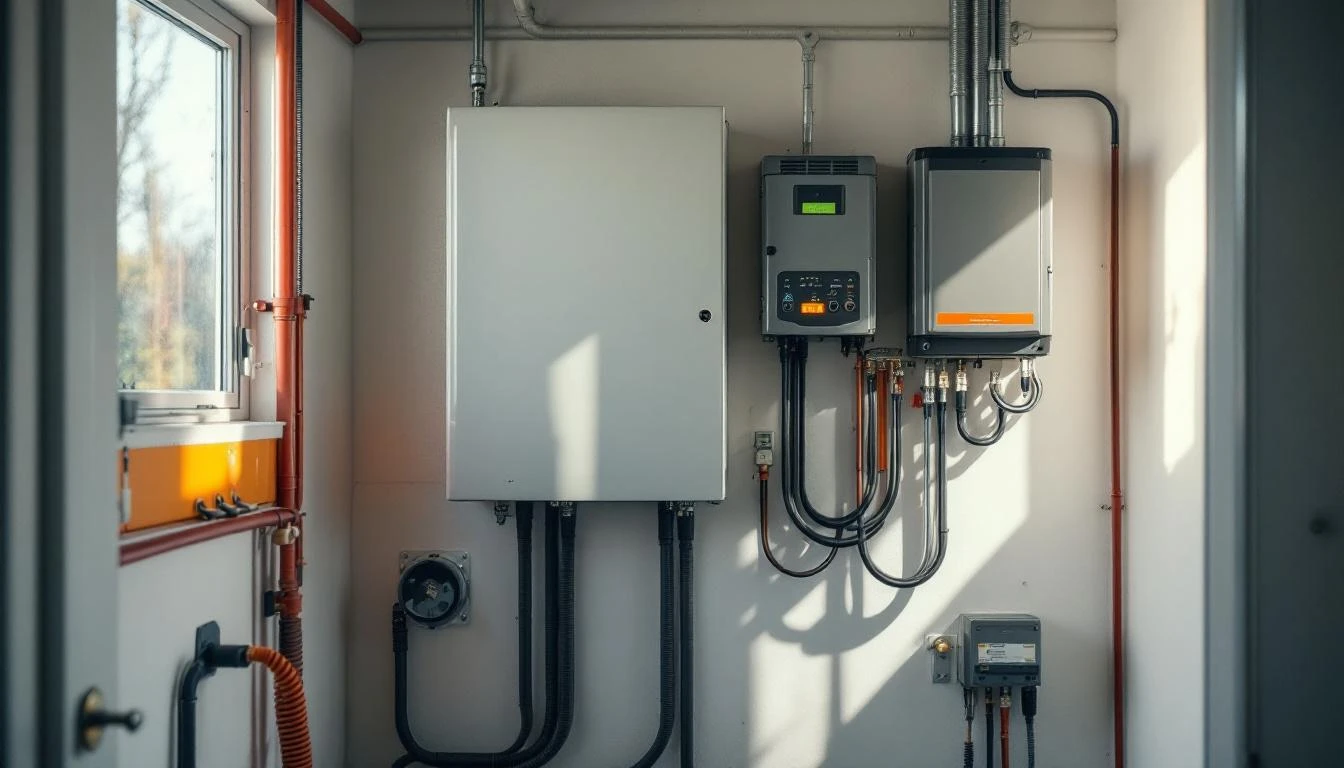
Building your own wind turbine charge controller appeals to tinkerers who want full control and lower upfront costs, but the decision hinges on electrical skills, local code compliance, and whether you can match the dump-load management and battery-protection logic of proven commercial units. A home-built PWM or relay-based controller typically costs $80-200 in components versus $250-600 for an off-the-shelf MPPT charge controller rated for small wind, yet the commercial option includes UL 1741 listing, three-year warranties, and algorithms tested across thousands of installations. Most owner-builders find the break-even point shifts when they factor in debugging time, the cost of replacing a destroyed battery bank, and the reality that inspectors in many US jurisdictions will red-tag a homebrew controller lacking third-party certification under NEC Article 705.
Why charge controllers matter for small wind turbines
Wind turbines generate wild AC that varies with rotor speed, so a rectifier converts it to DC before feeding a battery bank. Without a charge controller sitting between rectifier and batteries, voltage spikes during gusts can boil electrolyte out of flooded lead-acid cells or trigger the battery management system in lithium packs to disconnect. The controller's first job is voltage regulation—clamping battery voltage at the absorption setpoint (typically 14.4 V for 12 V lead-acid, 28.8 V for 24 V systems) and then dropping to float (13.6 V / 27.2 V). The second job is diversion or dump-load management: once batteries reach full charge, excess energy must go somewhere, so the controller switches resistive heaters or air elements into the circuit to keep the turbine loaded and prevent runaway overspeed.
Commercial controllers from manufacturers like Midnite Solar, Morningstar, and Xantrex bundle both functions plus temperature compensation, low-voltage disconnect to protect batteries from over-discharge, and data-logging over RS-485 or Ethernet. DIY builders can replicate voltage regulation with an Arduino or Raspberry Pi reading a voltage divider, but designing fail-safe dump-load switching that won't arc-weld relay contacts or let the turbine freewheel during a firmware crash is harder than online tutorials suggest.
Anatomy of a DIY wind charge controller
![INLINE: Schematic diagram of a basic DIY wind charge controller showing rectifier bridge, voltage sensing circuit, microcontroller, MOSFET dump-load switch, and battery terminals]
A minimal homebrew controller needs five blocks: a three-phase rectifier bridge (six diodes rated for peak turbine current), a voltage-sensing circuit (resistor divider feeding an ADC input), a microcontroller (Arduino Uno, ESP32, or similar), a high-current switch for the dump load (power MOSFET or solid-state relay), and the dump-load resistor itself. The microcontroller reads battery voltage every few hundred milliseconds and compares it to programmed setpoints. When voltage exceeds the absorption threshold, the code ramps up PWM duty cycle to the MOSFET, bleeding more power into the resistor. At float voltage, PWM holds just enough load to balance incoming turbine power with battery trickle current.
Builders often start with a 12 V / 30 A design, sourcing a 35 A bridge rectifier ($8), an IRL540N MOSFET ($2 each; parallel four for 120 A capability), an Arduino Nano clone ($6), a 0.1 Ω / 300 W wirewound dump resistor ($25), a project box, terminal blocks, and a cooling fan. Total parts run $70-90 if you already own a soldering iron and multimeter. Code examples circulate on GitHub and forums like WindPowerHome, though many lack the timeout logic and watchdog resets that prevent lockup-induced battery overcharge.
The appeal is transparency—you see every line of code, every connection, every component rating—and the ability to add features commercial units omit, such as data export to Home Assistant or custom low-wind disconnect thresholds. The downside is that the builder becomes the warranty department, and troubleshooting a MOSFET that fails short-circuit at 2 a.m. during a storm is less fun than forum posts make it sound.
Commercial MPPT charge controllers for wind
Maximum power-point tracking squeezes 10-25 % more energy from a wind turbine compared to simple voltage-clamping PWM controllers by dynamically adjusting load to keep the turbine at its optimal tip-speed ratio across varying wind speeds. Midnite's Classic 150 and Classic 200 are popular retrofit choices because they accept three-phase AC input directly (the turbine's rectifier can be omitted or left in place), handle battery banks up to 200 V, and include an internal dump-load relay plus auxiliary output for an external heater. Morningstar's TriStar TS-MPPT-600V steps down from turbines that generate 200-300 V AC peak, useful for 1-3 kW machines on tall towers where high-voltage wiring reduces resistive loss.
Prices reflect the engineering: the Midnite Classic 150 lists at $600-700, the TriStar-60 MPPT at $450-550. Both carry UL 1741 and UL 1741 SA listings, meaning they meet grid-interconnection anti-islanding and ground-fault requirements even if your system is off-grid (inspectors still want to see the label). Warranties run three to five years; manufacturers publish efficiency curves and certify temperature derating, two data points a DIY builder has no budget to generate.
Feature parity is another factor. Commercial units include temperature compensation probes that adjust setpoints for cold battery rooms or hot Australian sheds, programmable battery chemistry profiles (flooded, AGM, gel, lithium LiFePO₄), and Modbus or SNMP for integration with monitoring systems. Replicating that feature set in Arduino C++ is a semester project, not a weekend.
NEC Article 705 and third-party listing requirements
The US National Electrical Code Article 705 governs interconnected power sources, including off-grid wind-and-battery systems. Inspectors interpret Section 705.12(D) to require listed equipment in the power-conditioning path, which includes charge controllers. "Listed" means tested by UL, ETL, CSA, or another Nationally Recognized Testing Laboratory; a bare PCB in a project box with hand-lettered voltage ratings does not qualify.
Enforcement varies—rural counties with one part-time inspector may pass a homeowner-built controller if documentation looks thorough, while suburban jurisdictions send it back for a listed replacement. The penalty for skipping inspection entirely is loss of homeowner's insurance coverage after a fire and inability to claim the federal 30 % Residential Clean Energy Credit (IRS Form 5695, IRC §25D) since the credit requires a compliant installation. Some DIY builders solve this by installing a listed commercial controller for final inspection, then swapping their homebrew unit afterward—a move that voids insurance and violates permit conditions.
Professional installations always specify listed controllers because liability shifts to the installer if unlisted equipment causes a fire or electrocution. An electrician who signs off on a DIY controller risks their license and Errors & Omissions policy.
Cost breakdown: DIY versus off-the-shelf
| Item | DIY PWM | DIY MPPT | Commercial PWM | Commercial MPPT |
|---|---|---|---|---|
| Core components | $70-120 | $180-280 | $150-250 | $450-700 |
| Dump load / resistors | $25-60 | $40-80 | Included | Included or $80 |
| Enclosure, wiring, fuses | $30-50 | $50-80 | Included | Included |
| Assembly time (hrs @ $35/hr labor equivalent) | 8-15 ($280-525) | 20-40 ($700-1,400) | 1 ($35) | 1 ($35) |
| Testing & debugging (hrs) | 4-10 ($140-350) | 10-20 ($350-700) | 0 | 0 |
| Total first unit | $545-1,105 | $1,320-2,540 | $185-285 | $485-735 |
The table assumes you value your time at $35/hr—the rough cost of hiring an electrician's apprentice. If time is free and you already have a parts bin, the DIY PWM controller wins on cash outlay. Once you add labor and the risk of a $200 battery replacement after a logic bug causes overcharge, the commercial PWM controller saves money. Commercial MPPT beats DIY MPPT in every scenario because the firmware complexity jumps from undergraduate to graduate-level embedded design; the Midnite Classic's internal microcontroller runs a real-time OS with CAN-bus communication and flash-updateable algorithms that took a team years to refine.
When building makes sense
Three conditions tilt the scales toward DIY: you possess electronics skills at the technician or engineering level, the system is experimental or temporary, and local inspection is lenient or nonexistent. A farmer testing a 400 W vertical-axis turbine to charge a UTV battery in a barn might build a simple relay-and-Zener controller for $50 and accept the two-year lifespan. A graduate student characterizing turbine performance for a thesis wants data acquisition the commercial box doesn't provide, so an ESP32-based controller with SD-card logging and WiFi telemetry justifies the build time.
Hobbyists who enjoy the process—soldering, coding, iterating—get non-monetary value that offsets the cost delta. The education is real: understanding hysteresis in voltage comparators, sizing MOSFETs for safe operating area, and writing interrupt-driven ADC routines teaches principles you won't get from a sealed black box. Some builders eventually productize their designs, selling kits on Tindie or offering custom controllers for oddball turbine voltages (48 V, 120 V DC) that major manufacturers ignore.
The risk profile also matters. A DIY controller feeding a $150 AGM battery in a shed 200 feet from the house has contained downside. A DIY controller managing a $4,000 lithium LiFePO₄ bank inside an attached garage where a thermal-runaway fire could spread to living space is a poor bet.
When buying makes sense
Buy if the system includes expensive batteries, if resale value matters, if inspection is mandatory, or if you lack confidence debugging power electronics under fault conditions. Lithium batteries require precise voltage control—±0.1 V—and most hobby-grade ADCs plus resistor-divider drift don't hit that tolerance without calibration. A BMS will disconnect the pack if the charge controller overshoots, leaving the turbine unloaded and potentially overspeeding into mechanical failure; commercial controllers read temperature-compensated voltage at 0.01 V resolution and adjust in real time.
Resale and insurance also favor commercial units. A homebuyer sees a UL-listed Midnite Classic and nods; a 3D-printed enclosure with a Raspberry Pi and hand-wired terminal blocks triggers questions. Mortgage underwriters may flag the system as non-code-compliant, tanking the appraisal. Homeowner's policies often include sub-limits ($1,000-2,500) for unlisted renewable equipment, so a lightning strike that fries the controller and batteries might recover only a fraction of replacement cost.
Installation labor swings the math too. If you're hiring an electrician at $85-120/hr, they'll mount and wire a commercial controller in one billable hour versus three to five hours deciphering your DIY schematic, verifying connections, and explaining to the inspector why it's safe.
Hybrid approach: Arduino-controlled dump load with commercial charge stage
A middle path splits battery charging and dump-load management. Use a listed commercial MPPT controller (Morningstar TriStar, Victron SmartSolar) with its auxiliary relay output, then build an Arduino-controlled SSR array to drive multiple dump loads—water-heater elements, space heaters, heat-trace cable—prioritized by temperature sensors or time-of-day schedules. The commercial controller handles the life-safety function (battery voltage regulation), the DIY piece adds automation without introducing failure modes that destroy batteries.
This architecture passes inspection because the charge controller is listed; the inspector views the Arduino box as a glorified thermostat, which NEC permits as field-fabricated control wiring under Article 725. The homeowner gets the tinkering satisfaction of writing custom logic (dump to hot-water tank first, then greenhouse heating mats, then resistive load) while the battery bank enjoys commercial-grade protection.
Code example for a basic DIY controller (educational use only)
A minimal Arduino sketch reads battery voltage via A0, compares it to setpoints, and PWM-drives a MOSFET on pin 9 to control dump-load duty cycle. This example omits timeout logic, watchdog resets, and temperature compensation—features a production controller requires.
const float V_ABSORB = 14.4; // 12V lead-acid absorption
const float V_FLOAT = 13.6;  // float voltage
const int DUMP_PIN = 9;

void setup() {
  pinMode(DUMP_PIN, OUTPUT);
  analogReference(EXTERNAL); // 5V Aref
}

void loop() {
  int raw = analogRead(A0);
  float vBatt = raw * (5.0 / 1023.0) * 4.0; // resistor divider 3:1

  if (vBatt > V_ABSORB) {
    analogWrite(DUMP_PIN, 255); // full dump
  } else if (vBatt > V_FLOAT) {
    int pwm = map(vBatt*100, V_FLOAT*100, V_ABSORB*100, 50, 255);
    analogWrite(DUMP_PIN, pwm);
  } else {
    analogWrite(DUMP_PIN, 0); // no dump
  }

  delay(200);
}
This 20-line sketch lacks overcurrent shutdown, EEPROM setpoint storage, and communication—gaps that matter in real deployments. Expanding it to production quality typically balloons code size tenfold and requires oscilloscope verification of PWM rise times to ensure MOSFET switching stays in the safe operating area.
Testing and commissioning a DIY controller
Bench-test before connecting to the turbine. Use a variable DC power supply set to turbine open-circuit voltage (18-22 V for a 12 V nominal turbine), a 12 V battery, and an ammeter in series with the dump load. Confirm the controller transitions from off to PWM to full dump as you raise supply voltage past float and absorption setpoints. Induce faults—disconnect the battery, short the dump load, reverse polarity on the voltage sense—and verify the controller doesn't latch up or emit smoke.
Field commissioning starts with the turbine blades parked (tape or brake), then releasing them gradually while monitoring battery voltage and dump-load current. Watch for oscillation: if PWM frequency is too low (< 1 kHz), the dump resistor and battery form an LC tank that rings, causing voltage to hunt around the setpoint and prematurely wearing relay contacts or MOSFET gates. Increasing PWM frequency to 10-20 kHz usually damps oscillation, but high-frequency switching requires snubber networks (RC across the MOSFET) to suppress EMI that can interfere with AM radio and other equipment within 100 feet.
A shunt and data logger (even a $15 INA219 breakout board logging to SD card) provide the evidence you need to tune setpoints and prove system performance over weeks. Commercial controllers include this telemetry; DIY builders must add it or fly blind.
Regulatory and insurance considerations
Beyond NEC compliance, the Federal Aviation Administration Part 77 applies to towers exceeding 200 feet AGL in uncontrolled airspace; few residential turbines hit that threshold, but if yours does, you must file Form 7460-1 and may need obstruction lighting synchronized by the charge controller's auxiliary output. State incentives listed in the DSIRE database often require third-party certification, disqualifying DIY controllers from rebates even if the turbine itself is listed.
Liability is personal. If a guest is injured by a battery fire traced to controller malfunction, homeowner's insurance may deny the claim and your personal assets are exposed. An LLC won't shield you for negligence in your own residence. This risk is why professional installers carry $2-5 million in general liability coverage and refuse to touch homebrew power electronics.
Can I use a solar MPPT charge controller for wind?
Some work, most don't. Solar MPPT controllers expect slowly ramping voltage as the sun rises; wind turbines slam them with rapid voltage swings during gusts. Controllers labeled "solar and wind" (Midnite Classic, Morningstar TriStar Wind) include algorithms that slow down MPPT sweeps and prevent the turbine from stalling. Pure solar controllers like the Victron SmartSolar often trip on overvoltage or fail to regulate properly, though users report success by derating them 50 % and setting conservative absorption voltages.
What dump-load wattage do I need?
Match or exceed turbine rated power. A 1 kW turbine needs at least a 1 kW dump load, preferably 1.2-1.5 kW to handle momentary gusts. Resistive elements—old water-heater coils, air-heating elements, or wirewound power resistors—work well. Mount them in a ventilated space; a 1 kW load at full duty glows red and radiates 3,400 BTU/hr. Some builders cascade multiple small loads (three 400 W elements) switched by separate relays for finer control than PWM provides.
How do I calculate resistor value for a dump load?
Ohm's law: R = V² / P. For a 24 V system dumping 1 kW, R = 24² / 1000 = 0.576 Ω. Use the next standard size down (0.5 Ω) to ensure adequate dissipation. Power rating must exceed dump power; a 0.5 Ω / 1.5 kW resistor is safer than running a 1 kW unit at its limit. Wirewound resistors handle surge better than thick-film; aluminum-housed chassis-mount types (Ohmite, Vishay) are common.
Do I need a separate inverter or does the charge controller include one?
Charge controllers output DC to the battery; they don't produce household AC. You need a separate inverter (Victron MultiPlus, Magnum Energy, Schneider Conext) to convert battery DC to 120/240 V AC for appliances. Hybrid inverter-chargers integrate both functions but still require a charge controller on the turbine input because inverter-chargers optimize for grid or generator AC input, not the wild AC from a wind turbine.
What happens if the dump load fails open during high wind?
The turbine freewheels, rotor RPM climbs until mechanical or aerodynamic limits kick in—blade stall, furling, or structural failure. Overspeed can destroy the alternator windings, throw a blade, or snap the tower. A failsafe design uses a normally closed relay or contactor: loss of controller power closes the relay, shorting the turbine through a permanent dump resistor. This "fail-to-dump" logic is standard in commercial controllers but requires deliberate design in DIY versions.
Bottom line
DIY wind turbine charge controllers cut initial parts cost by 60-80 % but demand intermediate electronics skills, double or triple the project timeline when labor is counted, and introduce code-compliance risk that can void insurance and tax credits. Commercial MPPT units from Midnite, Morningstar, or Xantrex deliver UL-listed reliability, three-year warranties, and algorithms refined over thousands of field deployments—features worth the $450-700 price when protecting a multi-thousand-dollar battery bank. Build your own if the system is experimental, batteries are cheap, and you value the learning experience over plug-and-play assurance; buy if resale, inspection, or insurance matter. For many residential installs, the hybrid approach—commercial charge stage plus DIY dump-load automation—balances safety and customization without betting the battery bank on untested firmware.
Ready to move forward? Read our guides on [wind turbine battery bank sizing], [wiring turbines for off-grid systems], and [dump load heater element selection] to complete your system design. For those leaning toward purchase, compare specifications in our [best MPPT charge controllers for small wind turbines] roundup.
Share this article
windturbinehome.com/s/5a1f6e
Editorial note: This article was researched and written by a member of the Wind Turbine Home editorial team. AI-assisted tools were used for spell-checking and light grammar review only — all research, analysis, and conclusions are our own. Our editorial policy prohibits sponsored content and paid placements. Read our editorial policy →
Related reading
battery storage inverters
Hybrid Inverter Selection for Small Wind + Battery Systems
Choose the right hybrid inverter for your wind turbine battery setup—DC-coupled models work best for systems under 5 kW, while AC-coupled units offer easier solar retrofits.
battery storage inverters
Best Batteries for Small Wind Systems in 2026 | Expert Guide
Lithium iron phosphate batteries dominate 2026 wind storage. Compare cycle life, depth-of-discharge, and cold-weather performance for systems 400W-10kW.
battery storage inverters
Lithium vs AGM Batteries for Wind Systems in Cold Weather
Cold weather cuts AGM capacity by 20-40% and lithium by 10-15%. Learn which chemistry survives winter turbine charging, how battery management systems respond, and what installers must change below 32°F.
battery storage inverters
12V vs 24V vs 48V Wind Turbine Systems: Which Voltage Is Right?
Choosing between 12V, 24V, and 48V wind turbine systems depends on power needs, wire costs, and battery architecture. Most residential setups favor 24V or 48V.
battery storage inverters
MPPT vs PWM Controller for Small Wind: Which to Buy and Why
MPPT controllers harvest 15-30% more energy than PWM in variable-wind conditions but cost 2-4× more. Choose MPPT for systems above 1 kW or battery banks over 400 Ah.
battery storage inverters
Best Battery Banks for Home Wind Turbines (LiFePO4, 2026)
Home wind turbines charge in irregular bursts, so battery chemistry matters as much as capacity. Here is why lithium iron phosphate leads on reliability.
battery storage inverters
Off-Grid Wind Turbine Battery Setup: Complete System Guide
Complete guide to off-grid wind turbine battery systems covering charge controllers, battery banks, inverters, and load management for residential installations.
battery storage inverters
Home Wind Turbine Kits With Battery and Inverter (2026)
See how all-in-one home wind turbine kits bundle the turbine, battery bank and inverter, how to size each part, and what the installation actually involves.